


Jim Simons' Medallion Fund made 66% annual returns for 30 years.
Rajesh Sharma
Analyste Forex Senior ·  India
India
☕ 13 min de lecture
Ce que vous apprendrez :
- 1The Medallion Myth: What They Don't Tell You
- 2The Real Edge for Retail Traders
- 3Data, Not Dogma: Your New Religion
- 4The Indian Market Reality Check (2026 Rules)
- 5Building Your 'Poor Man's' Quant System
- 6The Psychology of a Machine
- 7Why Costs Will Kill Your 'Medallion' Dream
- 8What To Do Tomorrow (A Practical Plan)

Jim Simons' Medallion Fund made 66% annual returns for 30 years. That's the headline that makes every trader's heart race. Here's the brutal truth: you will never, ever replicate that. Not with ₹50,000 in your Zerodha account. Not with Python code you copied from GitHub. The real lesson from Simons isn't in the algorithms - it's in the mindset. For Indian traders in 2026, trying to copy his exact strategy is a guaranteed path to blowing up your account. Let's talk about why, and what you should actually be stealing from his playbook.
Everyone quotes the 66% annualized return. Nobody talks about the context that makes it completely irrelevant to you.
First, Medallion was a closed fund. It only traded for employees and former employees of Renaissance Technologies. You couldn't buy in if you tried. Second, and this is critical, they achieved those returns on a relatively small capital base - reportedly around $10 billion at its peak. Managing ₹50,000 is a different universe from managing ₹80,000 crores. Strategies that print money at one scale often evaporate at another.
Most importantly, their edge wasn't just a clever indicator. It was an insurmountable infrastructure advantage. They hired PhDs in physics and mathematics, not finance MBAs. They built their own data centers. They had direct market access and co-location servers microseconds from the exchange. In India, SEBI's 2026 algo framework mandates all strategies run on broker infrastructure. Your 'high-frequency' strategy on Zerodha's servers is competing in a different sport entirely.

Warning: Any course or guru selling you 'The Jim Simons Secret Algorithm' is lying. The actual code is a billion-dollar trade secret guarded by former NSA cryptographers. What's being sold is a repackaged moving average crossover.
I learned this the hard way early on. I spent three months building a statistical arbitrage model for Nifty 50 stocks, backtesting it beautifully. I put ₹2 lakh into it. The live market chewed it up in a week. Why? My backtest didn't account for SEBI's Order-to-Trade Ratio (OTR) penalties, which kicked in and suspended my orders. I was playing checkers while the market was playing 3D chess with different rules. The scalping strategy I thought I had built was dead on arrival because I ignored the regulatory reality.
So if you can't have his supercomputers, what can you actually take from the Jim Simons trading strategy philosophy?
It's not about the specific math. It's about the process. Simons' team didn't guess. They didn't have 'conviction plays.' They identified microscopic statistical edges and exploited them systematically, thousands of times a day. Your version of this isn't predicting the next RBI move. It's finding a small, repeatable setup where the odds are slightly in your favor.
Forget Prediction, Focus on Probability
Renaissance models didn't say 'Nifty will go up tomorrow.' They said, 'When Condition A, B, and C occur in this sequence, there's a 52% chance the price moves 0.3% in the next 10 minutes.' That's it. Your job is to find your own version of that. Maybe it's a specific RSI indicator divergence on Bank Nifty options in the first hour. Maybe it's a volume spike pattern in Reliance. Find it, test it, measure it.
Ruthless Elimination of Emotion
This is the biggest takeaway. Every trade was automated. No fear, no greed, no 'let's hold for a little more.' For you, this means rigid rules. A predefined position size calculator entry, stop loss, and take profit for every single trade. No deviations. I keep a trading journal, and my worst losing months are always the ones where I broke my own rules 'just this once.'

Pro Tip: Your edge isn't a magical indicator. It's your discipline. The ability to take 20 small, boring, identical losses in a row while knowing the 21st trade will make it all back. Most traders blow up because they can't stomach the 20 losses.
This systematic approach is what separates a gambler from a trader. It's the core of any sustainable swing trading or day trading plan.

💡 Conseil de Winston
Your first ₹1 lakh in algorithmic trading should be budgeted for education, data, and server costs, not live trading capital. Consider it tuition.
“Your edge isn't a magical indicator. It's your discipline to take 20 small, boring, identical losses in a row.”
Simons' team worshipped at the altar of data. Not news, not analyst reports, not gut feeling. Raw, historical price data. This is the one area where retail traders have a fighting chance.
You need to become a data collector. Every trade you take should be based on a hypothesis tested against past performance. Did this setup work more often than not? What was the average win vs. the average loss? If you're not backtesting, you're just gambling with extra steps.
Thankfully, tools for this exist in India now. Platforms like Tradetron, Streak, or uTrade Algos let you build and backtest rule-based strategies without needing a PhD. The key is the quality of your data. Using just the last month of data is useless. You need multiple market cycles - bull runs, corrections, sideways chop. See how your strategy behaves in a May 2020 V-shaped recovery versus a slow grind up in 2023.
Here's a personal example. I had a momentum strategy for XAU/USD (Gold) that was killing it in 2022. 2023 came, the market regime changed to range-bound, and it started giving back all the profits. I didn't adapt because I was in love with the strategy. I lost about ₹1.5 lakh before I went back to the data, saw the regime shift, and added a filter to keep the strategy out of low-volatility environments. The data told the story; I was just too stubborn to listen.
Your trading platform's built-in MACD indicator or other tools are just the start. The real work is in the journal, the spreadsheet, the performance metrics. How does your strategy's win rate change when the USD/INR futures are above 83.50? That's the level of detail you need.

You can have the world's best strategy, and SEBI's framework will break it if you're not careful. Ignoring this is the fastest way to turn a great backtest into a real-life disaster.
Let's talk about the new rules that directly impact any attempt at a quantitative approach:
1. The Algo-ID Mandate (From April 1, 2026): Every automated order must have a unique identifier. For you, using a broker's API like Zerodha Kite Connect or Dhan, this is handled by the broker. But it means all your activity is tagged and traceable. Sloppy code that fires off erroneous orders won't just cost you money; it could get your algo blacklisted by the exchange.
2. Broker as Principal: Your broker is now fully responsible for your algo's actions. This makes them risk-averse. They will have kill switches and monitoring. If your strategy hits an order rate that looks like a runaway algorithm, they will shut it down. Your 'high-frequency' dream ends here.
3. The Revised OTR Rule: This is a big one for options traders. As of April 6, 2026, orders within +/- 40% of the LTP or +/- ₹20 (whichever is higher) are excluded from the Order-to-Trade Ratio penalty calculation. This is actually a relaxation. Before, a strategy placing many orders to 'fish' for liquidity around a price could get suspended. Now you have a wider band. You must understand this band and code your entry logic around it to avoid penalties.
4. Infrastructure Lockdown: Your algo must run on your broker's servers or an approved cloud setup integrated with them. You can't run it from your laptop at home. This adds latency and cost. That ₹2800/month AWS bill is now a mandatory cost of doing business, not an optimization.

Example: Let's say your Nifty option strategy aims to place orders 0.5% away from LTP. With Nifty at 22,000, that's a ₹110 band. Under the new OTR rule, your orders are within the ₹20 (whichever is higher) band? Actually, ₹20 is higher than 0.5% of 22,000 (which is ₹110)? Wait, 0.5% of 22,000 is ₹110. The rule says +/- ₹20 OR +/- 40% of LTP. 40% of 22,000 is ₹8,800. So the ₹20 threshold applies. Your orders at +/- ₹110 are OUTSIDE the protected band. They count toward your OTR. Get this math wrong, and you face a 15-minute trading suspension.
“Your strategy needs to make at least 29-41% per year just to break even on infrastructure and brokerage costs.”
You can't be Renaissance. But you can be systematic. Here’s a practical, step-by-step approach for an Indian trader in 2026.
Step 1: Find a Boring, Mechanical Edge. Don't look for 5% daily returns. Look for a 55% win rate with a 1:1 risk-reward ratio. That's an edge. It could be as simple as: 'Buy when the 20 EMA crosses above the 50 EMA on the 15-minute chart AND the previous candle closed above the VWAP. Place stop loss below the recent swing low.' Boring. Repeatable.
Step 2: Code the Rules & Backtest RELIGIOUSLY. Use a platform that allows backtesting with Indian data. Test over at least 2-3 years. Include all costs: brokerage (₹20 per order adds up), STT, GST, exchange charges. Your beautiful 60% win rate in theory might be a 52% win rate in reality after costs.
Step 3: Paper Trade with Real-Time Data. Run your strategy in a simulated environment for a full month. Does it behave like the backtest? How do you feel watching it take 5 losses in a row? This is where you test your psychology.
Step 4: Go Live with Tiny Size. Start with a position size so small that a loss feels irrelevant. Your goal is to validate the execution, not make money. Are your orders getting filled at the expected prices? Is the broker's API stable?
Step 5: Scale Only After a Track Record. After 100 live trades with a verified positive expectancy, then you can think about increasing your position size calculator stake. Not before.
I use a broker like IC Markets for forex and Pepperstone for certain international instruments because of their strong API, but for pure Indian markets, I'm on Zerodha. Their Kite Connect API, while having its quirks, is reliable for this kind of systematic rule-based trading. The key is knowing exactly what your spread definition and costs will be on every single trade.
💡 Conseil de Winston
If you can't explain your strategy's edge in one simple sentence, you don't have one. Complexity is the enemy of robustness.

This is the hardest part. Jim Simons' trading strategy worked because machines don't have psychology. You do. Implementing a system means surrendering your intellect to a set of rules. It means watching a trade hit your stop loss, then re-enter immediately when the signal reappears. Most humans can't do this.
Your brain will scream at you to override the system. 'This time is different!' 'The news is bad, I should skip this trade.' 'I'm on a losing streak, I should reduce size.' Every one of these interventions destroys the statistical integrity of your model.
Think of yourself as the mechanic, not the driver. Your job is to maintain the system (the algorithm/rules), refuel it (add capital), and fix it when it breaks (review and adjust parameters quarterly). Your job is NOT to grab the steering wheel because you see a pothole ahead.
The fear of a margin call or a drawdown will tempt you to deviate. You must have your risk management rules baked into the system so tightly that you can't override them. This is where tools that enforce discipline are worth their weight in gold. If your platform allows you to manually close a trade before the stop loss, you will eventually do it. Find ways to lock yourself out.
My own rule: I only adjust my trading system on Sundays, based on the weekly performance review. Never during market hours. If I feel the urge to change something mid-day, I write it down on a notepad and revisit it Sunday. 90% of the time, the idea looks stupid with the benefit of hindsight and calm.
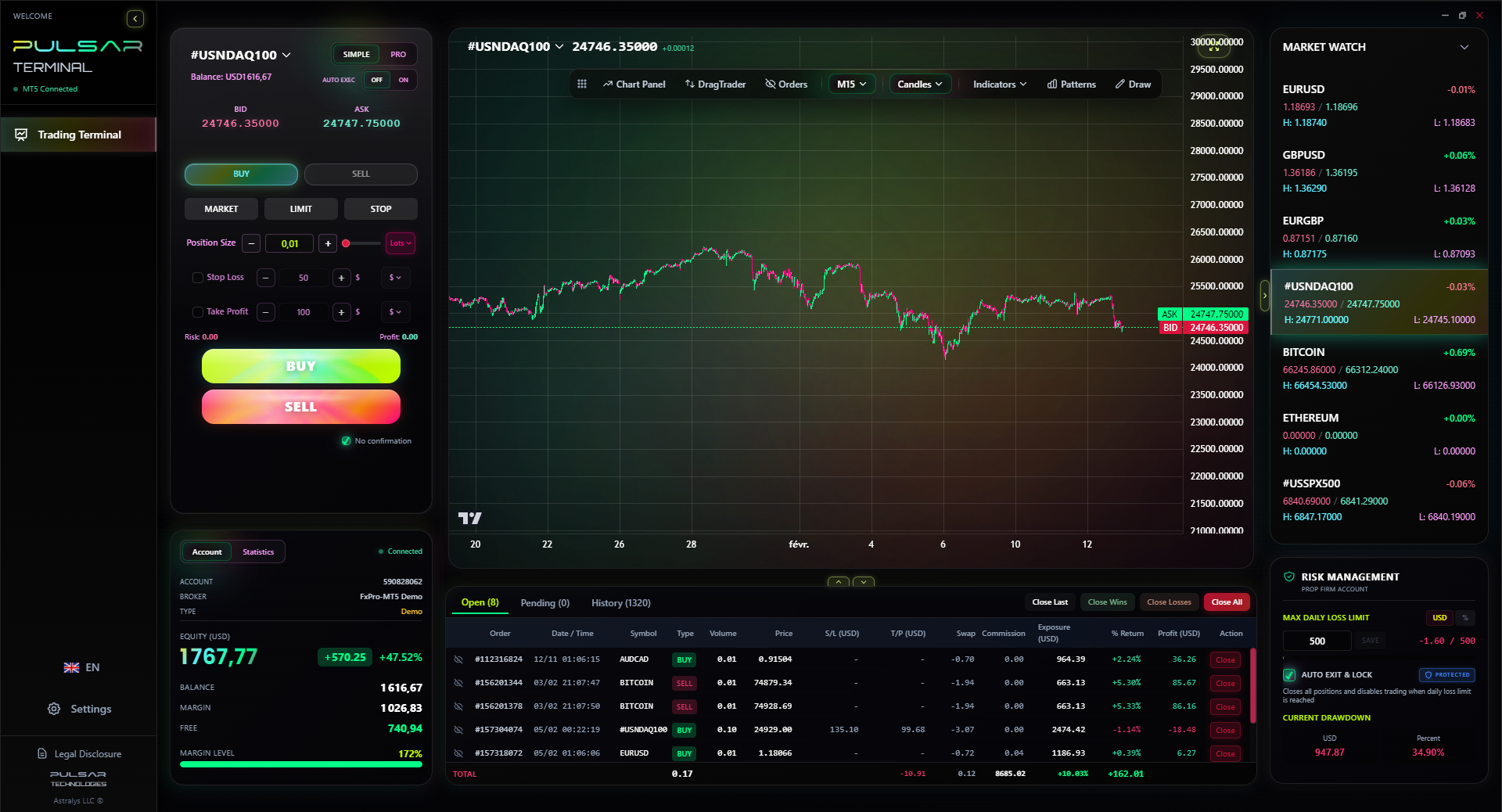
Maintaining the discipline of a machine is hard, which is why tools like Pulsar Terminal that automate trade management and enforce risk rules directly on your MT5 platform are essential for systematic traders.
Pulsar Terminal
L'outil MT5 tout-en-un : ordres glisser-déposer, multi-TP/SL, trailing stop, grid trading, Volume Profile et protection prop firm. Utilisé quotidiennement par 1 000+ traders.
“Think of yourself as the mechanic, not the driver. Your job is to maintain the system, not grab the steering wheel.”
Let's run the numbers for a realistic Indian retail quant setup. Forget 66% returns. Let's see if you can beat a fixed deposit.
Assume a ₹5 lakh account.
| Cost Component | Monthly Estimate | Annual Cost | % of ₹5L Capital |
|---|---|---|---|
| Broker API Fee (e.g., Zerodha) | ₹500 - ₹2,000 | ₹6,000 - ₹24,000 | 1.2% - 4.8% |
| Cloud Server (AWS/Azure) | ₹2,500 - ₹4,000 | ₹30,000 - ₹48,000 | 6.0% - 9.6% |
| Market Data Feeds | ₹1,000 - ₹3,000 | ₹12,000 - ₹36,000 | 2.4% - 7.2% |
| Brokerage (20 trades/day @ ₹20) | ~₹8,000 | ~₹96,000 | 19.2% |
| Total Annual Cost | ₹1,44,000 - ₹2,04,000 | 28.8% - 40.8% |
Look at that last column. Your strategy needs to make at least 29-41% per year just to break even on costs. That's before you pay yourself a single rupee. The Medallion Fund's gross returns were huge, but their costs (salaries, tech, research) were astronomical too. Their net was 'only' 39%. Your gross needs to be stellar just to cover a basic setup.
This is why most retail algo traders fail. They see a 15% backtested return and think they're geniuses. They don't factor in that ₹20 per order brokerage, and suddenly that 15% is a 10% loss. Use a position size calculator that includes all transaction costs. If your broker offers low costs like Exness for forex or XM for metals, that's one thing. For Indian equities, the brokerage structure is what it is. Plan for it.
💡 Conseil de Winston
The market's job is to find the flaw in your system. Your job is to find it first, in a backtest, before it finds your wallet.
Forget about cloning Jim Simons. Start here instead:
- Pick ONE Market & ONE Timeframe. Nifty 50 15-minute charts. Or Bank Nifty options on expiry day. Or USD/INR futures. Master one thing. Don't jump.
- Define a Single, Testable Rule. 'When the price pulls back to the 20-period EMA in a clear uptrend (higher highs/higher lows), enter on the close of the first bullish candle that closes above the EMA.' Something that clear.
- Manual Backtest. Go back on your charting software and manually check the last 50 instances of this setup. Use a notepad. Write down Win/Loss and the size of each. Calculate your expectancy. This is more valuable than any fancy software.
- Paper Trade for One Month. Execute this rule exactly, every time, in a demo account. No skipping.
- Go Live with 1/10th Your Usual Size. If you normally trade 5 lots, trade 0.5 lots. The goal is to validate your process and psychology, not to make money.
This process embodies the core of the Jim Simons trading strategy: hypothesis, data, execution, review. It's the scientific method applied to markets. It's slow. It's boring. It won't make you 66% a year. But it might just keep you in the game long enough to compound steady, realistic gains.
The greatest lesson from Jim Simons isn't a line of code. It's that markets are a complex system best navigated with humility, data, and an unemotional process. Your job is to build that process, one tested rule at a time. Start small. Be consistent. And for god's sake, mind your costs.
FAQ
Q1Can I legally use algorithmic trading in India like Jim Simons did?
Yes, but under strict rules. SEBI's 2026 framework makes algorithmic trading a formally regulated activity. You must operate through a broker's approved infrastructure, your strategy needs to be tagged with a unique Algo-ID, and you must comply with Order-to-Trade Ratio (OTR) limits. It's legal, but it's not the wild west. You can't run unregulated high-frequency trading from your basement.
Q2What's the minimum capital needed to start algorithmic trading in India?
There's no official minimum, but practically, you need enough to cover costs and survive drawdowns. With monthly infrastructure and data costs easily hitting ₹8,000-₹10,000, plus brokerage, a ₹2-₹5 lakh capital base is a realistic starting point just to see if your strategy can overcome the overhead. Starting with less means costs will eat you alive before you even know if your system works.
Q3Did Jim Simons' strategy work on Indian markets?
Renaissance's Medallion Fund primarily traded US markets. The core principles - statistical arbitrage, market neutrality, data-driven models - are universal, but the specific patterns they exploited were unique to the liquidity and participants of US equities and futures. A direct copy-paste would fail. The Indian market has different volatility patterns, liquidity profiles (especially in options), and is heavily influenced by FII/DII flows and local news, requiring a completely rediscovered edge.
Q4What programming language is best for building trading algorithms in India?
Python is the undisputed king for retail algorithmic trading. It has extensive libraries for data analysis (Pandas, NumPy), backtesting (Backtrader, Zipline), and connects easily to most Indian broker APIs (Zerodha, Upstox, Dhan etc.) via REST or WebSocket. The learning curve is manageable compared to C++, which is what firms like Renaissance use for ultra-low latency.
Q5How do I backtest my strategy with accurate Indian data?
You have a few options. Some broker APIs (like Kite Connect) provide historical data. Dedicated platforms like Tradetron, QuantMan, or Zerodha Streak have built-in backtesting engines with Indian market data. For more control, you can purchase quality historical tick or minute data from vendors like TrueData or Tick-by-Tick and use Python to run your own backtests. Always include all transaction costs (brokerage, taxes) in your backtest.
Q6Is high-frequency trading (HFT) possible for retail traders in India?
Effectively, no. SEBI's rules, mandatory broker infrastructure, and the OTR penalty framework create massive barriers. True HFT requires co-location, direct market access, and microsecond latencies, which are inaccessible and prohibitively expensive for retail. What you can do is 'systematic' or 'algorithmic' trading with a frequency of seconds or minutes, not milliseconds.
Q7What is the single biggest mistake retail traders make when trying a quant approach?
Overfitting. They tweak their strategy parameters until the backtest curve is a beautiful, smooth upward line. This 'curve-fitting' creates a strategy that works perfectly on past data but fails instantly in the live market because it's tuned to random noise, not a real edge. The solution is to test on out-of-sample data (data you didn't use to build the strategy) and keep your rules as simple and logical as possible.
La leçon du Prof. Winston
Points clés:
- ✓Simons' edge was infrastructure, not ideas. You can't copy it.
- ✓Focus on a 55% win rate with 1:1 risk-reward, not 66% annual returns.
- ✓SEBI's 2026 rules add 28-40% in annual costs. Factor them in.
- ✓Overfitting a backtest is the most common fatal error.
- ✓Your psychology is the weakest link. Automate everything you can.
Cet article vous a-t-il été utile ?
Cliquez sur une étoile
Analyses Trading Hebdo
Analyses et stratégies hebdo gratuites. Pas de spam.
À propos de l'auteur
Rajesh Sharma
Analyste Forex Senior
Plus de 10 ans d'expérience sur les marchés indiens et sud-asiatiques. A débuté avec les dérivés de change du NSE avant de passer au forex international. Spécialiste des paires USD/INR et des marchés émergents.
Commentaires
Avertissement sur les risques
Le trading d'instruments financiers comporte des risques importants et peut ne pas convenir à tous les investisseurs. Les performances passées ne garantissent pas les résultats futurs. Ce contenu est fourni à titre éducatif uniquement et ne constitue pas un conseil en investissement. Effectuez toujours vos propres recherches avant de trader.
Vous aimerez aussi

Cara Trading Forex Sukses: 7 Prinsip dari Trader Profesional
Cara trading forex sukses dengan 7 prinsip trader pro: manajemen modal, disiplin, journal trading, backtest. Data nyata, bukan janji profit palsu.
Jam Trading Forex Terbaik untuk Trader Indonesia: Panduan Lengkap dengan Tabel Waktu
Panduan jam trading forex untuk trader Indonesia. Tabel 4 sesi dunia, jam emas 20:00-00:00, sesi mana yang harus dihindari. Data akurat + tips dari trader berpengalaman.
Top 5 Sàn Forex Uy Tín Nhất 2026: Review Jujur dari Trader Indonesia
Top 5 sàn forex uy tín 2026 untuk trader Indonesia. Review jujur: spread, deposit, withdraw, dukungan lokal. Exness, XM, IC Markets & lebih.
Obtenir Pulsar Terminal
Tous ces calculateurs sont intégrés dans Pulsar Terminal avec des données en temps réel de votre compte MT5. Dimensionnement de position en un clic, gestion automatique des risques et calculs instantanés.
Obtenir Pulsar Terminal