


Here's a fact that should sober you up: over 190,000 South Africans are trading forex, moving more than $2.1 billion daily.

David van der Merwe
Trader des Marchés Émergents ·  South Africa
☕ 10 min de lecture
Ce que vous apprendrez :
- 1What 'Market Structure' Really Means for a South African Trader
- 2The Rulebook: FSCA Regulations & The 30:1 use Cap
- 3The Real Costs: A ZAR-Centric Breakdown of Fees That Eat Profits
- 4Tax & SARS: Reporting Gains from Local and Offshore Brokers
- 5Choosing a Broker in South Africa: 2024 Realities
- 6Trading Strategies That Work Within This Structure
- 7Essential Tools & Resources for SA Traders
Here's a fact that should sober you up: over 190,000 South Africans are trading forex, moving more than $2.1 billion daily. Yet, 90% of the 'market structure forex PDF' guides you'll find online are generic rubbish, written by people who've never placed a real trade with real Rand. The market's structure isn't just charts; it's the legal framework, the real costs, and the brokers who can actually get your money in and out. Let's cut through the noise.
Forget the fancy YouTube definitions. In South Africa, 'market structure' has two layers. First, it's the price action on your chart - the highs, lows, and trends that everyone talks about. Second, and far more critical, it's the regulatory and financial scaffolding that holds the entire game up. This is where most new traders get blindsided.
They'll spend weeks learning about bullish and bearish order blocks from some free market structure forex PDF, but have zero clue that the FSCA caps their use at 30:1, or that SARS wants a cut of their profits as income tax. I learned this the hard way. Back in 2018, I had a killer quarter trading GBP/ZAR. My chart structure was perfect. Then tax season hit, and I hadn't kept a single clear record of my trades from my offshore broker. The admin nightmare cost me more in accountant fees than some of the trades made.
The real structure is this: you operate within a regulated environment (if you're smart), you pay specific fees, and you report your gains. The chart patterns are just the game on the field. The FSCA, SARS, and your broker's terms are the rulebook and the stadium. You need to know both to play.

Warning: Trading with an unregulated offshore broker might seem tempting for higher use, but you step completely outside South African consumer protection. If they vanish with your deposit, the FSCA can't help you. It's a risk I don't take anymore.

💡 Conseil de Winston
Your first R10,000 in trading should be spent on education and a strong internet/power setup, not leveraged into a market gamble. Infrastructure is a trade cost.
The Financial Sector Conduct Authority (FSCA) is your main referee. Since 2021, their biggest rule for retail traders is the use cap: a maximum of 30:1 on major forex pairs. This isn't a broker choice; it's the law for any FSCA-licensed entity.
Why This Matters to Your Strategy
That 30:1 number changes everything if you're used to the old ways or international chatter. It directly limits your position size for a given account balance. Where you might have used 100:1 for a small scalping strategy before, you now need four times the margin. This forces better risk management, but it also means your old position size calculator settings need a serious review. A margin call happens faster.
The Good Stuff: Client Protection
Regulation isn't just about restrictions. A proper FSCA-licensed broker must segregate client funds. This means your trading capital is held in a separate account from the broker's operating money. If the broker goes bankrupt (it happens), your funds are theoretically safer and shouldn't be used to pay the broker's debts. They also have to be transparent about all costs - spreads, commissions, overnight fees. No hidden surprises.
My go-to brokers like IC Markets and Exness have FSCA licenses for their South African clients. It's the first thing I check. Don't just look for a fancy platform; look for the FSP number on their website.

“The real market structure isn't just charts; it's the legal framework, the real costs, and the brokers who can actually get your money in and out.”
This is where that market structure forex pdf probably glosses over the details. Let's talk real numbers, because this is what determines if you're actually profitable.
The Obvious Costs:
- Spreads: You can get decent spreads here. On a good ECN account, majors can go as low as 0.0 pips, but you pay a commission. Raw spread accounts might have 0.6-1.0 pips. For a standard lot (100,000 units), a 1 pip spread on EUR/USD costs you about $10 off the bat.
- Commissions: Typically $3-$7 per side, per lot. So a round turn (open and close) on one lot could cost $6-$14.
- Overnight Fees (Swaps): These are based on interest rate differentials. Holding a EUR/USD buy position overnight might cost or earn you a few dollars. For swing trading, this adds up. Check your broker's swap sheet daily.
The Hidden South African Costs: This is the crucial local knowledge.
- Currency Conversion: If your broker account is in USD but you deposit ZAR, they'll convert it. The fee is often baked into a poor exchange rate, sometimes adding 1% or more on top of the interbank rate. That's R1,000 gone on a R100,000 deposit.
- Bank Fees: Capitec's 2025 schedule shows a R250 fee for an outgoing international payment (like a broker deposit) and R350 for an incoming one (a withdrawal). Standard Bank, FNB, and others have similar charges. This makes frequent small withdrawals a profit-killer.
- Inactivity Fees: Leave your account dormant for 3 months? Some brokers, like AvaTrade, will hit you with a $50 fee. Others charge monthly after a period. Read the terms.
- Withholding Tax: If you trade CFDs on US stocks and hold a long position, a 30% tax on dividends may apply unless you've submitted a W8-BEN form to your broker.

Example: You deposit R20,000. Bank fee: -R250. Currency conversion fee (1.2%): -R240. You start with R19,510. You need to make back R490 just to break even on your deposit. This is real market structure.
Here’s the absolute non-negotiable: SARS considers forex trading profits as income if you trade frequently. It's not capital gains. That means your profits are added to your salary and taxed at your marginal income tax rate (which can be 45% at the top end).
I treat tax as my biggest trading cost. It changes your profit targets. If you're in the 36% tax bracket, a R10,000 profit is really R6,400 after tax. You need to account for this from the start.
Record Keeping is Your Job: SARS doesn't care if your broker is in Mauritius or Cyprus. You must declare worldwide income. The onus is on you to keep records:
- Full trade history (entry, exit, P&L).
- All deposit and withdrawal slips.
- Bank statements showing the flow of funds.
- Broker statements (monthly, yearly).
Most decent brokers like XM or Pepperstone provide detailed downloadable reports. Download them monthly. I have a simple spreadsheet where I log every single trade the moment I close it. The 'market structure forex pdf' that teaches you trading but not bookkeeping is setting you up for failure.
A good accountant who understands trading is worth every cent. They can advise on deductible expenses (internet, trading software subscriptions, education) but don't get creative. SARS is getting sharper on trading income.
💡 Conseil de Winston
Treat every 1 pip of spread as a R10 toll fee on a standard lot trade. If your strategy can't comfortably pay that toll and still make a profit, it's not a strategy, it's hope.
“A broker with perfect charts but a 5-day withdrawal process to an international account is a nightmare.”
The broker is your gateway to the market's price structure. Your choice dictates your costs, execution speed, and peace of mind. Here’s my blunt take on the landscape.
FSCA-Regulated is Table Stakes. This is your baseline for safety. It means the broker adheres to local rules, including the 30:1 use and client fund segregation. Brokers like IG, FP Markets, and FxPro have strong local presences and FSCA licenses.
The Execution & Cost Battle. Once regulation is satisfied, you fight over pips and execution.
- ECN/RAW Accounts: For active traders, these are king. You pay a commission but get raw spreads from liquidity providers. Slippage is usually lower. IC Markets and Pepperstone excel here.
- Standard Accounts: The spread is marked up but no commission. Simpler, but often more expensive for larger volumes.
The Local Access Question. Can you deposit in ZAR via EFT (Instant EFT, SiD) without a crazy conversion fee? How fast are withdrawals back to your South African bank account? This is a huge practical factor. A broker with perfect charts but a 5-day withdrawal process to an international account that then gets held up by your local bank is a nightmare.
My Personal Experience: I split my capital. The majority is with an FSCA-licensed ECN broker for serious trading. I once tried a flashy international prop firm-style challenge with a different platform. The market structure on their charts felt 'off' - re-quotes during news, weird spread widening that wasn't happening on my main broker. I passed the challenge but failed the first payout withdrawal on a technicality. Lesson learned: simplicity and reliability with a known, regulated entity trump exotic offers.
So you know the rules and costs. How do you actually trade the price structure profitably here?
1. Scalping with Tight Stops: The 30:1 use makes traditional micro-lot scalping with 50-pip stops less effective. You need more capital per trade. Focus on quality over quantity. Use the RSI indicator or MACD indicator on lower timeframes to find overextended moves, but your edge must be razor-sharp to cover the tighter spreads and commissions of frequent trading.
2. Swing Trading is Your Friend: This aligns well with our structure. Lower frequency means fewer commission costs. You can use the use to take sensible positions on higher timeframes, aiming for 150-300 pip moves. This also makes tracking trades for SARS simpler. I had my best year in 2022 focusing on weekly swing trading setups on AUD/USD and GBP/JPY, holding for days or weeks. The overnight swaps were a factor in the calculation, not a daily drain.
3. Risk Management is Non-Negotiable: With capped use, you might be tempted to risk a higher percentage of your account per trade to chase returns. This is a trap. I stick to a max 1-2% risk per trade. Use a position size calculator religiously. Knowing that a R250 bank fee eats into your profits, you can't afford to blow up an account. A 10% drawdown requires an 11% gain just to get back to even. After costs and tax, it's more like 15%.
Finding a Real 'Market Structure Forex PDF': Don't Google that phrase. You'll get garbage. Look for content from actual traders who discuss order flow, liquidity pools, and higher timeframe analysis. The best 'PDF' is often your own trading journal where you annotate charts with what you saw in the market's structure (support/resistance, break of structure) and why the trade worked or failed.
💡 Conseil de Winston
The most important 'market structure' line you'll draw isn't on a chart; it's the line in your budget for SARS. Set aside 30% of every withdrawal immediately. Future you will send a bottle of wine.
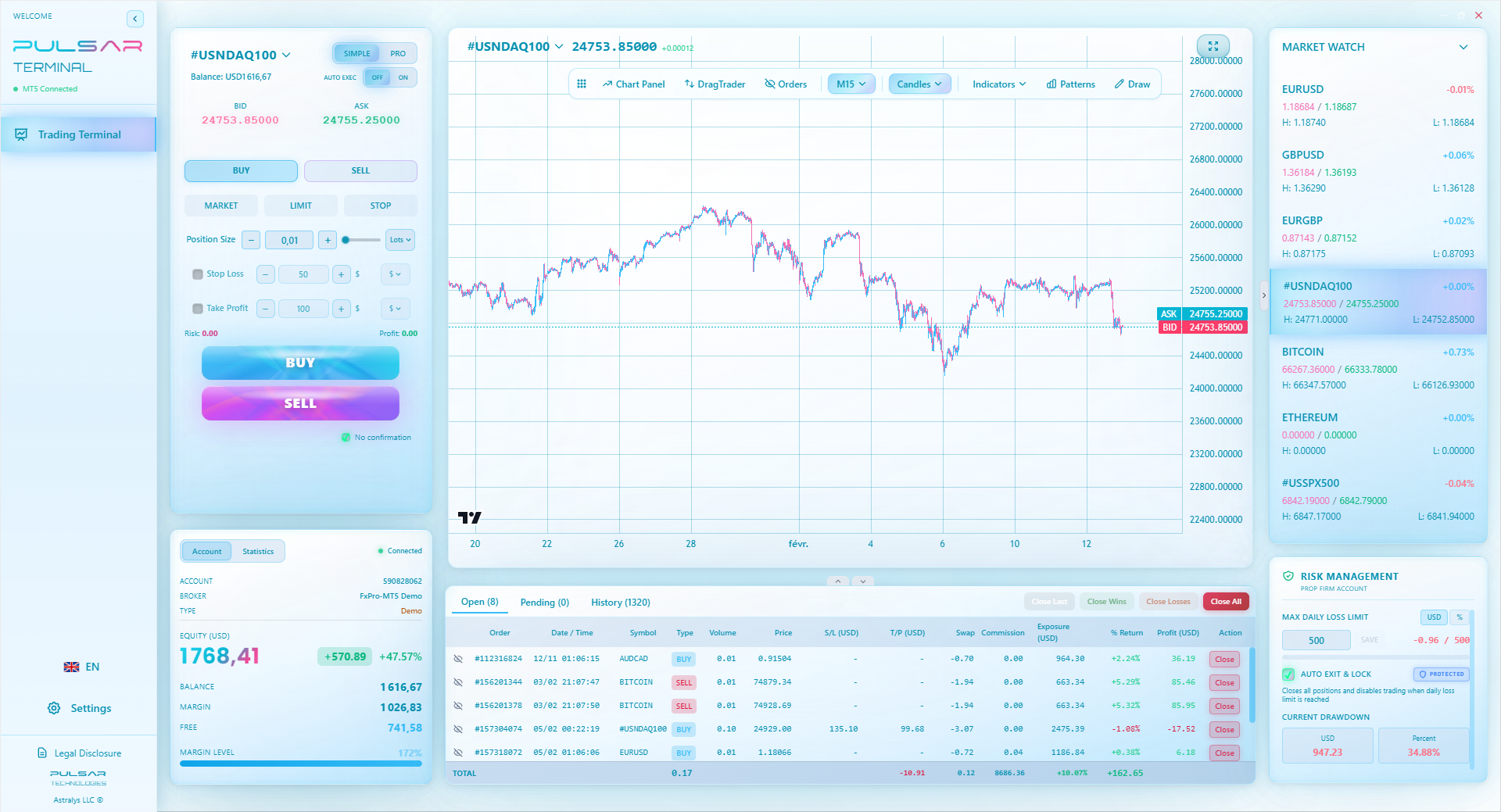
Managing multiple swing trades and their risk parameters manually is a chore; Pulsar Terminal automates trailing stops, breakeven moves, and partial closures directly on your MT5 charts, letting you focus on the market's structure, not your platform's buttons.
Pulsar Terminal
L'outil MT5 tout-en-un : ordres glisser-déposer, multi-TP/SL, trailing stop, grid trading, Volume Profile et protection prop firm. Utilisé quotidiennement par 1 000+ traders.
“SARS considers forex trading profits as income. Treat tax as your biggest trading cost.”
Beyond the broker's platform, here’s what you actually need.
Trading Journal Software: This is your most important tool after your charting platform. You need to log emotions, strategy adherence, and most importantly, the exact pips and Rands gained/lost. I use a simple Google Sheets template that auto-calculates my risk-reward and weekly P&L. It’s my personal market structure pdf.
Economic Calendars: Know when SARB announces interest rates. Know South African CPI data release times. These events cause massive volatility in ZAR pairs. Trading USD/ZAR around a SARB announcement without knowing is gambling.
Reliable Internet & Power Backup: Load-shedding is part of our market structure. A UPS for your router and monitor is a trading expense. A mobile data hotspot as a backup is non-negotiable. I got stopped out unfairly in 2019 because my line went down during a scheduled outage I forgot about. A R2,000 UPS would have saved me R8,000. Now I have one.
Community (The Right Kind): Find a small group of serious local traders. Not a Telegram pump-and-dump group. A place to discuss real broker experiences, tax tips, and strategy. The shared local context is useful.
FAQ
Q1Is forex trading legal in South Africa?
Yes, completely legal. It's regulated by the Financial Sector Conduct Authority (FSCA). The key is to use an FSCA-licensed broker to ensure you have legal protection and that the broker follows local rules like the 30:1 use cap.
Q2What is the best broker for forex trading in South Africa?
There's no single 'best.' It depends on your style. For low-cost, high-volume trading (like scalping), look at FSCA-licensed ECN brokers like IC Markets or Pepperstone. For beginners wanting simplicity, a regulated broker like IG or Exness with a standard account might be better. Always prioritize FSCA regulation, then compare spreads, commissions, and ZAR deposit/withdrawal ease.
Q3How much tax do I pay on forex profits in South Africa?
SARS typically treats frequent trading profits as income, not capital gains. This means your profits are added to your other income (like your salary) and taxed at your marginal tax rate. This can range from 18% to 45%. You must declare profits from all brokers, even international ones. Keep impeccable records.
Q4Can I use international brokers like MetaTrader brokers in South Africa?
You can, but it's riskier. Many international brokers are not regulated by the FSCA. This means they might offer higher use (like 500:1), but you lose the protection of South African law, including client fund segregation rules. If you use them, understand you're operating in a less protected space.
Q5What is a good 'market structure forex pdf' for beginners?
Frankly, most free PDFs are low-quality. Instead of searching for a PDF, focus on learning the core concepts: support/resistance, trendlines, and higher highs/lows. Use free resources from established trading educators and apply it on a demo account. The best document you'll create is your own annotated trading journal.
Q6What are the typical withdrawal fees and times for South African traders?
It varies. Some brokers offer one free withdrawal per month. Fees can be around $25 otherwise. Withdrawals to a South African bank account usually take 1-3 business days from the broker, plus additional time for your local bank to clear the international transfer. Remember your local bank (e.g., Capitec, FNB) will also charge an incoming international payment fee, often around R350.
La leçon du Prof. Winston
Points clés:
- ✓FSCA use is capped at 30:1 for retail majors.
- ✓Bank and conversion fees can eat 2-3% of deposits.
- ✓Tax on profits is at your income tax rate, not CGT.
- ✓Client fund segregation is non-negotiable for safety.
Cet article vous a-t-il été utile ?
Cliquez sur une étoile
Analyses Trading Hebdo
Analyses et stratégies hebdo gratuites. Pas de spam.
À propos de l'auteur
David van der Merwe
Trader des Marchés Émergents
Trader basé à Johannesbourg avec 11 ans d'expérience sur les devises des marchés émergents. Spécialisé dans les paires ZAR, le trading régulé par la FSCA et l'analyse du marché sud-africain.
Commentaires
Avertissement sur les risques
Le trading d'instruments financiers comporte des risques importants et peut ne pas convenir à tous les investisseurs. Les performances passées ne garantissent pas les résultats futurs. Ce contenu est fourni à titre éducatif uniquement et ne constitue pas un conseil en investissement. Effectuez toujours vos propres recherches avant de trader.
Vous aimerez aussi

Cara Trading Forex Sukses: 7 Prinsip dari Trader Profesional
Cara trading forex sukses dengan 7 prinsip trader pro: manajemen modal, disiplin, journal trading, backtest. Data nyata, bukan janji profit palsu.
Jam Trading Forex Terbaik untuk Trader Indonesia: Panduan Lengkap dengan Tabel Waktu
Panduan jam trading forex untuk trader Indonesia. Tabel 4 sesi dunia, jam emas 20:00-00:00, sesi mana yang harus dihindari. Data akurat + tips dari trader berpengalaman.
Top 5 Sàn Forex Uy Tín Nhất 2026: Review Jujur dari Trader Indonesia
Top 5 sàn forex uy tín 2026 untuk trader Indonesia. Review jujur: spread, deposit, withdraw, dukungan lokal. Exness, XM, IC Markets & lebih.
Obtenir Pulsar Terminal
Tous ces calculateurs sont intégrés dans Pulsar Terminal avec des données en temps réel de votre compte MT5. Dimensionnement de position en un clic, gestion automatique des risques et calculs instantanés.
Obtenir Pulsar Terminal