


I remember watching the Naira chart in late 2020, seeing the volatility spike, and thinking something was off.

Olumide Adeyemi
Pionnier du Trading en Afrique de l'Ouest ·  Nigeria
☕ 11 min de lecture
Ce que vous apprendrez :
- 1What Was MBA Forex and Capital Investment Limited? (Spoiler: Not a Broker)
- 2How to Spot a Forex Scam in Nigeria (The Red Flags)
- 3Real Forex Trading in Nigeria: The Legal Landscape
- 4Choosing a Legitimate Broker: Your Safety Checklist
- 5Getting Started the Right Way: From Demo to Live
- 6Common Pitfalls for Nigerian Traders (And How to Avoid Them)
- 7Moving Forward: Building Real Skill, Not Buying Empty Promises
I remember watching the Naira chart in late 2020, seeing the volatility spike, and thinking something was off. Not just with the currency, but with the chatter. Everyone and their uncle was suddenly a forex expert, all talking about this one company guaranteeing 20% monthly returns. That company was MBA Forex and Capital Investment Limited. By the time the music stopped in 2021, over 125,000 Nigerians were left holding an empty bag worth N171 billion. Let's be clear from the start: this wasn't forex trading. It was a textbook Ponzi scheme, and its collapse is the most expensive lesson Nigeria's retail trading scene has ever had.
MBA Forex and Capital Investment Limited sold a dream. They promised monthly returns of 15% to 20% for simply handing over your money. That's an annualized return of 180% to 240% if you compounded it. In the real world of forex trading, even the best professional traders struggle to consistently hit 20-30% per year. Their entire model was based on using new investors' deposits to pay 'returns' to earlier ones. The Securities and Exchange Commission (SEC) Nigeria never licensed them. They were an illegal, unregistered investment scheme, and the SEC publicly warned people about them. When the inflow of new money couldn't keep up with the promised payouts, the whole thing collapsed like a house of cards. The CEO fled, the EFCC got involved, and thousands of lives were ruined. I've seen my share of blowouts, but the scale of this one was staggering.

Warning: Any 'investment' promising guaranteed monthly returns, especially in double digits, is almost certainly a scam. Real trading involves risk and loss. Period.
The Aftermath and Ongoing Cases
As of mid-2025, civil lawsuits are still crawling through the courts. Victims are trying to claw back anything they can. In June 2025, a director was arraigned for an alleged N13.8 billion slice of the fraud. The EFCC alleges the total fraud hit N213 billion. That's over half a billion US dollars. Let that sink in. The CBN had frozen their accounts back in February 2021, but by then the damage was done. This wasn't a trading failure; it was a massive financial crime dressed up in forex terminology.

💡 Conseil de Winston
A guaranteed return is a guaranteed lie. The only thing the market guarantees is that prices will change. Your job is to manage your risk around that uncertainty.
After 12 years, you develop a nose for this stuff. MBA Forex and Capital Investment Limited ticked every box on the scam bingo card. Here’s what to run from, fast.
Guaranteed Profits: This is the biggest one. If it's guaranteed, it's a lie. The market doesn't guarantee anything. I've had winning streaks wiped out by one bad margin call. Real brokers will hit you with risk warnings, not profit promises.
Too-Good-To-Be-True Returns: 15-20% per month? Please. Warren Buffett averages about 20% per year. Anyone offering more is either running a Ponzi or about to blow up your account with insane risk.
Lack of Regulatory License: This is non-negotiable. In Nigeria, legitimate international brokers are regulated abroad by bodies like the UK's FCA, Cyprus's CySEC, or South Africa's FSCA. Check their website footer. If there's no license number from a reputable authority, close the tab. The SEC Nigeria doesn't license forex brokers, so a 'SEC Nigeria' claim from a forex firm is a major red flag.
Pressure to Recruit: Ponzi schemes need a constant stream of new money. If the focus is more on getting you to bring in friends and family than on teaching you to trade, it's a pyramid scheme.
Vague or Secretive 'Strategies': MBA Forex claimed to have secret algorithms. Real traders are usually happy to explain their edge (within reason). If they can't or won't explain how the money is made, it's because the money is coming from new deposits, not the market.
I learned this the hard way early on. I once put $1,000 into a 'managed account' promising 10% monthly. It hit 12% the first month, and I felt like a genius. The second month, the website vanished. Poof. Gone. That $1,000 lesson was cheap compared to what MBA Forex victims lost.
“MBA Forex wasn't a trading failure; it was a massive financial crime dressed up in forex terminology.”
Okay, so scams are out. What does real, legal forex trading look like for a Nigerian? It's a bit of a patchwork, but it's absolutely doable.
First, it's legal for you, as an individual, to trade forex. The catch is that you'll be doing it through international brokers. The Central Bank of Nigeria (CBN) has a restrictive view. They manage the Naira's stability and don't want local banks facilitating speculative forex trades. So, you won't find a CBN-licensed retail forex broker.
The Securities and Exchange Commission (SEC) regulates stocks and bonds, but as of now, they don't license or oversee retail spot forex brokers either. Their main role here is consumer protection: issuing warnings about outfits like MBA Forex and Capital Investment Limited.
So where does that leave you? With internationally regulated brokers who accept Nigerian clients. Your money is held in segregated accounts under the watch of a foreign regulator. You'll trade on platforms like MetaTrader 4 or 5, and you'll fund your account using methods that work around CBN restrictions.
Recent Regulatory Shifts
Things are moving, slowly. In late 2024, the CBN introduced new guidelines for the Nigerian Foreign Exchange Market (NFEM). They launched an Electronic Foreign Exchange Matching System (EFEMS). This is a big deal for the wholesale and interbank market - it aims for transparency in setting the Naira's official rate. For you, the retail trader, it means the underlying liquidity for currency pairs like USD/NGN might become more stable and transparent over time, which is a good thing. But it doesn't change where you place your trades.
Forget the fancy marketing. Here’s your practical checklist, born from getting burned and finding the good ones.
1. Regulation is King: This is your first and only non-negotiable. Look for a license number from a top-tier authority. The UK Financial Conduct Authority (FCA) is the gold standard. Cyprus Securities and Exchange Commission (CySEC) is common and solid. The Financial Sector Conduct Authority (FSCA) in South Africa is another good one. Go to the regulator's website and verify the license. I trade primarily with an FCA-regulated broker for my main account because I sleep better at night.
2. Realistic Costs & Spreads: Expect EUR/USD spreads from 0.9 pips on a standard account, or raw spreads from 0.0 pips with a commission (e.g., $3.50 per lot). If someone offers 'zero spread' with no commission, dig deeper. The cost is somewhere.
3. Naira-Friendly Services: Can you deposit in Naira? What's the spread on their currency conversion? Some brokers offer NGN-denominated accounts, which simplifies things. Check the deposit/withdrawal methods: bank transfer, credit cards, and e-wallets like PayPal, Skrill, and even crypto are common.
4. Platform & Tools: MT4/MT5 is the standard. Does the broker offer a good mobile app? What about additional tools? For serious charting and order management beyond basic MT5, I use a companion app that lets me drag-and-drop orders and set multi-level take-profits easily.
5. Start Small: Legit brokers have low minimum deposits. Some start at $0, others at $100 or 4,000 NGN. Start with the smallest amount you can trade with properly. Use their demo account first. I opened my first real account with just $200 to test the withdrawal process before committing more. If a broker makes it hard to withdraw a small profit, you don't want to be with them when you have a big one.
| Feature | Scam (Like MBA Forex) | Legitimate Broker |
|---|---|---|
| Returns | Guaranteed, 15-20%/month | Never guaranteed, high risk of loss |
| Regulation | None, or fake claims | FCA, CySEC, FSCA (verifiable) |
| Focus | Recruiting new members | Providing a trading platform & tools |
| Transparency | Secret 'system' | Clear pricing, fees, spreads |
| Money Movement | You send money to a company/personal account | You deposit to a segregated client money account |
💡 Conseil de Winston
Your first profitable withdrawal is more important than your first profitable trade. It proves the entire system - from deposit to trade to bank account - actually works.
“Real trading is a skill, like welding or coding. It takes time, practice, and painful lessons. There are no shortcuts.”
You want to trade? Good. Let's do it without losing your shirt to a scam or the market.
Step 1: Education, Not Deposit. Learn what a pip is. Understand use. Learn basic swing trading or scalping concepts. YouTube has great free content, but be skeptical of 'gurus' selling courses with get-rich-quick promises.
Step 2: Demo Account. Open a demo with a reputable broker like IC Markets or XM. Trade it like it's real money. Try to double it. Then try not to blow it up. Everyone blows up a demo account. It's a rite of passage. I blew my first three demos trying to trade gold (XAU/USD) like it was a stock.
Step 3: Develop a Simple Strategy. Pick one major pair, like EUR/USD. Learn its personality. Use one or two indicators, like the RSI or MACD, to understand momentum. Write down every trade: why you entered, your stop-loss, your take-profit, and your emotional state. This journal is more valuable than any indicator.
Step 4: Risk Management Before Profit. This is the pro's secret. Before you even think about profit, decide how much you're willing to lose on a single trade. I risk no more than 1% of my account per trade. Use a position size calculator religiously. If your account is $500, your max loss per trade is $5. It sounds tiny, but it keeps you in the game.
Step 5: Fund a Live Account. Start with the minimum. Your goal for the first six months is not to make money. Your goal is to execute your plan, manage your risk, and survive. Withdraw your first profit, even if it's just 5,000 NGN. Proving you can get money out of the system is a huge psychological win.

Pro Tip: Your first live trade will feel nothing like your demo. Your heart will pound. That's normal. Place the trade, set your stop-loss and take-profit, and walk away from the screen for an hour. Let the plan work.
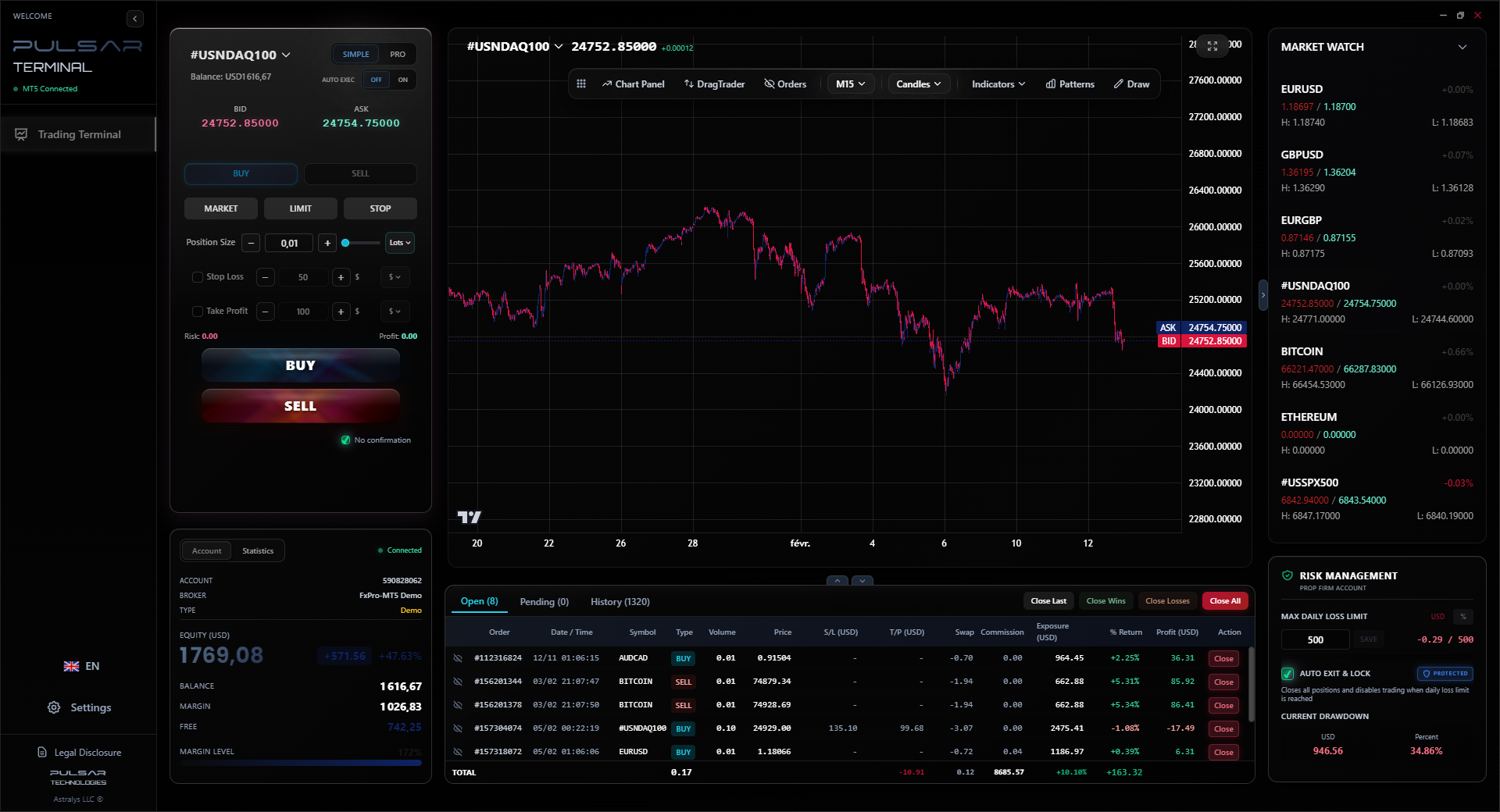
Sticking to a trading plan requires iron discipline, and tools like Pulsar Terminal help by letting you set multi-level take-profits and stop-losses directly on your MT5 charts before you even enter the trade.
Pulsar Terminal
L'outil MT5 tout-en-un : ordres glisser-déposer, multi-TP/SL, trailing stop, grid trading, Volume Profile et protection prop firm. Utilisé quotidiennement par 1 000+ traders.
We face unique challenges. Recognizing them is half the battle.
Pitfall 1: Chasing the 'Magic Bullet' After a Loss. You lose 20,000 NGN on a bad trade. The temptation is to find a 'sure thing' to make it back fast. This is how people fall for the next MBA Forex. Accept the loss as the cost of doing business. Stick to your 1% risk rule.
Pitfall 2: Overtrading the USD/NGN Pair. It's tempting to trade your home currency. Don't. The CBN's interventions and illiquid offshore markets create massive, unpredictable spikes. It's a great way to get stopped out for no technical reason. I learned this in 2017 when a CBN announcement moved the pair 500 pips in minutes, wiping my carefully placed stop.
Pitfall 3: Ignoring the True Cost of Trading. You see a 0.6 pip spread on EUR/USD. Great. But how much is the broker marking up the USD/NGN conversion when you deposit your Naira? That hidden fee can be your biggest cost. Always calculate the total cost of depositing, trading, and withdrawing.
Pitfall 4: Social Media Hype. WhatsApp groups and Instagram pages are full of 'signal sellers' and fake account screenshots. If they were that good, they'd be trading, not selling signals for 5,000 NGN. Do your own analysis.
Pitfall 5: Underestimating Psychology. The market's job is to make you feel wrong, scared, and greedy. When you're up, greed says 'let it run more.' When you're down, fear says 'it'll come back.' Your trading plan exists to silence these voices. Follow it.
💡 Conseil de Winston
If you wouldn't risk 10,000 NGN on a football bet with a stranger, don't risk it on a 'signal' from a stranger on WhatsApp. Your analysis, your risk, your responsibility.
“Your goal for the first six months is not to make money. Your goal is to execute your plan, manage your risk, and survive.”
The ghost of MBA Forex and Capital Investment Limited will haunt Nigeria's financial scene for years. But its real legacy shouldn't be fear. It should be a hardened, smarter generation of traders who do the work.
Real trading is a skill, like welding or coding. It takes time, practice, and painful lessons. There are no shortcuts sold by unlicensed companies. Your path is through regulated brokers, continuous education, and brutal self-honesty about your wins and losses.
The tools have never been better. You have free demo accounts with real-time data. You have advanced platforms that were once only for hedge funds. You have access to global markets from your phone in Lagos. The opportunity is real, but it's the opposite of what MBA Forex sold.
They sold passive income with no effort. Real trading is active, difficult, and demands constant effort. They sold guaranteed returns. Real trading guarantees only that you will face uncertainty and risk. They sold a community of recruiters. Your community should be one of analysts, risk managers, and disciplined executors.
Start today. But start right. Verify a broker's license. Fund a demo. Learn one thing well. The market isn't going anywhere. It'll be here when you're ready.
FAQ
Q1Is MBA Forex and Capital Investment Limited still operating?
No. The scheme collapsed in 2021. Its bank accounts were frozen by the CBN, the CEO was declared wanted by the EFCC, and the company is defunct. Civil lawsuits by victims are still ongoing in courts as of 2025.
Q2Can I get my money back from MBA Forex?
The chances are extremely low. The scheme operated as a Ponzi, meaning most of the money was paid out to earlier investors or siphoned off. While the EFCC is pursuing criminal cases and some assets may be recovered, the process is long and complex. Individual investors should contact the EFCC with their evidence, but should not expect full recovery.
Q3Who regulates forex brokers in Nigeria?
No Nigerian body currently licenses or regulates international retail spot forex brokers. The CBN regulates the official foreign exchange market but not retail trading platforms. The SEC regulates investments but not forex brokers. Therefore, Nigerian traders must use international brokers regulated by foreign authorities like the UK's FCA, Cyprus's CySEC, or South Africa's FSCA.
Q4What is a safe minimum deposit to start forex trading?
With a legitimate broker, you can start with as little as $10-$100 (approx. 14,000-140,000 NGN). Many brokers offer micro or cent accounts. The key is to only deposit an amount you are 100% prepared to lose while you learn. Never deposit money you need for living expenses.
Q5What are the safest payment methods for funding a forex account in Nigeria?
E-wallets like Skrill, Neteller, or PayPal are often fastest and can avoid direct CBN scrutiny on international transfers. Cryptocurrency deposits are also offered by many brokers and are efficient. Credit/debit cards (Visa/Mastercard) work but may be declined by some Nigerian banks for forex trading. Direct bank wire transfers can be slow and may face questions from your bank.
Q6How can I verify if a forex broker is legitimately regulated?
- Go to the broker's website and find their regulatory license number (e.g., FCA #123456). 2. Go to the official website of that regulator (e.g., register.fca.org.uk). 3. Use the 'Financial Services Register' search tool and enter the license number. 4. Verify the company name, permitted activities, and that the license is 'active'. If you can't verify it in 5 minutes, walk away.
La leçon du Prof. Winston
Points clés:
- ✓Verify broker regulation first. No license, no trade.
- ✓Risk a maximum of 1% of your capital on any single trade.
- ✓Ponzi schemes promise 20% monthly. Pros aim for 20% yearly.
- ✓Trade majors like EUR/USD first. Avoid illiquid pairs like USD/NGN.
Cet article vous a-t-il été utile ?
Cliquez sur une étoile
Analyses Trading Hebdo
Analyses et stratégies hebdo gratuites. Pas de spam.
À propos de l'auteur
Olumide Adeyemi
Pionnier du Trading en Afrique de l'Ouest
L'un des formateurs de trading forex les plus actifs au Nigeria. 8 ans d'expérience de trading depuis Lagos. Spécialisé dans les stratégies à petit capital et les challenges de prop firms pour les traders africains.
Commentaires
Avertissement sur les risques
Le trading d'instruments financiers comporte des risques importants et peut ne pas convenir à tous les investisseurs. Les performances passées ne garantissent pas les résultats futurs. Ce contenu est fourni à titre éducatif uniquement et ne constitue pas un conseil en investissement. Effectuez toujours vos propres recherches avant de trader.
Vous aimerez aussi

Cara Trading Forex Sukses: 7 Prinsip dari Trader Profesional
Cara trading forex sukses dengan 7 prinsip trader pro: manajemen modal, disiplin, journal trading, backtest. Data nyata, bukan janji profit palsu.
Jam Trading Forex Terbaik untuk Trader Indonesia: Panduan Lengkap dengan Tabel Waktu
Panduan jam trading forex untuk trader Indonesia. Tabel 4 sesi dunia, jam emas 20:00-00:00, sesi mana yang harus dihindari. Data akurat + tips dari trader berpengalaman.
Top 5 Sàn Forex Uy Tín Nhất 2026: Review Jujur dari Trader Indonesia
Top 5 sàn forex uy tín 2026 untuk trader Indonesia. Review jujur: spread, deposit, withdraw, dukungan lokal. Exness, XM, IC Markets & lebih.
Obtenir Pulsar Terminal
Tous ces calculateurs sont intégrés dans Pulsar Terminal avec des données en temps réel de votre compte MT5. Dimensionnement de position en un clic, gestion automatique des risques et calculs instantanés.
Obtenir Pulsar Terminal