


Let's get this out the way: mirror trading is the financial equivalent of handing your car keys to a stranger because they have a fancy jacket.

David van der Merwe
Trader des Marchés Émergents ·  South Africa
☕ 9 min de lecture
Ce que vous apprendrez :
- 1What Mirror Trading Actually Is (Spoiler: It's Not Investing)
- 2The Real Costs for South Africans: It's Never Just 'Free'
- 3Why 80% of Mirror Traders Blow Their Accounts
- 4The FSCA's Stance: They're Watching, But You're Still on Your Own
- 5A Better Alternative: The 'Observer Account' Method
- 6Choosing a Platform: The Red Flags Checklist
- 7My Own R10,000 Mirror Trading Mistake
- 8The Final Verdict: When It *Might* Make Sense
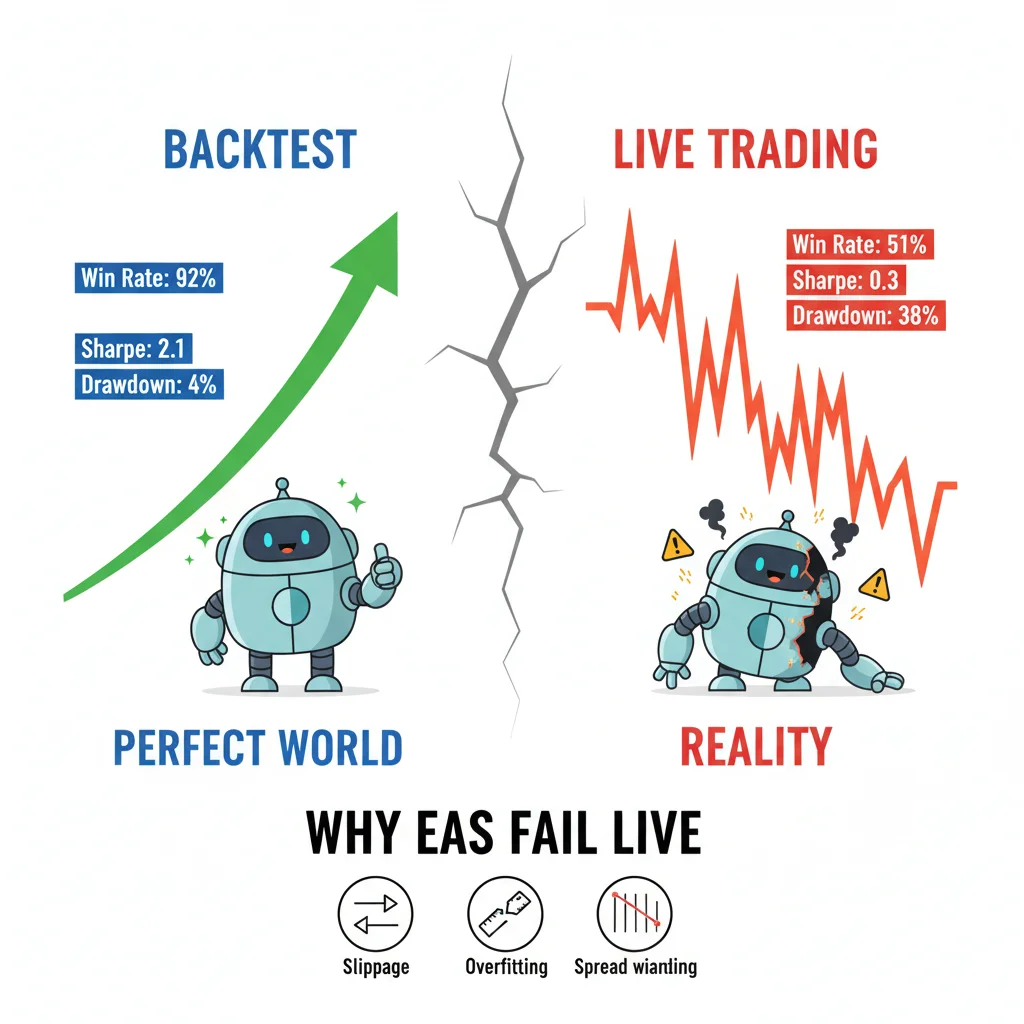
Let's get this out the way: mirror trading is the financial equivalent of handing your car keys to a stranger because they have a fancy jacket. It's marketed as a passive income dream for South Africans, but it's mostly a way for platforms and 'master traders' to earn fees from your inevitable losses. I've seen it blow up more accounts than a bad load-shedding surge. In this guide, I'll show you the ugly mechanics behind the glossy ads, explain why the FSCA is rightly nervous about it, and give you the real numbers on what 'passive' actually costs.
Mirror trading, copy trading, social trading. They're all different labels on the same bottle of hope. You connect your live trading account to a platform or a specific trader. When they buy, your account automatically buys. When they sell, you sell. You're a shadow, a copycat. The promise is that you're leveraging the skill of a proven expert while you sit back. The reality is you're leveraging their risk appetite, their emotional state, and their often-conflicted incentives. It's not a strategy. It's outsourcing your thinking, and in trading, that's the one thing you can never afford to do. The platform makes money on spreads or fees whether you win or lose. The 'master trader' often gets a performance fee, encouraging them to swing for the fences with other people's money. Your role is simply to fund the experiment.

Warning: Most platforms show you a trader's historical performance, which is about as useful as a weather report from last year. Past returns guarantee absolutely nothing about future results, especially in volatile markets like the EUR/USD.
They hook you with 'commission-free' copying. Don't be fooled. The costs are baked in, and for South Africans dealing with a weak Rand, they bite harder.
The Spread Mark-Up
This is the big one. The broker or platform widens the spread on the trades you copy. If the normal spread on EUR/USD is 1.0 pip, your mirrored trade might execute at 1.3 or 1.5. That extra 0.3-0.5 pips goes straight to the platform. On a R100,000 position, that's an extra R30-R50 lost on every single trade before it even moves. Do the math over 100 trades.
Performance Fees
If your chosen guru makes a profit, they take a cut - usually 20-30% of your gains. They have no skin in the game for your losses, only a share of the wins. This creates a 'heads I win, tails you lose' dynamic for them.
The Rand Conversion Trap
You're depositing Rands. Your chosen master trader is likely trading in USD or EUR. Every time you allocate funds, you're hit with a forex conversion fee. When you withdraw, you get hit again. Using a local broker like Exness or XM with ZAR accounts can mitigate this, but you still need to check their mirror trading terms closely.

Example: You allocate R20,000. A 1% conversion fee costs R200 upfront. The platform's widened spreads cost you an extra R500 over a month of trades. The trader makes a R2,000 profit for you. Their 25% performance fee is R500. Your 'net' gain is R800, but your total costs were R700. Your real return was 4%, not the 10% it looked like.

💡 Conseil de Winston
If you wouldn't hand them R10,000 in cash to bet at the casino, don't hand it to them via a mirror trading platform. The principle is identical.
“Mirror trading is not a strategy. It's outsourcing your thinking, and in trading, that's the one thing you can never afford to do.”
I've mentored guys who came from these platforms, accounts in tatters. The pattern is always the same.
First, you chase past performance. You pick the trader with the 300% return last month. What you don't see is that they achieved that with a 50% drawdown, risking 5% per trade. They got lucky. When their luck reverts to the mean (and it always does), your account gets halved. You didn't understand their position size calculator logic, so you have no idea how much risk you were really taking.
Second, you have zero context. The master trader might be shorting gold (XAU/USD) based on a specific MACD indicator divergence on the 4-hour chart. You have no clue. When the trade goes against them by $30, they might hold, knowing their support level is $10 away. You, sweating in Pretoria, hit the 'stop copy' button in a panic, crystallising a loss they would have recovered from. You're reacting to P&L, not to the market.
Finally, the strategy decay. A good scalping strategy works until too many people use it. By the time a signal is popular enough to be on a mirror platform, the edge is often gone. You're copying yesterday's news.
I once copied a 'volatility breakout' trader for two weeks as a test with a $500 account. They had 8 winning trades in a row. I joined. We immediately hit 4 losing trades that wiped out all those gains and 15% of my capital. Their strategy had simply hit a different market regime. I was the new money funding the old winners' exits.

The Financial Sector Conduct Authority (FSCA) categorises most mirror trading platforms as 'discretionary FSPs' (Financial Service Providers). This means the platform, or the master trader, is making discretionary decisions with your money. They need to be licensed. This is good - it weeds out the outright scams. But here's the critical part: FSCA licensing is not a performance guarantee. It's a minimum standards check. It doesn't mean their strategy is good, or that you won't lose everything. It just means they've jumped through some administrative hoops. Always, always check the FSP number on the FSCA's website. If they're not registered, run. But even if they are, remember: the FSCA won't refund you when a high-risk copy trade goes south. Your protection is limited to fair treatment, not profitable outcomes. Your due diligence is still your responsibility.

“You're reacting to P&L, not to the market. That's why you panic and they don't.”
If you're fascinated by the idea of following others, do this instead. It's what I made my most successful student do after he lost R15k on a copy platform.
- Open a demo account with a broker like IC Markets or Pepperstone. No real money.
- Pick 2-3 traders from a mirror platform you were considering. Paper-trade them. Mirror their trades manually on your demo account for at least three months. Track every trade.
- Your job is not to just watch the P&L. Your job is to reverse-engineer their strategy. Why did they enter here? Where did they place their stop-loss? What timeframe are they using? Are they a swing trading style or a scalper? Use tools to analyse their habits.
- Only after you can consistently articulate why they took a trade, and after seeing them navigate a losing period, should you even consider using real money. And even then, you should be taking the strategy you learned, not blindly following the person.
This turns you from a passive payer of fees into an active learner. You might find the trader you loved has a terrible risk-reward ratio you never noticed. This process saved my student and turned him into a competent independent trader. He learned more in those three months of observation than a year of blind copying.
💡 Conseil de Winston
The only thing you should ever mirror is the *process* of a good trader - their journaling, their review routine. Never mirror their specific trades.
If you've read this and still want to proceed, fine. But go in with your eyes wide open. Here’s your checklist:
| What to Check | Green Flag | Red Flag |
|---|---|---|
| Regulation | Clear FSCA license (or equivalent like FCA, ASIC) displayed. | "Regulation pending," offshore only, or no mention. |
| Fee Transparency | Full breakdown of spreads, commissions, performance fees BEFORE you deposit. | "Commission-free!" with no detail on how they make money. |
| Trader History | Shows at least 2 years of live trading history, including max drawdown. | Only shows 3-month "star performer" with 500% returns. |
| Risk Control | Lets YOU set a global max risk per trade, max drawdown limit on your account. | No risk controls; you accept the trader's risk profile fully. |
| Withdrawals | Clear process, local ZAR bank withdrawals available, no hidden fees. | Stories online of withdrawal delays or excessive paperwork. |
A huge red flag is any platform that advertises mirror trading forex as a get-rich-quick scheme. Real trading is boring and methodological. The marketing should feel dull, not exciting.
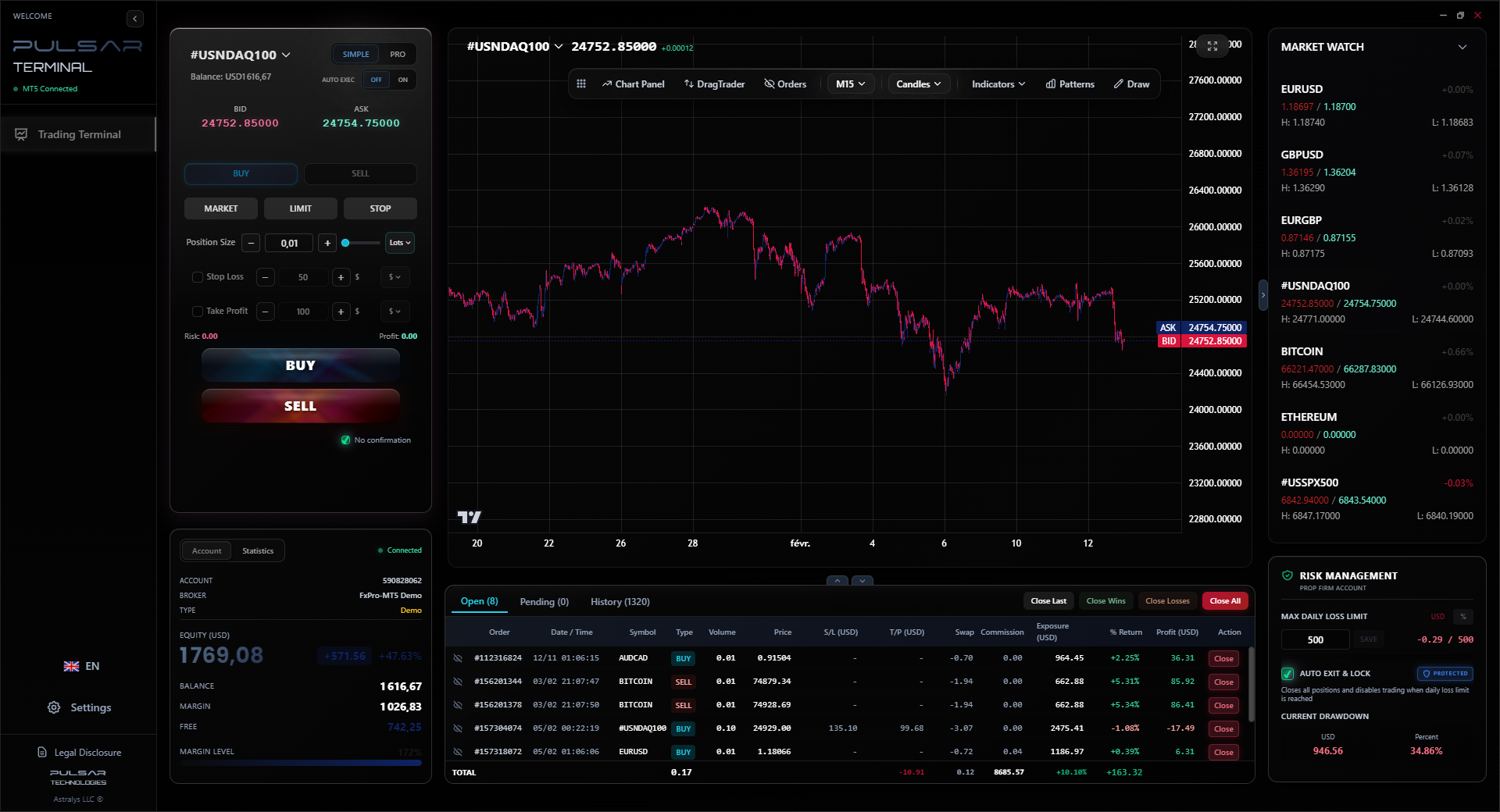
If you insist on following signals, a tool like Pulsar Terminal lets you manually place and manage those copied trades with precise risk controls and automated stop-losses, keeping you in the driver's seat.
Pulsar Terminal
L'outil MT5 tout-en-un : ordres glisser-déposer, multi-TP/SL, trailing stop, grid trading, Volume Profile et protection prop firm. Utilisé quotidiennement par 1 000+ traders.
“You are paying tuition fees, not expecting a return. The moment you start dreaming of passive income, you've already lost.”
Early in my career, I got arrogant. I thought I could pick the winners. I allocated R10,000 to a platform, splitting it between two 'top' traders. One was a gold specialist, the other a forex news scalper. For two months, it was smooth. Up about 8%. Then the US Fed made an unexpected announcement. My news scalper, trying to catch the volatility, placed 5 rapid trades. They all went wrong. His algorithm malfunctioned or just misread the move. Because I had no individual trade risk limits set, my account mirrored every one of those losing trades. I watched in real-time as R3,200 was wiped out in under 90 seconds. The gold trader was also stopped out on the same news. Total loss for the day: R4,100. I learned two brutal lessons: 1) You cannot control an algorithm or a stranger's panic during an event. 2) Correlated risk is a killer - both traders were smashed by the same macro event. I withdrew the remaining R5,900 and never went back. That R4,100 lesson was cheaper than what many of my clients have paid later.
Mirror trading forex is not a way to build wealth. At best, it's a very expensive, moderately educational crutch. The only scenario where I can see a sliver of logic is this: you are a complete beginner with a small amount of risk capital (money you can afford to lose entirely). You use a strictly regulated platform as a paid observation tool. You allocate a tiny amount (say, R2,000) with the sole goal of watching how a professional executes trades - their timing, their patience, their loss management. You are paying tuition fees, not expecting a return. The moment you start dreaming of passive income, you've already lost. The path to real trading success in South Africa or anywhere is through education, self-discipline, and managing your own margin call risks. Anything that promises to bypass that hard work is selling you a bridge. Build your own bridge instead. It's slower, but you'll know exactly what's holding it up.
FAQ
Q1Is mirror trading legal in South Africa?
Yes, it's legal, but the platform and the 'master traders' acting on your behalf must be licensed as Financial Service Providers (FSPs) with the FSCA. Always verify their FSP number on the regulator's website before depositing any money.
Q2What is the minimum deposit for mirror trading in South Africa?
It varies wildly. Some global platforms start as low as $100 (roughly R1,800). Local brokers offering copy trading features might have minimums from R500 to R2,000. Remember, the minimum is often set low to get you in; it doesn't mean it's a sensible amount to risk with this strategy.
Q3Can I make a living from mirror trading forex?
The short, blunt answer is no. The fee structures, strategy decay, and lack of control make consistent, reliable income virtually impossible. It's marketed as passive income, but it's far more likely to be a source of passive losses. Treating it as a full-time income strategy is a fast track to financial stress.
Q4How are taxes handled on mirror trading profits in SA?
SARS sees profits from mirror trading as normal income tax. You are liable for tax on your net profits (gains minus fees and losses). The platform will likely not provide a tax certificate (ITA3), so you must keep careful records of all statements, deposits, withdrawals, and fees. It's a admin headache. Losses can be carried forward to offset future trading profits.
Q5What's the difference between mirror trading and a managed account?
In mirror trading, you retain legal ownership of your account and the platform automatically copies trades. In a managed account, you hand over your login details or give power of attorney to a manager who trades directly in your account. Managed accounts are generally riskier from a security and fraud perspective and are heavily scrutinised by the FSCA.
Q6Can I set my own stop-loss orders in mirror trading?
It depends entirely on the platform. The better ones allow you to set a global stop-loss (e.g., stop copying if my account loses 20%) or a per-trade risk limit. Many basic platforms offer no such controls, meaning you accept the master trader's risk profile completely, which is a major danger.
La leçon du Prof. Winston
Points clés:
- ✓Platforms earn on widened spreads; your costs are hidden.
- ✓Past performance is a marketing tool, not a guarantee.
- ✓You bear 100% of the loss, the 'guru' often shares only the win.
- ✓Without your own risk controls, you are a passenger in a crash.
Cet article vous a-t-il été utile ?
Cliquez sur une étoile
Analyses Trading Hebdo
Analyses et stratégies hebdo gratuites. Pas de spam.
À propos de l'auteur
David van der Merwe
Trader des Marchés Émergents
Trader basé à Johannesbourg avec 11 ans d'expérience sur les devises des marchés émergents. Spécialisé dans les paires ZAR, le trading régulé par la FSCA et l'analyse du marché sud-africain.
Commentaires
Avertissement sur les risques
Le trading d'instruments financiers comporte des risques importants et peut ne pas convenir à tous les investisseurs. Les performances passées ne garantissent pas les résultats futurs. Ce contenu est fourni à titre éducatif uniquement et ne constitue pas un conseil en investissement. Effectuez toujours vos propres recherches avant de trader.
Vous aimerez aussi

Cara Trading Forex Sukses: 7 Prinsip dari Trader Profesional
Cara trading forex sukses dengan 7 prinsip trader pro: manajemen modal, disiplin, journal trading, backtest. Data nyata, bukan janji profit palsu.
Jam Trading Forex Terbaik untuk Trader Indonesia: Panduan Lengkap dengan Tabel Waktu
Panduan jam trading forex untuk trader Indonesia. Tabel 4 sesi dunia, jam emas 20:00-00:00, sesi mana yang harus dihindari. Data akurat + tips dari trader berpengalaman.
Top 5 Sàn Forex Uy Tín Nhất 2026: Review Jujur dari Trader Indonesia
Top 5 sàn forex uy tín 2026 untuk trader Indonesia. Review jujur: spread, deposit, withdraw, dukungan lokal. Exness, XM, IC Markets & lebih.
Obtenir Pulsar Terminal
Tous ces calculateurs sont intégrés dans Pulsar Terminal avec des données en temps réel de votre compte MT5. Dimensionnement de position en un clic, gestion automatique des risques et calculs instantanés.
Obtenir Pulsar Terminal