


Everyone loves a discount, but in the prop firm world, that 50% off coupon might be the most expensive mistake you make.

James Mitchell
Analyste Trading Senior
☕ 9 min de lecture
Ce que vous apprendrez :
Everyone loves a discount, but in the prop firm world, that 50% off coupon might be the most expensive mistake you make. I've seen traders chase promo codes so hard they forget what they're actually buying: a chance, not a guarantee. The US prop trading scene is changing fast, with regulators breathing down necks and firms shutting down. Let's cut through the marketing hype. I'll show you exactly how to use prop firm discount codes smartly, what the real costs are, and why that shiny 90% profit split might be a mirage.
Think of a prop firm discount code like a coupon for a driver's test. You're not buying a license; you're buying the right to take the exam. If you fail, you're out the fee. These codes slash the upfront cost of a firm's evaluation challenge, which is a simulated trading test you must pass to get access to their capital.
They're a marketing tool, pure and simple. Firms use them to attract volume. For you, the trader, it's a way to lower your initial risk. A $200 challenge at 50% off costs you $100. That's real money saved if you're confident in your strategy. But here's the catch: a cheaper entry fee doesn't make the challenge any easier. The profit targets, drawdown limits, and time constraints remain the same. I once used a 30% off code for a $50,000 challenge, saving me $45. I blew the account in three days trying to trade too big, too fast. The discount made me careless. The real cost wasn't the $105 I paid; it was the overconfidence it bred.

Warning: A discount code is not an endorsement of the firm's quality. Some of the shakiest operations run the biggest promotions. Always vet the firm first, then look for a code.
Focusing only on the challenge fee is like buying a car based only on the down payment. The real cost of trading with a prop firm is a multi-layered beast. Let's break it down with real 2025 numbers.
The Upfront Fees
You've got your discounted challenge fee, sure. But what if you fail? Most firms charge a reset fee, typically $60-$80, to try again. Some will even refund your original challenge fee after your first successful payout, which changes the math entirely. Then there's the activation fee. Once you pass, some firms hit you with a one-time fee to activate your live, funded account. I've seen these range from $0 to a jaw-dropping $800. A discount code never applies to these secondary fees.
The Profit Split Illusion
This is where they get you. Everyone brags about their 90% split. But 90% of what? You need to understand the fee structure on the trading itself. If a firm offers "raw spreads" but charges a $7 round-turn commission per lot, that eats directly into your profit before the split is calculated. A firm with a slightly worse spread but no commission might net you more money. I ran the numbers on two similar trades last year:
- Firm A: 90% split, 0.2 pip spread on EUR/USD, $5 commission. Net profit after costs: $85.
- Firm B: 80% split, 0.8 pip spread, no commission. Net profit after costs: $92.
The lower split actually paid more. Use a position size calculator to model this with your typical trade sizes.
The Hidden Cost of Rules
Your strategy might not fit their rulebook. Many US firms are tightening rules around news trading and holding times. If your edge comes from scalping around economic releases, a firm that bans news trading has just made your strategy worthless. That's a massive, hidden cost.

💡 Conseil de Winston
A discount on a bad product is still a bad deal. Vet the prop firm's rules and reputation twice before you even look for a code.
“A cheaper entry fee doesn't make the challenge any easier.”
Good codes are out there, but you need to know where to look. Avoid random Instagram pages selling "lifetime access" codes; that's usually a scam.
- The Firm's Own Website & Newsletter: This is the best source. Check their promotions page or blog. Sign up for their newsletter; they often send exclusive codes to subscribers. For example, in early 2026, DNA Funded offered "PROPFIRMS25" right on their homepage.
- Reputable Affiliate Reviewers: Some trading educators and review sites (like ours) negotiate exclusive codes for their audience. The key is "reputable." If the site does nothing but praise every firm and has a code for all of them, be skeptical. Look for sites that offer balanced critiques.
- YouTube & Podcast Giveaways: Legitimate educators sometimes give away challenge codes during live streams or as contest prizes. The code is free, but you're trading your time and attention for it.
I got my best code ever - 75% off a $100,000 evaluation - from a podcast sponsor spot. I'd been listening to the host for years and trusted his curation. It worked. The code was "PODCAST100K" and saved me $375. I passed that challenge and it funded my first real prop account. The lesson? Build relationships with sources you trust, don't just hunt for random strings of letters.
You can't talk about US prop firms in 2025 without talking about regulators. The free-wheeling days are ending. The CFTC is looking hard at these firms, likely to classify them as Commodity Trading Advisors (CTAs). That means future registration, stricter capital rules, and formal risk disclosures. It's why FTMO, a giant, stopped taking US traders entirely.
A federal judge did push back on some SEC expansion plans in late 2024, giving the industry a brief sigh of relief. But the direction is clear: more oversight. This affects you directly. Firms are reacting by tightening their own rules preemptively. They're banning trading around specific volatile events (think political announcements) and enforcing stricter KYC checks.
What does this mean for discount codes? Firms under regulatory pressure might use aggressive discounts to boost cash flow quickly. Or, they might stop offering them altogether as they shift to a more formal, compliant model. When you use a code now, you're betting on that firm's ability to navigate this regulatory shift. A deep discount from a firm that might not exist in 12 months is no discount at all.

Pro Tip: Before using any code, search "[firm name] + regulatory news" from the last 6 months. If they've just settled a case or suspended US services, steer clear, no matter how good the coupon looks.
💡 Conseil de Winston
Calculate the 'all-in' cost: challenge fee + potential reset fees + activation fee. That's your true risk capital, not just the discounted price.
“The real cost wasn't the $105 I paid; it was the overconfidence the discount bred.”
The code is the last step, not the first. Here’s how to pick the firm, then find a deal.
- Profit Split & Scaling: Don't just look at the starting split. Look at the scaling plan. How do you grow from a $50k to a $200k account? The5ers has a great scaling model. Some firms offer 100% splits after you hit certain milestones. That's a better long-term "discount" than any initial code.
- Trading Rules: Read the rulebook. Can you hold over weekends? What's the maximum daily loss? Is your strategy compatible? A firm with a 5% max daily loss is very different from one with a 3% limit.
- Payout Proof: Can you find verifiable payout proofs from current traders? Look on independent forums, not the firm's testimonial page. Firms like FundedNext guarantee 24-hour payouts, which is a huge plus.
- Platform & Instruments: Do they support your platform (MT5, TradingView, NinjaTrader)? Can you trade the instruments you know? If you're a gold trader, you need a firm that offers XAU/USD with decent conditions.
- Broker Partnership: Who executes the trades? Is it through a reputable broker like the ones we review (IC Markets, Pepperstone)? This affects execution speed and slippage.
Only after a firm passes this checklist should you go hunting for a prop firm discount code to make your entry cheaper.
Let me give you two real examples from my ledger.
Trade 1 (The 'Smart' Discount): I used a 40% off code for a $25,000 challenge with a firm I'd researched. Fee was $150 instead of $250. I traded my normal swing trading strategy, used a tight stop, and passed in 3 weeks. I scaled that account to $100,000 over 8 months. The discount was a nice perk, but the research was what paid off.
Trade 2 (The 'Dumb' Discount): A pop-up offered 60% off a "premium" $100k challenge. I got excited, didn't read the new, hyper-strict rules about holding times. I entered a long EUR/USD position based on my MACD indicator signal. The rule? No positions held during the London-New York overlap. I forgot. The system automatically liquidated my position for a 0.5% loss during overlap, even though it was in profit. I hit a daily loss limit later that day out of frustration. I lost the $240 I 'saved' and another $80 on a reset. Net loss: $320 and my pride.
The lesson wasn't about the code. It was about the rules. The discount blinded me to a rule that completely invalidated my strategy. No amount of saved upfront cost can fix that.
“Your goal isn't to be a professional coupon user. It's to be a professional trader.”
Where is this all going? The industry is consolidating. Weak firms are folding - over 80 closed between 2023-2024. The survivors will be those with strong compliance, clean broker partnerships, and sustainable models.
I think discount codes will become less about huge percentages and more about targeted promotions: "20% off for first-time traders" or "Free reset on your second attempt." The era of the perpetual 50% off coupon is probably ending as costs (compliance, technology, liquidity) rise.
The real value will shift from the sign-up discount to the long-term trader benefits: higher profit splits, faster scaling, better support, and integrated tools. Speaking of tools, managing a prop account requires discipline. Passing a challenge means watching your daily loss limit like a hawk. This is where technology can save you from yourself. Setting automated trailing stops or breakeven orders takes the emotion out of it.
, your goal isn't to be a professional coupon user. It's to be a professional trader. The code is just a tool to reduce your initial trial cost. Your edge, your psychology, and your ability to follow a plan are what get you funded and keep you funded. Don't let the thrill of a deal cloud the real work.
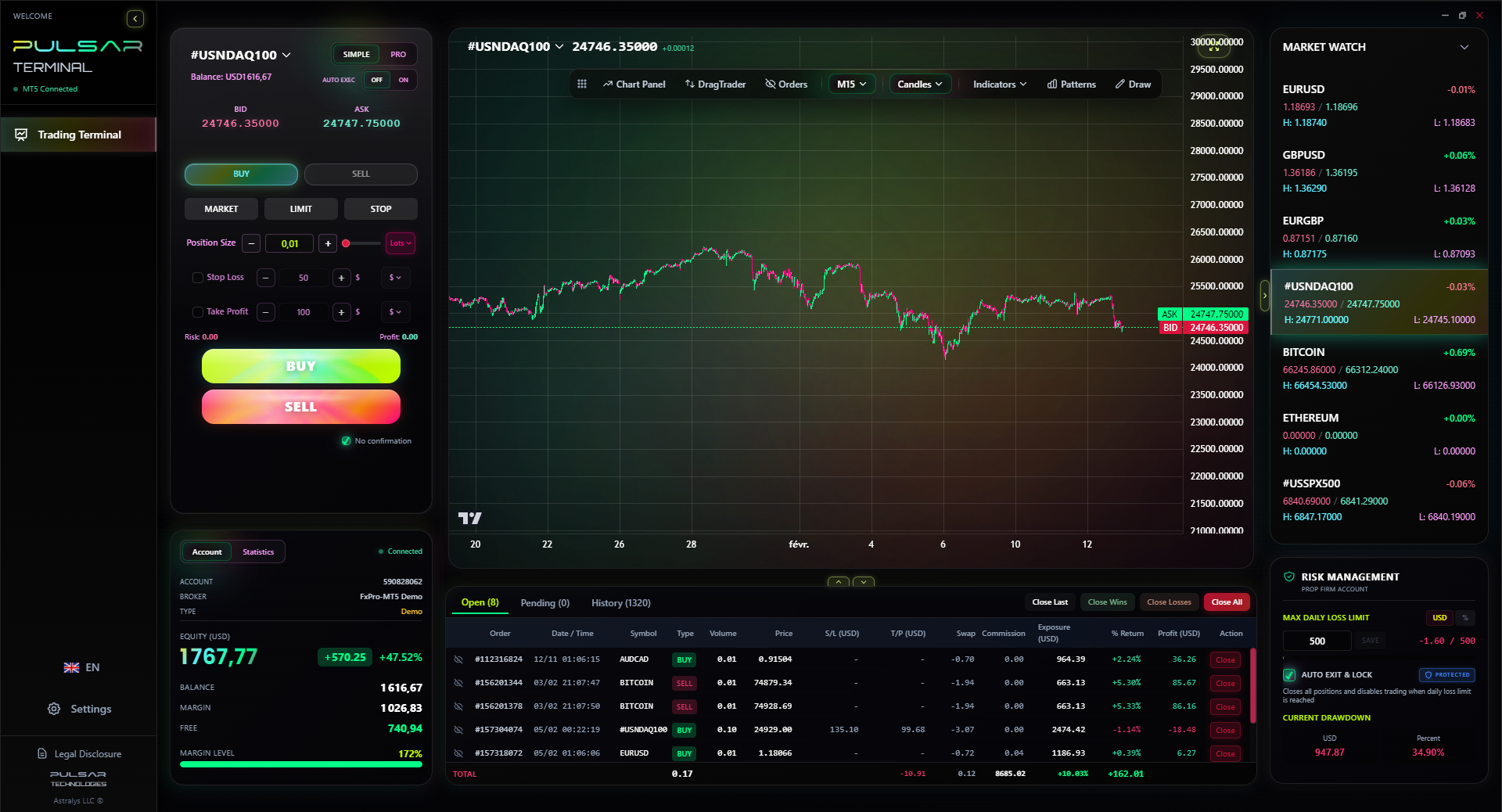
Sticking to prop firm rules like daily loss limits is critical, and Pulsar Terminal can automate those protections directly on your MT5 platform.
Pulsar Terminal
L'outil MT5 tout-en-un : ordres glisser-déposer, multi-TP/SL, trailing stop, grid trading, Volume Profile et protection prop firm. Utilisé quotidiennement par 1 000+ traders.
FAQ
Q1Are prop firm discount codes a scam?
Not inherently. The codes themselves from the firm's official channels are legitimate. The scam risk comes from third parties selling fake or expired codes, or from using a code to join a fundamentally unsound firm. Always apply codes directly on the firm's own website.
Q2What's the best prop firm discount code right now?
There is no single 'best' code. It changes daily and depends on the firm that's right for YOUR strategy. As of early 2026, firms like FXIFY and Goat Funded Trader have run promotions with 15-50% off. The best practice is to decide on a firm first, then search for "[Firm Name] discount code" or check their official social media.
Q3Do discount codes affect my profit split?
Almost never. Your profit split is governed by the firm's scaling plan and your performance. A discount code only reduces the evaluation fee. Once you're funded, you're on the same split schedule as everyone else who passed the same challenge.
Q4Can I use a discount code on a reset fee?
Very rarely. Discount codes are almost exclusively for new evaluation challenges. Reset fees are generally fixed. Some firms might run a special promotion on resets, but it's not common. Read the terms of the code carefully.
Q5Why are there so many prop firms in the US if regulations are tightening?
The industry grew explosively before regulators caught up. Now we're in a correction phase. The tightening regulations are precisely why some firms are closing or leaving the US market. The ones that remain are (theoretically) preparing for a more regulated environment, which could mean more stability for traders in the long run.
Q6Is it better to wait for a discount or just start a challenge?
If you're ready to trade your strategy with discipline today, start today. A few weeks of potential funded profits are worth more than a 20% discount. If you're still practicing or a new challenge fee would stretch your budget, it's smart to wait for a sale. Never rush into a challenge just because a code is expiring.
La leçon du Prof. Winston
Points clés:
- ✓Discount codes are marketing, not a strategy.
- ✓Always read the full rulebook before buying a challenge.
- ✓Calculate trading costs (spread + commission) before profit split.
- ✓Regulatory change is the biggest risk for US prop firms in 2025.
Cet article vous a-t-il été utile ?
Cliquez sur une étoile
Analyses Trading Hebdo
Analyses et stratégies hebdo gratuites. Pas de spam.
À propos de l'auteur
James Mitchell
Analyste Trading Senior
Basé à New York avec plus de 9 ans d'expérience en trading. Spécialisé dans les paires USD majeures, les challenges de prop firms et la réglementation financière américaine.
Commentaires
Avertissement sur les risques
Le trading d'instruments financiers comporte des risques importants et peut ne pas convenir à tous les investisseurs. Les performances passées ne garantissent pas les résultats futurs. Ce contenu est fourni à titre éducatif uniquement et ne constitue pas un conseil en investissement. Effectuez toujours vos propres recherches avant de trader.
Vous aimerez aussi

Cara Trading Forex Sukses: 7 Prinsip dari Trader Profesional
Cara trading forex sukses dengan 7 prinsip trader pro: manajemen modal, disiplin, journal trading, backtest. Data nyata, bukan janji profit palsu.
Jam Trading Forex Terbaik untuk Trader Indonesia: Panduan Lengkap dengan Tabel Waktu
Panduan jam trading forex untuk trader Indonesia. Tabel 4 sesi dunia, jam emas 20:00-00:00, sesi mana yang harus dihindari. Data akurat + tips dari trader berpengalaman.
Top 5 Sàn Forex Uy Tín Nhất 2026: Review Jujur dari Trader Indonesia
Top 5 sàn forex uy tín 2026 untuk trader Indonesia. Review jujur: spread, deposit, withdraw, dukungan lokal. Exness, XM, IC Markets & lebih.
Obtenir Pulsar Terminal
Tous ces calculateurs sont intégrés dans Pulsar Terminal avec des données en temps réel de votre compte MT5. Dimensionnement de position en un clic, gestion automatique des risques et calculs instantanés.
Obtenir Pulsar Terminal