


I remember staring at my screen in late 2023, watching the AUD/USD whip around on some dodgy US CPI data.

Sarah Collins
Stratégiste Trading ·  Australia
☕ 11 min de lecture
Ce que vous apprendrez :
- 1What Exactly is a Prop Firm? (The Aussie Version)
- 2The Top Australian Prop Firms Compared
- 3The Challenge Rules, Explained Without the Jargon
- 4Costs & Realistic Profit Splits: What You Actually Keep
- 5Legal & Tax Implications in Australia
- 6A No-BS Strategy to Pass the Challenge
- 7Common Pitfalls (And How I Fell Into Them)
- 8So, Is a Prop Firm Right for You?

I remember staring at my screen in late 2023, watching the AUD/USD whip around on some dodgy US CPI data. My personal account was getting hammered, but my funded account with a local prop firm? That one was fine. I'd hit my daily loss limit an hour earlier and was forced to sit on my hands. At the time, it was frustrating. Now, I see it saved me from a $2,500 mistake. That's the prop firm game in Australia. It's not about getting rich quick. It's a structured path to trading bigger capital without risking your house. Let's talk about how it really works here, from Sydney to Perth.
Forget the Wall Street movies. In Australia, a proprietary trading firm (prop firm) is a company that gives you access to its capital to trade. You pass their evaluation challenge, they give you a funded account, and you split the profits. They take on the financial risk, you bring the skill. It's become a massive side-door for retail traders who are good but lack the serious bankroll.
Here’s the key difference in our market: regulation. ASIC (the Australian Securities and Investments Commission) watches this space closely. A legit prop firm operating for Aussies isn't just a website offshore. They have specific rules about how they handle client agreements and, crucially, they don't take your money to 'manage' it. You're trading their capital on their terms.

Warning: If a 'prop firm' asks for a large upfront 'management fee' or wants to trade on your behalf, run. That's not a prop firm; that's likely an unlicensed managed investment scheme, and ASIC shuts those down regularly.
The appeal is obvious. Instead of scraping together $50k to maybe make 10% a year ($5k), you could pass a challenge, get a $200k account, and take home a 70-90% split on the profits. The math changes everything. But first, you have to prove you can follow the rules.

💡 Conseil de Winston
In a challenge, your first 10 trades should feel boring. If you're excited, you're probably risking too much.
Not all firms are created equal. Some are global giants with an Aussie presence, others are homegrown. Your choice depends on your style: are you a forex scalper or a stock index swing trader?
Here’s a breakdown of the main players accessible to Australian traders as of 2026. Remember, offerings change, so always check the latest rules.
| Firm Name (Type) | Typical Challenge Cost (AUD) | Key Instruments | Profit Split | What Makes Them Aussie-Friendly |
|---|---|---|---|---|
| FTMO (Global) | ~$500 - $1,000+ | Forex, Indices, Commodities, Crypto | Up to 90% | Offers AUD accounts for funding, local bank transfers. Rules are clear and consistent. |
| The5%ers (Global) | ~$200 - $600 | Mainly Forex | Up to 100% (on higher plans) | Simple scaling plan. Good for traders who want a long-term partnership and less frequent payouts. |
| City Traders Imperium (Global) | ~$300 - $800 | Forex, Indices, Commodities | 80% - 90% | Known for more flexible challenge rules (e.g., no time limit on some challenges). |
| Axiory Select (Global/Broker-Linked) | Varies by challenge | Forex, Metals, Indices | 50% - 80% | Linked to the Axiory broker, which is common among Aussies. Streamlined setup if you're already with them. |
| Globex360 (Homegrown) | ~$400 - $900 | Forex, Indices, Commodities | 80% | Actually headquartered in Australia. Direct local support and understanding of ASIC framework. |
My Experience with Two
I've personally done challenges with FTMO and The5%ers. The FTMO one was brutal for my style at the time. I passed a $100k challenge in 2021, but I almost blew it on the last day trying to hit the profit target. I was up 8% and needed 10%. I took a stupid, oversized trade on the EUR/USD and watched it go 20 pips against me. I closed it for a 2% loss, putting me back to 6%. I was gutted. I learned more about patience in that failure than in any win.
With The5%ers, their model is different. It's slower growth, but the pressure felt lower. I used a basic scalping strategy on the AUD/USD during the Asian session and grinded it out. It worked better for my psychology.

Pro Tip: Your choice of firm should match your trading personality. If you're impatient, a firm with no time limit might save you. If you need structure, a firm with strict daily limits will protect you from yourself.
“The challenge is a test of risk management, not genius.”
This is where most traders fail. They treat the challenge like their normal account. Big mistake. The challenge is a test of risk management, not genius.
You'll face three main rules:
- Profit Target: Usually 8-10% for the evaluation phase. Seems easy, right? It's not the hard part.
- Maximum Daily Loss: Typically 3-5% of your starting equity. This is your circuit breaker. Hit it, and you're done for the day. This stopped my CPI disaster I mentioned earlier. Use a position size calculator religiously.
- Maximum Overall Loss: Usually 8-12%. This is the total drawdown limit for the entire challenge. It's often tracked from your starting balance or your peak equity (this is called 'trailing drawdown' and it's trickier).
Let's get specific. Say you buy a $100k challenge with a 10% profit target, 5% daily loss, and 10% max loss.
- Day 1: You lose $2,000 (2%). You're fine.
- Day 2: You open a trade and it immediately moves against you. Your floating loss hits $5,000. The platform will automatically close your positions. Challenge failed. You broke the 5% daily loss rule.

Example: That $5,000 daily loss limit means your maximum position size, with a 50-pip stop loss, is roughly 10 standard lots on a major forex pair. Size too big, and one bad trade ends it. Most traders fail because they ignore this math.
The secret? Trade smaller than you think you need to. Aim for 0.5-1% risk per trade, not 2-3%. Your goal is to pass, not to impress anyone. This discipline is exactly what the swing trading mindset teaches – patience over excitement.

Let's talk money, because the marketing can be misleading.
Upfront Costs: The challenge fee. This isn't an investment; it's a test fee. For a $100k account, expect to pay $500 - $1,000 AUD. This fee is often refunded when you hit your first profit target on the funded account. Some firms, like The5%ers, even roll your fee into your first payout.
The Profit Split: This is where you need to read the fine print. "Up to 90%" sounds great. But is that 90% of the total profits, or 90% after the firm takes its cut first? Most reputable firms use a simple split: you make $10,000, you keep $9,000 (90%), they keep $1,000.
Other Fees: Watch for:
- Platform Fees: Some firms charge a monthly fee for the trading platform (like MetaTrader). $50-$100 a month.
- Withdrawal Fees: Bank transfer fees, especially for international transfers. Can be $20-$50 per payout.
- Inactivity Fees: If you don't trade for a set period (e.g., 30 days).
Here’s a real payout example from my FTMO account last year:
- Month's Gross Profit: $8,400 AUD
- My Split (90%): $7,560
- Withdrawal Fee: -$35
- Net to My Bank: $7,525
That's real money from a starting challenge fee of $609. But it took three months of consistent, boring trading to get there. The first payout is the hardest; after that, you're playing with their money, which is a huge psychological relief. Just don't get cocky and trigger a margin call on their capital.
💡 Conseil de Winston
Always calculate your maximum position size *before* the market opens. Knowing your hard limit removes emotion in the heat of the moment.
“Trade smaller than you think you need to. Your goal is to pass, not to impress anyone.”
This isn't fun, but it's critical. Ignorance here can cost you more than a failed challenge.
Legal Status: You are not an employee of the prop firm. You're an independent contractor (or in some structures, you're participating in a profit-sharing arrangement). The firm provides the capital and platform; you provide the service (trading). Your challenge fee is generally considered a cost of doing business, not an investment.
Tax Treatment (This is General Advice, See an Accountant!): The ATO views your profit split as personal income. It's not capital gains. You need to declare it as assessable income on your tax return.
- You can likely deduct your challenge fee, platform fees, internet, part of your home office, etc., as business expenses.
- You are responsible for your own GST registration if your turnover exceeds $75,000. Most prop traders won't hit this, but if you're really successful, it's something to plan for.
I made the mistake in my first year of not keeping proper records of my 'business' expenses. I claimed the challenge fee but forgot about the monthly platform costs and charting software subscriptions. My accountant sorted it out, but it was a hassle. Get a spreadsheet going from day one.
The Big Question: Is it Legal? Yes, trading with a legitimate international prop firm is legal for Australians. You are entering a contractual agreement with a company. The key is that the firm is not providing financial product advice to you, nor are you giving them money to manage. You are solely responsible for your trades. Always check that the firm has a clear legal entity and terms of service.

Based on my wins and (many) fails, here's the blueprint.
Phase 1: The Grind (First 50% of Profit Target)
- Instrument: Pick one or two. I used the XAU/USD guide for its clear patterns, but the EUR/USD guide is great for liquidity. Don't jump around.
- Strategy: Use a mechanical system. A simple trend-following strategy with the MACD indicator for direction and the RSI indicator for overbought/oversold levels works. Backtest it.
- Risk: Never, ever risk more than 1% of your account per trade. Use a stop loss on every single trade. No exceptions.
- Goal: Chip away. A 0.5% gain per day is a huge success.
Phase 2: The Hold (Second 50% of Profit Target)
- This is where psychology kills you. You're close. You get greedy or scared.
- Reduce Risk: Cut your position size in half. Seriously. If you were risking 1%, now risk 0.5%. The goal is to finish, not to set records.
- Defend Your Drawdown: If you've hit 8% profit, your max loss is now 10%. You only have a 2% buffer. Trade like it.
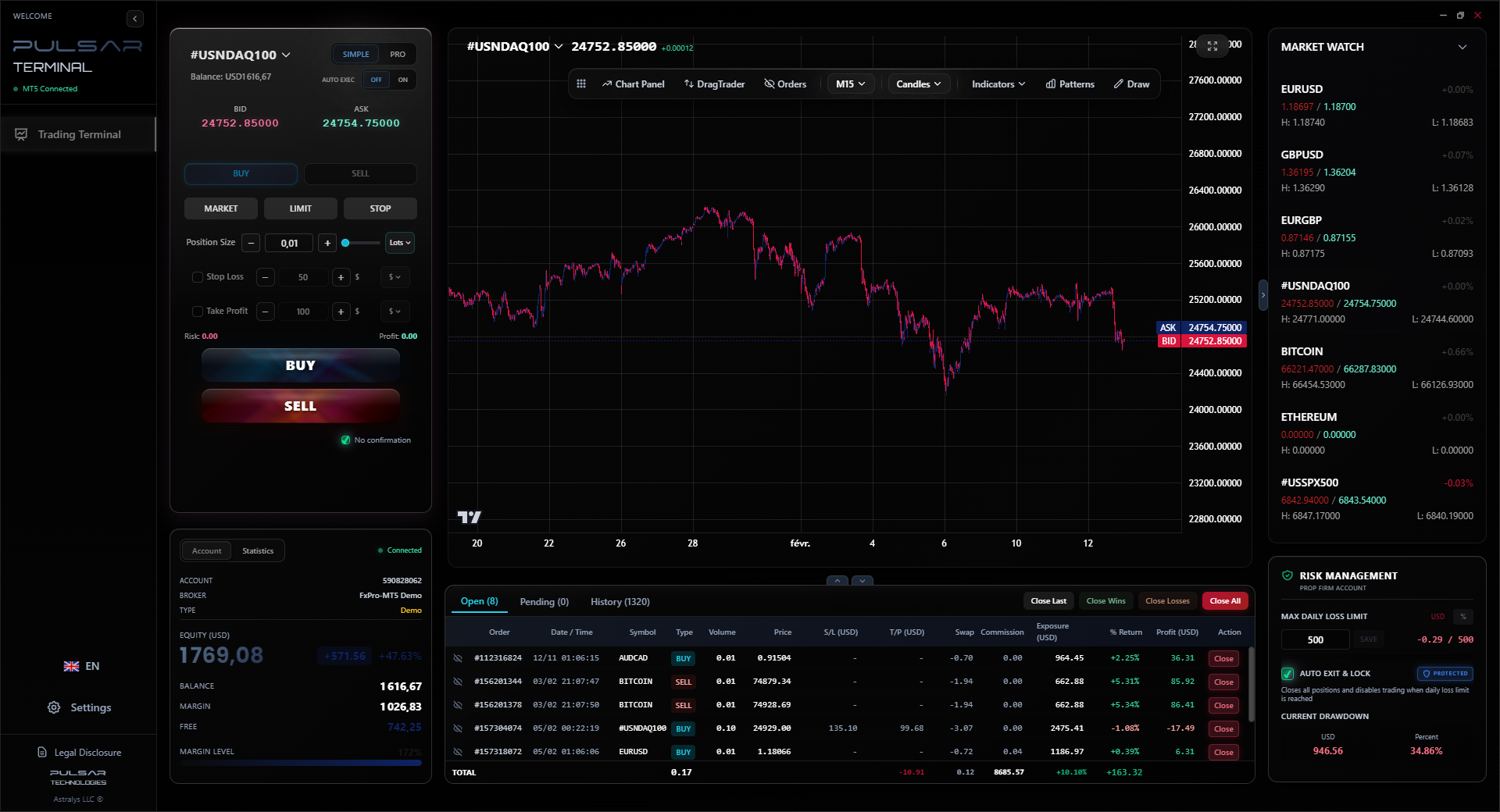
The Tool That Saved Me: Automation. I set hard rules on my platform to auto-close positions if my daily loss hit 4% (leaving a 1% buffer before the firm's 5% limit). Managing this manually while in a trade is stressful. Modern tools can enforce this discipline for you, which is a game-saver when emotions run high.

Manually tracking daily loss limits during a prop challenge is stressful; Pulsar Terminal can automate this and close all trades if your loss threshold is hit, enforcing the rule for you.
Pulsar Terminal
L'outil MT5 tout-en-un : ordres glisser-déposer, multi-TP/SL, trailing stop, grid trading, Volume Profile et protection prop firm. Utilisé quotidiennement par 1 000+ traders.
“Your profit split is personal income to the ATO. Get a spreadsheet going from day one.”
Let me save you some time and money.
Pitfall 1: Overtrading. You hit the profit target too fast and think, "I'm a genius! Let's go for 20%!" The market humbles you quickly. The challenge is a marathon, not a sprint.
Pitfall 2: Ignoring the Spread. Scalping with a 3-pip spread definition on the AUD/JPY? You're fighting an uphill battle. Know the costs of your trades. This is why brokers like IC Markets review or Pepperstone review are popular with prop traders for their raw spreads.
Pitfall 3: Changing Strategy Mid-Challenge. You have three losing trades in a row, so you abandon your plan. This is the #1 reason for failure. Your strategy should account for losing streaks. Stick to the plan.
Pitfall 4: Not Understanding the Drawdown Type. Is it based on starting balance or trailing from peak equity? If it's trailing, once you're up 5%, your loss limit might now be measured from that new high. This catches everyone out. Read. The. Rules.
My most expensive pitfall was with a now-defunct firm. Their 'max loss' rule was so poorly explained in their platform that I triggered it without realizing. I thought I had a 3% buffer, but I actually had 0.5%. $550 challenge fee gone in one trade. It was my fault for not being 100% clear. Now, I make a cheat sheet of the exact rules and tape it to my monitor.
💡 Conseil de Winston
Pick a firm whose rules protect you from yourself. A strict daily loss limit isn't a cage; it's a safety net for your worst trading day.

Prop firms in Australia aren't a magic bullet. They're a tool. Ask yourself these questions:
- Are you consistently profitable in a demo/live account over 6+ months? If not, do not pass Go. You're just donating your challenge fee.
- Can you follow rules robotically? The challenge is about discipline, not flair.
- Do you have the spare capital for the fee? Never use rent money or use yourself to buy a challenge.
- Are you prepared for the tax paperwork?
If you answered yes, then a prop firm could be an incredible accelerator for your trading career. It gives you the capital to make meaningful profits and forces the discipline most of us lack.
Start small. Buy the smallest challenge a reputable firm offers. Treat it as a paid education. If you pass, you've learned a valuable skill and get funded. If you fail, you've (hopefully) learned why, and that lesson is worth the fee. Just make sure you choose a partner with a solid reputation, like those vetted in our Exness review or XM review for broker-linked programs, to ensure you're playing on a fair field.

FAQ
Q1Are prop firms legal in Australia?
Yes, it is legal for Australian residents to trade with international proprietary trading firms. You are entering a contractual profit-sharing agreement. The key is that the firm is not providing financial advice or managing your money. Always ensure the firm is a legitimate business entity with clear terms.
Q2How much does it cost to join a prop firm in Australia?
Challenge fees typically range from $200 to over $1,000 AUD, depending on the account size you're targeting (e.g., $50k, $100k, $200k). This is a one-time evaluation fee, which is often refunded after your first successful profit withdrawal from the funded account.
Q3Which prop firm is best for beginners in Australia?
Beginners should look for firms with clear, simple rules and lower challenge costs. The5%ers' 'Bootcamp' model or FTMO's smallest account challenge are good starting points. Focus on firms that offer the instruments you know best, like major forex pairs, to reduce complexity.
Q4How are profits from prop firms taxed in Australia?
The ATO treats your profit split as personal income, not capital gains. You must declare it in your tax return. You can generally deduct related expenses like challenge fees, platform fees, and home office costs. Consult a tax professional for advice specific to your situation.
Q5Can I use my preferred broker with a prop firm?
Usually, no. Prop firms provide you with a funded account on their chosen trading platform (often a version of MetaTrader 4/5 or their own platform). You must trade through their system so they can monitor your compliance with their risk rules in real-time.
Q6What's the biggest mistake traders make in prop firm challenges?
Oversizing their trades. They risk 3-5% per trade trying to hit the profit target fast, which puts them inches from the daily loss limit. One bad trade then fails the challenge. Successful traders risk 0.5%-1% and understand it's a marathon of consistency.
La leçon du Prof. Winston
Points clés:
- ✓Risk a maximum of 1% per trade during a challenge.
- ✓Choose your firm based on your trading psychology, not just the payout.
- ✓The challenge fee is a cost of education, not an investment.
- ✓Automate your daily loss limit to enforce discipline.
Cet article vous a-t-il été utile ?
Cliquez sur une étoile
Analyses Trading Hebdo
Analyses et stratégies hebdo gratuites. Pas de spam.
À propos de l'auteur
Sarah Collins
Stratégiste Trading
Stratégiste de trading basée à Londres avec 12 ans d'expérience sur les marchés financiers. Ancienne analyste dans un courtier de la City. Couvre les paires GBP, les marchés européens et le trading sous régulation FCA.
Commentaires
Avertissement sur les risques
Le trading d'instruments financiers comporte des risques importants et peut ne pas convenir à tous les investisseurs. Les performances passées ne garantissent pas les résultats futurs. Ce contenu est fourni à titre éducatif uniquement et ne constitue pas un conseil en investissement. Effectuez toujours vos propres recherches avant de trader.
Vous aimerez aussi

Cara Trading Forex Sukses: 7 Prinsip dari Trader Profesional
Cara trading forex sukses dengan 7 prinsip trader pro: manajemen modal, disiplin, journal trading, backtest. Data nyata, bukan janji profit palsu.
Jam Trading Forex Terbaik untuk Trader Indonesia: Panduan Lengkap dengan Tabel Waktu
Panduan jam trading forex untuk trader Indonesia. Tabel 4 sesi dunia, jam emas 20:00-00:00, sesi mana yang harus dihindari. Data akurat + tips dari trader berpengalaman.
Top 5 Sàn Forex Uy Tín Nhất 2026: Review Jujur dari Trader Indonesia
Top 5 sàn forex uy tín 2026 untuk trader Indonesia. Review jujur: spread, deposit, withdraw, dukungan lokal. Exness, XM, IC Markets & lebih.
Obtenir Pulsar Terminal
Tous ces calculateurs sont intégrés dans Pulsar Terminal avec des données en temps réel de votre compte MT5. Dimensionnement de position en un clic, gestion automatique des risques et calculs instantanés.
Obtenir Pulsar Terminal