


Here's a fact that should make you pause: over 90% of retail forex traders lose money.

Olumide Adeyemi
Pionnier du Trading en Afrique de l'Ouest ·  Nigeria
☕ 11 min de lecture
Ce que vous apprendrez :
- 1What is Resistance in Forex? (It's Not a Magic Line)
- 2How to Spot a Real Resistance Level (Beyond the Obvious)
- 3How to Trade Resistance: The Fade and The Break
- 4The Killer: False Breakouts and Stop Hunts
- 5Risk Management When Trading Resistance
- 6Resistance vs. Support: The Dynamic Duo
- 7Common Mistakes Nigerian Traders Make with Resistance
- 8Putting It All Together: Your Resistance Trading Checklist
Here's a fact that should make you pause: over 90% of retail forex traders lose money. In Nigeria, where the hunger for financial escape is real, that number feels personal. A huge chunk of those losses come from one simple misunderstanding - not knowing how to properly read and respect a resistance level in forex. We treat it like a suggestion, not the concrete wall it often is. This guide isn't about fancy theories; it's about learning to see the walls on the chart so you stop running headfirst into them.
Let's cut through the jargon. A resistance level in forex is simply a price zone where selling pressure consistently overwhelms buying pressure, stopping an upward move. Think of it as a ceiling. Price hits it, struggles, and gets pushed back down. It's not a single, perfect line you draw with a ruler. It's more like a price neighborhood where the market has a collective memory of sellers stepping in.
The key word is 'zone.' New traders draw a thin line and panic when price pokes 2 pips above it, calling it a breakout. Veterans see a thicker band, maybe 10-15 pips, where the battle happens. This zone forms because a lot of traders have their sell orders clustered there, or because buyers who got in at lower prices decide to take profit, creating a wave of selling.

Warning: Don't get mystical about it. Resistance isn't a force of nature. It's pure psychology and order flow. It exists because traders believe it exists and act accordingly. When that belief shifts, the resistance breaks.
I learned this the hard way trading GBP/NGN spreads years ago. I'd see a clear high on the chart, draw my line, and short right at it. Sometimes it worked. Other times, price would bleed a few pips above my line, trigger my stop-loss, and then reverse sharply. I was treating the level as an exact price, not a zone of conflict. My risk was too tight for the reality of the market.
Anyone can circle a previous high. The skill is in judging which highs actually matter. Here’s how you separate the significant walls from the minor speed bumps.
Look for Multiple Touches
A single price peak is a clue, not a confirmed level. True resistance shows its strength through repetition. Look for a price zone that has been tested at least two, preferably three or more, times. Each touch that results in a rejection adds to the level's significance. The more times price respects it, the more powerful it becomes in traders' minds.
Check Different Timeframes
A level on the 1-hour chart might be meaningless noise on the daily. For a resistance level to be truly strong, you need to see it holding across multiple timeframes. If the 4-hour chart shows a clear resistance zone, pull up the daily chart. Is it sitting near a major daily or weekly high? That confluence adds massive weight. I use a top-down approach: find the key levels on the daily chart first, then see how price interacts with them on the lower timeframes I trade, like the 4-hour or 1-hour.
Volume is Your Truth-Teller
This is where most free charting platforms fall short. A resistance test on high volume tells a different story than one on low volume. A sharp rejection on surging volume shows strong, committed selling. A slow grind into resistance on low volume might mean it's weak and ready to break. While not always available in forex spot markets directly, volume data from futures contracts (like the 6E for EUR/USD) or using a tool like the Volume Profile in platforms like Pulsar Terminal can give you this critical edge.

Example: You're looking at USD/NGN. Price hits 1600. It's touched that area three times in the past month on the daily chart, each time falling back to 1550. On the 4-hour chart, the last approach saw a long upper wick and a big red candle. That's a high-probability resistance zone, not just a random number.

💡 Conseil de Winston
A resistance level is like a reputation. It's built on past actions. The more times it holds, the stronger the reputation. But like any reputation, it can be broken in a moment if the underlying truth changes.
“A resistance level in forex is a price zone where selling pressure consistently overwhelms buying pressure, not a single, perfect line.”
There are two primary philosophies: fading the move (selling at resistance) or trading the breakout (buying when it breaks). Both can work, but they require completely different mindsets and risk management.
Fading the Resistance (The Conservative Play) This is the classic approach. You assume the resistance will hold and look to sell as price enters the zone. Your profit target is the next level of support below.
- Entry: Don't sell at the exact top. Wait for a confirmation of rejection - a bearish candlestick pattern (like a shooting star or bearish engulfing) within the resistance zone, or a reversal shown by an indicator like the RSI indicator showing divergence.
- Stop-Loss: Place your stop just above the resistance zone, not just above your thin line. Give the market room to wiggle.
- Mindset: You're betting on continuity - that the existing range or downtrend will continue.
Trading the Breakout (The Momentum Play) This is where many Nigerian traders get burned. They see price poke above resistance, FOMO in, and buy the top just before a false breakout reverses.
- Entry: Never buy the first touch above the line. Wait for a 'retest.' Price breaks above, pulls back, and then finds support on what was formerly the resistance level. This old resistance becomes new support. Your buy order goes at this retest.
- Stop-Loss: Place it below the retest level (the new support).
- Mindset: You're betting on change - that a new uptrend is beginning. This strategy is core to swing trading new trends.
I have a scar from 2021 trading XAU/USD (Gold). Price broke above a clear $1830 resistance. I jumped in immediately at $1832, convinced it was moon-time. It spiked to $1835, then collapsed back to $1810 over the next day. I bought the breakout but ignored the need for a retest. I was stopped out for a 1.5% account loss, a completely avoidable mistake.
This is the main reason traders blow up at resistance. A false breakout (or stop hunt) is when price moves convincingly above a resistance level, triggers all the buy stops and breakout orders, and then violently reverses. It's a trap.
The market loves to take out the obvious stops before moving in its intended direction. If everyone sees resistance at 1.1000 on EUR/USD, you can bet there's a pile of buy orders just above it and sell orders just below. Big players can run the price up to 1.1010, collect all those buy orders, and then sell into the strength, driving price back down.
How to Avoid Getting Caught:
- Trade the Close: Don't judge a breakout on a 5-minute candle wick. Wait for the candle (or better yet, the daily candle) to close above the resistance zone. A wick is noise; a close is commitment.
- Demand the Retest: As mentioned, this is your best filter. A true breakout will often come back to kiss the level goodbye. A false breakout won't give you that second chance; it just reverses.
- Watch for Momentum Divergence: If price is making a new high above resistance but your momentum indicator (like the MACD indicator) is making a lower high, that's a huge red flag for a false move.
Using a broker with tight spreads and reliable execution, like IC Markets or Pepperstone, is crucial here. During a false breakout, slippage on a slow broker can turn a small planned loss into a disaster.
💡 Conseil de Winston
The market's favorite party trick is to do exactly what will cause the maximum number of people the maximum amount of pain. If everyone is watching the same resistance level, assume it will be briefly broken before the real move begins.
“The key to surviving false breakouts is to trade the close, not the wick, and to demand a retest.”
Trading at resistance is a high-probability game, but only if you manage it like one. Your position sizing and stop placement are everything.
First, use a position size calculator. Every time. When volatility is high near a key level, your stop might need to be wider. A wider stop means a smaller position size to keep your risk (in Naira or % of account) constant. If you normally risk 0.5% per trade, a 50-pip stop requires a much smaller lot size than a 20-pip stop.
Second, consider partial closures. If you're fading resistance and price moves in your favor, take off part of your position (e.g., 50%) when it reaches the first minor support level. Move your stop-loss on the remainder to breakeven. This way, you lock in some profit and give the rest of the trade room to run risk-free. Managing trades like this is a game-changer, and tools that automate it can remove emotion. For instance, setting a multi-target order where you close half at 1:1 risk-reward and let the rest ride is a professional tactic.

Pro Tip: Your stop-loss is a fee for being wrong. Pay it willingly and quickly. The worst thing you can do at a strong resistance level is to watch your short trade go against you, hit your stop, and then decide 'the level is still holding' and re-enter. That's just doubling down on a losing idea. Take the L, and wait for a clearer signal.
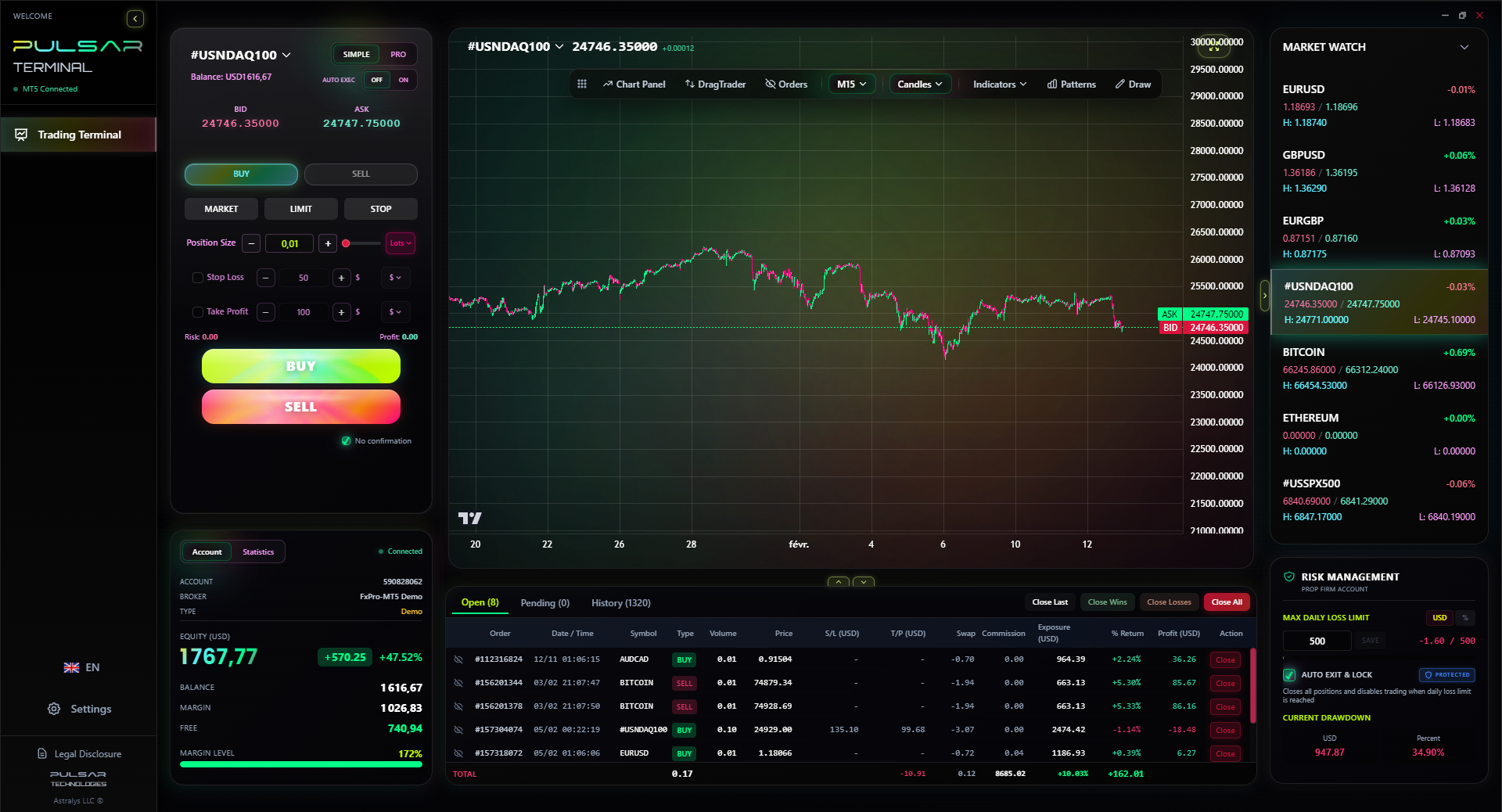
Managing partial closures and moving stops to breakeven at key levels is critical, and Pulsar Terminal automates these advanced order types directly on your MT5 charts.
Pulsar Terminal
L'outil MT5 tout-en-un : ordres glisser-déposer, multi-TP/SL, trailing stop, grid trading, Volume Profile et protection prop firm. Utilisé quotidiennement par 1 000+ traders.
You can't talk about resistance without its counterpart: support. They are two sides of the same coin, and they constantly flip roles.
- Support: A price zone where buying pressure overwhelms selling pressure, stopping a downward move (a floor).
- The Role Reversal: This is a critical concept. When a strong resistance level is decisively broken, it often becomes a new level of support. Conversely, when support breaks, it becomes new resistance. This is the foundation of the 'retest' strategy for breakouts.
Think of the market moving in a range between support and resistance. Your job is to identify these boundaries and trade the bounces until one side finally gives way. A trading range is just a series of support and resistance tests. When you're looking at a chart, you're not just looking for one level; you're mapping out this entire structure of potential floors and ceilings.
| Concept | What It Is | What Happens When It Breaks |
|---|---|---|
| Resistance | Price ceiling / selling zone | Can become new support |
| Support | Price floor / buying zone | Can become new resistance |
Understanding this relationship helps you anticipate where the next battle will be, not just the current one.
💡 Conseil de Winston
Your goal isn't to be right about the market. Your goal is to manage risk so precisely that you can be wrong half the time and still end the month in profit. That starts with how you set stops at levels like resistance.
“If you can't check most of the boxes on your trading checklist, the most professional trade you can make is no trade at all.”
Let's get local and specific. Here's what I see blowing up accounts in Lagos, Abuja, and on WhatsApp trading groups:
- Trading Too Close to the Level: They sell at 1599.99 because resistance is at 1600. The spread itself might be 3 pips. They are in a losing position from the moment they click sell. Always factor in the spread definition and give the level a buffer.
- No Confirmation: They see a wick touch a level on a 15-minute chart and enter a full position. No waiting for a candle close, no looking for bearish patterns. This is gambling, not trading.
- Ignoring Higher Timeframes: They spot a nice resistance on the 30-minute chart and go all in, not realizing they're selling right into a massive support zone on the daily chart. The higher timeframe always wins. Always do your analysis from the top down.
- Revenge Trading After a False Breakout: This is the account killer. They get stopped out on a false breakout, get angry, and immediately reverse their position to chase the new move, often with a larger size. Emotion has taken over, and discipline is gone. This is a direct path to a margin call.
- Using Resistance Alone: No indicator, no volume clue, no price action pattern. Just a line on a chart. Resistance is a context, not a signal. Combine it with other tools for a complete picture.
Before you take any trade based on a resistance level in forex, run through this list. If you can't check most of these boxes, stay out.
- ✅ Multi-Timeframe Confluence: Is the level visible and respected on a higher timeframe (e.g., Daily)?
- ✅ Multiple Touches: Has price tested and rejected this zone at least twice before?
- ✅ Clear Zone, Not a Line: Have I defined a reasonable zone (e.g., 1595-1605), not a single price?
- ✅ Entry Confirmation: Am I waiting for a rejection candle/pattern within the zone before selling, or a confirmed retest after a breakout before buying?
- ✅ Sensible Stop-Loss: Is my stop placed beyond the zone, accounting for spread and normal volatility?
- ✅ Calculated Position Size: Have I used my position size calculator to ensure my risk is exactly 0.5%-1% of my account on this trade?
- ✅ Market Context: Is the overall trend aligning with my trade? (Selling resistance in a downtrend is better than selling it in a strong uptrend).
Stick to this process. It's boring. It means you'll take fewer trades. But the trades you do take will have a real edge. That's how you move from the 90% who lose to the 10% who consistently win. It's not about being a hero on one trade; it's about being a professional over hundreds.
FAQ
Q1What is the best timeframe to draw resistance levels?
Start with the daily chart to find the major, market-moving levels. These are the most significant. Then, zoom into the 4-hour and 1-hour charts to find more precise entry zones within the context of those major levels. Never draw a level on a 5-minute chart and ignore the daily.
Q2How many pips above resistance should I place my stop-loss?
There's no magic number. Place your stop-loss beyond the resistance zone, not the line. If your zone is 1600-1605, your stop for a short trade should be above 1605, with an additional buffer for the spread and a bit of market noise. This could be 10-20 pips above the zone, depending on the pair's volatility.
Q3Can I use indicators to confirm resistance?
Absolutely. Indicators like the RSI indicator showing bearish divergence (price makes a higher high, RSI makes a lower high) at resistance is a powerful confirmation. Moving averages (like the 200-period) can also act as dynamic resistance. Use them to confirm the story price is telling.
Q4Why does resistance become support after a breakout?
It's a psychological shift. Traders who missed the initial breakout often wait for a pullback to buy. Traders who sold at the old resistance and were wrong may now buy back to cover their shorts. This cluster of buy orders at the old price level turns it into a new floor of support.
Q5Is horizontal or diagonal (trendline) resistance more important?
Horizontal resistance from previous price highs/lows is generally stronger and more objective. Diagonal trendline resistance is dynamic and shows the slope of a downtrend. The most powerful setups occur when a diagonal trendline and a horizontal resistance level converge at the same point - this is called confluence and offers a very high-probability trading area.
Q6How do I trade resistance during high-impact news?
Very carefully, or not at all. Technical levels often break easily during major news events (like US NFP or MPC announcements in Nigeria). The order flow is driven by fundamentals, not technicals. It's often better to wait 15-30 minutes after the news release for the initial volatility to settle and see if price respects any key levels in the new environment.
La leçon du Prof. Winston
Points clés:
- ✓Treat resistance as a zone, not a line (10-15 pips wide).
- ✓Always wait for price action confirmation within the zone.
- ✓Place stops beyond the zone, not 1 pip above your line.
- ✓The best breakout entry is often on the retest, not the initial spike.
Cet article vous a-t-il été utile ?
Cliquez sur une étoile
Analyses Trading Hebdo
Analyses et stratégies hebdo gratuites. Pas de spam.
À propos de l'auteur
Olumide Adeyemi
Pionnier du Trading en Afrique de l'Ouest
L'un des formateurs de trading forex les plus actifs au Nigeria. 8 ans d'expérience de trading depuis Lagos. Spécialisé dans les stratégies à petit capital et les challenges de prop firms pour les traders africains.
Commentaires
Avertissement sur les risques
Le trading d'instruments financiers comporte des risques importants et peut ne pas convenir à tous les investisseurs. Les performances passées ne garantissent pas les résultats futurs. Ce contenu est fourni à titre éducatif uniquement et ne constitue pas un conseil en investissement. Effectuez toujours vos propres recherches avant de trader.
Vous aimerez aussi

Cara Trading Forex Sukses: 7 Prinsip dari Trader Profesional
Cara trading forex sukses dengan 7 prinsip trader pro: manajemen modal, disiplin, journal trading, backtest. Data nyata, bukan janji profit palsu.
Jam Trading Forex Terbaik untuk Trader Indonesia: Panduan Lengkap dengan Tabel Waktu
Panduan jam trading forex untuk trader Indonesia. Tabel 4 sesi dunia, jam emas 20:00-00:00, sesi mana yang harus dihindari. Data akurat + tips dari trader berpengalaman.
Top 5 Sàn Forex Uy Tín Nhất 2026: Review Jujur dari Trader Indonesia
Top 5 sàn forex uy tín 2026 untuk trader Indonesia. Review jujur: spread, deposit, withdraw, dukungan lokal. Exness, XM, IC Markets & lebih.
Obtenir Pulsar Terminal
Tous ces calculateurs sont intégrés dans Pulsar Terminal avec des données en temps réel de votre compte MT5. Dimensionnement de position en un clic, gestion automatique des risques et calculs instantanés.
Obtenir Pulsar Terminal