


The screen was a sea of red.

David van der Merwe
Trader des Marchés Émergents ·  South Africa
☕ 10 min de lecture
Ce que vous apprendrez :
- 1What is Retail Forex, Really? (The South African Angle)
- 2The Rules of the Game: FSCA and You
- 3Picking Your Corner: Brokers for South Africans
- 4Trading the USD/ZAR: It's a Beast, Not a Pet
- 5Mistakes I've Made (So You Don't Have To)
- 6Your Trading Toolkit: Beyond the Basic Platform
- 7Putting It All Together: Your SA Trading Plan

The screen was a sea of red. It was March 2020, and the USD/ZAR had just ripped through R18.50. My phone was buzzing with messages from panicked traders who'd been caught on the wrong side of the Rand's collapse. One guy, let's call him Thabo, had just blown R15,000 in an hour because he didn't understand what a margin call was. That moment, watching a currency pair that feels local and familiar go absolutely berserk, perfectly captures the brutal opportunity of retail forex in South Africa. It's not just trading numbers on a screen, it's trading the value of the money in your pocket against the world.
Forget the fancy definitions. In South Africa, retail forex is you, with your laptop and a few thousand Rand, trying to profit from the constant movement of global currencies. The key pair for us is always the USD/ZAR. You're not moving physical money for a holiday, you're speculating on the price. When you hear on the news that the 'Rand is weakening,' in our world, that's the USD/ZAR chart going up. That's your signal, not just a headline.
What makes it uniquely South African? First, the volatility. Our currency is considered an 'emerging market' or 'exotic' pair. It doesn't move in tidy little increments like the EUR/USD. It jumps, it gaps, and it reacts violently to local politics, load-shedding news, and global risk sentiment. Second, the cost. Trading the USD/ZAR usually comes with a much wider spread than the majors. I've seen spreads as tight as 30 pips on a good day with a top-tier broker like IC Markets, and as wide as 80 pips during volatile news. That's your immediate cost just to enter a trade.

Warning: Many 'bucket shops' and unregulated offshore brokers specifically target South Africans with promises of 'zero spread' on USD/ZAR. It's almost always a scam. The real cost is hidden in massive commissions or outright price manipulation. If it sounds too good to be true with the Rand, it is.

💡 Conseil de Winston
The spread on USD/ZAR is your first enemy. If your broker's typical spread is over 60 pips on an ECN account, you're starting every race 60 meters behind. Find a better price.
“Trading the USD/ZAR is a different sport. You can't just copy strategies from YouTube gurus trading the EUR/USD.”
This is the most important section. Get this wrong, and you could lose everything with zero recourse. The Financial Sector Conduct Authority (FSCA) is your watchdog. They took over from the FSB a few years back. A broker offering services to South Africans should be licensed by them. Full stop.
Why Regulation Matters
I learned this the hard way early on. In 2015, I deposited $500 with an unregulated, flashy broker advertising from Cyprus. The platform was slick. I turned that $500 into $2,100 in two weeks of solid scalping. When I tried to withdraw R20,000 (about $1,300 at the time), the excuses started. 'Processing delay.' 'Compliance check.' Then, radio silence. The money was gone. An FSCA license doesn't guarantee perfection, but it gives you a fighting chance. It means the broker must adhere to capital adequacy requirements, keep client funds segregated, and provide a formal complaints process.
The Practical Implications
FSCA regulation affects your daily trading. use is capped. While offshore brokers might offer you 1:1000 (a sure way to blow up), FSCA-regulated entities typically max out at 1:20 for major pairs and even less for minors and exotics. This feels restrictive, but it's saving you from yourself. It forces you to use proper position size. You also get negative balance protection, meaning you can't lose more than you deposited. Check a broker's FSP number on the FSCA website. Don't just trust the logo on their homepage.

“The market doesn't care about your patriotism.”
Your broker is your gateway. The right one doesn't help you win, but the wrong one will definitely help you lose. You need to look at three things: regulation, costs on the USD/ZAR, and deposit/withdrawal methods.
The Regulatory Divide: You have two paths.
- FSCA-Registered International Brokers: These are global giants with a local presence. Think Pepperstone (regulated via their SA entity) or Exness. They offer the FSCA safety net but with access to their global liquidity and tight spreads on majors.
- Global Brokers (Offshore): Brokers like IC Markets or XM are not FSCA-regulated but are top-tier with ASIC or CySEC licenses. Many experienced South Africans use them for better conditions, accepting the (lower) regulatory risk. I've used both types for years.
The Cost Breakdown:
| Broker Type | Typical USD/ZAR Spread (ECN/Raw) | Commission? | Key Consideration |
|---|---|---|---|
| FSCA-Registered | 40-60 pips | Often none, cost in spread | Safety first, higher trading cost on ZAR. |
| Top Offshore (ASIC) | 30-50 pips | ~$3.50 per 100k lot | Lower cost, but no local regulator. |
Getting Your Money In & Out: This is where local knowledge is key. The best brokers for South Africans offer Instant EFT via providers like Ozow or PayFast. It should be free and instant. International bank transfers can take days and get eaten by fees. I once lost R400 on a R10,000 deposit just from bank charges before I switched to Instant EFT.
“The market doesn't care about your patriotism.”
Trading the Rand is a different sport. You can't just copy strategies from YouTube gurus trading the EUR/USD. Here’s what works (and what gets you slaughtered).
What Moves the Rand?
Political announcements (SONA, budget speech), SARB interest rate decisions, commodity prices (platinum, gold), and plain old global risk-on/risk-off sentiment. When the world gets scared, money flees emerging markets like South Africa. The USD/ZAR spikes. I made one of my best trades shorting the USD/ZAR (betting on Rand strength) at R19.35 in April 2020 after the SARB intervened. I used a simple RSI indicator showing extreme overbought conditions on the weekly chart. Took profit in chunks at R18.80, R18.40, and finally at R17.90. That was a swing trading home run.
A Strategy That Actually Works
Forget fancy systems. Price action and liquidity are king. The USD/ZAR respects key psychological levels like R18.00, R18.50, R19.00. It also tends to have a strong daily trend once it gets going. My bread and butter is waiting for a clear break of a consolidation zone on the 4-hour chart, then entering on the retest. I'll use the MACD indicator on the 1-hour to confirm momentum. But here's the critical part: your stop-loss must be huge. A 50-pip stop on the USD/ZAR is a joke. It will get taken out by noise. I rarely use a stop under 150 pips, which means my position size has to be tiny. That's the real secret: surviving the volatility long enough to catch the big move.

Pro Tip: Trade the USD/ZAR during London and New York overlap (3pm - 5pm SAST). That's when liquidity is deepest and spreads are tightest. Avoid trading around major SA political announcements unless you're already positioned - the spreads widen to insane levels and slippage can be catastrophic.
💡 Conseil de Winston
Your trading plan is worthless if it's not written down. The moment of panic is not the time to debate your rules. Write them, print them, stick them next to your screen.
“A 50-pip stop on the USD/ZAR is a joke. It will get taken out by noise.”
Let's get vulnerable. I've lost money in almost every stupid way possible. Here’s the hall of shame.
Overtrading the ZAR: Because it's 'our' currency, you feel like you understand it. You watch the news and get a gut feeling. This is a trap. In 2018, I was convinced a positive political development would strengthen the Rand. I went long ZAR against USD and JPY simultaneously without a stop, 'knowing' I was right. A surprise credit rating downgrade hit overnight. I woke up to a margin call and a loss of R8,000. The market doesn't care about your patriotism.
Ignoring the Swap (Overnight Financing): Trading the USD/ZAR with a long-term swing trading horizon? Check the swap rate. If you're long USD/ZAR (betting the Rand weakens), you typically earn a small daily credit. If you're short USD/ZAR, you pay. Over weeks, this can add up to a significant cost or a nice little bonus. I once held a short USD/ZAR position for 45 days and paid more in swap fees than I made on the small price move. Use your broker's swap calculator before entering.
Chasing 'Prop Firm' Dreams with the Wrong Tools: Passing a prop firm challenge requires iron-clad discipline on daily loss limits. Manually tracking this while in a volatile USD/ZAR trade is a nightmare. I failed two challenges before I got smart about tools. This is where automation saves your sanity.

Example: Let's say a prop firm has a 5% daily loss limit on a $100,000 challenge account. That's $5,000. If you're in a USD/ZAR trade that moves 200 pips against you with a 2-lot position (where 1 pip = $10 on a standard lot), that's a $4,000 move. You're suddenly on the razor's edge. Manual tracking under that pressure leads to mistakes.
“A 50-pip stop on the USD/ZAR is a joke. It will get taken out by noise.”
MetaTrader 4 or 5 is the standard, but it's just the engine. You need the right instruments in the cockpit.
A Reliable Economic Calendar: You need one that highlights South African events with high impact. Don't just look for USD events. Know when the SARB announcement, CPI data, and budget speech are scheduled. Mark them in red.
A Proper Position Size Calculator: This is non-negotiable. With the USD/ZAR's volatility, you must know exactly how much you're risking per trade. I risk a maximum of 1% of my account on any single USD/ZAR trade. For a R20,000 account, that's R200. If my stop-loss is 200 pips away, my position size calculator tells me I can only trade a mini lot (0.1 standard lots). Doing this math in your head during a fast market is how you blow up.
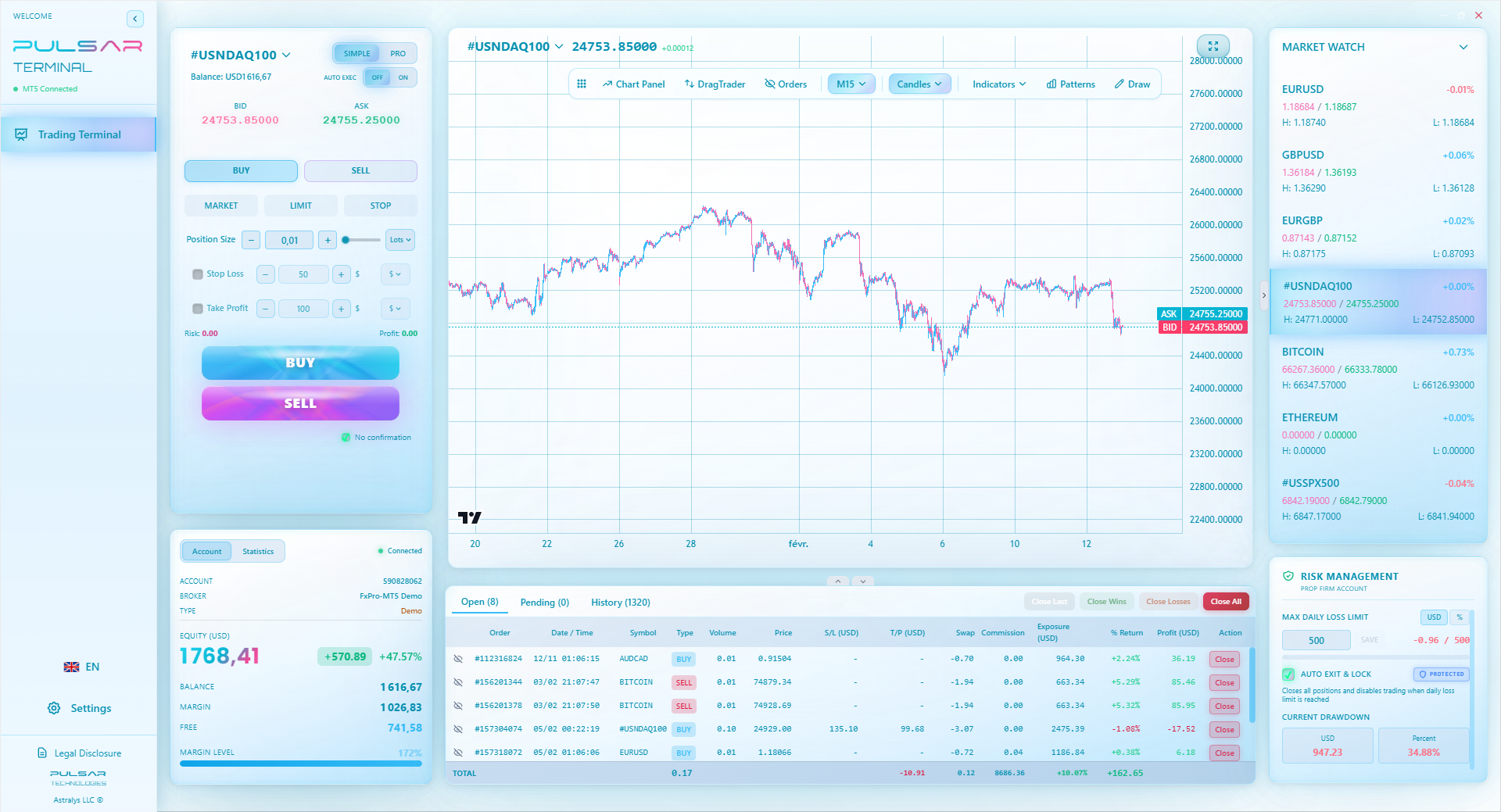
Advanced Charting and Order Management: MT5 is powerful but clunky for complex order management. Setting multiple take-profit levels, moving stops to breakeven, or running a trailing stop on a fast-moving Rand trade requires quick, precise clicks. When you're in three trades and the market is moving, fumbling with the platform is a luxury you don't have. This is where a dedicated terminal that sits on top of MT5 becomes a force multiplier.
Managing complex orders and strict prop firm rules on a volatile pair like USD/ZAR is where a tool like Pulsar Terminal, which automates trailing stops, breakeven moves, and daily loss limits directly on your MT5, becomes indispensable.
Pulsar Terminal
L'outil MT5 tout-en-un : ordres glisser-déposer, multi-TP/SL, trailing stop, grid trading, Volume Profile et protection prop firm. Utilisé quotidiennement par 1 000+ traders.
“The biggest edge you have is discipline. The USD/ZAR will test it every single day.”
A plan isn't a vague intention to 'make money.' It's a specific, written set of rules. Here's a skeleton you can adapt.
- Market Condition: I will only trade the USD/ZAR when the average true range (ATR) on the 4-hour chart is above 150 pips, indicating sufficient volatility for my strategy.
- Entry Signal: I will enter on a confirmed break and close above/below a 4-hour consolidation range, with a supporting momentum reading from the 1-hour MACD.
- Risk Management: I will never risk more than 1.5% of my account on any single trade. I will use a position size calculator for every entry. My stop-loss will be placed at least 1.5x the ATR beyond the consolidation range.
- Trade Management: I will use a 2:1 risk-to-reward ratio as a minimum. I will take 50% of my position off at the first profit target and move my stop-loss to breakeven on the remainder.
- Weekly Review: Every Sunday, I will review all trades, screenshot my charts, and note what I did right or wrong. No review, no trading the next week.
The biggest edge you have is discipline. The USD/ZAR will test it every single day. Having a plan you can refer to when the screen is flashing red is what separates the survivors from the statistics.
💡 Conseil de Winston
Never, ever add to a losing USD/ZAR position. Averaging down on the Rand is like trying to catch a falling knife while blindfolded. It's not a strategy, it's a suicide pact.
FAQ
Q1Is forex trading legal in South Africa?
Yes, absolutely. It is legal to trade forex through brokers that are appropriately licensed. The key is to ensure your broker is regulated by the Financial Sector Conduct Authority (FSCA) or another reputable international regulator like ASIC. Trading with unregulated entities is where you run into legal and financial risk.
Q2What is the minimum amount needed to start trading forex in South Africa?
You can technically start with as little as R500 or R1000 with some brokers offering micro accounts. But realistically, to trade the USD/ZAR with sensible risk management (like using a 150-pip stop), you need enough capital so that a 1% risk is a meaningful amount. I'd say a minimum of R10,000 is a more practical starting point to avoid being wiped out by a single bout of volatility.
Q3Which is better for South Africans, MT4 or MT5?
For forex, MT4 is still perfectly fine and more widely supported. However, MT5 is the more modern platform, handles hedging better, and has more built-in indicators and timeframes. Most serious brokers now offer MT5. If you're just starting, MT4 is simpler. If you plan to trade other instruments like indices or stocks later, go with MT5 from the beginning.
Q4How are my forex profits taxed in South Africa?
SARS views profits from speculative forex trading as income, not capital gains. This means they are added to your other income and taxed at your marginal income tax rate. It's crucial to keep detailed records of all your trades, deposits, and withdrawals. Speak to a tax consultant who understands trading - it's a complex area.
Q5Can I trade forex with a South African bank?
Some major banks offer forex trading platforms, but they are generally not recommended for active retail traders. Their spreads are typically much wider than dedicated forex brokers, their platforms are less advanced, and they often don't offer use or short-selling in the same way. You'll pay a premium for the perceived safety of the bank brand.
Q6What's the biggest mistake new South African forex traders make?
Two things, tied for first: using excessive use because an offshore broker offers it, and treating the USD/ZAR like any other pair. They use 50-pip stops, get stopped out repeatedly by normal volatility, and then double their lot size to 'make it back,' which is a direct path to a margin call. Respect the Rand's volatility and use appropriate risk sizing.
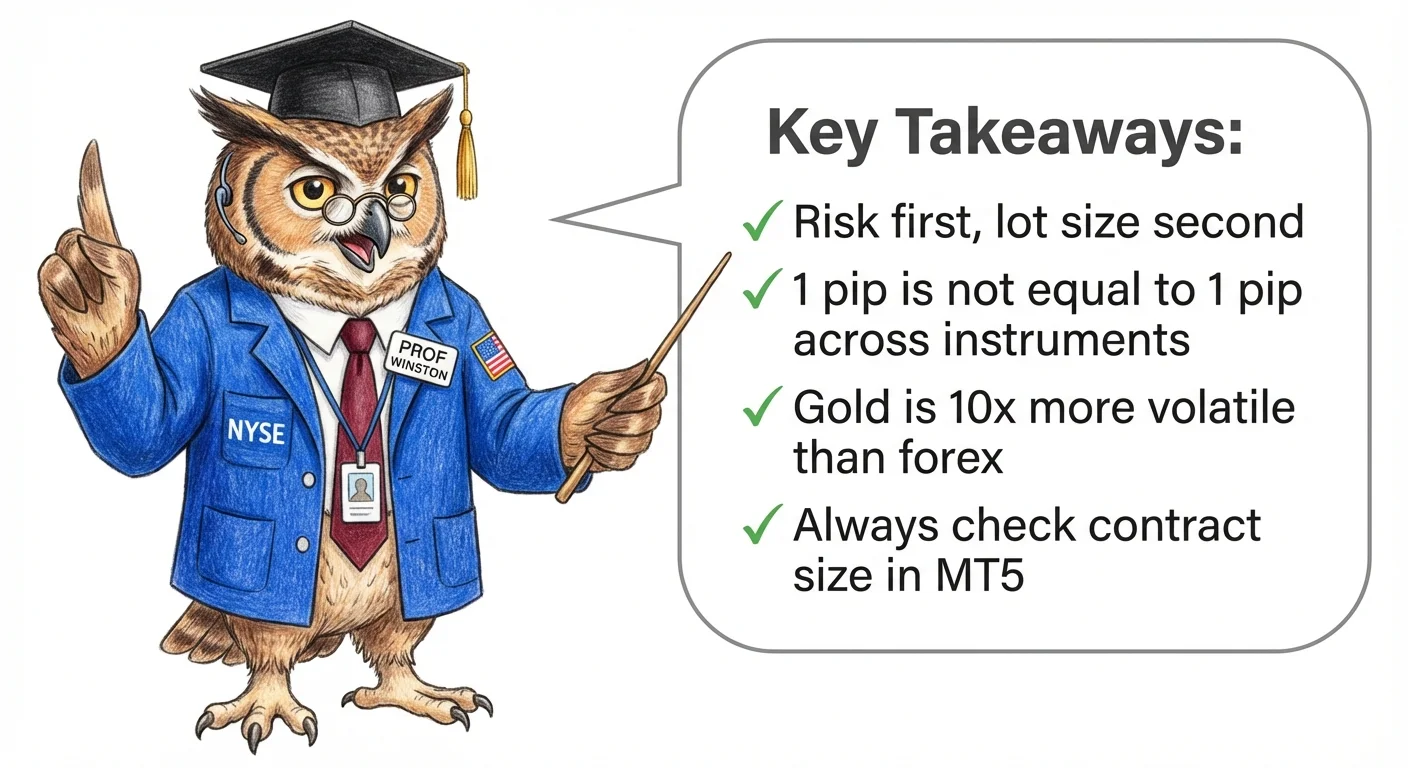
La leçon du Prof. Winston
Points clés:
- ✓Trade USD/ZAR with stops under 150 pips at your peril.
- ✓FSCA regulation is your safety net, not a hindrance.
- ✓Instant EFT deposits save you hundreds in bank fees.
- ✓Risk a maximum of 1.5% per trade on volatile ZAR pairs.
- ✓Swap fees can turn a winning swing trade into a loser.
Cet article vous a-t-il été utile ?
Cliquez sur une étoile
Analyses Trading Hebdo
Analyses et stratégies hebdo gratuites. Pas de spam.
À propos de l'auteur
David van der Merwe
Trader des Marchés Émergents
Trader basé à Johannesbourg avec 11 ans d'expérience sur les devises des marchés émergents. Spécialisé dans les paires ZAR, le trading régulé par la FSCA et l'analyse du marché sud-africain.
Commentaires
Avertissement sur les risques
Le trading d'instruments financiers comporte des risques importants et peut ne pas convenir à tous les investisseurs. Les performances passées ne garantissent pas les résultats futurs. Ce contenu est fourni à titre éducatif uniquement et ne constitue pas un conseil en investissement. Effectuez toujours vos propres recherches avant de trader.
Vous aimerez aussi

Cara Trading Forex Sukses: 7 Prinsip dari Trader Profesional
Cara trading forex sukses dengan 7 prinsip trader pro: manajemen modal, disiplin, journal trading, backtest. Data nyata, bukan janji profit palsu.
Jam Trading Forex Terbaik untuk Trader Indonesia: Panduan Lengkap dengan Tabel Waktu
Panduan jam trading forex untuk trader Indonesia. Tabel 4 sesi dunia, jam emas 20:00-00:00, sesi mana yang harus dihindari. Data akurat + tips dari trader berpengalaman.
Top 5 Sàn Forex Uy Tín Nhất 2026: Review Jujur dari Trader Indonesia
Top 5 sàn forex uy tín 2026 untuk trader Indonesia. Review jujur: spread, deposit, withdraw, dukungan lokal. Exness, XM, IC Markets & lebih.
Obtenir Pulsar Terminal
Tous ces calculateurs sont intégrés dans Pulsar Terminal avec des données en temps réel de votre compte MT5. Dimensionnement de position en un clic, gestion automatique des risques et calculs instantanés.
Obtenir Pulsar Terminal