


I was staring at my screen in late 2022, watching a trade go sideways.

James Mitchell
Analyste Trading Senior ·  Canada
☕ 9 min de lecture
Ce que vous apprendrez :
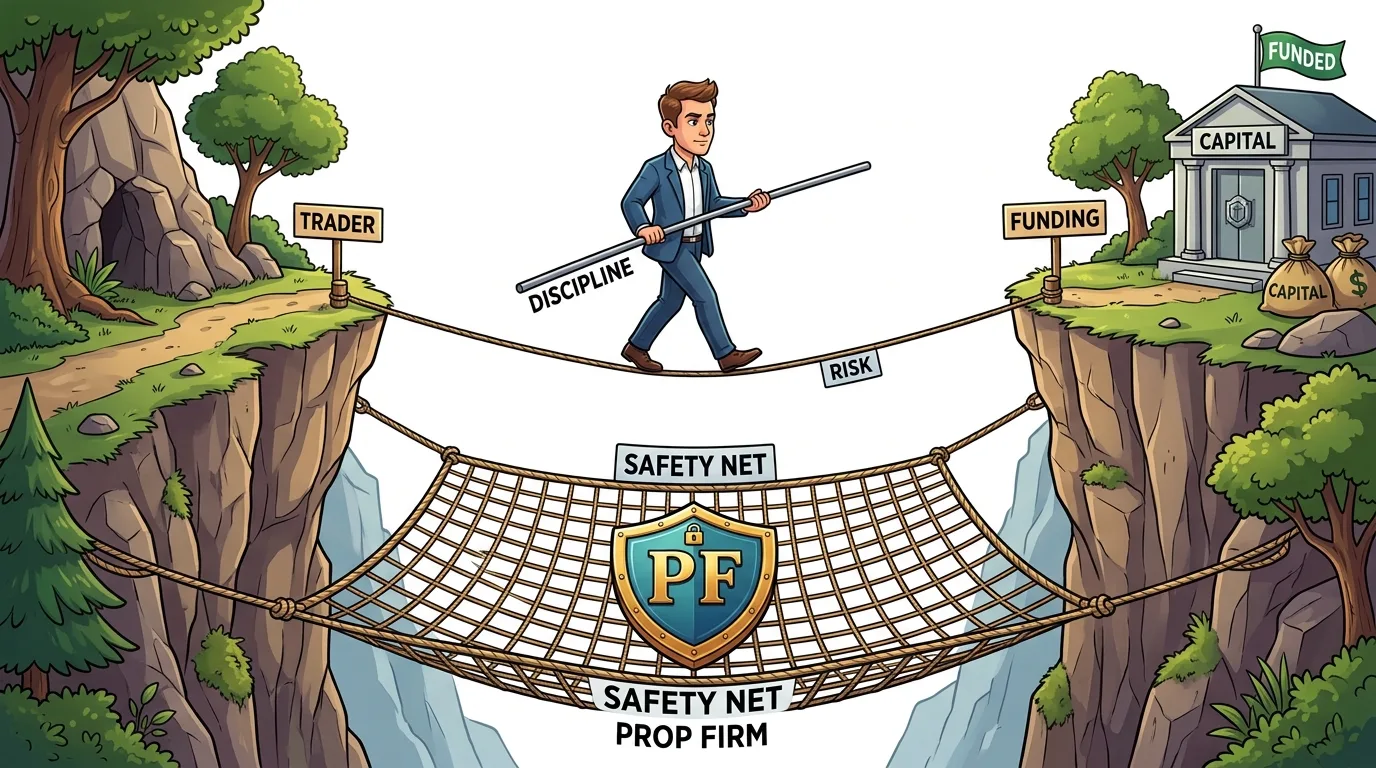
I was staring at my screen in late 2022, watching a trade go sideways. Out of frustration, I posted a quick chart snapshot on Twitter with a one-line comment: 'EUR/USD acting like it's allergic to 1.0600. Sitting this one out.' I didn't think much of it. The next morning, I had three DMs from prop firm scouts asking about my approach. That was the moment I realized social media isn't just for gurus selling courses; it's a direct line to the people who cut the checks. But most traders are doing it completely wrong.
Let's get this straight: you're not trying to become an influencer. The goal of a social media strategy for prop firms is credibility, not celebrity. Prop firms and their scouts are constantly hunting for consistent, disciplined traders who won't blow up an account. They use social media as a filtering tool. Your feed is your public trading journal. It shows your process, your psychology, and whether you're full of hot air. I've had two funded offers come directly from scouts who watched my Twitter feed for a month before reaching out. They told me they liked that I posted my losers with analysis, not just the winners. That transparency was the key.

Warning: If your strategy is to post only your 10:1 risk-reward wins, you'll attract only gullible followers, not serious firms. They've seen that act before.
Think of it as a long-term audition. Every chart you share, every market thought you articulate, is a data point for someone evaluating you. It's about demonstrating a professional edge over time. This is especially critical if you're using a scalping strategy or other short-term methods that can look like gambling without proper context.
“Your social media feed is your public trading journal. It shows your process, your psychology, and whether you're full of hot air.”
You can dabble elsewhere, but for a social media strategy for prop firms, X (formerly Twitter) is the main arena. It's where the trading community, prop firm owners, and scouts are most active. LinkedIn is for after you're funded and want to network with other professionals. Instagram and TikTok are for entertainment and broad reach, not for serious professional evaluation.
How to Use X Effectively
Forget follower count. Focus on engagement with the right people. Follow prop firms you're interested in, their lead traders, and known scouts. Engage thoughtfully on their content. Don't just say 'great chart!' Ask a smart question about their risk management or how they handled a specific volatile session.
I made the mistake early on of trying to be everywhere. I wasted hours making fancy chart videos for Instagram. The result? A few hundred likes and zero professional leads. When I shifted 80% of my effort to X, simply posting clear charts with my RSI indicator and MACD readings and a few sentences of rationale, the quality of my interactions skyrocketed. A scout from a firm I respected finally replied to one of my threads, and that started a real conversation.
Your bio is crucial. Mine used to say 'Passionate Forex trader | Seeking funding.' It was generic and desperate. I changed it to 'Disciplined EUR/USD & XAU/USD specialist | Risk-first approach | Tracking performance publicly.' The second one positions you as a specialist, not a gambler.

💡 Conseil de Winston
Your first 100 followers don't matter. Your first meaningful conversation with a professional does. Focus on depth, not breadth.

“A single reply from a prop firm scout is worth more than a hundred 'likes' from random accounts.”
Here’s what you should be posting, in order of importance:
-
Post-Trade Analysis (Wins AND Losses): This is the gold. Take a screenshot of your closed trade. Annotate it. Why did you enter? Where was your stop? Why did you take profit or get stopped out? What did you learn? This shows a reviewable process. I once posted a loss on XAU/USD where I misread a key support level. I wrote, 'Stopped out for -0.8%. Misplaced my support by $5. Lesson: wait for the hourly close confirmation next time.' A scout later told me that post was more impressive than any win I'd shared.
-
Market Observations, Not Predictions: Don't say 'GBP/USD going to 1.30 tomorrow!' Say, 'GBP/USD is testing this multi-week trendline. Volume is declining, suggesting a potential break. I'm watching for a close below 1.2500 for a short bias.' One shows gambling, the other shows analysis.
-
Educational Snippets on Your Process: Explain how you use your position size calculator, or how you determine a daily loss limit. This demonstrates professional habits.

Pro Tip: Use the same color scheme and annotation style on all your charts. It creates a recognizable, professional brand. Green for entries, red for stops, blue for targets. Keep it simple.
What not to post: screenshots of your profit/loss statement with a huge number. It's tacky and screams 'one-hit wonder.' Avoid vague motivational quotes. Nobody funds a quote.

“A single reply from a prop firm scout is worth more than a hundred 'likes' from random accounts.”
How much do you share? This is the hardest part. You need to be transparent enough to build trust, but not so detailed that you give away your actual edge or look like you're breaking prop firm rules.
Do Share:
- General strategy type (e.g., 'price action swing trading on H4')
- Your core risk management principles (e.g., 'I never risk more than 1% per trade')
- General market rationale
- Lessons from losses
Do NOT Share:
- The exact entry/exit logic of your proprietary system
- The specific name of the prop firm challenge you're in (if active)
- Your actual account balance or specific profit targets
- Anything that could be construed as financial advice
I learned this the hard way. Early on, I posted a very detailed breakdown of my mean reversion setup on EUR/USD. A week later, I saw the exact setup, with my exact annotations, being sold as a 'secret strategy' by some guru. Now, I show the what (the chart, the level) and the why (the macro reason), but I'm vague on the precise how (the exact trigger). It protects your edge while still showing you have one.
💡 Conseil de Winston
Treat every public post as part of a permanent job interview. You cannot unsay it. A moment of frustration can cost you a future opportunity.

“Transparency about a loss is often more impressive to a scout than boasting about a win.”
The goal is to get on their radar, not to ask for a job in the first message.
The Wrong Way: 'Hi, I'm a great trader, please fund me. Here's my MyFxBook.' (This gets ignored 100% of the time).
The Right Way: Engage with their content for a few weeks. Then, when you have a genuine question or insight related to something they posted, send a DM. For example: 'Hey, saw your thread on managing margin call pressure during high volatility. Really resonated. I use a similar method of scaling down position size by 50% when VIX spikes above 25. Do you find that impacts your opportunity capture significantly?'
This starts a conversation about methodology, not a transaction. The topic of funding will come up naturally if they're interested. I connected with a scout from a firm I liked by commenting on his analysis of a Bank of Canada announcement. We debated the CAD impact for a bit over DMs. A month later, he asked if I was currently in any evaluation. That's how it's done.

Example: Track your social interactions like trades. I keep a simple spreadsheet: Date, Person/Prop Firm Engaged, Topic, Outcome. It helps you remember conversations and follow up intelligently.

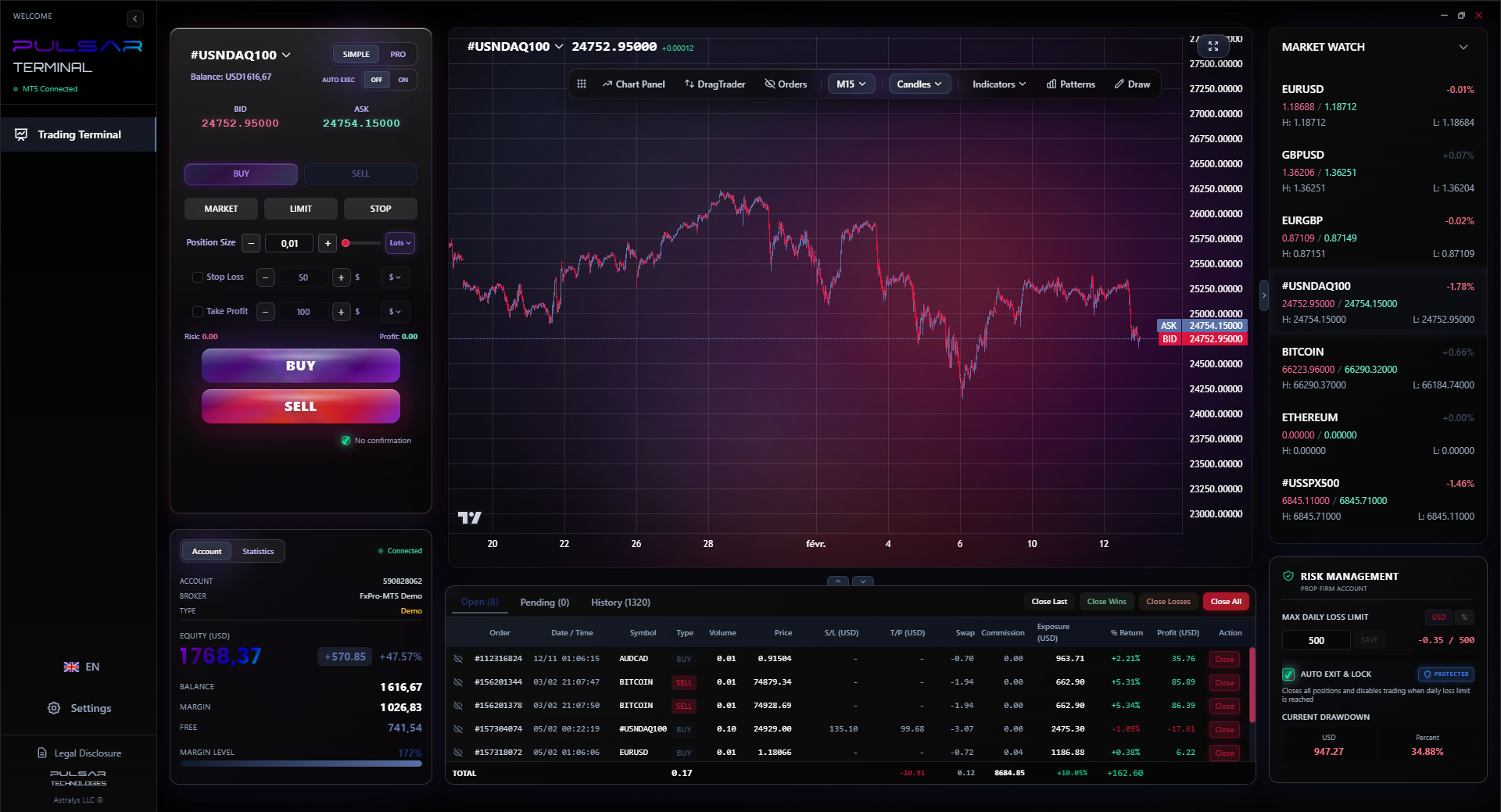
When showcasing your trade management, tools like Pulsar Terminal that allow for clean, precise annotation of entries, stops, and targets help you create professional, scout-ready chart graphics directly from your MT5 platform.
Pulsar Terminal
L'outil MT5 tout-en-un : ordres glisser-déposer, multi-TP/SL, trailing stop, grid trading, Volume Profile et protection prop firm. Utilisé quotidiennement par 1 000+ traders.
“Transparency about a loss is often more impressive to a scout than boasting about a win.”
Throw vanity metrics out the window. Your key performance indicators (KPIs) for a prop-focused social media strategy are completely different.
| What to Measure | Why It Matters |
|---|---|
| Quality of Engagement | Are prop firm reps, scouts, or serious traders replying to you? A single reply from a scout is worth more than 100 'likes' from random accounts. |
| Profile Visits | Are people clicking to see who you are after reading your take? This indicates interest in you, not just your chart. |
| Direct Messages Initiated | Are professionals reaching out to you first? This is a leading indicator of success. |
| Consistency of Posting | This is a discipline metric for yourself. Can you maintain a professional presence for 3, 6, 12 months? |
My first real success metric was when a principal from a mid-sized prop firm quoted one of my tweets in his own thread. That single event led to more quality followers than any 'viral' chart post I'd ever made. It signaled endorsement within the community. Remember, this is a marathon. It took me about 5 months of consistent, quality posting before I got my first serious DM from a firm. If you're looking for a quick fix, you're in the wrong business. Building a reputation for swing trading discipline or any other method takes visible, sustained proof.
💡 Conseil de Winston
The most valuable thing you can post is a detailed autopsy of a loss. It demonstrates intellectual honesty, which is rarer than profitability.
“You're not trying to become an influencer. The goal is credibility, not celebrity.”
I've seen talented traders torch their reputations in weeks. Don't be this person.
- Complaining About Prop Firm Rules: Publicly moaning about drawdown limits, profit targets, or 'unfair' stop-outs makes you look amateurish and difficult. Firms see that and think, 'This one will be a headache.'
- Posting During Live Trades: This is the biggest red flag. It shows you're distracted and emotionally attached to the outcome. Post after the trade is closed and you've had time to analyze.
- Getting Into Public Arguments: Debating analysis is fine. Personal attacks or heated arguments over spread definition semantics make you look unstable.
- Using Someone Else's Content Without Credit: Sharing a great chart from another trader is fine, but tag them! The trading community is small, and plagiarism is remembered.
- The 'Humble Brag': 'Ugh, only a 3% gain today, really struggling.' Everyone sees through it. It's transparently fake.
I fell into the complaining trap once. A platform glitch caused a slippage that hit my stop. I tweeted angrily about the broker (not Exness or IC Markets, but another one). While I had a legitimate gripe, the public venting made me look like I couldn't handle adversity. A trader I respected DMed me and said, 'We all get slippage. How you handle it publicly matters more.' He was right. I deleted the tweet and later posted a calm analysis of how I now build in a small buffer for volatile news events. That was the better lesson.
FAQ
Q1How often should I post for an effective social media strategy for prop firms?
Quality trumps quantity. Aim for 3-5 high-quality posts per week on your main platform (X). One deep trade review is better than five low-effort chart posts. Consistency is key, so find a schedule you can maintain without burning out.
Q2Should I link my MyFxBook or prop firm dashboard?
Not in your main bio or pinned post. Have it available if someone asks, but leading with it looks like you're selling a performance history, which can be easily manipulated. It's better to demonstrate your process live through your analysis. If a scout is interested, they will ask for verified track records.
Q3What if I'm not in a prop firm challenge yet?
That's the perfect time to start. Document your journey in a demo or personal account. Post your learning process. Scouts are often more interested in a trader with a clear, developing process than one who is already funded but has no visible history of how they got there.
Q4Can social media get me fast-tracked in a challenge?
Directly? Almost never. Firms have strict rules. However, building a relationship with a scout can mean they might recommend you try their firm's challenge, or they might pay closer attention to your evaluation account if you tell them you're starting one. The real benefit is getting the offer after you pass.
Q5Is it worth paying for promoted posts or ads?
No. Zero value. You're targeting a niche professional audience, not the general public. Your content, through organic engagement and networking, will reach the right people far more effectively than any ad targeting 'people interested in trading.'
Q6I'm an introvert. Can I still make this work?
Absolutely. You don't need to be a loud personality. In fact, a calm, analytical, and consistent written feed can be more appealing to a firm than a flashy video trader. Focus on your chart analysis and written commentary. Your work can speak for itself.
La leçon du Prof. Winston
Points clés:
- ✓X (Twitter) is the primary platform for professional trading networking.
- ✓Post detailed analysis of losses to build authentic credibility.
- ✓Never post in anger about brokers or prop firm rules.
- ✓Engage with scouts by discussing methodology, not asking for funding.
- ✓Measure success by quality of connections, not follower count.
Cet article vous a-t-il été utile ?
Cliquez sur une étoile
Analyses Trading Hebdo
Analyses et stratégies hebdo gratuites. Pas de spam.
À propos de l'auteur
James Mitchell
Analyste Trading Senior
Basé à New York avec plus de 9 ans d'expérience en trading. Spécialisé dans les paires USD majeures, les challenges de prop firms et la réglementation financière américaine.
Commentaires
Avertissement sur les risques
Le trading d'instruments financiers comporte des risques importants et peut ne pas convenir à tous les investisseurs. Les performances passées ne garantissent pas les résultats futurs. Ce contenu est fourni à titre éducatif uniquement et ne constitue pas un conseil en investissement. Effectuez toujours vos propres recherches avant de trader.
Vous aimerez aussi

Cara Trading Forex Sukses: 7 Prinsip dari Trader Profesional
Cara trading forex sukses dengan 7 prinsip trader pro: manajemen modal, disiplin, journal trading, backtest. Data nyata, bukan janji profit palsu.
Jam Trading Forex Terbaik untuk Trader Indonesia: Panduan Lengkap dengan Tabel Waktu
Panduan jam trading forex untuk trader Indonesia. Tabel 4 sesi dunia, jam emas 20:00-00:00, sesi mana yang harus dihindari. Data akurat + tips dari trader berpengalaman.
Top 5 Sàn Forex Uy Tín Nhất 2026: Review Jujur dari Trader Indonesia
Top 5 sàn forex uy tín 2026 untuk trader Indonesia. Review jujur: spread, deposit, withdraw, dukungan lokal. Exness, XM, IC Markets & lebih.
Obtenir Pulsar Terminal
Tous ces calculateurs sont intégrés dans Pulsar Terminal avec des données en temps réel de votre compte MT5. Dimensionnement de position en un clic, gestion automatique des risques et calculs instantanés.
Obtenir Pulsar Terminal