


I remember the first time I clicked 'buy' on a full standard lot.

David van der Merwe
Trader des Marchés Émergents ·  South Africa
☕ 10 min de lecture
Ce que vous apprendrez :
- 1What Exactly Is a Standard Forex Account?
- 2The Real Costs & use in South Africa
- 3Standard vs. Micro/Cent Account: The Psychological Chasm
- 4Who Should Actually Upgrade to a Standard Account?
- 5Choosing a Broker & Your First Standard Lot Strategy
- 6Risk Management: The Non-Negotiable Pillar
- 7Classic South African Trader Pitfalls (I've Done Them All)
- 8Making the Transition: A Step-by-Step Plan
I remember the first time I clicked 'buy' on a full standard lot. It was EUR/USD at 1.3850, back in 2012. My screen froze for a second, the position size calculator showing a P&L swing of R130 per pip. That's when demo account fantasies end and real trading begins. In South Africa, moving from a cent account or a micro lot to a standard account forex is like getting your driver's license after years in a simulator. It's where you stop playing and start operating. This guide isn't about convincing you to trade big. It's about showing you exactly what you're getting into, from the real spread costs with your ZAR to why your psychology needs an upgrade.
Forget the broker marketing fluff. A standard account is defined by one thing: it trades in standard lots. One standard lot is 100,000 units of the base currency. If you buy EUR/USD, you're controlling €100,000. That's the global, professional unit of size.
In South Africa, brokers like Exness, IC Markets, and XM all offer them, but the local wrapper matters. Your deposit and withdrawal are in Rand (ZAR), your profit and loss is converted, and your use is set within the FSCA's guidelines. The key difference from a mini or cent account isn't just size, it's market reality. The spreads are often tighter, but the monetary value of each pip movement is real adult money.

Warning: Don't confuse 'Standard' with 'Premium' or 'VIP'. Those are just marketing tiers. A true standard account is about the lot size. If you can trade 0.01 of a 100k lot, you're in a standard account environment, even if you start small.
This is where new traders get a cold shower. That tight 1.0 pip spread on EUR/USD sounds great until you do the math for a standard lot.
The Spread Cost in Rands
A 1.0 pip spread on EUR/USD means you're down R130 (approx $7) the moment you enter a trade on a full lot. On a R20,000 account, that's 0.65% gone before the market even moves. Trade in and out three times a day? You've paid nearly 2% in spreads. This is why scalping a standard account with a high-frequency scalping strategy is a spread-paying job for most.
South African use Rules
This is critical. The FSCA (Financial Sector Conduct Authority) limits use for retail clients. It's not the 1:2000 you see advertised offshore. For major forex pairs, the max is typically 1:30. For minors and exotics, it's lower. This changes the game completely.
At 1:30 use, to open that full standard lot on EUR/USD (€100,000), you need roughly €3,333 in margin. That's about R67,000. This forces proper capitalisation. You can't open a standard lot with R5,000. This rule, while frustrating for some, probably saved my account back in 2015. I learned about margin call dynamics the hard way, but the lower use prevented a total blow-up.

Example:
- Instrument: EUR/USD
- Lot Size: 1 Standard Lot (100,000 units)
- Price: 1.0850
- use: 1:30
- Margin Required: 100,000 / 30 = €3,333.33 ≈ R67,000
- Pip Value: $10 ≈ R185 (varies with USD/ZAR rate)
Your broker's swap rates (overnight financing) also apply to the full 100k position. Holding a standard lot sell on EUR/USD over a weekend can cost you R400 or more. These are the real costs of the big leagues.

💡 Conseil de Winston
Your first ten trades on a standard account should be 1/10th your normal size. The goal is to acclimate your nervous system to the new ticket size, not to make money.
“The skill isn't in the percentage gain; it's in handling the absolute Rand value swings.”
I made this switch in 2014. On a cent account, a 50-pip loss felt like R50. No big deal. I'd take reckless trades because the sting was negligible. Moving to a standard account, that same 50-pip move was suddenly R6,500. The psychological weight is incomparable.
| Feature | Micro/Cent Account | Standard Account |
|---|---|---|
| Lot Size | 1,000 units (Micro) or Cent-based | 100,000 units |
| Pip Value (EUR/USD) | ~$0.10 (R1.85) | ~$10 (R185) |
| Primary Use | Learning mechanics, testing strategies | Real capital growth, serious trading |
| Psychological Pressure | Low to none | Very High |
| Broker Treatment | Often higher spreads, lower priority | Better pricing, potential for raw spreads |
The biggest mistake? Traders use a micro account, see a 20% gain in a month, and think they're ready for standard. They're not. That 20% might be R200. The skill isn't in the percentage; it's in handling the absolute Rand value swings. A 2% loss on a standard account can be a R4,000 down day. That gets your attention in a way a cent account never will.
This is my blunt assessment. You should only move to a standard account forex when three boxes are ticked.
First, your strategy is proven over at least 100 live trades on a micro account, in real South African market hours (don't just test on London opens). The proof is in a consistent equity curve, not one lucky trade.
Second, your risk management is automated and non-negotiable. You're using a position size calculator for every single trade, risking no more than 1-2% of your capital. On a R100,000 standard account, that's a R1,000-R2,000 max risk per trade. If that number makes you sweat, stay with micro lots.
Third, and most importantly, you have the capital to absorb the drawdowns. If funding your account would clean out your emergency savings, you're not ready. The minimum I'd consider for a standard account start is R50,000. This lets you trade 0.1 or 0.2 lots comfortably, using proper risk management, without the account being too small for the instrument's volatility.
I upgraded too early in 2013. I had a R25,000 account. One bad swing trading setup on GBP/USD hit my stop for a 2% loss. That was R500. Logically, fine. Emotionally, it wrecked me for a week and made me overtrade to 'get it back'. The account size was too small for the emotional magnitude of the losses.
“On a micro account, poor risk management is a lesson. On a standard account, it's a funeral.”
Not all standard accounts are created equal, especially for South Africans.
Broker Selection
You need a broker that offers true ECN/RAW spread pricing on their standard accounts. Look for the typical spread on EUR/USD guide being under 0.5 pips during London/NY overlap. Brokers like Pepperstone have Razor accounts, IC Markets has their Raw Spread account. The commission model (e.g., $3.50 per lot per side) is cheaper than a wide spread when trading standard lots. Also, confirm they are FSCA regulated for your protection. The ease of ZAR deposits/withdrawals via local bank transfer is non-negotiable.
Starting Strategy
Your first trades on a standard account should not be your most aggressive. Pick your highest-probability, slowest-moving setup. For me, that was using the MACD indicator on the 4H chart for trend confirmation, only entering on daily support/resistance. The goal isn't to make money fast. The goal is to get used to the ticket size on your screen.
Start with a 0.1 lot size. This makes the pip value R18.50. It's enough to feel real, but not enough to cause panic. Practice moving your stop loss to breakeven after a 15-pip profit. Practice taking partial profits. These mechanics feel different when real money is attached.

Pro Tip: Before you go live, do a 'live simulation'. Take your real standard account, open a trade with 0.01 lots, but use a position size calculator to track it as if it were a 0.1 or 0.2 lot trade. Journal the emotional response to the simulated P&L swings. It's a cheap way to stress-test your psychology.
💡 Conseil de Winston
If the thought of a 50-pip loss on your intended position size makes you check the chart every minute, your size is too big. Scale down until the emotion is manageable.
On a micro account, poor risk management is a lesson. On a standard account, it's a funeral. Your rules must be mechanical.
1. The 1% Rule is Gospel: Never, ever risk more than 1% of your account equity on a single trade. On a R100,000 account, that's R1,000. If your stop loss is 50 pips away on EUR/USD, your maximum position size is R1,000 / (50 pips * R185 per pip) = 0.108 lots. You round DOWN to 0.10 lots.
2. Use a Trailing Stop from Day One: The hardest part of standard lot trading is letting winners run while protecting gains. A trailing stop automates this. If you go 20 pips in profit, trail your stop 10 pips behind price. This locks in profit and removes emotion.
3. Daily Loss Limit: Set a hard daily loss limit of 3%. Hit it? Turn off the screens. Walk away. The urge to revenge trade after losing R3,000 in a morning is overwhelming. A hard rule is the only thing that stops you.
I learned this after a brutal Tuesday in 2019. I lost 1.5% on a gold (XAU/USD guide) trade. Annoyed, I jumped into another without my usual setup, sized up to 'recover quickly', and took another 4% loss. I violated every rule and turned a bad day into a catastrophic one. The standard account magnifies stupidity exponentially.
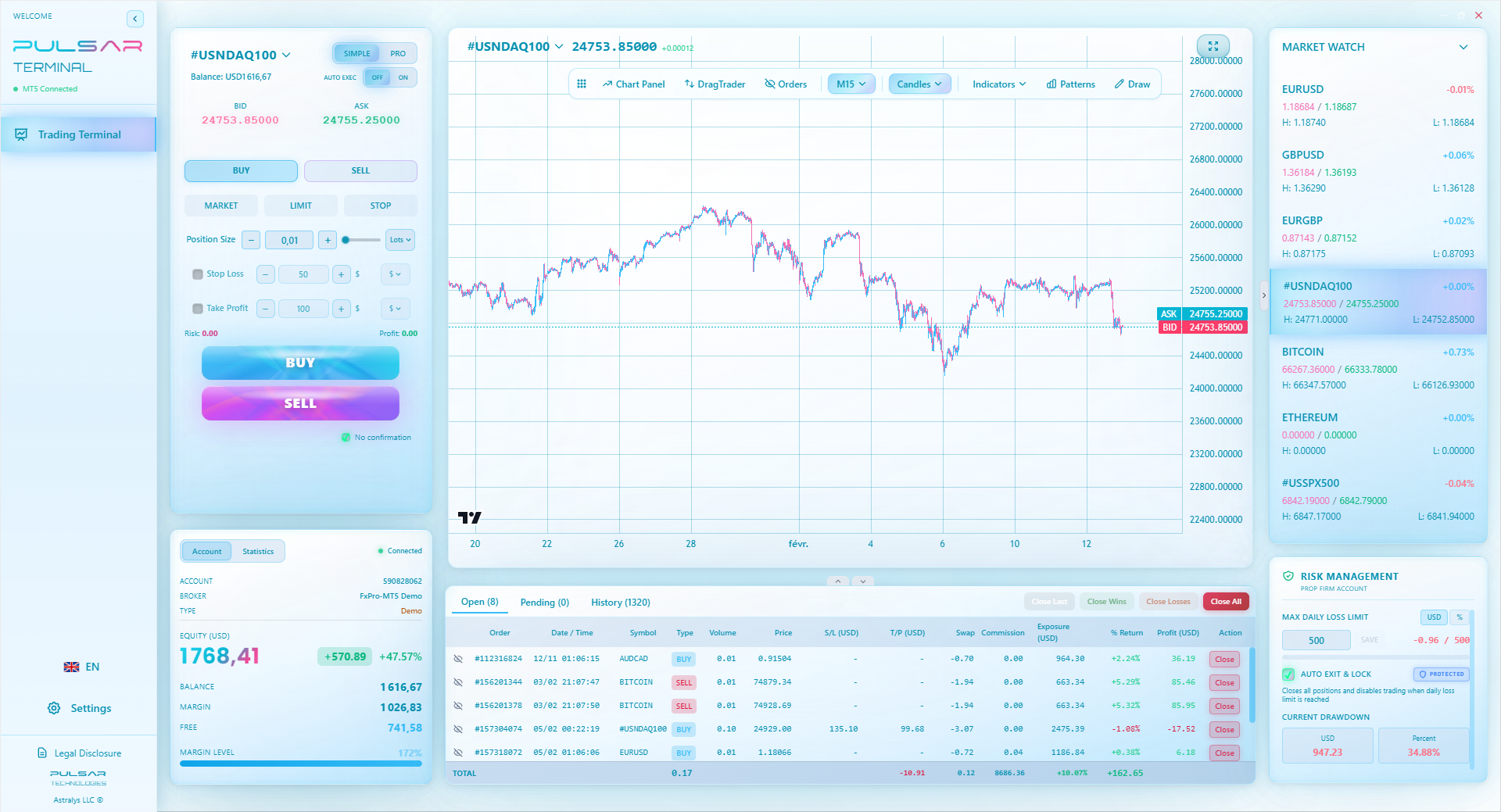
Managing multiple partial closes and trailing stops on standard lot trades is complex, which is why a tool like Pulsar Terminal that automates this on MT5 is a game-saver for serious capital.
Pulsar Terminal
L'outil MT5 tout-en-un : ordres glisser-déposer, multi-TP/SL, trailing stop, grid trading, Volume Profile et protection prop firm. Utilisé quotidiennement par 1 000+ traders.
“The standard account magnifies stupidity exponentially.”
Let me save you some expensive tuition.
Pitfall 1: Chasing 'Prop Firm' Dreams with Standard Lots. You see these funded account challenges. They often require trading standard lots to hit targets. Traders take their R20,000 standard account and use insane use to 'practice' for the challenge. They blow up their own money before even paying the challenge fee. The psychology of trading someone else's virtual money is completely different. Don't use your real standard account as a prop firm simulator.
Pitfall 2: Ignoring USD/ZAR Volatility. Your account is in ZAR, but your pip value is based on the USD. If the Rand strengthens or weakens dramatically, your actual Rands profit/loss can be significantly different from your USD P&L. Hedge if you must, or just be acutely aware of this during local political or budget events.
Pitfall 3: Over-trading Because 'Costs are Low'. You get a nice, tight-spread standard account. The cost per trade feels minimal. So you trade 10 times a day. At R130 cost per round turn (spread only), you're paying R1,300 a day in spreads. That's R26,000 a month in costs you have to overcome just to break even. Quality over quantity.
Pitfall 4: Not Understanding Correlation. You might be in a standard long EUR/USD trade (R185/pip). Seeing USD weakness, you think 'great, I'll also go long on GBP/USD'. Now you have two standard lots effectively on the same Dollar weakness thesis. Your real risk is double what you think. A USD rebound will hammer both positions simultaneously. This is how a 1% risk per trade becomes a 5% account loss in an hour.
💡 Conseil de Winston
Keep a 'panic journal' for your first month on a standard account. Note the exact moment you felt fear in a trade. That feeling is your #1 enemy, and you must learn its triggers.
Here's how I'd do it today, with the experience I have.
Month 1: Fund your chosen broker's standard account with your allocated capital (e.g., R100,000). Do NOT trade it. Use a demo version of the platform to place your usual trades. Simultaneously, on your live account, place tiny 0.01 lot trades in the same direction. The demo is for your analysis, the 0.01 lot trade is to connect you to the live market feel and execution speed.
Month 2: Start trading with 0.05 lot sizes. Your goal this month is not profit. Your goal is to execute 20-30 trades with flawless risk management. Every trade must have a pre-calculated stop loss and take profit. Use the RSI indicator or your preferred tool, but the focus is on process. Journal how you feel when a 0.05 lot trade goes 20 pips against you (that's a R185 paper loss).
Month 3: If your process is solid and your psychology is stable, scale to 0.10 lots. This is your first meaningful standard account position (a 'mini' within the standard account). This is where you start focusing on strategy refinement. Only after 3-6 months of consistent, process-driven trading at 0.10-0.20 lots should you even consider a full 1.0 standard lot.
The standard account is your tool for building serious wealth over years, not months. Respect the power it has, both to build and to destroy. Trade it with the humility that real capital demands.
FAQ
Q1What is the minimum deposit for a standard forex account in South Africa?
There's no legal minimum, but practically, I wouldn't go below R50,000. Brokers might let you open one with R5,000, but with 1:30 use, that only gives you enough margin to trade tiny fractions of a lot. You'll be over-leveraged on every trade. R50k allows for sensible 0.1 lot trades with proper risk management.
Q2Is a standard account better than a micro account for beginners?
No, it's worse. A beginner's job is to learn mechanics and strategy without emotional pressure. The massive pip value of a standard lot creates panic, which leads to every mistake in the book. Start with a micro or cent account. Move up only after you have a proven, documented edge over dozens of trades.
Q3How is profit taxed from a standard forex account in South Africa?
SARS views forex trading profits as capital gains if you're deemed an investor (holding trades longer), or as revenue from a business if you're an active day trader. The tax treatment is complex. Keep careful records of all trades. Consult a South African tax professional who understands trading. Do not guess on this.
Q4Can I trade fractions of a standard lot?
Absolutely. This is the best way to start. A standard account lets you trade any size, from 0.01 lots upwards. You don't have to trade full 1.0 lots. Starting with 0.05 or 0.10 lots is a professional approach to gradually scale into the psychology of larger position sizes.
Q5What's the biggest advantage of a standard account?
Two things: cost efficiency and market reality. The spreads and commissions per lot are usually far better than on micro accounts. More importantly, it forces you to trade seriously. There's no pretending when each pip move is worth real money. It separates the hobbyists from the committed traders.
Q6Will I get better customer service with a standard account?
Often, yes. Brokers see clients trading standard lots as more valuable. You might get a dedicated account manager, faster withdrawal processing, and priority support. Don't choose a broker for this, but it's a common perk for higher-volume traders.
La leçon du Prof. Winston
Points clés:
- ✓A standard lot = 100,000 units. Pip value is ~R185 on EUR/USD.
- ✓FSCA use max is 1:30. This dictates your minimum capital.
- ✓Never risk >1% of equity per trade. Calculate position size for every entry.
- ✓Start with 0.1 lots to acclimatize. A full lot is for seasoned pros.
- ✓Tighter spreads are key. Look for raw/ECN pricing from your broker.
Cet article vous a-t-il été utile ?
Cliquez sur une étoile
Analyses Trading Hebdo
Analyses et stratégies hebdo gratuites. Pas de spam.
À propos de l'auteur
David van der Merwe
Trader des Marchés Émergents
Trader basé à Johannesbourg avec 11 ans d'expérience sur les devises des marchés émergents. Spécialisé dans les paires ZAR, le trading régulé par la FSCA et l'analyse du marché sud-africain.
Commentaires
Avertissement sur les risques
Le trading d'instruments financiers comporte des risques importants et peut ne pas convenir à tous les investisseurs. Les performances passées ne garantissent pas les résultats futurs. Ce contenu est fourni à titre éducatif uniquement et ne constitue pas un conseil en investissement. Effectuez toujours vos propres recherches avant de trader.
Vous aimerez aussi

Cara Trading Forex Sukses: 7 Prinsip dari Trader Profesional
Cara trading forex sukses dengan 7 prinsip trader pro: manajemen modal, disiplin, journal trading, backtest. Data nyata, bukan janji profit palsu.
Jam Trading Forex Terbaik untuk Trader Indonesia: Panduan Lengkap dengan Tabel Waktu
Panduan jam trading forex untuk trader Indonesia. Tabel 4 sesi dunia, jam emas 20:00-00:00, sesi mana yang harus dihindari. Data akurat + tips dari trader berpengalaman.
Top 5 Sàn Forex Uy Tín Nhất 2026: Review Jujur dari Trader Indonesia
Top 5 sàn forex uy tín 2026 untuk trader Indonesia. Review jujur: spread, deposit, withdraw, dukungan lokal. Exness, XM, IC Markets & lebih.
Obtenir Pulsar Terminal
Tous ces calculateurs sont intégrés dans Pulsar Terminal avec des données en temps réel de votre compte MT5. Dimensionnement de position en un clic, gestion automatique des risques et calculs instantanés.
Obtenir Pulsar Terminal