


What's the best use for forex trading in South Africa? Is it the 30:1 the FSCA allows, or should you chase those offshore brokers offering 500:1? I've blown accounts using both extremes, and let me tell you, the answer isn't what most new traders want to hear.

David van der Merwe
Trader des Marchés Émergents ·  South Africa
☕ 11 min de lecture
Ce que vous apprendrez :
What's the best use for forex trading in South Africa? Is it the 30:1 the FSCA allows, or should you chase those offshore brokers offering 500:1? I've blown accounts using both extremes, and let me tell you, the answer isn't what most new traders want to hear. It's not about getting the highest number possible. It's about finding the sweet spot where use works for your strategy, not against your psychology. Let's break down what actually works in our market.
Alright, let's get this straight first. use isn't a magic profit multiplier. It's borrowed capital from your broker that lets you control a larger position with less of your own money. Think of it like buying a house with a bond. You put down a 10% deposit, the bank lends you the other 90%. That's 10:1 use. In forex, if you have R1,000 and use 30:1 use, you can control a position worth R30,000.
Here's the kicker, and where most guys get it wrong: your profit and loss are calculated on the full position size, not your deposit. So if that R30,000 position moves 1% against you, you lose R300. That's 30% of your original R1,000 capital gone in a single move. I learned this the hard way back in 2015. I deposited R5,000 with a broker offering 400:1, maxed out my use on a EUR/USD trade, and watched a 25-pip move wipe out half my account. I was focused on the potential profit from controlling such a big position. I completely ignored the risk.

Warning: High use doesn't improve your trading edge. It only amplifies the results, good or bad. A bad strategy with high use will blow up faster, that's all.
The FSCA's 30:1 limit for retail traders isn't there to spoil your fun. It's a reality check. It forces you to use a more reasonable position size calculator and think about risk first. When you're looking for the best use for forex, you're really asking, "What's the maximum amount of risk I can handle without making emotional, panic-driven decisions?"
“The best use for forex is often 5-10% of what your broker offers.”
In South Africa, the game changed in 2021. The Financial Sector Conduct Authority (FSCA) capped retail use at 30:1. This applies to any broker licensed here. So if you open an account with an FSCA-regulated broker like Exness or IC Markets, that's your ceiling as a retail client.
The Professional Client Loophole (It's Not Easy)
You might see ads for brokers offering 500:1 or even 1000:1. How? They're usually through their offshore entities (like in the Seychelles or Cyprus) or by classifying you as a 'professional client.' To get that classification, you typically need to meet two of these three criteria:
- Have carried out significant trading (at least 10 trades per quarter) in the last year.
- Have a financial portfolio exceeding R8.5 million (including cash).
- Work or have worked in the financial sector for at least one year in a professional role.
Most of us don't qualify. And honestly, if you're asking about the best use for forex, you probably shouldn't be chasing professional status just for higher limits.
The Offshore Route: Higher Risk
You can open an account directly with an offshore broker. No FSCA, no 30:1 limit. Brokers like XM or Pepperstone have global entities that might offer 500:1. But here's the trade-off: you lose FSCA protection. If there's a dispute or the broker goes under, your recourse is much harder. Your funds aren't necessarily held in South African banks under local segregation rules. I've used offshore accounts for specific strategies, but I never keep my entire capital there. It's an added layer of risk you must accept.
So, your practical options are: play it safe with 30:1 locally, or take on more regulatory risk for higher use offshore. For 95% of traders, the best use for forex is found within the FSCA's framework. It teaches discipline.

💡 Conseil de Winston
Your broker's maximum use is a measure of their risk appetite, not yours. Your trading plan should define your own, much lower, limit.
“High use doesn't improve your trading edge. It only amplifies the results, good or bad.”
Forget the broker's maximum. Your personal use should be a calculation, not a choice. Here's the method I've used for the last 8 years.
The 1% Rule in Action: First, decide your maximum risk per trade. A common, sane rule is 1% of your account. If you have a R10,000 account, you shouldn't risk more than R100 on any single trade.
Now, let's say you want to trade GBP/USD. You identify a setup where your stop-loss is 30 pips away from your entry. With a standard lot (100,000 units), each pip move in GBP/USD is worth about $10 (or roughly R180).
- Risk per pip on a full lot: R180
- Total risk with a 30-pip stop: 30 pips * R180 = R5,400
But you only want to risk R100 total. So, your position size needs to be: R100 / R5,400 = 0.0185 lots (or 1,850 units).
Now, how much margin does that require? At 30:1 use, the margin for GBP/USD is roughly 3.33% of the trade value. A 1,850 unit trade is worth about $2,300 (R41,000).
- Margin Required: R41,000 * 3.33% = R1,365
Look at that. To take this trade with proper risk management, you only needed about R1,365 of your R10,000 account tied up as margin. Your effective use on this trade is (Trade Value / Capital Used) = R41,000 / R10,000 = 4.1:1.

Example: Your broker says 30:1, but your risk management says 4:1. That's the secret. The best use for forex is often 5-10% of what your broker offers. I rarely use more than 10:1 effective use, even on my most confident scalping strategy setups.
This is why a position size calculator is non-negotiable. It does this math instantly and stops you from over-leveraging based on emotion.
“High use doesn't improve your trading edge. It only amplifies the results, good or bad.”
When you're tempted by high use, you often overlook the costs that scale with your position size. These can turn a winning trade into a loser real quick.
Spreads & Commissions: On a R1 million position (which you could control with just R2,000 at 500:1), a 1-pip spread costs you R180. If you're paying a $7 commission per round turn, that's another R125. You're down R305 before the market even moves. For a scalping strategy, these costs are deadly.
Overnight Financing (Swap): This is the interest paid or received for holding a position overnight. It's based on the full position size. On a large, leveraged position, a negative swap can be a significant daily drain. I once held a long AUD/JPY position over a weekend with high use. The negative swap was more than my anticipated profit from the next move. I had to close it at a loss.
Slippage: In fast markets, your order might fill at a worse price than expected. On a massive position, that slippage is multiplied. A 0.5 pip slippage on a standard lot is R90. On 10 lots, it's R900 gone in a blink.
The Psychology Tax: This is the biggest hidden cost. High use causes stress, which leads to bad decisions. You'll cut winners short because you're up 'too much too fast' and scared to lose it. You'll move stop-losses wider because a small retracement threatens a margin call. I've done both. The mental fatigue from managing a highly leveraged account isn't worth it.
The table below shows how costs scale. Assume a R10,000 account, targeting a 30-pip profit on GBP/USD.
| Effective use | Position Size (ZAR) | 1-Pip Spread Cost | Cost as % of 30-pip Target Profit |
|---|---|---|---|
| 5:1 | R50,000 | R90 | 5% |
| 20:1 | R200,000 | R360 | 20% |
| 50:1 | R500,000 | R900 | 50% |
See the problem? At 50:1 effective use, the spread alone eats half your target profit. You're fighting an uphill battle. The best use for forex keeps these friction costs low relative to your profit targets.
💡 Conseil de Winston
If you can't calculate the exact rand value of your maximum loss before entering a trade, you have no business using any use at all.
“Your use should feel boring. If you get an adrenaline rush from seeing your P&L swing, your use is too high.”
One size doesn't fit all. Your trading style should dictate your use, not the other way around.
Scalpers: You're in and out for 5-20 pips. You need tight spreads and low commissions. Because your profit per trade is small, you might be tempted to use higher use to make it worthwhile. This is dangerous. A 2-pip stop-loss with 100:1 use can still blow up your account if you're wrong consistently. I find 10:1 to 20:1 is more than enough for scalping. It lets you take a sensible position size so that a 10-pip win is meaningful, without the constant threat of a margin call.
Day Traders: Holding trades for hours, targeting 30-100 pip moves. You have more room for your stop-loss, so your position size can be smaller relative to your capital. The FSCA's 30:1 is perfect here. I run most of my day trading between 5:1 and 15:1 effective use. It gives me room to breathe and manage the trade without watching every tick.
Swing Traders: Holding for days or weeks, targeting 100+ pips. You use wider stops, so your position size must be even smaller. High use is completely unnecessary and increases your overnight financing costs. I use 3:1 to 10:1 for swing trading. The goal is to be comfortable leaving the trade alone. If you're checking it every hour because the use is giving you heart palpitations, it's too high.

Pro Tip: Your use should feel boring. If you get an adrenaline rush from seeing your P&L swing, your use is too high. The best trades are the ones you can set and forget, knowing your risk is covered.
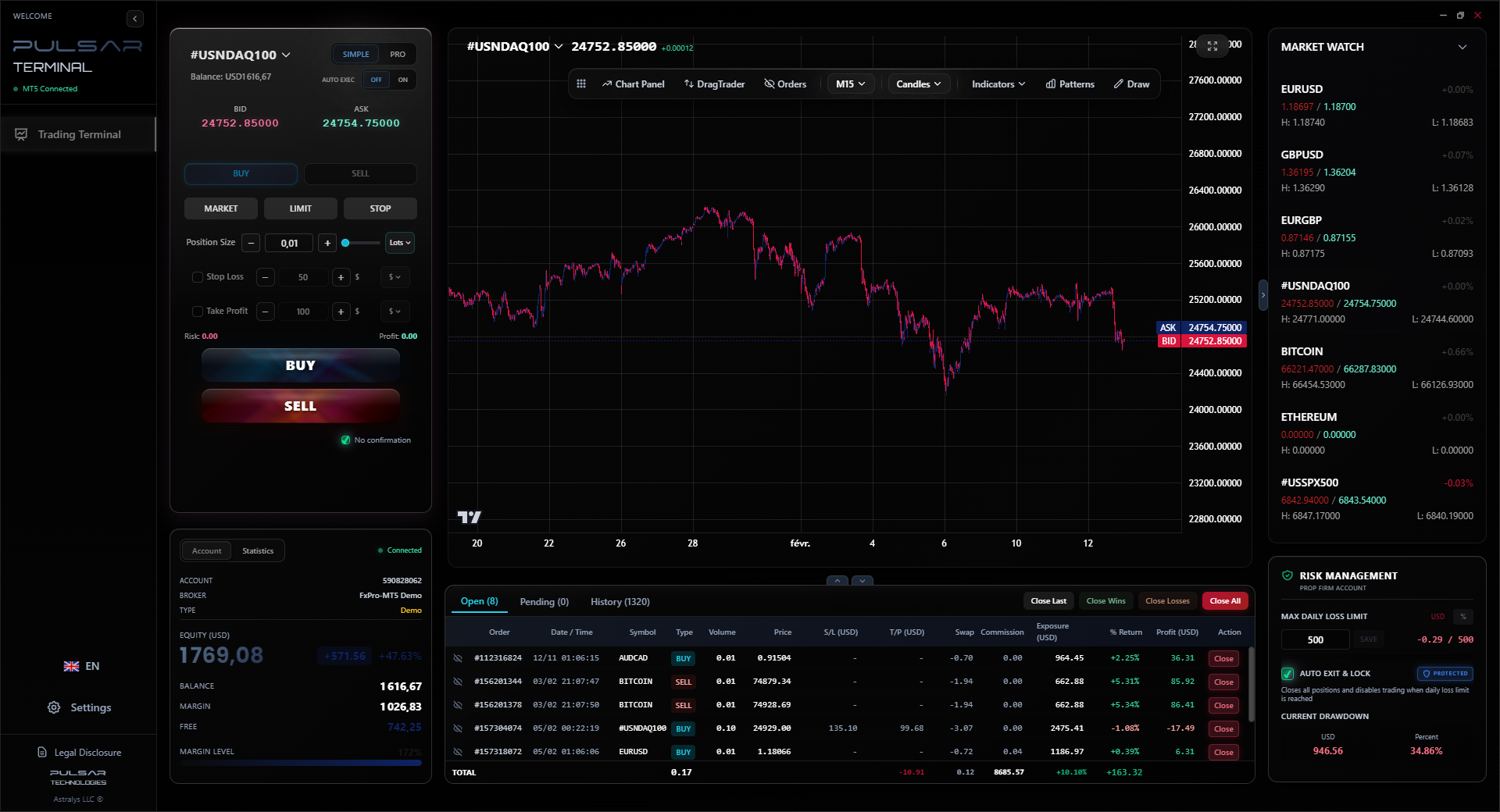
Managing multiple trades with precise risk levels is key to using leverage wisely, and Pulsar Terminal's drag-and-drop order system lets you set exact stop-losses and take-profits instantly on MT5.
Pulsar Terminal
L'outil MT5 tout-en-un : ordres glisser-déposer, multi-TP/SL, trailing stop, grid trading, Volume Profile et protection prop firm. Utilisé quotidiennement par 1 000+ traders.
“Your use should feel boring. If you get an adrenaline rush from seeing your P&L swing, your use is too high.”
Let me be real with you. I've screwed this up royally, more than once.
The Mistake (2017): I had a solid month, up 15% on my R50,000 account using around 10:1 use. Got greedy. Saw a 'sure thing' setup on USD/ZAR. I used my entire margin available (30:1) to open a huge position. A surprise SARB announcement moved against me by 150 pips in minutes. I didn't have a stop-loss because 'I knew I was right.' The loss was R11,200. I wiped out nearly all my monthly gains and then some. The use didn't cause the bad trade, but it turned a manageable loss into a catastrophic one.
The Win (2020): During the March volatility, gold (XAU/USD) was going nuts. I had a XAU/USD guide strategy based on support levels. I spotted a bounce at $1,450. Instead of going big, I used 5:1 effective use. My risk was 0.8% of my account. I held for two weeks as gold rallied to $1,700. The profit was significant because the market move was huge, not because my use was huge. The low use let me hold through scary retracements without panicking.
The difference was psychological. High use makes you a prisoner to price action. Low use sets you free to make logical decisions. The best use for forex is the level where you can be wrong, take the loss, and it doesn't ruin your day or your account.
💡 Conseil de Winston
The most powerful use of use is not in opening a position, but in surviving the inevitable drawdowns that follow. Always leave room to be wrong.
“Stop chasing the highest number your broker will give you. Start using the smallest number your strategy will allow.”
So, what's the best use for forex trading in South Africa? For the vast majority of traders, it's significantly less than what you're allowed to use.
Start with the FSCA's 30:1 as your absolute ceiling, not your target. Then, build a risk management system that dictates your actual use. Here's your action plan:
- Pick a Regulated Broker: Start with an FSCA broker. The protection is worth it. Check our Exness review or IC Markets review for good local options.
- Set a Hard Risk Rule: Never risk more than 1-2% of your account on a single trade. Write this down.
- Use a Calculator: Before every trade, use a position size calculator. Input your account size, risk %, and stop-loss distance. Let it tell you your position size and the required margin.
- Calculate Your Effective use: (Position Value in ZAR) / (Your Account Balance in ZAR). Aim to keep this below 10:1 for most trades.
- Practice First: Use a demo account. Try your strategy with 5:1, 10:1, and 30:1 effective use. See which one lets you sleep at night and execute your plan without emotion.
The goal isn't to get rich on one trade. It's to survive and compound gains over hundreds of trades. Low, managed use is the tool that lets you do that. It's boring. It's unsexy. But it's the only thing that works long-term. Stop chasing the highest number your broker will give you. Start using the smallest number your strategy will allow. That's the real secret.
FAQ
Q1Can I get more than 30:1 use in South Africa?
Yes, but not easily. As a retail trader with an FSCA-regulated broker, 30:1 is the hard limit. You can access higher use by qualifying as a professional client (requires significant trading volume/portfolio size) or by opening an account with a broker's offshore entity, which comes with less regulatory protection.
Q2What use do professional traders use?
Professionals and prop firms often use much lower use than retail traders think. They focus on risk-adjusted returns. It's common for professional setups to use between 5:1 and 10:1 effective use. They make money through consistency and volume, not by betting the farm on a single trade.
Q3Is 50:1 use safe?
'Safe' is relative. 50:1 means a 2% move against you wipes out your entire margin. For a volatile pair like GBP/JPY, a 2% move can happen in a single day. It's not safe for holding positions long-term or for traders without strict stop-loss discipline. For most, it's unnecessary risk.
Q4How does use affect my profit?
use multiplies both your profit and loss based on the full position size. If you control a R100,000 position with R2,000 (50:1), a 1% profit is R1,000 - a 50% return on your capital. However, a 1% loss is also R1,000, a 50% loss. It amplifies the outcome.
Q5What's a good use for a R5,000 account?
With a R5,000 account, your focus should be on survival, not magnification. I'd recommend starting with no more than 10:1 effective use. This means controlling positions worth around R50,000. Combined with a strict 1% risk rule (R50 per trade), this forces you to trade smaller lots and use sensible stop-losses, which is the right habit to build.
Q6Do all currency pairs have the same use?
No. Brokers often offer lower use on exotic pairs (like USD/ZAR, USD/TRY) or minor pairs due to their higher volatility. Majors like EUR/USD typically get the highest offered use. Always check your broker's specifications for each instrument.
Q7What happens if I get a margin call?
A margin call happens when your account equity falls below the required margin to maintain your open positions. Your broker will then issue a warning to deposit more funds. If you don't, they will automatically close one or all of your positions to prevent further losses, often at the worst possible price. Using lower use is the best way to avoid this.
La leçon du Prof. Winston
Points clés:
- ✓Effective use above 10:1 is usually unnecessary risk.
- ✓Always calculate position size based on a fixed % risk (1-2%).
- ✓The FSCA's 30:1 limit is a protective ceiling, not a target.
- ✓High use multiplies hidden costs like spreads and swaps.
- ✓Your psychology is the ultimate use limiter.
Cet article vous a-t-il été utile ?
Cliquez sur une étoile
Analyses Trading Hebdo
Analyses et stratégies hebdo gratuites. Pas de spam.
À propos de l'auteur
David van der Merwe
Trader des Marchés Émergents
Trader basé à Johannesbourg avec 11 ans d'expérience sur les devises des marchés émergents. Spécialisé dans les paires ZAR, le trading régulé par la FSCA et l'analyse du marché sud-africain.
Commentaires
Avertissement sur les risques
Le trading d'instruments financiers comporte des risques importants et peut ne pas convenir à tous les investisseurs. Les performances passées ne garantissent pas les résultats futurs. Ce contenu est fourni à titre éducatif uniquement et ne constitue pas un conseil en investissement. Effectuez toujours vos propres recherches avant de trader.
Vous aimerez aussi

Cara Trading Forex Sukses: 7 Prinsip dari Trader Profesional
Cara trading forex sukses dengan 7 prinsip trader pro: manajemen modal, disiplin, journal trading, backtest. Data nyata, bukan janji profit palsu.
Jam Trading Forex Terbaik untuk Trader Indonesia: Panduan Lengkap dengan Tabel Waktu
Panduan jam trading forex untuk trader Indonesia. Tabel 4 sesi dunia, jam emas 20:00-00:00, sesi mana yang harus dihindari. Data akurat + tips dari trader berpengalaman.
Top 5 Sàn Forex Uy Tín Nhất 2026: Review Jujur dari Trader Indonesia
Top 5 sàn forex uy tín 2026 untuk trader Indonesia. Review jujur: spread, deposit, withdraw, dukungan lokal. Exness, XM, IC Markets & lebih.
Obtenir Pulsar Terminal
Tous ces calculateurs sont intégrés dans Pulsar Terminal avec des données en temps réel de votre compte MT5. Dimensionnement de position en un clic, gestion automatique des risques et calculs instantanés.
Obtenir Pulsar Terminal