


I remember staring at my screen, watching the E-mini S&P 500 futures chart do absolutely nothing for three hours.

James Mitchell
Analyste Trading Senior
☕ 12 min de lecture
Ce que vous apprendrez :
- 1What Exactly is TradeDay?
- 2The Rules: Trading Days, Drawdowns, and Profit Targets
- 3Breaking Down the Real Cost
- 4The Good, The Bad, and The Ugly
- 5How TradeDay Stacks Up Against the Competition
- 6Who Should (and Shouldn't) Use TradeDay
- 7How to Actually Pass the TradeDay Evaluation
- 8The Bottom Line on TradeDay
I remember staring at my screen, watching the E-mini S&P 500 futures chart do absolutely nothing for three hours. I was in a TradeDay evaluation, up $1,200 for the day, and my rule was to stop at $1,000. But greed whispered, 'Just one more tick.' I took a tiny, impulsive trade. It reversed instantly, and I watched a $250 loss eat into my hard-earned profits. I didn't blow the account, but that sick feeling in my gut taught me more about prop firm psychology than any rulebook. Let's talk about TradeDay - not as some magical funding solution, but as a real tool with real pitfalls and potential.
TradeDay is a US-based proprietary trading firm that's been around since 2020. They're laser-focused on one market: futures. We're talking the E-mini S&P 500 (ES), Nasdaq (NQ), crude oil (CL), Treasury notes, the whole CME Group suite. Unlike some prop firms that dabble in forex or stocks, TradeDay's entire model is built around futures traders.
Their main offering is a single-step evaluation program. You pay a monthly fee for a simulated account, hit specific profit targets and risk rules, and if you pass, you get a funded account where you trade the firm's capital and keep a chunk of the profits. It's a straightforward concept, but the devil, as always, is in the details.
One thing that sets them apart is their founder, Robb Reinhold. He's a trader himself and is pretty active in the community. That doesn't automatically make them better, but it gives them a slightly different vibe than some of the more faceless corporate prop shops. They also run a podcast and educational content, which is a nice value-add if you're into that.

Warning: Don't confuse 'educational content' with a guaranteed edge. A firm can teach you concepts, but they can't teach you discipline. That $250 loss I took? That was 100% a discipline failure, not a knowledge gap.
This is where you need to put on your reading glasses. TradeDay's rules aren't crazy complicated, but you must understand them cold. Misinterpreting a rule is the fastest way to fail before you even start.
The Evaluation Structure
You choose an account size ($50k, $100k, or $150k) and a drawdown type. This is the big decision. Your drawdown - the maximum loss you're allowed - is calculated differently for each:
- Intraday Drawdown: Your loss limit resets at the start of each new trading day. This is the most forgiving for aggressive day traders who close all positions daily. Your max loss is based on the account's starting balance each morning.
- End-of-Day (EOD) Drawdown: Your loss limit is based on the account's highest equity point (its 'peak'). Once you hit a new high, your floor rises. This is good for swing trading styles where you might hold a trade overnight.
- Static Drawdown: Your loss limit is fixed. It never increases, even if you make new profits. This is the toughest rule set and offers the smallest buffer.
The Numbers You Must Hit
| Rule | Typical Requirement (e.g., $100k Account) | What It Means For You |
|---|---|---|
| Minimum Trading Days | 5 Days | You can't hit your profit target in one lucky trade and pass. You need to show consistency over at least a week. |
| Profit Target | $6,000 | This is your total goal to pass the evaluation. It's a 6% return on the account size. |
| Daily Loss Limit | $2,500 (2.5%) | You cannot lose more than this in a single day. Hit this, and you're failed. |
| Maximum Drawdown | $5,000 (5%) | This is your overall loss limit (calculated per your chosen type). Breach this, and you're done. |

Example: On a $100k EOD account, if you make $3,000, your new equity peak is $103,000. Your max drawdown line moves up to $98,000 ($103,000 - $5,000). This 'trailing' aspect protects the firm's capital once you're profitable.
The profit target is reasonable. The daily loss limit is your biggest enemy. A couple of bad scalping trades can trigger it if you're not careful with your position size calculator.
“Passing a TradeDay evaluation isn't about being a genius. It's about being a robot for 5-10 trading days.”
Let's talk dollars and cents. TradeDay's listed prices are one thing, but they almost always run promotions. Here’s the real-world pricing you’ll likely see as of 2026.
Monthly Evaluation Fees (Promotional Rates):
- $50k Account: Intraday costs $87/mo, EOD is $122/mo, Static is $115/mo.
- $100k Account: Intraday costs $140/mo, EOD is $192/mo, Static is $175/mo.
- $150k Account: Intraday costs $210/mo, EOD is $262/mo, Static is $245/mo.
My advice? Go for the EOD account. The extra $30-50 per month over the Intraday account is cheap insurance for the flexibility it gives you. The Static account is for masochists or incredibly disciplined traders.
Now, the funded account side. TradeDay has a pretty standard profit split: you keep 80% of the profits you generate. They take 20%. There's no monthly fee for the funded account itself, which is a huge plus. Some firms sneak in a 'platform fee' or 'data fee' even after you're funded; TradeDay doesn't.
You need to factor the evaluation fee into your trading math. If you're paying $140 for a $100k eval, you need to make that back in profits plus your target just to break even on the attempt. This is why rushing is fatal. Take the full month if you need it.
One more cost: platform fees. You'll likely trade on Tradovate or NinjaTrader, which have their own fees for live data and exchange commissions. In the evaluation, these are simulated. In a funded account, they're real and come out of your profits. It's not a huge amount per trade, but for high-frequency traders, it adds up.

💡 Conseil de Winston
The daily loss limit isn't a target. Your real target should be 50% of it. Survive the day, and you live to trade tomorrow.
After trading with them and talking to others who have, here's my unfiltered take.
The Good (Why I Gave Them a Shot):
- Futures-Only Focus: They understand the product. Their rules are built for futures volatility, not adapted from a forex model. This matters.
- Single-Step Evaluation: No confusing multi-phase challenge where the rules change halfway through. One set of rules from start to finish.
- No Consistency Rules: Some firms require you to have a certain percentage of winning days. TradeDay doesn't. You can have four breakeven days and one massive winning day and still pass. This suits certain trading styles.
- Scaling Plan: Once funded, you can grow your account size significantly by hitting profit milestones. It's a clear path from a $100k to a $400k account.
The Bad (The Frustrations):
- The Daily Loss Limit is a Killer: That 2.5% daily loss rule is tight. In a volatile NQ session, two bad decisions can end your month. You must master risk management to a degree that feels almost robotic. This is where a tool that helps enforce daily loss limits is useful.
- Profit Target is Realistic, But Not Easy: 6% is fair, but with the daily loss leash, you can't just grind it out with tiny wins. You need controlled, profitable days.
- The "Refundable Fee" Thing: They offer a one-time fee that's refunded when you pass. It's more expensive upfront. I see it as a psychological trick. I opted for the monthly, treating it as a cost of business.
The Ugly (A Potential Future Headache):
The regulatory landscape for prop firms in the US is getting fuzzy. The CFTC is looking at firms like TradeDay and asking if they should be registered as Commodity Trading Advisors (CTAs). This isn't a TradeDay-specific issue; it's industry-wide. Right now, it doesn't affect how you trade, but it's a cloud on the horizon that could change how all US prop firms operate. It's something to keep in the back of your mind.
“The daily loss limit is a significant constraint that will break undisciplined traders.”
TradeDay isn't the only game in town for futures. Let's compare it quickly to two common alternatives.
TradeDay vs. Apex Trader Funding: Apex is the giant in the space. They offer lower evaluation fees (sometimes as low as $30 for a $50k account on sale) and a more generous trailing drawdown rule. However, Apex has a two-step evaluation (a 'PA' account then a 'Pro' account), which some find annoying. TradeDay's single step is simpler. Apex also has a reputation for slower payout processing. TradeDay's profit split (80%) is slightly better than Apex's standard (100% of first $25k, then 90/10). For a beginner, Apex's cheaper entry might be appealing. For a trader who values simplicity and a direct path, TradeDay has the edge.
TradeDay vs. Trading Your Own Capital: This is the real question. Let's say you have $5,000. You could blow it in a week trading micro futures on your own. Or, you could use it to fund 3-4 years' worth of TradeDay evaluation attempts ($140/month). The prop firm gives you use ($100k buying power) and, crucially, it separates your emotional capital (the fee) from your trading capital (their simulated money). For most developing traders, that psychological buffer is worth the fee. It forces you to treat it like a real business. I know it did for me.

Pro Tip: Don't get trapped in 'analysis paralysis' comparing every firm's tiny rule differences. Pick one whose rules best fit your natural trading style (day trader vs. swing trader), understand the costs, and commit to the process for at least 6 months. Jumping from one failed challenge to another is just an expensive hobby.
💡 Conseil de Winston
Choose your drawdown type based on your holding period, not which one seems 'easiest.' Holding a swing trade in an Intraday account is a recipe for a [margin call](/en/glossary/margin-call) at the open.
TradeDay isn't for everyone. Based on what I've seen and experienced, here's who fits and who doesn't.
TradeDay is a GREAT fit for:
- The Disciplined Futures Day Trader: If you trade ES or NQ and close all positions before the market closes, the Intraday drawdown model is made for you.
- The Swing Trader with a Day Job: The EOD account lets you set trades and not babysit them every second, as long as you manage your overall risk.
- The Trader Who Blows Small Accounts: If you keep blowing up $2,000 accounts, the structure of a prop firm evaluation can teach you discipline that your own money can't.
- Someone Who Wants a Clear Path: Their scaling plan is transparent. Hit $X in profits, get $Y in increased capital.
TradeDay is a POOR fit for:
- Forex or Stock Traders: Obviously. Go find a firm that specializes in those markets.
- The Impatient Gambler: If you can't follow rules and see the evaluation as a lottery ticket, you'll fail and waste your money.
- The Ultra-High-Frequency Scalper: The daily loss limit is too constraining for a strategy that takes 50+ trades a day. The law of averages will kill you on a bad day.
- Traders Terrified of Regulation: If the potential for future CFTC rules changes keeps you up at night, you might prefer an international firm, though that comes with its own set of complexities and risks.
My personal failure was a lapse in discipline, not a mismatch with the firm. Once I tightened up my personal daily loss rule (even stricter than theirs), I found the structure helpful.
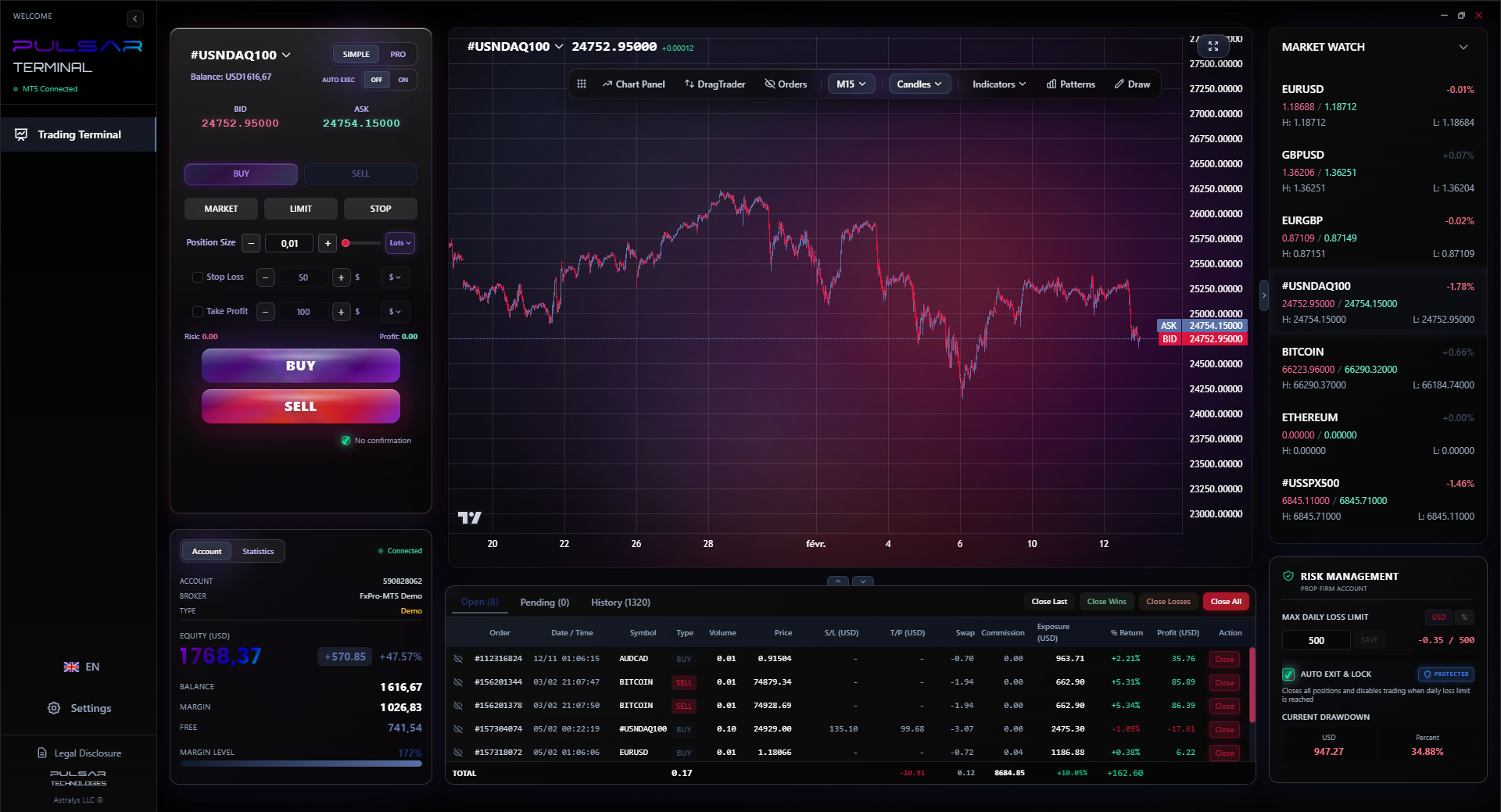
Sticking to a daily loss limit is the hardest part of any prop firm challenge, and Pulsar Terminal can automate this rule enforcement directly on your MT5 platform.
Pulsar Terminal
L'outil MT5 tout-en-un : ordres glisser-déposer, multi-TP/SL, trailing stop, grid trading, Volume Profile et protection prop firm. Utilisé quotidiennement par 1 000+ traders.
“The prop firm gives you use and, crucially, it separates your emotional capital from your trading capital.”
Okay, you've decided to give it a shot. Here's a battle plan from someone who's been through the wringer.
- Treat the Fee as Sunk Cost: The moment you pay the $140, consider it gone. This removes the pressure to 'make it back fast,' which leads to overtrading.
- Paper Trade Their Rules FIRST: Don't jump in live. Take your strategy and paper trade for a week, strictly enforcing their daily loss and max drawdown rules. You'll quickly see if your strategy is compatible.
- Size Tiny, Especially at First: On a $100k account, the max loss is $2,500 daily. That doesn't mean you should risk $2,500! Start by risking no more than $100 per trade. That's 1-2 ES points. Use a position size calculator religiously. Your goal in the first week is survival, not glory.
- The 50% Rule: This was my golden rule after my mistake. Once you hit 50% of your daily profit potential (say, $1,250 on a $2,500 max gain day), remove half your position or switch to a much smaller size. Lock in the win.
- Use Technology to Enforce Discipline: You are your own worst enemy. Set hard stops on every trade. Consider tools that can automate rule enforcement. For example, managing a trailing stop or ensuring you don't breach a daily loss requires focus you might not have when a trade goes against you.
- Keep a Trading Journal: Note not just your trades, but your mindset. Were you bored when you took that impulsive loss? Were you fearful after two small wins? The evaluation is as much about testing your psychology as your strategy.
Passing a TradeDay evaluation isn't about being a genius. It's about being a robot for 5-10 trading days. Execute your plan, manage your risk, and get out of your own way.
💡 Conseil de Winston
Your first goal in any evaluation is to trade for 5 days without hitting the daily loss. Profit is a secondary concern. Master survival first.
So, is the TradeDay prop firm worth it? Here's my final take.
TradeDay is a legitimate, well-run firm that offers a solid path for futures traders to access larger capital. Their single-step evaluation is straightforward, their 80% profit split is competitive, and their focus on futures means they get it. The founders are traders, which shows in the design of their programs.
However, it's not a golden ticket. The daily loss limit is a significant constraint that will break undisciplined traders. You must have a strategy that can generate profits without relying on home-run trades, and you must have the emotional control to walk away when you're ahead.
For the right trader - a disciplined, risk-aware futures specialist - TradeDay is an excellent choice. It provides the structure and capital that can accelerate a trading career. For everyone else, it's an expensive lesson in why risk management is the only skill that truly matters in this game.
My advice? If you're consistently profitable in a futures sim account over 2-3 months, TradeDay is a logical next step. If you're not, save your money, keep practicing, and come back when you are. The firm will still be here. The goal isn't just to pass a challenge; it's to build a sustainable trading business. TradeDay can be a tool for that, but it's not the foundation. Your discipline is.
FAQ
Q1Does TradeDay allow trading during news events like the NFP?
Yes, TradeDay does not restrict trading during major news events. However, this is where their daily loss limit is most dangerous. The volatility can hit your 2.5% limit in minutes if you're on the wrong side. Most experienced traders either avoid news or trade with drastically reduced size during these windows.
Q2What trading platforms can I use with TradeDay?
TradeDay primarily supports Tradovate and NinjaTrader. Both are excellent, industry-standard platforms for futures trading. You'll use them during the evaluation (in sim mode) and in your funded account. You can't use MetaTrader 4/5 with TradeDay, as those are primarily forex platforms.
Q3How long do payouts take once I'm funded and profitable?
TradeDay processes payouts on a bi-weekly schedule. You request a withdrawal, and it's typically sent within a few business days. Reviews from funded traders suggest their payout process is reliable and timely, which is a critical factor often overlooked when choosing a prop firm.
Q4Can I trade micro futures contracts in the evaluation?
Absolutely. In fact, I'd strongly recommend it, especially when starting. Trading MES (micro E-mini S&P) or MNQ (micro Nasdaq) lets you practice with real price action while keeping your dollar risk per trade very small. This helps you focus on hitting the profit target through consistency, not luck.
Q5What happens if I violate a rule without realizing it?
The platform and TradeDay's systems monitor the rules automatically. There's no 'oops' forgiveness. If you breach the daily loss or max drawdown, your evaluation account will be closed. This is why understanding the rules - especially the difference between Intraday and EOD drawdown - is non-negotiable.
Q6Is the TradeDay evaluation fee refundable?
They offer two options: a lower monthly non-refundable fee (the prices I quoted) and a higher one-time fee that is refunded if you pass the evaluation. Think of the refundable fee as a more expensive pass-or-get-your-money-back bet. Most traders I know opt for the monthly fee to keep upfront costs lower.
La leçon du Prof. Winston
Points clés:
- ✓The 2.5% daily loss limit is your primary enemy, not the profit target.
- ✓Choose EOD drawdown for flexibility; it's worth the extra monthly fee.
- ✓Size for $100 risk per trade, not $2,500, to ensure longevity.
- ✓Trade micro contracts (MES, MNQ) to manage risk while proving consistency.
Cet article vous a-t-il été utile ?
Cliquez sur une étoile
Analyses Trading Hebdo
Analyses et stratégies hebdo gratuites. Pas de spam.
À propos de l'auteur
James Mitchell
Analyste Trading Senior
Basé à New York avec plus de 9 ans d'expérience en trading. Spécialisé dans les paires USD majeures, les challenges de prop firms et la réglementation financière américaine.
Commentaires
Avertissement sur les risques
Le trading d'instruments financiers comporte des risques importants et peut ne pas convenir à tous les investisseurs. Les performances passées ne garantissent pas les résultats futurs. Ce contenu est fourni à titre éducatif uniquement et ne constitue pas un conseil en investissement. Effectuez toujours vos propres recherches avant de trader.
Vous aimerez aussi

Cara Trading Forex Sukses: 7 Prinsip dari Trader Profesional
Cara trading forex sukses dengan 7 prinsip trader pro: manajemen modal, disiplin, journal trading, backtest. Data nyata, bukan janji profit palsu.
Jam Trading Forex Terbaik untuk Trader Indonesia: Panduan Lengkap dengan Tabel Waktu
Panduan jam trading forex untuk trader Indonesia. Tabel 4 sesi dunia, jam emas 20:00-00:00, sesi mana yang harus dihindari. Data akurat + tips dari trader berpengalaman.
Top 5 Sàn Forex Uy Tín Nhất 2026: Review Jujur dari Trader Indonesia
Top 5 sàn forex uy tín 2026 untuk trader Indonesia. Review jujur: spread, deposit, withdraw, dukungan lokal. Exness, XM, IC Markets & lebih.
Obtenir Pulsar Terminal
Tous ces calculateurs sont intégrés dans Pulsar Terminal avec des données en temps réel de votre compte MT5. Dimensionnement de position en un clic, gestion automatique des risques et calculs instantanés.
Obtenir Pulsar Terminal