


You're looking at Tradeify and wondering if it's the real deal or just another prop firm trap.

James Mitchell
Analyste Trading Senior
☕ 10 min de lecture
Ce que vous apprendrez :

You're looking at Tradeify and wondering if it's the real deal or just another prop firm trap. I get it. The promise of trading a $150k account for a few hundred bucks sounds too good to be true. After 12 years in this game and seeing dozens of these firms come and go, I've learned to read between the marketing lines. Let's cut through the hype. Tradeify is a US-based futures prop firm that launched in mid-2024. They've got some interesting features, like End-of-Day drawdowns, but they've also baked in some serious limitations that could trip you up. This isn't a cheerleading session. It's a risk assessment from someone who's blown up an account or two learning these lessons the hard way.
First, let's clear up the name. It's Tradeify, not 'Tradify.' They're a proprietary trading firm focused exclusively on futures markets. Their model is standard for the modern prop space: you pay a fee for an evaluation, pass their rules, and then get access to a simulated account where you can earn a split of the profits.
They partner with the broker Tradovate and support platforms like NinjaTrader and TradingView, which is a solid tech stack for US futures traders. Their big selling point is the End-of-Day (EOD) drawdown. Instead of a trailing stop that follows your equity peak intraday, your max loss is only calculated at the market close (5:00 PM EST for most products). This is a massive, legitimate advantage over firms that use aggressive intraday trailing drawdowns. It gives you breathing room.
But here's the catch I learned early: a friendly rule doesn't make a firm legitimate. It just makes the test slightly easier. The real test is what happens after you pass. Their structure, especially the payout caps, tells you exactly what they're optimizing for.

Warning: Just because a firm uses a major broker like Tradovate doesn't mean your funded account is a 'real' live account. You are almost certainly trading in a simulated environment. The firm's capital is real, but your trades are likely not in the live market until you reach their highest tier (like their 'Elite' program). Always read the terms.
This is where most traders get wrecked. They see the account size and the profit target, but they don't study the rulebook like a contract. Because it is one.
The Deceptive Daily Loss Limit
Tradeify's Growth 50k account has a $2,000 max drawdown but a $1,250 daily loss limit. That means if you're down $1,249 on the day, you're still alive. But if you lose $1,251, you're out. It's a hard stop. This forces a ridiculously tight risk management style. On a $50k account, a $1,250 loss is just 2.5%. One bad trade can blow your entire evaluation. I've seen it happen to traders who normally risk 1% per trade. They get frustrated, double down, and hit that invisible wall.
The Profit Consistency Rule
This is a classic prop firm profit-smoothing mechanism. For their Growth accounts, your biggest winning day cannot account for more than 35% of your total profit target. Let's say you need $3,000 to pass. If you have a monster day and make $1,200, you've already used up 40% of your allowed 'big day' allocation (35% of $3,000 is $1,050). You now have to make the remaining $1,800 without any single day contributing more than $1,050. It forces you to trade small and consistently, which sounds good in theory but can punish legitimate breakout success. It's designed to prevent someone from getting lucky on a single news event and passing.
The Payout Caps Are a Major Limiter
This is Tradeify's most restrictive feature, and it's a deal-breaker for serious profit potential. Your payouts are capped, hard.
For a $150k 'Lightning Funded' account (which costs $729), your first three payouts are capped at $3,000 each. That's a maximum of $9,000 you can withdraw before your fourth payout. Even after that, the cap only rises to $3,500 per payout. Let's put that in perspective.
| Account Size | Cost (Lightning) | Max Payout (1st-3rd) | Max Payout (4th+) |
|---|---|---|---|
| $25,000 | $270 | $1,000 | $1,000 |
| $50,000 | $385 | $2,000 | $2,500 |
| $100,000 | $540 | $2,500 | $3,000 |
| $150,000 | $729 | $3,000 | $3,500 |
If you're a truly skilled trader who can generate 10% a month on a $150k account ($15,000), you cannot withdraw it. You're limited to taking out $3,500. The rest stays in the firm's environment. This structure heavily favors the firm and caps your earning potential dramatically. It's the opposite of a true profit split. Compare this to a firm like FTMO (though they're forex-focused) where once funded, you can typically withdraw all profits above a threshold each month.

Example: You trade a $150k account and make a 10% profit ($15,000) in your first month. With Tradeify, you can only request a $3,000 payout (for your first payout). The remaining $12,000 of your profit stays in the account. You can't access it until you slowly drip it out over future months, assuming you don't hit a drawdown first.

💡 Conseil de Winston
A prop firm's most important rule isn't the profit target. It's the line that says 'Maximum Payout Per Period.' That number tells you what they truly think your skill is worth.
“The real cost of a prop firm isn't the evaluation fee. It's the opportunity cost of your skill being capped.”
Let's talk numbers. The evaluation fees are competitive, especially with discount codes floating around. A 50k Growth account can be had for about $100. The reset fees are under $100, which is reasonable. The one-time fees for their 'Lightning Funded' instant accounts are higher, but you skip the evaluation.
The profit split is advertised as 'up to 90%.' That's after you climb their ladder. Initially, it's 80/20 in your favor for most accounts. You need to get 5 payouts from a single account to qualify for their 'Elite' program with the 90/10 split. That's a long road, given the payout caps.
But the real cost isn't just the fee. It's the opportunity cost of your time and skill being limited by their payout structure. If you're a consistently profitable swing trading futures trader, these caps will feel like a ceiling. You're not trading for unlimited upside; you're trading for a capped monthly stipend.
I made this mistake early in my career with a similar firm. I passed their challenge, traded well, and made $8,000 in a month on a $100k sim account. My payout was capped at $2,500. I was furious. I'd spent hours trading, managed my risk perfectly, and the firm kept the majority of the simulated profits I'd generated. It was a brutal lesson in reading the Terms of Service. Your position size calculator might say you can risk $1,000, but their payout calculator says you can only keep a fraction of what you make.

Given all these restrictions, does Tradeify have a niche? Actually, yes, for a very specific type of trader.
Tradeify is ideal for the extremely disciplined, small-target scalper. If your strategy is to grind out $200-$500 per day on the NQ or ES futures without ever going for a home run, this structure might work. The EOD drawdown protects you from intraday volatility, and the daily profit consistency rule won't bother you if you never have huge winning days.
It's also a decent low-cost practice environment. For about $100, you get a month of trading a 50k sim account with realistic rules. Even if you fail, it's cheaper than most trading education scams. Think of it as a paid simulation with stricter rules than your demo account.
It is not for the trader who has a proven, high-return strategy. It's not for the trader who wants to compound profits aggressively. The caps make that impossible. It's also a poor choice if you rely on catching big, trending moves, as the consistency rule will penalize you for your best days.
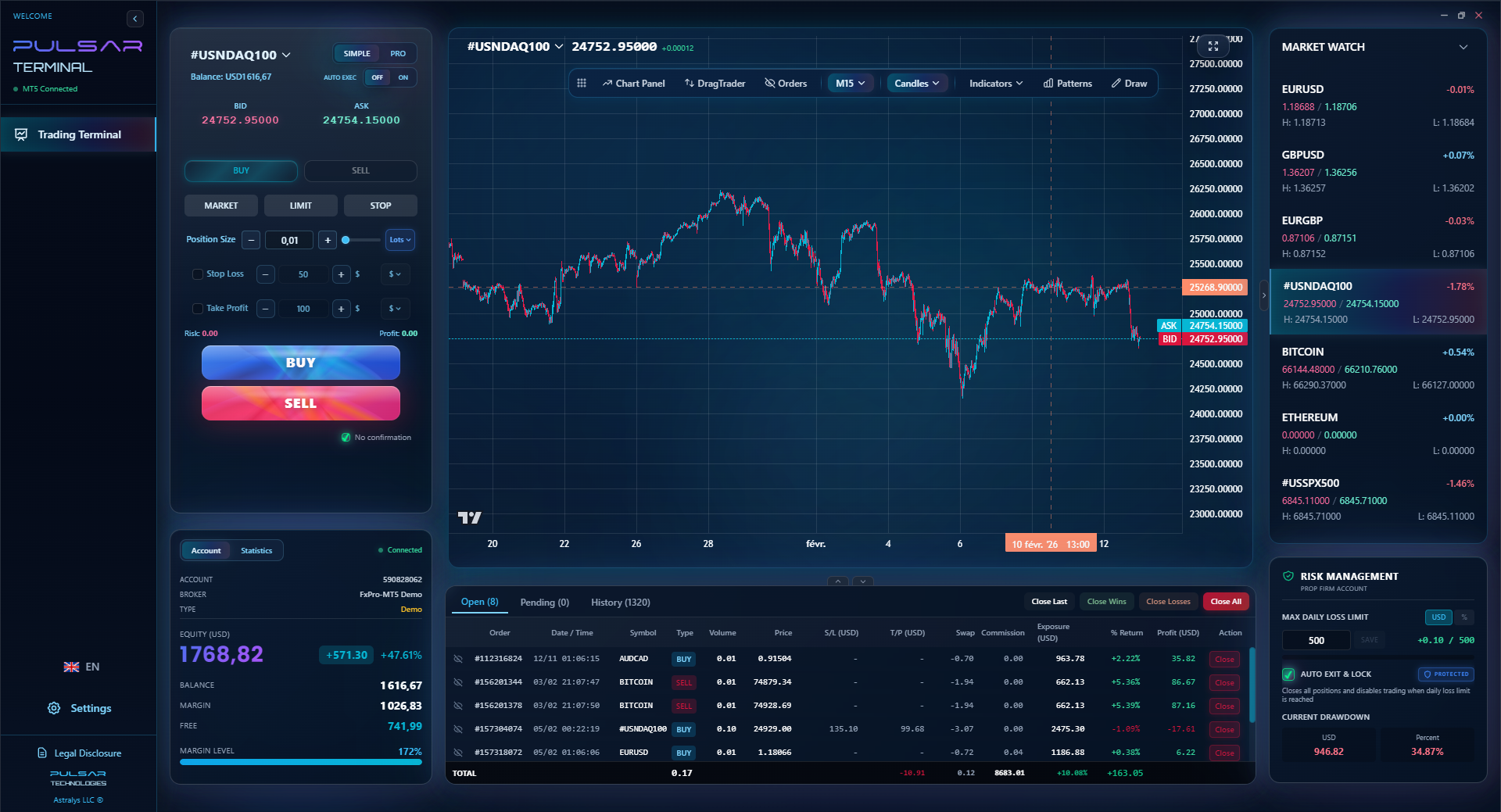
If your goal is purely to pass a challenge and get a certificate, there are firms with simpler rules. If your goal is to build long-term capital, your own account or a different firm with uncapped profits is a better path. For managing the strict risk these challenges require, a tool that automates protections is key. Passing a prop firm challenge requires strict loss management, which tools like Pulsar Terminal handle automatically, setting hard daily loss limits directly on your MT5 platform.
💡 Conseil de Winston
If a funding model wouldn't work for a hedge fund, it won't work for you. No serious manager accepts a 90% lock on their generated profits.

“A friendly drawdown rule doesn't make a firm legitimate. It just makes the test slightly easier.”
Potential Red Flags:
- The Payout Caps: I keep coming back to this because it's that significant. It's a major red flag for anyone with serious profit expectations.
- The 'Winning Day' Threshold: To even be eligible for a payout, you need a minimum of 5 'winning days' where your profit exceeds a threshold ($250 for a $150k account). A winning day of $249 doesn't count. This can delay payouts even if you're profitable overall.
- Lack of Long-Term Track Record: The firm launched in June 2024. While reviews in 2025-2026 are positive, the true test of a prop firm is how it handles payouts during a market crisis or when a trader starts making very large, consistent profits. That history doesn't exist yet.
Realistic Alternatives for US Traders:
- Build Your Own Account: This is always my first recommendation. Start small with a $500 account at a reputable broker like Pepperstone or IC Markets (for forex/CFDs) or a direct futures account. Every dollar of profit is 100% yours. The use is lower, but the freedom is absolute.
- Futures-Focused Firms with Better Terms: Look for other futures prop firms that offer uncapped profit splits or much higher payout limits. Some even offer direct live accounts from the start, though the barriers to entry are higher.
- Forex/CFD Prop Firms: If you're not wedded to futures, the forex prop space is more mature. Firms often have clearer, more trader-friendly payout structures once funded, though their evaluation challenges can be tough with trailing drawdowns.
The core lesson? Don't get dazzled by the advertised account size. The real number to obsess over is the maximum withdrawable profit per month. For Tradeify, that number is disappointingly low relative to the capital they're 'giving' you.

Pro Tip: Before paying any prop firm, do this: calculate your hypothetical first-month profit based on your historical returns. Then, find the firm's payout cap or policy. If your hypothetical profit is double the cap, that firm is not for you. You are literally leaving money on their simulated table.

Managing the tight daily loss limits of a prop firm challenge is stressful; Pulsar Terminal automates this by setting hard daily loss limits that protect you from yourself, directly on your trading platform.
Pulsar Terminal
L'outil MT5 tout-en-un : ordres glisser-déposer, multi-TP/SL, trailing stop, grid trading, Volume Profile et protection prop firm. Utilisé quotidiennement par 1 000+ traders.
Tradeify is a mixed bag. They get real credit for using End-of-Day drawdowns and offering a decent tech stack. For a beginner or a very conservative scalper looking to prove themselves without the fear of an intraday trailing stop, it's one of the better-structured challenges out there.
However, the punitive payout caps fundamentally limit its utility for anyone with genuine skill and ambition. It feels like a platform designed to identify steady, low-volatility traders, not to fund high-performing ones. The caps ensure the firm's liability is always tightly controlled, turning what could be a career opportunity into more of a limited freelance gig.
My advice? If you're new to prop firms and want a futures-focused challenge with a fair drawdown rule, the Tradeify evaluation is a reasonable, low-cost training exercise. Pay the $100, treat it as a paid course in discipline, and see if you can pass. But go in with your eyes wide open about the earning potential on the other side.
If you're already a consistently profitable trader, your $729 is better spent adding to your own live account, or pursuing a funding model where your upside isn't artificially limited. Remember, in trading, you're not just managing market risk. You're managing counterparty risk - the risk that the firm you're dealing with has rules that work against you. With Tradeify, that counterparty risk, in the form of profit caps, is exceptionally high.
, the best prop firm is the one you build yourself, one trade at a time. No consistency rules, no payout caps, and no one can change the rules on you overnight. It's harder, slower, and far more honest.

FAQ
Q1Is Tradeify a legit prop firm?
Based on available information as of 2026, Tradeify appears to be a legitimate operational business. They have a functional website, clear rules, partner with a real broker (Tradovate), and have user reviews discussing payouts. However, 'legit' doesn't mean 'ideal for all traders.' Their restrictive payout caps are a significant drawback for profitable traders.
Q2What is Tradeify's profit split?
Tradeify offers an initial profit split of 80/20 in the trader's favor for most accounts. They advertise a split 'up to 90/10' for traders who reach their 'Elite' tier, which requires 5 successful payouts from a single account.
Q3What are Tradeify's payout caps?
Payouts are strictly capped. For example, on a $150k account, your first three payouts are limited to $3,000 each. After that, the cap increases to only $3,500 per payout. This is a major limitation on earning potential compared to the advertised account size.
Q4Does Tradeify use a trailing drawdown?
No, and this is one of their best features. For their core accounts, Tradeify uses an End-of-Day (EOD) drawdown. Your maximum loss is calculated only at the daily market close, not intraday. This is much more trader-friendly than a live trailing drawdown.
Q5What platforms can I use with Tradeify?
Tradeify supports trading through NinjaTrader, Tradovate (their partner broker), Quantower, TradingView, and WealthCharts. This is a solid selection of popular platforms for US futures trading.
Q6Is the Tradeify challenge hard to pass?
The difficulty is relative. The EOD drawdown makes it easier than firms with intraday trailing stops. However, the daily loss limits are very tight (e.g., $1,250 on a $50k account), and the profit consistency rule (limiting how much one day can contribute) adds another layer of challenge. It requires a disciplined, small-ball approach.
Q7What happens if I fail a Tradeify challenge?
You can reset your evaluation by paying a reset fee (around $95-$99). For their 'Lightning Funded' instant accounts, however, you cannot reset. If you fail, you must purchase a new account.
La leçon du Prof. Winston
Points clés:
- ✓Payout caps are the ultimate profit limiter.
- ✓EOD drawdowns are a true trader advantage.
- ✓Daily loss limits of 2.5% are dangerously tight.
- ✓Profit consistency rules punish breakout success.
- ✓Always calculate your potential withdrawable profit first.
Cet article vous a-t-il été utile ?
Cliquez sur une étoile
Analyses Trading Hebdo
Analyses et stratégies hebdo gratuites. Pas de spam.
À propos de l'auteur
James Mitchell
Analyste Trading Senior
Basé à New York avec plus de 9 ans d'expérience en trading. Spécialisé dans les paires USD majeures, les challenges de prop firms et la réglementation financière américaine.
Commentaires
Avertissement sur les risques
Le trading d'instruments financiers comporte des risques importants et peut ne pas convenir à tous les investisseurs. Les performances passées ne garantissent pas les résultats futurs. Ce contenu est fourni à titre éducatif uniquement et ne constitue pas un conseil en investissement. Effectuez toujours vos propres recherches avant de trader.
Vous aimerez aussi

Cara Trading Forex Sukses: 7 Prinsip dari Trader Profesional
Cara trading forex sukses dengan 7 prinsip trader pro: manajemen modal, disiplin, journal trading, backtest. Data nyata, bukan janji profit palsu.
Jam Trading Forex Terbaik untuk Trader Indonesia: Panduan Lengkap dengan Tabel Waktu
Panduan jam trading forex untuk trader Indonesia. Tabel 4 sesi dunia, jam emas 20:00-00:00, sesi mana yang harus dihindari. Data akurat + tips dari trader berpengalaman.
Top 5 Sàn Forex Uy Tín Nhất 2026: Review Jujur dari Trader Indonesia
Top 5 sàn forex uy tín 2026 untuk trader Indonesia. Review jujur: spread, deposit, withdraw, dukungan lokal. Exness, XM, IC Markets & lebih.
Obtenir Pulsar Terminal
Tous ces calculateurs sont intégrés dans Pulsar Terminal avec des données en temps réel de votre compte MT5. Dimensionnement de position en un clic, gestion automatique des risques et calculs instantanés.
Obtenir Pulsar Terminal