


Most Aussies trading gold forex are doing it wrong.

Sarah Collins
Stratégiste Trading ·  Australia
☕ 12 min de lecture
Ce que vous apprendrez :
- 1Why Gold Isn't Just Another Forex Pair
- 2The ASIC Rules You Absolutely Can't Ignore
- 3Picking an Australian Broker: Spreads & Sneaky Fees
- 4How Gold Actually Moves: The Three Drivers
- 5A Simple, High-Probability Gold Trading Strategy
- 6Risk Management: Your Golden Rule (Pun Intended)
- 7Mistakes I've Made (So You Don't Have To)
- 8Your First Gold Trade: A Step-by-Step Plan
Most Aussies trading gold forex are doing it wrong. They treat XAU/USD like just another currency pair, and that's a fast track to blowing up an account. Gold doesn't move like the Aussie dollar. It's a beast with its own rules, driven by fear, central banks, and real-world metal flows. I've made and lost serious money on it. In this guide, I'll show you how to trade gold forex properly under ASIC's strict rules, which brokers won't rip you off, and the one strategy that's saved me more times than I can count.
You can't trade gold the same way you trade EUR/USD. If you try, you'll get chewed up. The first thing to understand is that gold (quoted as XAU/USD) is a commodity first and a currency second. Its price is a global sentiment gauge.
When markets panic, money flees to gold. When the US dollar strengthens, gold usually weakens (because it's priced in USD). But sometimes, they both rise together during a true crisis. This inverse relationship with the dollar is key, but it's not a perfect 1:1 correlation. I learned this the hard way in 2013.
I was short EUR/USD and figured, 'strong dollar, weak gold.' I went short XAU/USD at $1,480. Then the Cyprus banking crisis hit. Fear spiked. Gold ripped higher to $1,530 in days, and I got stopped out for a $5,000 loss. The dollar was strong, but fear was stronger. Gold does what it wants.

Warning: Never assume the USD/gold inverse relationship holds during a genuine geopolitical or financial crisis. That's when the correlation breaks, and gold does its own thing.
Its moves are also chunkier. A 1% daily move for a major forex pair is notable. For gold, it's a regular Tuesday. You need a wider stop-loss and a stomach for bigger swings. This makes position sizing absolutely critical, more so than with any currency pair I trade. Always use a position size calculator before you click buy or sell.

💡 Conseil de Winston
Gold's true direction is whispered by real yields, not shouted by headlines. Watch the 10-year TIPS yield chart more closely than any news feed.
Trading in Australia means playing by ASIC's rules. They're strict for a reason: to stop you from losing your house. Ignoring these is professional suicide.
The 20:1 use Cap
This is the big one for gold forex. For retail clients, the maximum use on gold CFDs (which is how you trade XAU/USD with a broker) is 20:1. That means for every $1 in your account, you can control $20 worth of gold.
It sounds restrictive if you're used to hearing about 500:1 offshore. Trust me, it's a blessing. At 20:1, a 5% move against you will wipe out 100% of your margin. Gold can do 5% in a bad week. This rule forces you to trade with sensible size. Before these rules, I saw too many guys get obliterated using 100:1 on gold.
The 50% Margin Close-Out Rule
Your broker will automatically start closing your positions if your equity falls to 50% of the required margin. This is your forced safety net. It's designed to prevent a negative balance, but it can also trigger a cascade of losses during a volatile spike. You need to manage your risk well before this level is ever hit.
Negative Balance Protection & Segregated Funds
Your maximum loss is your account balance. Full stop. Your funds are also held separately from the broker's money. These are non-negotiable protections. Only trade with an ASIC-licensed broker. If you're tempted by an offshore outfit offering 500:1, you're giving up all these safeguards. It's not worth it.

Pro Tip: If you qualify as a 'wholesale' or professional client, you can access higher use. But the tests are stringent. For 99% of traders, 20:1 is your reality. Learn to work with it. It will make you a better trader.
“At 20:1 use, a 5% move against you will wipe out 100% of your margin. Gold can do 5% in a bad week.”
Not all ASIC brokers are created equal for trading gold forex. The difference in costs can kill your profitability. You're mainly looking at two account types: commission-free (wider spread) or raw spread (tight spread + commission).
Let's talk real numbers from my accounts and research. For XAU/USD, the spread is the difference between the buy and sell price, quoted in USD.
| Broker & Account Type | Typical XAU/USD Spread (USD) | Commission | Best For |
|---|---|---|---|
| IC Markets Raw Spread | 0.10 - 0.16 | $3.50 per lot, per side | Scalpers, high-volume traders |
| Pepperstone Razor | 0.08 - 0.15 | $3.50 round-turn per lot | Tight spreads, active trading |
| FP Markets Commission-based | Varies | $6.00 per round lot | ECN execution |
| XM Standard | 0.25 - 0.35 | None | Beginners, swing traders |
| Exness Standard | 0.30 - 0.50 | None | Flexible accounts |
Here's the math: If you trade one standard lot (100 oz) on a raw spread account with a 0.15 spread, your cost is (0.15 * $100) = $15 plus commission ($7 round-turn) = $22 total. On a commission-free account with a 0.35 spread, your cost is (0.35 * $100) = $35, no commission.
For most active traders, the raw spread account is cheaper. But if you're a swing trader holding positions for days, the wider spread matters less. I use a raw spread account from IC Markets for my gold trades because I'm in and out often. For my longer-term swing trading ideas, the spread is less of a concern.
Also, check if they offer XAU/AUD. It's less liquid, so spreads are much wider (often 50-100 pips). I generally avoid it unless I have a very specific view on the AUD against gold itself. Stick with XAU/USD, the global benchmark.

Example: A 5-pip win on XAU/USD with a 0.35 spread needs the market to move 5.35 pips in your favor just to break even. With a 0.15 spread + commission, it needs to move about 5.22 pips. The tighter spread gives you a slightly better starting point.
Forget complex theories. In my experience, gold price action boils down to three main drivers, in this order of importance:
- Real Interest Rates (US TIPS Yields): This is the big one. Gold pays no interest. When real yields (bond yield minus inflation) on US Treasuries (TIPS) go up, money flows out of gold into bonds. When real yields fall or go negative, gold shines. Watch the 10-year TIPS yield like a hawk. A falling line on that chart is often a rising line on XAU/USD.
- The US Dollar (DXY Index): The classic inverse relationship. A strong USD makes gold more expensive for holders of other currencies, dampening demand. I use the DXY index as a primary filter. If the DXY is powering higher on a daily chart, I'm very cautious about long gold positions, unless driver #1 is overpowering it.
- Geopolitical & Systemic Fear: War, banking crises, market meltdowns. This is the 'fear trade.' It can override the other two drivers for short, violent bursts. This is what caught me in 2013. These moves are explosive but hard to trade because they reverse just as fast when headlines calm.
My best trades have come from aligning #1 and #2. In late 2022, real yields peaked and started to roll over while the DXY also looked exhausted. I went long XAU/USD at $1,650. The trend took months to play out, but riding that wave up to $1,950 was a winner. Patience was key.
For a deeper look at a major currency pair's dynamics, you can see how different drivers work in our EUR/USD guide.
💡 Conseil de Winston
The London AM fix (10:30 AM London time) is a known volatility magnet. Don't trade the initial spike. Wait for the dust to settle and see where price actually wants to go.
“My best trades have come from aligning falling real yields with a weak US dollar. Patience was key.”
I'm going to give you one framework I've used for years. It's not a get-rich-quick scheme. It's a method to find high-probability setups by combining the macro driver with price action.
The 'Trend & Retracement' Setup on the 4-Hour Chart
- Identify the Macro Trend: Is the 10-year TIPS yield trending down? Is the DXY weak or topping? If yes, the macro bias is LONG. If TIPS yields are rising and DXY is strong, the bias is SHORT. Only trade in the direction of this macro bias. This filters out 50% of the noise.
- Mark Key Levels on XAU/USD: Use the daily and 4-hour charts. Draw horizontal lines at recent swing highs and lows. Gold respects these levels with scary accuracy.
- Wait for a Retracement: Gold never goes straight up or down. It rallies, then pulls back to a key level. Wait for the price to pull back into a support level (if macro bias is long) or a resistance level (if macro bias is short).
- Look for a Price Action Signal: At that level, I want to see a rejection candle - a pin bar, a bullish/bearish engulfing pattern on the 4-hour chart. This shows the retracement is failing.
- Enter and Manage the Trade: Enter on a break of the signal candle's high/low. Place your stop-loss just beyond the recent swing low/high. Your take-profit target should be at the next major resistance/support level, aiming for a risk-reward ratio of at least 1:2.
I used this in January 2024. Macro bias was long (falling yields). Price rallied to $2,050, then pulled back to the $2,015 support area. A bullish pin bar formed on the 4-hour chart. I entered long at $2,022, stop at $2,005. Price rallied back to the $2,050 resistance, where I took half profit, and then ran my trailing stop on the remainder.
This strategy requires patience. You might only get 2-3 clear signals a month. But the quality is far better than chasing every little wiggle. For more aggressive, short-term tactics, the principles are different, as outlined in our guide to scalping strategy.
This is the only section that can make or break you. Gold's volatility demands military-grade discipline.
Position Size: With ASIC's 20:1 use, a standard lot (100 oz) on XAU/USD requires about $10,000 in margin with gold at $2,000/oz. That's huge for most accounts. Never risk more than 1-2% of your account on a single gold trade. For a $10,000 account, that's $100-$200 max risk.
Let's say your stop-loss is 100 points ($10 per pip for a mini lot, $1 per pip for a micro lot). To risk $150, you could trade 1.5 mini lots or 15 micro lots. This keeps you in the game after a loss. I have a position size calculator open on every single trade. No exceptions.
Stop-Loss Placement: Place your stop based on the chart, not the dollar amount you're willing to lose. If the market needs $250 of room to breathe, but your 2% risk is only $150, you have two choices: trade smaller (so the $250 stop only risks $150) or don't take the trade. Forcing a stop too tight is a guaranteed way to get stopped out before the move happens.
Beware of Gaps: Gold trades almost 24/5, but it can gap open on Sunday night or after major news. Your stop becomes a market order, filled at the next available price. I got caught in a $15 gap once. My planned $80 loss became a $350 loss overnight. Now, I either use a guaranteed stop (if the broker offers it, for a fee) or I reduce my position size before weekends or major events.
Understanding terms like margin call and spread is part of this essential discipline.
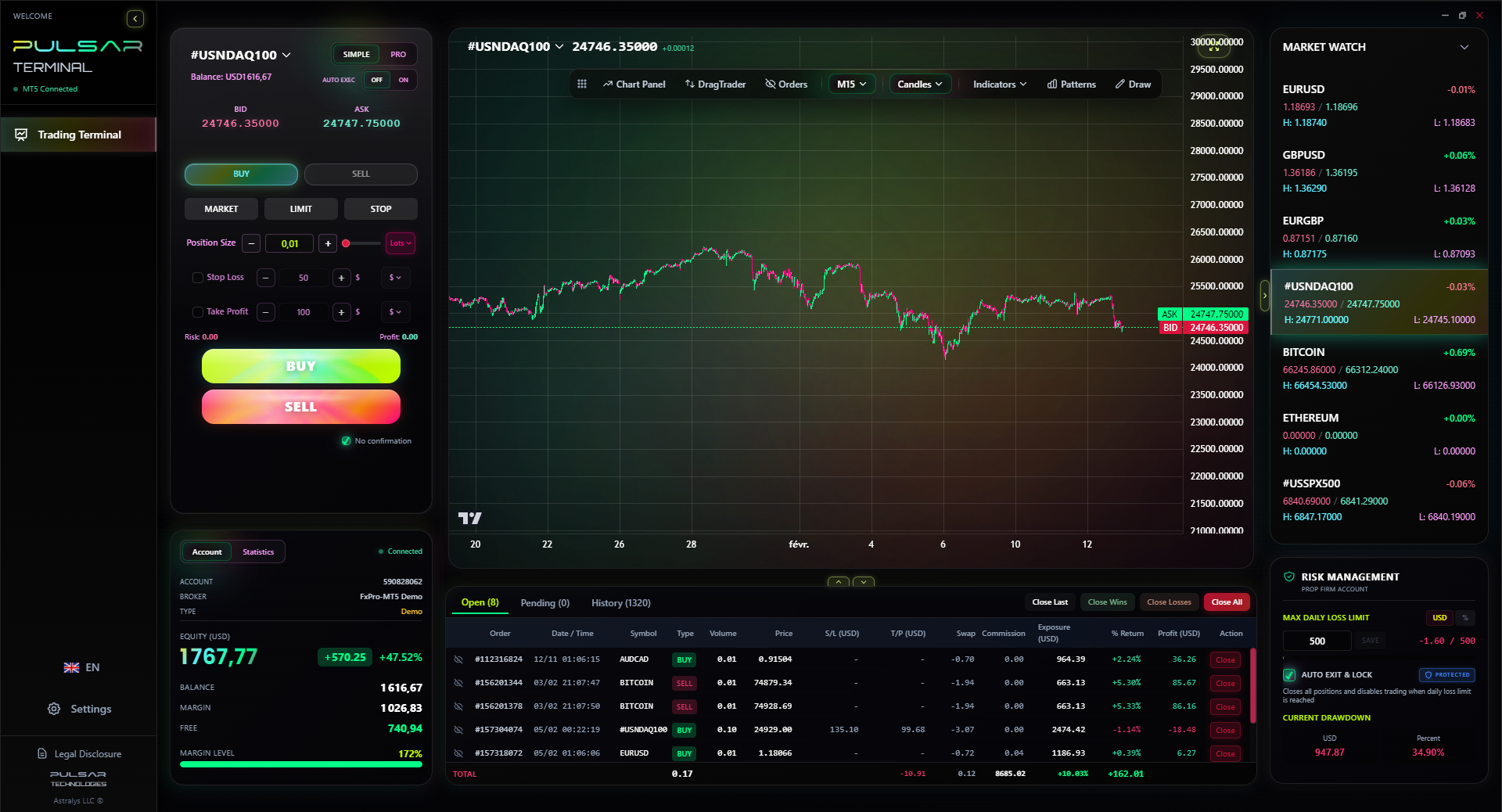
Managing multiple take-profit levels and trailing stops on volatile gold trades is complex, but tools like Pulsar Terminal automate this directly on your MT5 platform.
Pulsar Terminal
L'outil MT5 tout-en-un : ordres glisser-déposer, multi-TP/SL, trailing stop, grid trading, Volume Profile et protection prop firm. Utilisé quotidiennement par 1 000+ traders.
“Forcing a stop-loss too tight on gold is a guaranteed way to get stopped out before the move happens.”
Let's get painfully honest. Here's where I've handed money over to the market.
Trading Gold Like Forex: My 2013 Cyprus disaster. I ignored the fear driver. Gold is a sentiment animal, not just an economic one.
Overleveraging on 'Sure Things': In 2020, during the initial COVID panic, gold was soaring. I thought the pullback was over and went all-in with maximum position size at $1,920. The MACD indicator was showing divergence, but I ignored it. It dropped to $1,850. I was down over 15% on my account in a week. A brutal lesson in humility and ignoring contrarian signals.
Chasing Breakouts During London Fix: Gold is heavily traded around the London AM fix (10:30 AM London time). False breakouts are common. I've been whipsawed buying a breakout above the Asian high, only to see it slam back down 10 minutes later. Now I wait for the post-fix price action to settle, usually after 11:00 AM London.
Ignoring Confluence: One indicator saying 'buy' isn't enough. You need confluence. Price at support, RSI indicator showing oversold, and a bullish candle pattern. The more reasons you have, the better the odds. A single signal is just noise.
Finally, the biggest mistake: not having a written plan. Before every trade, I write down: Entry reason, entry price, stop-loss, take-profit, and what would invalidate my idea. If it's not written, it's not a trade. It's a gamble.
💡 Conseil de Winston
Your first profit target on any gold trade should be to move your stop to breakeven. Gold's retracements are vicious. Lock in safety before greed.
Let's put this all together. Here's how to place your first educated gold trade.
- Open a Demo Account: Pick a reputable ASIC broker like Pepperstone or Exness. Use their demo platform. Trade with virtual money for at least a month. Get a feel for the volatility.
- Analyze the Macro: Check the 10-year TIPS yield chart. Is it trending up or down? Check the DXY. What's the macro bias for gold this week?
- Find a Setup: On your 4-hour chart, is price pulling back to a clear support (if bias is long) or resistance (if bias is short)? Be patient.
- Calculate Your Trade: Use your position size calculator. If your demo account is $10,000, risk 1% ($100). If your stop-loss is 150 points away, you can trade approximately 6.6 micro lots (since 1 micro lot = $0.10 per pip, 150 pips * $0.10 * 6.6 = ~$99 risk).
- Place the Trade: Enter, set your stop-loss and take-profit. Write down your plan.
- Review: Win or lose, review the trade. Did it follow your plan? Did the market respect the level? What does the MACD indicator show now?
Start small. Your first goal is not to make money. It's to execute your plan flawlessly. The profits will follow the process. Gold trading is a marathon of disciplined decisions, not a sprint for quick bucks. It's one of the most rewarding markets to master, but it demands respect. Give it that, and you've got a fighting chance.
FAQ
Q1What's the best time of day to trade gold forex in Australia?
The most volatile and liquid sessions overlap with the London and New York markets. For Aussie traders, this is from around 5:00 PM AEST (London open) through to the early morning hours (New York afternoon). The London AM fix (around 7:30 PM AEST) often creates a volatility spike. Avoid the dead hours of the Sydney afternoon (2:00 PM - 5:00 PM AEST).
Q2Is XAU/AUD better to trade than XAU/USD?
Generally, no. XAU/USD has vastly higher liquidity, meaning much tighter spreads (often under 0.50 USD vs. 80+ pips for XAU/AUD). The spread on XAU/AUD alone can eat up your potential profit on a small move. Unless you have a very strong, specific view on the AUD against gold itself, stick with the global benchmark, XAU/USD.
Q3How much money do I need to start trading gold forex?
With ASIC's 20:1 use, you need significant margin to control a meaningful position. Realistically, to trade with proper risk management (not over-leveraging), a minimum of $2,000 is a sensible starting point for a live account. This allows you to trade micro lots and risk 1% per trade. Start with a demo account regardless of your capital.
Q4Why does my gold CFD price differ from the spot gold price I see online?
The price your broker shows is a CFD price derived from the underlying spot market. It will be almost identical, but may include a small mark-up or reflect the broker's own liquidity. The bigger difference comes from the spread - the gap between the buy and sell price. The 'spot price' you see online is usually a mid-point. You'll always buy slightly higher and sell slightly lower.
Q5What's the biggest risk when trading gold?
Volatility and gaps. Gold can move $50 in an hour on news. It can also gap open over the weekend due to geopolitical events. This means your stop-loss can be executed at a much worse price than you set, leading to a larger loss than planned. Always size your positions knowing this can happen.
Q6Can I use automated trading or EAs on gold?
You can, but be extremely careful. Most EAs are built for forex and fail miserably on gold's unique volatility. They often can't handle the larger stop distances and faster moves. If you use one, it must be specifically designed and extensively backtested on gold's character. I've found discretionary trading based on the macro drivers works far better.
La leçon du Prof. Winston
Points clés:
- ✓Trade gold's macro bias (real yields & USD), not just its chart.
- ✓ASIC's 20:1 use is a protective gift, not a limitation.
- ✓Never risk more than 1-2% per trade on XAU/USD.
- ✓Wait for price to retrace to key levels before entering.
- ✓The spread difference between brokers can define your success.
Cet article vous a-t-il été utile ?
Cliquez sur une étoile
Analyses Trading Hebdo
Analyses et stratégies hebdo gratuites. Pas de spam.
À propos de l'auteur
Sarah Collins
Stratégiste Trading
Stratégiste de trading basée à Londres avec 12 ans d'expérience sur les marchés financiers. Ancienne analyste dans un courtier de la City. Couvre les paires GBP, les marchés européens et le trading sous régulation FCA.
Commentaires
Avertissement sur les risques
Le trading d'instruments financiers comporte des risques importants et peut ne pas convenir à tous les investisseurs. Les performances passées ne garantissent pas les résultats futurs. Ce contenu est fourni à titre éducatif uniquement et ne constitue pas un conseil en investissement. Effectuez toujours vos propres recherches avant de trader.
Vous aimerez aussi

Cara Trading Forex Sukses: 7 Prinsip dari Trader Profesional
Cara trading forex sukses dengan 7 prinsip trader pro: manajemen modal, disiplin, journal trading, backtest. Data nyata, bukan janji profit palsu.
Jam Trading Forex Terbaik untuk Trader Indonesia: Panduan Lengkap dengan Tabel Waktu
Panduan jam trading forex untuk trader Indonesia. Tabel 4 sesi dunia, jam emas 20:00-00:00, sesi mana yang harus dihindari. Data akurat + tips dari trader berpengalaman.
Top 5 Sàn Forex Uy Tín Nhất 2026: Review Jujur dari Trader Indonesia
Top 5 sàn forex uy tín 2026 untuk trader Indonesia. Review jujur: spread, deposit, withdraw, dukungan lokal. Exness, XM, IC Markets & lebih.
Obtenir Pulsar Terminal
Tous ces calculateurs sont intégrés dans Pulsar Terminal avec des données en temps réel de votre compte MT5. Dimensionnement de position en un clic, gestion automatique des risques et calculs instantanés.
Obtenir Pulsar Terminal