


What are the best forex trading hours in South Africa, and how do you actually make money with them? If you're trading from Johannesburg, Cape Town, or Durban, you've got a unique advantage with your time zone.

David van der Merwe
Trader des Marchés Émergents ·  South Africa
☕ 12 min de lecture
Ce que vous apprendrez :
- 1The Forex Market Clock: How It Works for South Africans
- 2The Best Times to Trade Forex from South Africa
- 3Trading the ZAR: Unique Hours and Considerations
- 4Weekends, Holidays, and the Dreaded Gaps
- 5Building Your Daily Trading Routine Around SAST
- 6Essential Tools to Manage Trading Hours
- 7Common Mistakes South African Traders Make with Time
What are the best forex trading hours in South Africa, and how do you actually make money with them? If you're trading from Johannesburg, Cape Town, or Durban, you've got a unique advantage with your time zone. The market's open 24/5, but that doesn't mean you should be glued to your screen the whole time. I've been trading from SA for over a decade, and I'll show you exactly when the real opportunities happen, when to avoid the market, and how to structure your day around SAST. Let's get into the specifics of trading hours forex South Africa traders need to know.
First things first: the forex market doesn't sleep during the work week. It's a 24-hour beast, but it moves in distinct pulses based on which financial centers are open. For us in South Africa, we're on SAST (UTC+2), which puts us in a sweet spot between Asia, Europe, and the US.
The official trading week starts Sunday at 10:00 PM SAST when Sydney opens, and it runs straight through until Friday at 11:00 PM SAST when New York closes. That's your window. No trading on weekends - the banks are closed, and liquidity dries up completely.
Here's the breakdown of the major sessions in SAST:
| Session | Major Financial Center | SAST Trading Hours | Key Characteristics |
|---|---|---|---|
| Asian | Tokyo, Sydney | 10:00 PM - 8:00 AM | Lower volatility, range-bound moves. Good for certain JPY pairs. |
| European | London, Frankfurt | 8:00 AM - 5:00 PM | High liquidity, major trend moves begin. The engine room. |
| North American | New York, Chicago | 2:00 PM - 11:00 PM | Extreme volatility, news-driven moves. Where most action happens. |
Now, here's what most new traders miss: the market isn't equally active all the time. Those overlaps between sessions? That's where you make your money. The European/North American overlap (2:00 PM to 5:00 PM SAST) sees over 70% of the day's total volume. Spreads tighten, moves get decisive, and if you have a day job, this is when you need to be focused.
I learned this the hard way early on. I used to try trading the Asian session from 4:00 AM, thinking I was getting a head start. All I got was chopped up in tiny 10-pip ranges and a serious sleep deficit. Save your energy for when the big players are at their desks.

Warning: Don't confuse 'market is open' with 'market is tradeable.' Just because you can place an order at 3:00 AM SAST doesn't mean you should. Low liquidity can lead to wider spreads and erratic price spikes.

💡 Conseil de Winston
The market pays you for your patience, not your presence. Just because the screen is lit doesn't mean you need to be trading.
“The 24/5 market is a privilege, not a command. You don't get paid for screen time.”
Alright, let's get practical. Based on SAST, here are the golden hours and what to trade during them.
The London Open (8:00 AM - 10:00 AM SAST)
This is your first major opportunity of the day. London is the world's largest forex hub, and when those traders hit their desks, volume spikes. I've found this to be excellent for breakout strategies on EUR/USD and GBP/USD. The initial 90 minutes often set the tone for the European session.
A specific trade I remember: On October 15 last year, I was watching GBP/USD ahead of the 8:00 AM London open. Price was coiling in a tight 15-pip range. At 8:03 AM, a surge of volume came in and broke it north. I entered at 1.2185 and rode it for 45 pips to 1.2230 by 9:30 AM. The early bird gets the worm, but only if the bird is in London.
The London-New York Overlap (2:00 PM - 5:00 PM SAST)
This is the main event. Both London and New York are fully online. This three-hour window is the most liquid and volatile period of the entire 24-hour cycle. It's when major economic data (US CPI, Fed decisions, NFP) is usually released. This is prime time for any scalping strategy or momentum trading.

Pro Tip: If you can only trade one block of time per day, make it this one. Set your alerts, have your charts ready by 1:45 PM SAST, and focus. This overlap accounts for the majority of my profitable trades each month.
The US Session Alone (5:00 PM - 11:00 PM SAST)
After London closes at 5:00 PM SAST, the market is driven by New York. Volatility can remain high, especially if there's late US news. This is a good time for trading USD/CAD or USD/JPY. It's also when I often manage or close trades I entered during the overlap.
What about the Asian session (10:00 PM - 8:00 AM SAST)? For most major pairs like EUR/USD, it's a snoozefest. It can be useful for analyzing the chart and setting orders for the coming day, but live trading it requires immense patience. The one exception is if you're trading AUD/USD or NZD/USD, which can see action around Australian economic releases.
The key is to match your strategy to the session's personality. Don't try to scalp for 5-pip profits during the dead Asian night, and don't try to swing trade a 4-hour hold during the manic overlap. Your broker's conditions matter here too - during high volatility, even a good broker's spread can widen momentarily on news.
“Over 70% of the day's forex volume happens in just three hours: the London-New York overlap.”
Trading the South African Rand (ZAR) pairs like USD/ZAR or EUR/ZAR is a different ball game. While the global market is 24/5, liquidity for emerging market currencies like the Rand has more specific windows.
The most active trading for ZAR pairs happens during South African business hours, roughly 9:00 AM to 5:00 PM SAST, when the JSE is open and local banks are active. This is when you'll get the tightest spreads. Outside of these hours, especially during the Asian session, liquidity can plummet. I've seen the spread on USD/ZAR blow out from 15 pips to 60+ pips after 8:00 PM SAST.
This creates a specific risk. If you hold a ZAR trade overnight, a gap is more likely due to this lower liquidity. A piece of local news hitting when London is asleep can cause a sharp move with few buyers or sellers to smooth it out.
Also, remember the SARB's Exchange Control Regulations. You, as a South African resident, are not allowed to speculate against the Rand. In practice, this means brokers regulated here won't let you open a short (sell) position on a ZAR pair if your account is in ZAR. You can go long (buy) USD/ZAR, betting the Rand will weaken, but you can't short it to bet on Rand strength. This is a crucial local rule many overlook.
For this reason, many serious ZAR traders use international brokers who offer ZAR pairs but aren't bound by that specific rule for international clients. It's a gray area, so do your homework. My advice? If you're new, stick to the major pairs first. The EUR/USD guide is a better place to learn the ropes before tackling the unique volatility of ZAR.
“Over 70% of the day's forex volume happens in just three hours: the London-New York overlap.”
The market closes on Friday at 11:00 PM SAST and reopens Sunday at 10:00 PM SAST. That weekend closure is when global events accumulate and cause price gaps at the Sunday open.
I've been gap-hunted more than once. One brutal example: I was long EUR/USD over a weekend in 2022, holding a 20-pip profit. A surprise central bank comment came out Sunday afternoon. The pair gapped down 45 pips at the open, instantly putting me in a 25-pip loss before I could even blink. My stop-loss was useless; it was executed at the first available price, way past my level.
Warning: Holding positions over the weekend is a calculated, high-risk gamble. You're betting nothing major will happen globally for 48 hours. For most retail traders, it's just not worth the stress.
The safer play? Be a weekend planner, not a weekend holder. Use Saturday and Sunday to analyze weekly charts, plan your trades for the week ahead, and set alerts. But close your positions before Friday night.
South African public holidays also matter. If it's a holiday here but a normal day in London or New York, the market still runs. However, liquidity might be slightly lower if local institutions are offline. Major global holidays like Christmas and New Year's Day see virtually no trading - the spreads become enormous, and it's best to just stay away. Check your broker's holiday schedule; they'll list when trading is unavailable.
💡 Conseil de Winston
Treat the 2:00 PM - 5:00 PM SAST overlap like a surgeon's operating theatre. Have your tools ready, your plan sterile, and focus completely. No distractions.
“Trading the wrong session is like trying to surf on a calm lake. You need the right wave.”
How do you structure a day as a South African trader? Here's a sample routine that's worked for me and many traders I mentor.
Early Morning (6:00 AM - 8:00 AM SAST): Analysis & Planning
- Review what happened in the US session after you went to bed. Check your swing trading positions.
- Scan the economic calendar for the day. Key events? London open? US data at 4:30 PM SAST?
- Mark key support/resistance levels on your charts. No trading yet, just preparation.
London Session (8:00 AM - 2:00 PM SAST): Active Trading Window
- Be at your desk for the London open (8:00 AM). Look for the initial directional move.
- This is your first major trading block. Focus on European pairs.
- By 1:00 PM, start preparing for the volatility of the overlap.
Overlap & US Session (2:00 PM - 8:00 PM SAST): Prime Time
- From 2:00 PM to 5:00 PM, you should be fully focused. This is non-negotiable if you have open trades or are looking for entries.
- Trade your plan. This is when news hits, so if you're not a news trader, consider stepping aside during major announcements like the Fed.
- After 5:00 PM, manage existing trades. I rarely enter new positions after 7:00 PM SAST unless there's a very clear setup.
Evening (8:00 PM - 11:00 PM SAST): Review & Wind Down
- Close out any day trades you don't want to hold overnight.
- Review your day's trades. What worked? What didn't? Journal it.
- Set any alerts or pending orders for the Asian session or next London open.
- Market closes at 11:00 PM. Walk away.
This routine respects the market's rhythm and protects your time. You're not trying to catch every pip, just the high-probability moves during active hours. A good broker with reliable execution is key during these busy windows; platforms can lag during high volume. I've had good experiences with the stability of IC Markets and Pepperstone during these peak SAST times.
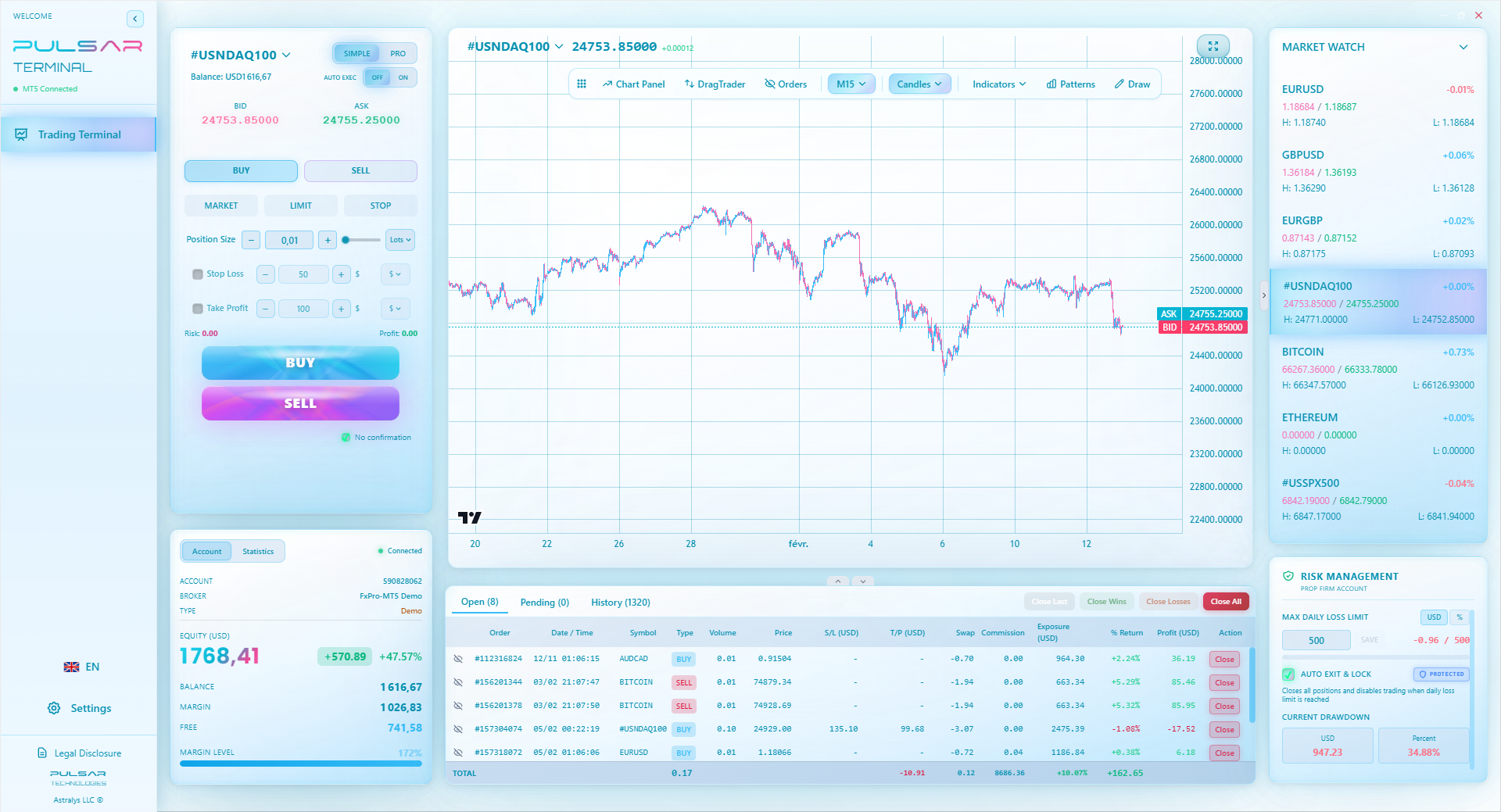
Sticking to a disciplined routine is easier with tools that automate trade management, like Pulsar Terminal's trailing stops and breakeven functions on MT5.
Pulsar Terminal
L'outil MT5 tout-en-un : ordres glisser-déposer, multi-TP/SL, trailing stop, grid trading, Volume Profile et protection prop firm. Utilisé quotidiennement par 1 000+ traders.
“Trading the wrong session is like trying to surf on a calm lake. You need the right wave.”
You can't be watching the clock all day. Use technology to do it for you.
- Economic Calendar: This is your bible. Filter it to SAST. Know when high-impact news (red events) are scheduled for the US (often 4:30 PM SAST) or Europe (11:00 AM SAST). I never enter a new trade 15 minutes before a major release.
- Session Indicator Scripts: Most platforms (MT4/MT5) have free indicators that shade the chart based on the Asian, London, and New York sessions. This gives you a visual cue of when volume should pick up or drop off.
- Price Alert Notifications: Set alerts at key price levels you've identified in your morning analysis. When price hits that level at 3:00 PM SAST, your phone buzzes. You don't need to stare at the screen.
- Broker Tools: Use your broker's platform features. Set trailing stops to lock in profits during volatile runs, or use guaranteed stop-loss orders (for a fee) around news events if you're worried about gaps.
A mistake I made for years was underestimating the power of a simple checklist. Now, I have a pre-session checklist: Are my charts clean? Is the news calendar clear? Is my position size calculator ready? This 2-minute drill prevents impulsive mistakes when the market gets busy.
Finally, understand your own energy levels. If you're not a morning person, maybe the London open isn't for you. Focus on the US afternoon (evening SAST). The best trading hours forex South Africa offers are useless if you're too tired to think straight.
💡 Conseil de Winston
Your most important trading tool isn't an indicator; it's the 'off' button on your trading platform. Know when to walk away.
“The best trade you'll make today might be the one you decide not to take.”
Let's talk about the pitfalls so you can avoid them.
Mistake 1: Trading the Dead Zones. Trying to force trades between 11:00 PM and 6:00 AM SAST is like fishing in a pond that's been drained. The moves are slow, spreads are often wider (brokers have to cover their risk), and breakouts usually fail. Save your capital and your sleep.
Mistake 2: Ignoring the Overlap. This is the opposite error. Some traders, especially those with day jobs, try to trade only in the morning SAST and completely miss the 2:00 PM - 5:00 PM power window. If you can't trade live then, at least use stop and limit orders to participate.
Mistake 3: Overtrading Because 'The Market is Open'. The 24/5 access is a privilege, not a command. You don't need to be in a trade constantly. I used to feel this pressure, leading to 3-4 low-quality trades a day. Now, I might take 1-2, but they're during my planned high-probability windows. Quality over quantity.
Mistake 4: Not Accounting for Daylight Saving Time (DST). SAST doesn't change, but London and New York do. When they spring forward or fall back, your overlap shifts by an hour. Mark the DST change dates on your calendar. Showing up an hour late for the main session is a sure way to miss the move.
Mistake 5: Poor Time-Specific Risk Management. Volatility changes with the session. A 20-pip stop-loss might be fine for the London session but get vaporized in 2 seconds during the US NFP news at 4:30 PM SAST. Adjust your risk parameters for the time of day you're trading. During high volatility, consider widening your stop or reducing your position size. The last thing you want is a premature margin call because you used Asian-session stops in a New York storm.
FAQ
Q1What are the exact forex market opening and closing times in South Africa?
The forex market opens on Sunday at 10:00 PM SAST and closes for the week on Friday at 11:00 PM SAST. It runs continuously between those times.
Q2What is the best time of day to trade forex in South Africa?
The absolute best time is the London-New York overlap from 2:00 PM to 5:00 PM SAST. This period has the highest liquidity and volatility, offering the best trading opportunities for most strategies.
Q3Can I trade USD/ZAR at 3:00 AM South African time?
Technically yes, but you shouldn't. Liquidity for ZAR pairs dries up significantly outside South African business hours (9:00 AM - 5:00 PM SAST). Spreads widen dramatically, making trading costly and risky.
Q4How does daylight saving time overseas affect my trading hours?
SAST stays constant, but London and New York switch to BST and EDT/EST. This means the London open shifts to 9:00 AM SAST (from 8:00 AM) and the key overlap shifts to 3:00 PM - 6:00 PM SAST for part of the year. Always check the international DST dates.
Q5Is it safe to hold trades over the weekend?
It's generally considered high-risk. The market is closed, but global events continue. Gaps at the Sunday open are common and can instantly hit your stop-loss at a much worse price. Most retail traders close positions before Friday's close at 11:00 PM SAST.
Q6What should I do during quiet trading hours (Asian session)?
Use this time for analysis, planning, education, and reviewing your strategy. Set alerts and pending orders for the upcoming London session. It's a time for preparation, not active trading for most pairs.
Q7Do South African public holidays affect forex trading?
Local liquidity for ZAR pairs may be lower, but the global forex market remains open. On major global holidays like Christmas, trading may be unavailable or have extremely limited liquidity. Always check your broker's official holiday schedule.
La leçon du Prof. Winston
Points clés:
- ✓Focus only on the London open (8:00 AM SAST) and the London-NY overlap (2:00 PM - 5:00 PM SAST).
- ✓Avoid trading ZAR pairs outside 9:00 AM - 5:00 PM SAST due to wild spreads.
- ✓Never hold speculative trades over the weekend unless you can afford a gap.
- ✓Adjust your stop-loss size for the session's volatility.
- ✓Use quiet hours for planning, not forced trading.
Cet article vous a-t-il été utile ?
Cliquez sur une étoile
Analyses Trading Hebdo
Analyses et stratégies hebdo gratuites. Pas de spam.
À propos de l'auteur
David van der Merwe
Trader des Marchés Émergents
Trader basé à Johannesbourg avec 11 ans d'expérience sur les devises des marchés émergents. Spécialisé dans les paires ZAR, le trading régulé par la FSCA et l'analyse du marché sud-africain.
Commentaires
Avertissement sur les risques
Le trading d'instruments financiers comporte des risques importants et peut ne pas convenir à tous les investisseurs. Les performances passées ne garantissent pas les résultats futurs. Ce contenu est fourni à titre éducatif uniquement et ne constitue pas un conseil en investissement. Effectuez toujours vos propres recherches avant de trader.
Vous aimerez aussi

Cara Trading Forex Sukses: 7 Prinsip dari Trader Profesional
Cara trading forex sukses dengan 7 prinsip trader pro: manajemen modal, disiplin, journal trading, backtest. Data nyata, bukan janji profit palsu.
Jam Trading Forex Terbaik untuk Trader Indonesia: Panduan Lengkap dengan Tabel Waktu
Panduan jam trading forex untuk trader Indonesia. Tabel 4 sesi dunia, jam emas 20:00-00:00, sesi mana yang harus dihindari. Data akurat + tips dari trader berpengalaman.
Top 5 Sàn Forex Uy Tín Nhất 2026: Review Jujur dari Trader Indonesia
Top 5 sàn forex uy tín 2026 untuk trader Indonesia. Review jujur: spread, deposit, withdraw, dukungan lokal. Exness, XM, IC Markets & lebih.
Obtenir Pulsar Terminal
Tous ces calculateurs sont intégrés dans Pulsar Terminal avec des données en temps réel de votre compte MT5. Dimensionnement de position en un clic, gestion automatique des risques et calculs instantanés.
Obtenir Pulsar Terminal