


I lost $450 on a single EUR/USD trade because I ignored a simple candlestick.

Olumide Adeyemi
Pionnier du Trading en Afrique de l'Ouest ·  Nigeria
☕ 14 min de lecture
Ce que vous apprendrez :
I lost $450 on a single EUR/USD trade because I ignored a simple candlestick. The price was climbing, I was feeling good, and then a single red candle with a tiny body and a massive upper wick appeared. I thought, 'It's just a pullback.' I held on. That candle was a Shooting Star, a classic bearish reversal signal. The market turned, hit my stop-loss, and wiped out my profit from three previous trades. That painful lesson taught me that understanding the different types of candlesticks in forex isn't just academic, it's the difference between keeping your capital and watching it vanish. For us trading in Nigeria, with the Naira's volatility and high use offers from brokers like Exness, reading these signals correctly is survival.
Before we get into the fancy patterns, let's break down the basic building block. A single candlestick is a snapshot of the market's battle between buyers and sellers over a specific time period - whether that's one minute, one hour, or one day.
Think of it like a scorecard for a boxing round. It shows you who won the round (bulls or bears), how fiercely they fought, and who had the upper hand at different moments.
Every candlestick has four critical pieces of information:
| Part of the Candle | What It Tells You |
|---|---|
| Open | The price when the period (e.g., the 1-hour candle) began. |
| Close | The price when the period ended. This is the most important price. |
| High | The highest price reached during that period. |
| Low | The lowest price reached during that period. |
The rectangle in the middle is called the real body. It shows the range between the open and close. If the close is above the open, the body is typically green or white (bullish). If the close is below the open, it's red or black (bearish).
The thin lines above and below the body are the wicks (or shadows). They show the extreme highs and lows the price tested but failed to hold. A long upper wick means buyers pushed price up, but sellers smashed it back down. A long lower wick is the opposite.

Example: Let's say you're looking at GBP/USD on a 15-minute chart. A candle opens at 1.2650, rallies to a high of 1.2670, drops to a low of 1.2635, and finally closes at 1.2660. That's a green candle (close > open). The body spans 1.2650 to 1.2660 (10 pips). The upper wick is 10 pips long (1.2660 to 1.2670), and the lower wick is 15 pips long (1.2635 to 1.2650). That long lower wick tells a story of a sell-off that was aggressively bought back.
Understanding this basic structure is how you start to see the story behind the price movement. It's the foundation for all the patterns we'll discuss. When you combine this with smart position size calculator use, you're building a solid trading plan from the ground up.
“That painful lesson taught me that understanding the different types of candlesticks in forex isn't just academic, it's the difference between keeping your capital and watching it vanish.”
Some of the strongest signals come from just one candle. These are the workhorses of my chart analysis, especially for quick decisions in volatile markets like when news hits the Naira.
The Doji: The Ultimate Indecision
This is where the open and close are virtually identical. The body is a tiny line, and it can have varying wick lengths. A Doji screams, 'The bulls and bears are in a deadlock.' After a strong trend, a Doji often signals exhaustion and a potential reversal. I've seen it countless times at key support or resistance levels. Don't trade the Doji in isolation, but treat it as a massive warning sign to tighten stops or prepare for a move.
The Hammer and Hanging Man
These look identical but mean opposite things depending on the trend. A Hammer has a small body at the top and a long lower wick that's at least twice the body's height. It forms in a downtrend. It tells you sellers drove price down hard, but by the close, buyers fought back to push it near the open. It's a potential bullish reversal signal. I caught a beautiful Hammer on USD/NGN (yes, some brokers offer it as a CFD) last year after a sharp drop, which led to a 180-pip rally.
The Hanging Man has the same shape but forms at the top of an uptrend. It's a bearish warning. That long lower wick shows buyers finally lost control during the session.
The Shooting Star and Inverted Hammer
These are the upside-down versions. A Shooting Star (my nemesis from the intro) has a small body at the bottom and a long upper wick. It appears in an uptrend. Price rallies, gets rejected hard, and closes near its lows. Classic bearish reversal.
The Inverted Hammer has the same shape but forms in a downtrend. It's a bullish signal, suggesting buyers are starting to test the waters despite the selling pressure.

Pro Tip: The color of the small body matters less than the candle's position in the trend and the length of the wick. Context is king. A green Hammer is slightly more bullish than a red one, but the structure is the main signal.
These single candles are fantastic for scalping strategy entries or for adding to existing swing trading positions. They give you a clear, visual point to place a stop-loss (usually just beyond the tip of the long wick).

💡 Conseil de Winston
A candlestick pattern is a clue, not a command. The market's overall trend is the detective in charge of the case.
“A Doji screams, 'The bulls and bears are in a deadlock.' After a strong trend, it often signals exhaustion and a potential reversal.”
When two candles team up to tell a story, you should listen closely. These patterns confirm that a shift in momentum is happening.
Bullish and Bearish Engulfing Patterns
This is one of the most reliable signals in my toolkit. A Bullish Engulfing pattern happens in a downtrend. The first candle is a red (bearish) candle. The second candle is a larger green (bullish) candle that completely 'engulfs' the body of the first. It visually shows buyers overwhelming the sellers from the previous period.
The Bearish Engulfing is the mirror image at the top of an uptrend: a small green candle followed by a large red candle that swallows it. I used a Bearish Engulfing on XAU/USD (Gold) to exit a long trade at $2045, just before a $50 drop. The second candle closed below the low of the first, which was my confirmation to get out.
Piercing Line and Dark Cloud Cover
These are slightly less aggressive siblings of the engulfing patterns. The Piercing Line is a bullish reversal. First, a long red candle. Second, a green candle that opens below the low of the first candle but then rallies to close above the midpoint of the first candle's body. It shows a strong intra-session recovery.
Dark Cloud Cover is the bearish counterpart. After a long green candle, a red candle opens above the previous close but then sells off to close below the midpoint of the first candle's body. It's like a dark cloud rolling over a sunny sky.

Warning: Always wait for the second candle to close before acting on these patterns. A lot of new traders jump in mid-formation, only to see the price reverse again before the close, trapping them. Patience is a strategy.
These two-candle patterns provide a clearer area for your stop-loss (below the low of the pattern for bullish, above the high for bearish) and help you gauge the strength of the new move. They work on any timeframe, but the higher the timeframe (like 4-hour or daily), the more weight they carry.
“A Doji screams, 'The bulls and bears are in a deadlock.' After a strong trend, it often signals exhaustion and a potential reversal.”
These patterns unfold over three or more candles. They take more patience to identify, but they often signal more significant trend changes or continuations.
The Morning and Evening Stars
Think of these as the three-act play of candlestick patterns. The Morning Star is a bullish reversal at the bottom of a downtrend.
- Act 1: A long red candle (selling pressure continues).
- Act 2: A small-bodied candle (a Doji or Spinning Top) that gaps down. This is the 'star' and shows indecision.
- Act 3: A long green candle that gaps up and closes well into the body of the first red candle. Buyers have decisively taken over.
The Evening Star is the exact opposite, forming at a market top. It's a powerful sign to take profits or look for short entries.
Three White Soldiers and Three Black Crows
These are about momentum, not reversal. Three White Soldiers are three consecutive, long green candles with each closing higher than the last, appearing after a period of stability or downtrend. They show sustained buying pressure. Three Black Crows are three long red candles closing lower and lower, showing relentless selling.
Continuation Patterns: The Rising and Falling Three Methods
These patterns tell you the trend is pausing to catch its breath before continuing. The Rising Three Methods happens in an uptrend:
- A long green candle.
- A series of three (or so) small, consolidating candles that stay within the range of the first long candle. These are usually red, showing minor profit-taking.
- Another long green candle that breaks above the first candle's high, resuming the uptrend. The Falling Three Methods is the bearish version in a downtrend.
These patterns are excellent for adding to winning positions or for avoiding the mistake of exiting a trend too early. When I see a Rising Three Methods forming on a major like EUR/USD, I often look to place a buy order above the consolidation range, using the low of the pattern as my stop. It's a way to trade with the trend's momentum. Combining this pattern recognition with an indicator like the MACD indicator for confirmation can be very effective.
💡 Conseil de Winston
If you can't immediately see where to place your stop-loss when you look at a pattern, you shouldn't be placing the trade.
“The best patterns form at confluences: trendlines, major support/resistance, or alongside overbought/oversold readings. Wait for the story to make sense.”
Knowing the patterns is one thing. Applying them in our unique market is another. Here’s how I make candlestick analysis work for me here in Nigeria.
First, Context is Everything. A Hammer pattern is meaningless if it forms in the middle of a ranging market on USD/NGN. It only has power at the bottom of a clear downtrend or at a known support level. Always ask: 'What is the overall trend?' Use higher timeframes (like the 4-hour chart) to establish the trend, then use lower timeframes (like 15-minute or 1-hour) and their candlestick patterns to find precise entries.
Second, Manage Your use. Brokers like Exness or XM offer incredibly high use here - sometimes 1:1000 or more. This is a double-edged sword. A correct read on a Doji reversal can magnify profits. A wrong read on an Engulfing pattern can trigger a margin call instantly. I never use the maximum use offered. A good rule is to size your position so that even if you're wrong on a clear pattern, your loss is a small, pre-defined percentage of your account (1-2%).
Third, Factor in the Spread. When you're trading with a broker, their profit comes from the spread definition. On exotic pairs or even majors during volatile times, spreads can widen. A broker like IC Markets might have a 0.0 pip spread on EUR/USD, but a wider one on GBP/NGN. If your profit target on a trade is only 15 pips, a 5-pip spread eats a third of your potential gain. Make sure your anticipated move (the distance from your entry to your target) is significantly larger than the spread.
A Real Trade Example: Last quarter, I was watching GBP/USD on the daily chart. It was in a steady uptrend. It then pulled back and formed a clear Morning Star pattern right on a key moving average. The third candle closed strong. I entered a buy at 1.2780. My stop-loss was placed below the low of the first (red) candle of the pattern at 1.2720 (60 pips risk). My first profit target was at a previous resistance level, 1.2880 (100 pips reward). The trade worked, hitting my target in a few days. The candlestick pattern gave me a clear, high-probability entry and a logical place for my stop.
Finally, remember the 10% tax. The FIRS wants 10% of your gross profits. When you're calculating your risk-reward, factor this in. A trade that makes a 100-pip profit before tax isn't a 100-pip profit for you. Keep clean records.
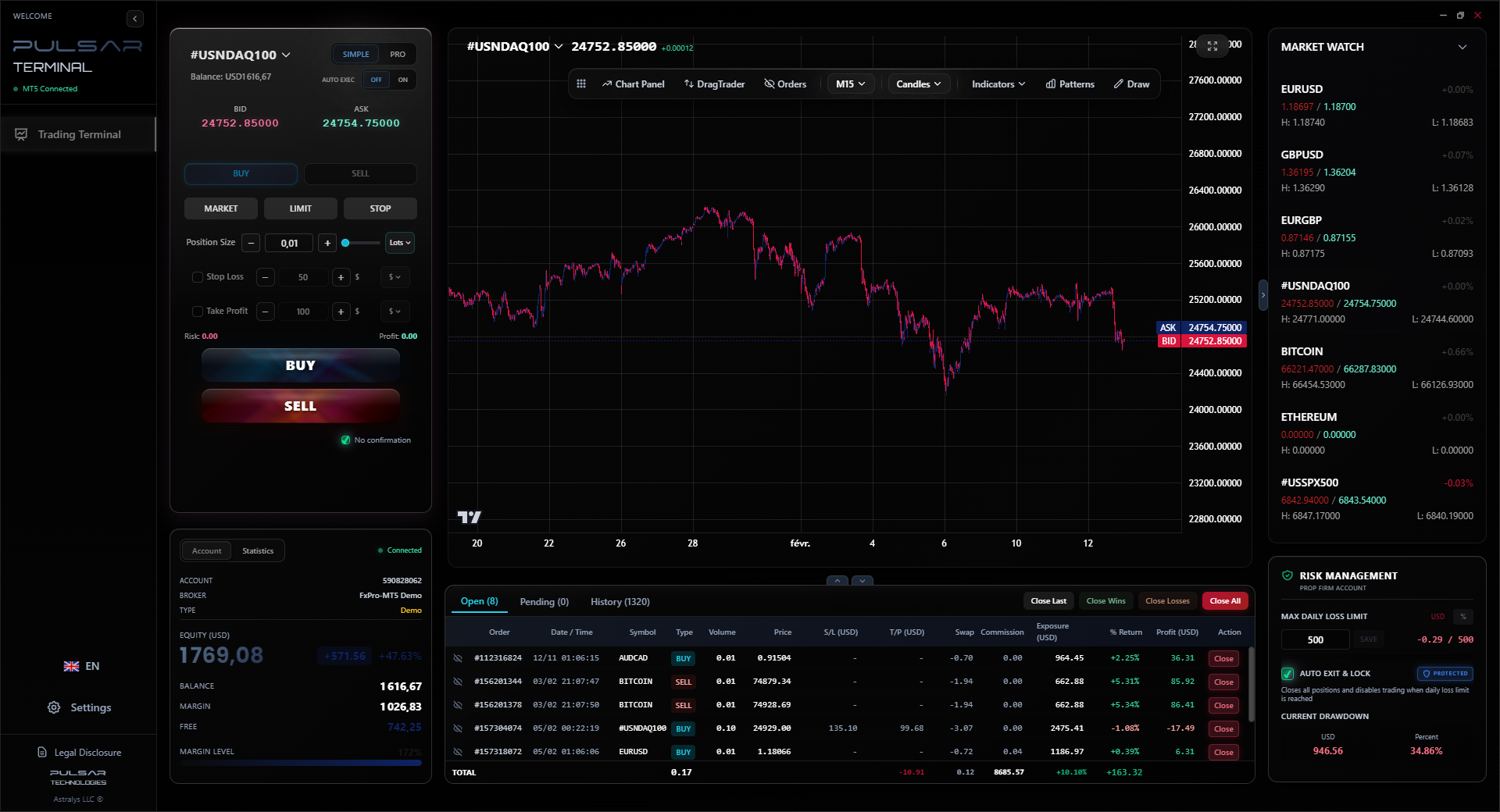
Spotting a perfect Morning Star is one thing; executing a multi-target trade with a trailing stop to protect profits is another. Pulsar Terminal automates this complex order management directly on your MT5 chart.
Pulsar Terminal
L'outil MT5 tout-en-un : ordres glisser-déposer, multi-TP/SL, trailing stop, grid trading, Volume Profile et protection prop firm. Utilisé quotidiennement par 1 000+ traders.
“The best patterns form at confluences: trendlines, major support/resistance, or alongside overbought/oversold readings. Wait for the story to make sense.”
I've blown up accounts learning this stuff. Here are the big pitfalls with candlestick trading, straight from my experience.
1. Trading Every Pattern You See. This was my biggest early mistake. I'd see a small Hammer on a 5-minute chart in the middle of nowhere and jump in. Candlesticks are not a crystal ball. They are probability tools. The best patterns form at confluences: trendlines, major support/resistance, Fibonacci levels, or alongside overbought/oversold readings on the RSI indicator. Wait for the story to make sense.
2. Ignoring the Wick. The body tells you who won the battle (bulls or bears). The wicks tell you how the battle was fought. A long wick is a rejection. Price went there and was forcefully pushed back. A candle with a long upper wick and a small green body is not a strong bullish candle, no matter how green it is. It shows weakness at the highs.
3. Not Waiting for Confirmation. A single Hammer is a signal, not a command. I can't count how many times I've bought a 'perfect' Hammer, only to see the next candle open and immediately drop below the Hammer's low, invalidating it. Many traders wait for the next candle to close above the Hammer's open/close as confirmation. That extra bit of patience saves capital.
4. Forgetting About Timeframes. A bullish engulfing pattern on a 1-minute chart is noise. The same pattern on a daily chart is a major event. Align your pattern timeframe with your trading style. If you're a day trader, focus on 15-minute to 1-hour charts. If you're a swing trader, the daily and 4-hour charts are your home. Don't mix them up.
5. Letting a Good Pattern Make You Overconfident. I once saw a perfect Evening Star on the weekly chart of a stock index CFD. I was so sure, I risked 5% of my account on the short trade. A week later, central bank news came out, the pattern failed, and I took a huge loss. No pattern works 100% of the time. Always use a stop-loss, and never let a 'perfect setup' convince you to break your own risk management rules. Your number one job is to protect your Naira capital.
💡 Conseil de Winston
The most profitable pattern you'll ever learn is the pattern of preserving your capital. Everything else is secondary.
“Your number one job is to protect your Naira capital. No pattern works 100% of the time.”
You don't need fancy software to start. MetaTrader 4 or 5 (MT4/MT5) is on almost every trader's phone and laptop in Nigeria and is offered by most brokers like Pepperstone and XM. It displays candlesticks perfectly.
Start Practicing:
- Go to a Free Demo Account. Open one with any major broker. It's play money, but the charts are real.
- Pick One Major Pair. Start with EUR/USD. It's liquid and tends to show clean patterns. You can find a dedicated EUR/USD guide to understand its quirks.
- Switch to Candlestick Charts. In your MT4 platform, right-click on the chart, go to 'Properties,' and select 'Candlesticks.'
- Look Back in Time. Scroll back on the chart and try to label patterns you see. 'That's a Doji at the top. That's an Engulfing pattern at that low.' Don't worry about predicting; just practice seeing them.
- Combine with One Indicator. Once you're comfortable spotting candles, add one trend or momentum indicator to the chart, like a moving average or the RSI. See how candlestick reversals often occur when the RSI is overbought or oversold.
The Final Word: Candlestick patterns are a language. At first, you'll slowly sound out the words (single candles). Then you'll form sentences (two-candle patterns). Eventually, you'll read paragraphs (multi-candle patterns) and understand the full story the market is telling. It takes screen time and patience. You will have losing trades even with perfect patterns. But if you combine this knowledge with strict discipline - controlling your use, using a position size calculator, and always using a stop-loss - you'll have a significant edge over traders who are just guessing. Start slow, risk small, and let the candles guide you.
FAQ
Q1What is the most reliable candlestick pattern for beginners in Nigeria?
For beginners, I'd start with the Engulfing patterns (Bullish and Bearish). They're visually clear, easy to spot, and their logic is straightforward: one side completely overpowering the other. They work well on the 1-hour and 4-hour charts for major pairs like GBP/USD or Gold (XAU/USD). Just remember to always trade them in the context of the overall trend and wait for the second candle to close for confirmation.
Q2How do I know if a Doji means a reversal or just a pause?
You don't know immediately, and that's the point. A Doji means indecision. The key is what happens next. If the next candle closes strongly above the Doji's high, the indecision was resolved to the upside. If it closes strongly below the Doji's low, it resolved to the downside. Never trade the Doji itself. Use it as a warning to watch for the next candle's direction, and be ready to act on that confirmation.
Q3Can I use candlestick patterns for scalping the Naira pairs?
You can, but be very careful. Pairs involving the Naira (like USD/NGN CFDs) can be less liquid and have wider, more volatile spreads. For scalping, focus on lower timeframes like the 1-minute or 5-minute chart. Single-candle patterns like Hammers, Shooting Stars, and Dojis become more relevant. However, the noise is also higher. It's a high-speed, high-stress environment. I'd recommend mastering patterns on 15-minute or 1-hour charts first before attempting to scalp with them.
Q4Do candlestick patterns work on all timeframes?
Yes, the patterns form on all timeframes, but their significance changes. A Bullish Engulfing on a monthly chart is a monumental event that could signal a trend change for months. The same pattern on a 1-minute chart might last for 10 minutes. Generally, the higher the timeframe, the more reliable the pattern and the larger the potential price move. Align the timeframe with your trading goals: use daily/weekly for long-term investing, 1-hour/4-hour for swing trading, and lower timeframes for day trading or scalping.
Q5How important is the color of the candle's body?
It's important, but it's not the only thing. The body color (green/red) tells you whether the period closed higher or lower than it opened - who won that round. However, the structure (the length of the wicks relative to the body) often tells a more important story about the battle within the period. A green candle with a very long upper wick is a weak close, showing sellers rejected higher prices. Context and structure usually trump color alone.
Q6Is it legal to use forex candlestick analysis in Nigeria?
Absolutely. Technical analysis, including candlestick charting, is a standard global practice. Forex trading itself is legal for individuals in Nigeria. The key legal point for you is taxation: the Federal Inland Revenue Service (FIRS) requires you to pay a 10% capital gains tax on your gross trading profits. Keep accurate records of your trades for your annual tax return.
Q7What's the biggest mistake new traders make with candlesticks?
Two big ones are linked: over-trading and ignoring risk management. They learn a few patterns and then see them everywhere, taking trades on low-quality setups without a clear stop-loss or profit target. They forget that a pattern is just a signpost, not a guarantee. The real skill isn't just spotting the pattern; it's knowing when to ignore it, how much to risk on it, and having the discipline to exit when you're wrong.
La leçon du Prof. Winston
Points clés:
- ✓Master single candles (Doji, Hammer) before complex patterns.
- ✓Always wait for candle close confirmation before entering.
- ✓Use patterns at confluences with support/resistance.
- ✓Never risk more than 2% of capital on any single pattern.
- ✓Factor the 10% FIRS tax into your profit calculations.
Cet article vous a-t-il été utile ?
Cliquez sur une étoile
Analyses Trading Hebdo
Analyses et stratégies hebdo gratuites. Pas de spam.
À propos de l'auteur
Olumide Adeyemi
Pionnier du Trading en Afrique de l'Ouest
L'un des formateurs de trading forex les plus actifs au Nigeria. 8 ans d'expérience de trading depuis Lagos. Spécialisé dans les stratégies à petit capital et les challenges de prop firms pour les traders africains.
Commentaires
Avertissement sur les risques
Le trading d'instruments financiers comporte des risques importants et peut ne pas convenir à tous les investisseurs. Les performances passées ne garantissent pas les résultats futurs. Ce contenu est fourni à titre éducatif uniquement et ne constitue pas un conseil en investissement. Effectuez toujours vos propres recherches avant de trader.
Vous aimerez aussi

Cara Trading Forex Sukses: 7 Prinsip dari Trader Profesional
Cara trading forex sukses dengan 7 prinsip trader pro: manajemen modal, disiplin, journal trading, backtest. Data nyata, bukan janji profit palsu.
Jam Trading Forex Terbaik untuk Trader Indonesia: Panduan Lengkap dengan Tabel Waktu
Panduan jam trading forex untuk trader Indonesia. Tabel 4 sesi dunia, jam emas 20:00-00:00, sesi mana yang harus dihindari. Data akurat + tips dari trader berpengalaman.
Top 5 Sàn Forex Uy Tín Nhất 2026: Review Jujur dari Trader Indonesia
Top 5 sàn forex uy tín 2026 untuk trader Indonesia. Review jujur: spread, deposit, withdraw, dukungan lokal. Exness, XM, IC Markets & lebih.
Obtenir Pulsar Terminal
Tous ces calculateurs sont intégrés dans Pulsar Terminal avec des données en temps réel de votre compte MT5. Dimensionnement de position en un clic, gestion automatique des risques et calculs instantanés.
Obtenir Pulsar Terminal