


I remember the first time I got a letter from HMRC.
Sarah Collins
Stratégiste Trading ·  United Kingdom
☕ 10 min de lecture
Ce que vous apprendrez :
- 1How HMRC Sees Your Trading: It's All About Your 'Badge of Trade'
- 2The Tax-Free Loophole: Spread Betting
- 3Tax on CFD and Spot Forex Trading: Capital Gains Rules
- 4When Trading Becomes a Business: Income Tax & NICs
- 5Practical Tax Management for Traders
- 6Brokers, Regulation, and What It Means for You
- 7Common Mistakes (And How to Avoid Them)
- 8Your Tax Year-End Checklist (Before 5th April)
I remember the first time I got a letter from HMRC. It was 2018, and I'd made about £28,000 trading EUR/USD and gold that tax year. I'd treated it all as casual gambling, assuming no tax was due. I was wrong. After a stressful investigation, I ended up with a bill for over £5,000 in back taxes and penalties. That lesson cost me real money and sleepless nights. In the UK, forex tax isn't straightforward - it changes based on how you trade. Getting it wrong can turn a profitable year into a loss. Let's walk through exactly how HMRC sees your trading, so you keep more of your hard-earned profits.
This is the most important concept. HMRC doesn't tax the instrument; they tax the activity. They look for what's called the 'badge of trade'. Are you a casual investor or running a business from your laptop?
If you're buying and holding currencies for the long term (weeks or months), making occasional trades, and it's not your main income, HMRC will likely class you as an investor. Your profits fall under Capital Gains Tax rules. Simple, right?
But if you're trading multiple times a day, using sophisticated systems, treating it as a job, and it's a primary source of income, that 'badge' looks more like a business. Suddenly, you're subject to Income Tax and possibly National Insurance. The difference in your tax bill can be massive.
I learned this the hard way. During that 2018 period, I was scalping the GBP/JPY, sometimes placing 20-30 trades a day. To HMRC, that wasn't investing; it was a business operation. They reclassified my profits accordingly.

Warning: There's no bright-line rule, like '10 trades a week means you're a business'. HMRC looks at the whole picture: frequency, organization, profit motive, and how you finance it. Keep a detailed trading journal; it's your best defense if they ever ask questions.

💡 Conseil de Winston
The taxman's favourite tool is a messy spreadsheet. Your least favourite task - logging every trade - is your best defence. Do it as you go.
Here's the good news for UK residents. Profits from financial spread betting are generally exempt from Capital Gains Tax and Income Tax. Yes, you read that right. It's because HMRC views it as gambling - a speculative bet on price movement - rather than owning the underlying asset.
This is why so many UK-focused brokers push their spread betting platforms. You can trade FX pairs, indices, and commodities in a tax-advantaged account. It's a legitimate, powerful tool.
But (there's always a but), there are two major catches.
The 'Wholly & Exclusively' Rule
If spread betting becomes your sole or main source of income, HMRC could argue it's no longer a hobby but a trade. In rare cases, they could try to tax it. This is uncommon for most retail traders, but if you're making six figures consistently, it's a risk to be aware of.
The Psychological & Cost Difference
Spread bets are priced in GBP per point. A standard lot in forex is 100,000 units, but a typical spread bet might be £10 per point. The profit/loss per pip feels different. Also, the spread on spread bets is often wider than on a raw ECN forex account. You're paying for that tax benefit through slightly higher costs.
I use both. For my longer-term, high-conviction swing trades, I often use a spread betting account. For my quick, precision scalps where a 0.1 pip spread matters, I use a CFD account and accept I'll pay CGT on the gains.
“Profits from financial spread betting are generally exempt from Capital Gains Tax and Income Tax. Yes, you read that right.”
This is where most forex traders operate - using CFDs or spot forex accounts. Here, you're treated as an investor by default. Your profits are subject to Capital Gains Tax (CGT).
Here’s how it works for the 2024/25 tax year:
- Annual Exempt Amount: You can make up to £3,000 in net gains completely tax-free. This allowance was slashed from £12,300 a few years ago, so it catches far more people now.
- Tax Rates:
- Basic rate taxpayers: Pay 10% on gains above the £3,000 allowance.
- Higher or additional rate taxpayers: Pay 20% on gains above the allowance.
Your tax band is determined by your total income (salary + trading gains + other income).

Example: Let's say you're a higher-rate taxpayer. You make £15,000 in profitable trades this year but have £4,000 in losing trades.
- Net Gain = £15,000 - £4,000 = £11,000
- Subtract Annual Exempt Amount: £11,000 - £3,000 = £8,000 taxable gain.
- CGT Due = £8,000 x 20% = £1,600
You must report this on a Self Assessment tax return. The key is netting. You add up all your realized gains and losses from all CGT assets (shares, forex, etc.) across the year. Losses can be carried forward indefinitely to offset future gains.
Using a reliable broker with clear tax statements is crucial. I find the reports from IC Markets and Pepperstone are formatted well for this purpose.
This is the higher-tax scenario, but it comes with one big advantage: you can deduct business expenses.
If HMRC decides your trading is a business (that 'badge of trade' is shining brightly), profits are taxed as income. This means:
- Income Tax Rates: 20%, 40%, or 45% depending on your total income.
- National Insurance Contributions: You'll likely pay Class 2 and Class 4 NICs as a self-employed person.
- Personal Allowance: You still get the first £12,570 of income tax-free (for 2024/25).
The Silver Lining: Deductible Expenses As a business, you can deduct 'wholly and exclusively' business costs from your profits before tax. This can include:
- Trading platform fees and data subscriptions (like TradingView premium).
- A proportion of your home office costs (heating, internet, rent).
- Computer equipment, monitors, and trading-related software.
- Education costs (books, courses).
- Professional fees (accountant, lawyer).
I had a friend who successfully argued he was a professional trader. His £8,000 profit turned into a £2,000 taxable profit after deducting his three monitors, fast internet, and part of his rent. It saved him thousands.
The line between investor and trader is fuzzy. If you're full-time, with a business plan and seeking to make a living, it's worth speaking to a specialist accountant. Don't guess.
💡 Conseil de Winston
That £3,000 CGT allowance is a use-it-or-lose-it shield. Plan your trade closures near the tax year end to maximize it.
“Assuming HMRC won't find you is a terrible strategy. Be proactive.”
Theory is one thing. Practice is another. Here’s what you need to do, starting today.
1. Keep Impeccable Records. This is non-negotiable. Use a simple spreadsheet or dedicated software. For every trade, log:
- Date opened/closed
- Instrument (e.g., EUR/USD)
- Position size
- Entry/exit price
- Profit/Loss in GBP
- Broker and account type (Spread Bet, CFD)
2. Separate Your Accounts. Physically separate your spread betting and CFD trading. Use different brokers or different logins. It makes end-of-year accounting infinitely easier.
3. Understand Your Broker’s Reports. Download your annual statement from your broker. Brokers like XM or Exness provide yearly profit/loss summaries. Check them against your own records.
4. Use Your Allowances. If you have a losing trade, realize the loss before the tax year ends (5th April). It offsets your gains. This is called 'bed and breakfasting' - closing a position to realize a loss, then reopening it shortly after.
5. Get a Specialist Accountant. For anything more than a few thousand in gains, hire an accountant who understands financial trading. The £300-£500 fee will save you stress and likely money. They’ll help you file your Self Assessment correctly.

Pro Tip: Open a separate savings account and label it 'Tax'. Every time you make a profitable withdrawal from your trading account, put 20-25% of it straight into this tax account. When the bill comes, the money is already there. This one habit prevents so much financial pain.
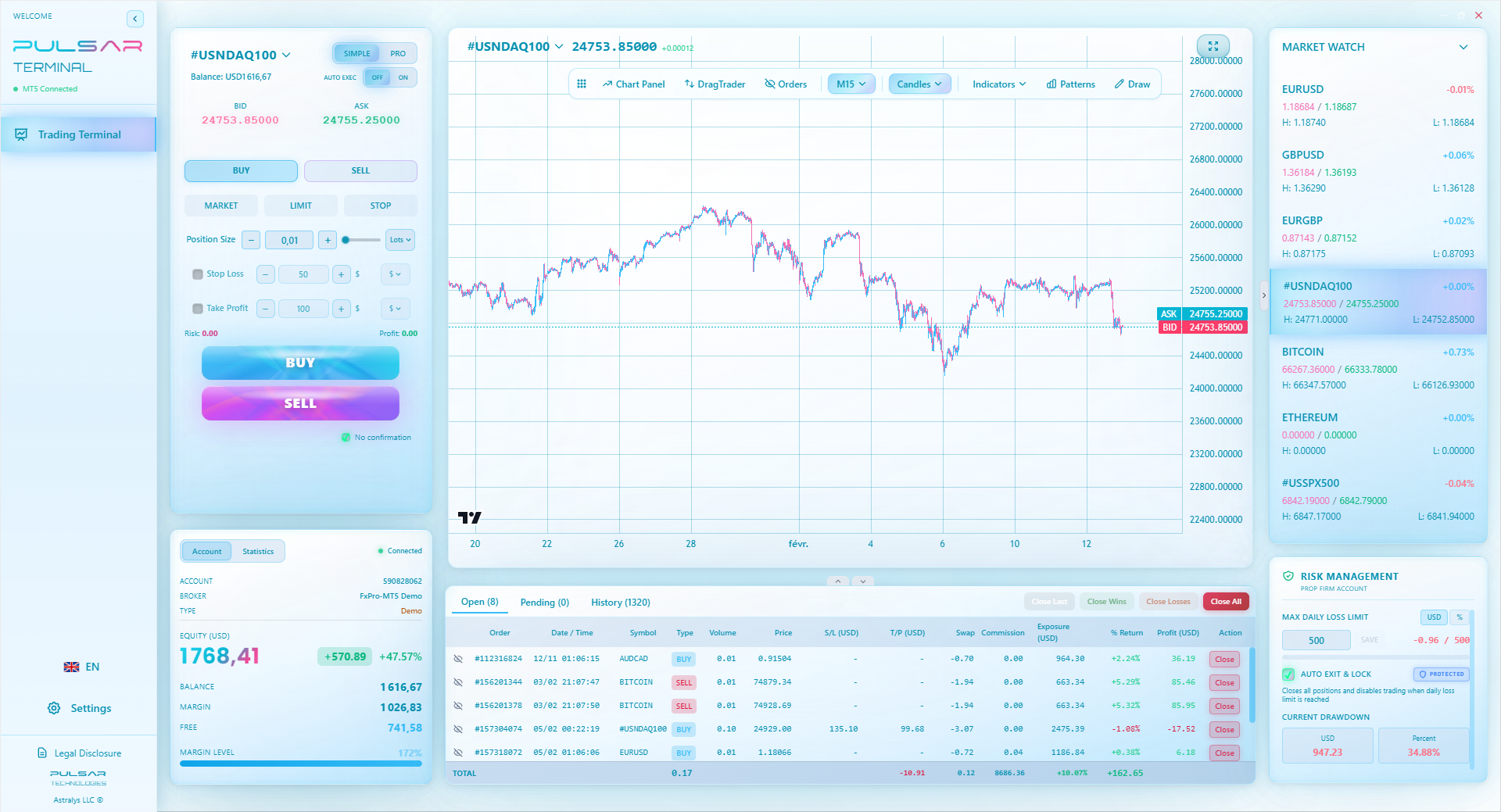
Keeping precise records of every entry, exit, and partial close is critical for tax reporting, and Pulsar Terminal logs all this activity automatically on your MT5 charts.
Pulsar Terminal
L'outil MT5 tout-en-un : ordres glisser-déposer, multi-TP/SL, trailing stop, grid trading, Volume Profile et protection prop firm. Utilisé quotidiennement par 1 000+ traders.
Trading with an FCA-regulated broker isn't just about safety; it directly impacts your tax situation and costs.
Why FCA Regulation Matters for Tax:
- Client Money Protection: Your funds are segregated. If the broker goes bust, your money is safe. This means your trading capital - and your tax liability - is secure.
- Accurate Reporting: FCA brokers must provide clear financial statements you can rely on for your tax return.
- Defined Products: They clearly distinguish between spread betting (tax-free) and CFD (taxable) accounts. There's no ambiguity.
Costs You Can't Ignore: Your net profit is what's left after costs, and that's what you're taxed on. The two biggest costs are spreads and commissions.
| Broker & Account Type | Typical EUR/USD Spread | Commission (per lot) | Key Feature for Tax |
|---|---|---|---|
| Pepperstone Razor (FCA) | 0.10 pips | £2.25 | Clear CFD reports, also offers spread betting. |
| IG Spread Bet (FCA) | 0.6 pips | £0 | Tax-free profits, but wider spread. |
| IC Markets Raw (FCA) | 0.10 pips | $3.00 | Low-cost CFD trading, great for active strategies. |
A tight spread is crucial for strategies like scalping. Paying 1 pip more on entry and exit is a direct 2-pip hit to your profit, which then reduces your net gain for HMRC. Always factor in total cost (spread + commission) when choosing. I made the mistake early on of chasing 'zero commission' accounts only to find the spreads were huge, eating my edge.
“The peace of mind from clean records is worth far more than the bit of admin it requires.”
I've made most of these. Learn from my errors.
Mistake 1: Ignoring It Until You're Caught. HMRC gets data from brokers. They have sophisticated software to cross-reference. Assuming they won't find you is a terrible strategy. Be proactive.
Mistake 2: Mixing Personal and Trading Money. Funding your trading account from your current account, then withdrawing profits to pay for a holiday. It creates an accounting nightmare. Use a dedicated bank account for all trading activity.
Mistake 3: Not Understanding Realized vs. Unrealized. You only pay tax on realized profits - when you close a trade. An open position that's up £10,000 isn't taxed yet. This is key for managing your tax liability across years.
Mistake 4: Forgetting About Losses. You had a bad month and lost £5,000. That's awful, but it's a capital loss for tax purposes. You must declare it on your Self Assessment to carry it forward. I forgot to do this one year and lost a valuable allowance.
Mistake 5: Trading Without a Position Size Calculator. Overtrading and blowing up your account isn't just a trading mistake; it's a tax mistake. You've now generated a capital loss you might have to carry for years. Manage your risk first. Every serious trader I know uses one religiously.
💡 Conseil de Winston
A good accountant costs less than one bad trade. For anything over £10k in gains, their fee is an investment, not an expense.
Don't leave this to the last minute. Here’s your action list.
- Reconcile All Accounts: Match every trade in your journal against your broker statements for all CFD and spread betting accounts.
- Calculate Net Gains/Losses: Tally up all realized profits and losses from your CFD/forex trading for the year (6th April to 5th April).
- Review Open Positions: Decide if you want to realize any losses to offset gains before the year ends.
- Gather Expense Receipts: If you're claiming as a business, have all your invoices and receipts organized.
- Book Your Accountant: Do this in March, not January when they're swamped.
- File Your Self Assessment: The online deadline is 31st January following the tax year end. But aim for December. Payment for any tax owed is also due by 31st January.
Forex trading in the UK is a fantastic opportunity, but the taxman is your silent partner. Understand the rules, keep clean records, and you can focus on what matters: finding the next good trade. The peace of mind is worth far more than the bit of admin it requires.
FAQ
Q1Do I pay tax on every forex trade I make?
No. You only pay tax on your net realized profit over the entire tax year, after subtracting your losses and your annual tax-free allowance (£3,000 for Capital Gains Tax in 2024/25). Individual trades aren't taxed in isolation.
Q2Is spread betting really 100% tax-free?
For the vast majority of UK retail traders, yes. Profits from financial spread betting are exempt from Capital Gains Tax and Income Tax. The main exception is if it becomes your main, organized business, which is rare. The trade-off is that spreads are typically wider than on CFD accounts.
Q3What happens if I make a loss trading forex?
If you trade CFDs/spot forex, the loss is a 'capital loss'. You should report it on your Self Assessment tax return. This loss can be carried forward indefinitely to offset any future capital gains, reducing your future tax bills. Don't let it go to waste.
Q4How do I know if I'm an investor or a trader (business) for tax purposes?
HMRC looks at the 'badge of trade'. Key factors are: frequency of trading (daily vs. monthly), whether it's your main income, how organized you are (business plan, dedicated office), and your profit motive. If you're full-time, treating it like a job, you're likely a trader. When in doubt, consult a specialist accountant.
Q5When is the deadline to pay my forex trading tax?
You must file a Self Assessment tax return online by 31st January following the end of the tax year (which runs 6th April to 5th April). Any tax you owe is also due by that same date, 31st January.
Q6Can I deduct trading costs like software and courses?
It depends. If HMRC views you as an investor (CGT rules), generally no. If you are classified as running a trading business (Income Tax rules), then yes, you can deduct 'wholly and exclusively' business expenses like platform fees, data, home office costs, and educational materials.
Q7Do I need to pay tax on demo account profits?
No. Tax is only due on real money profits. Demo accounts are for practice and carry no tax liability.
La leçon du Prof. Winston
Points clés:
- ✓Spread betting profits are tax-free for most UK traders.
- ✓CFD profits are subject to Capital Gains Tax above a £3,000 allowance.
- ✓Frequent, organized trading can be taxed as business income.
- ✓Keep a detailed trade journal for every single transaction.
- ✓Use a separate 'Tax' savings account for your potential bill.
Cet article vous a-t-il été utile ?
Cliquez sur une étoile
Analyses Trading Hebdo
Analyses et stratégies hebdo gratuites. Pas de spam.
À propos de l'auteur
Sarah Collins
Stratégiste Trading
Stratégiste de trading basée à Londres avec 12 ans d'expérience sur les marchés financiers. Ancienne analyste dans un courtier de la City. Couvre les paires GBP, les marchés européens et le trading sous régulation FCA.
Commentaires
Avertissement sur les risques
Le trading d'instruments financiers comporte des risques importants et peut ne pas convenir à tous les investisseurs. Les performances passées ne garantissent pas les résultats futurs. Ce contenu est fourni à titre éducatif uniquement et ne constitue pas un conseil en investissement. Effectuez toujours vos propres recherches avant de trader.
Vous aimerez aussi

Cara Trading Forex Sukses: 7 Prinsip dari Trader Profesional
Cara trading forex sukses dengan 7 prinsip trader pro: manajemen modal, disiplin, journal trading, backtest. Data nyata, bukan janji profit palsu.
Jam Trading Forex Terbaik untuk Trader Indonesia: Panduan Lengkap dengan Tabel Waktu
Panduan jam trading forex untuk trader Indonesia. Tabel 4 sesi dunia, jam emas 20:00-00:00, sesi mana yang harus dihindari. Data akurat + tips dari trader berpengalaman.
Top 5 Sàn Forex Uy Tín Nhất 2026: Review Jujur dari Trader Indonesia
Top 5 sàn forex uy tín 2026 untuk trader Indonesia. Review jujur: spread, deposit, withdraw, dukungan lokal. Exness, XM, IC Markets & lebih.
Obtenir Pulsar Terminal
Tous ces calculateurs sont intégrés dans Pulsar Terminal avec des données en temps réel de votre compte MT5. Dimensionnement de position en un clic, gestion automatique des risques et calculs instantanés.
Obtenir Pulsar Terminal