


Let's be brutally honest: most paid trading courses are a waste of money.

David van der Merwe
Trader des Marchés Émergents ·  South Africa
☕ 8 min de lecture
Ce que vous apprendrez :
- 1What the UNISA Course Actually Covers (And What It Doesn't)
- 2R6,000 vs. YouTube: The Real Value Question
- 3Trading in South Africa: Rules, Rand, and Reality
- 4From Theory to Practice: Brokers, Costs, and Starting Out
- 5Beyond the Certificate: Building a Real Trading Strategy
- 6Final Verdict: Who Should Take the UNISA Forex Course?
Let's be brutally honest: most paid trading courses are a waste of money. They promise the world and deliver a PDF you could find on Google. So when a mate asked me if the official UNISA forex course was any good, I was skeptical. I've been trading for over a decade, and I've seen it all. But this one's different. It's from a real university, costs R6,000, and claims to teach you the ropes. Is it the golden ticket for a Mzansi trader, or just another expensive lesson? I dug deep, talked to a few guys who've done it, and I'm going to give you the real story - no fluff, just facts.
The UNISA 'Course in Share and Forex Trading' (code 76988) is a 6-month short learning programme. It's not a full degree, but it carries the weight of the University of South Africa's name, which counts for something. The syllabus is split between shares and forex, so you're not getting a pure currency trading deep-dive.
The Good: It covers the absolute fundamentals. We're talking about what moves markets: central bank interest rates, inflation reports, GDP data. For a complete newbie who doesn't know a pip from a spread, this structured approach is valuable. It forces you to learn the theory behind the charts. They also touch on technical analysis - reading charts, spotting trends, that kind of thing.
The Gap: Here's where my experience kicks in. The course teaches you about trading. It doesn't teach you how to trade profitably in real-time. There's a massive difference. You won't learn about the psychological grind of watching a trade go against you, how to manage a live position when news hits, or the nitty-gritty of broker execution and spreads. I learned those lessons the hard way, blowing up a small account back in 2015 by not respecting my stop-loss. No university course can simulate that pressure.

Warning: Don't expect this course to spit you out as a ready-made profitable trader. It gives you the textbook. You have to write the story of your own trading journey, and that story is usually written in red ink before it turns black.
Let's talk numbers. The UNISA course costs R6,000 total, broken into three modules of R2,000 each. That's not pocket change. You could buy a decent laptop or make your first few live trades with that.
The big question is: can you get this info for free? Absolutely. You can learn about fundamental analysis from central bank websites and economic calendars. Technical analysis? There are thousands of videos on the MACD indicator or RSI.
So why pay? It comes down to structure and credibility. The internet is a chaotic library. The UNISA course is a guided tour. For some people, that discipline - having assignments, a set timeline, and a certificate at the end - is worth the price. It forces accountability. I'm self-taught, and my early years were a messy, disorganized struggle. A structured path might have saved me months of confusion.
The Certificate Factor
That UNISA certificate can be useful. It shows a potential prop firm or even just your family that you've taken a formal step to educate yourself. It's not a trading license, but it's a legitimate credential in a space full of 'gurus' with fake testimonials.

Pro Tip: Before you enroll, exhaust the free stuff. Spend a month watching reputable trading educators, read a few books, and paper trade. If you're still hungry for structured, academic knowledge, then the R6,000 might be a justifiable investment in your foundation.

💡 Conseil de Winston
A certificate proves you can study. A trading journal proves you can adapt. Build the second one with more passion than the first.
“Your R6,000 course fee is just the entry ticket. The real tuition is paid in the losses from your first live account.”
This is the most critical part, and where a local course has an edge. Trading in SA isn't like trading in the US or UK. We have our own rules, and getting them wrong can cost you.
The Regulator is King: The Financial Sector Conduct Authority (FSCA) runs the show. Any broker you use must be FSCA-regulated. Check their FSP number on the FSCA's website. This protects you. Your funds should be segregated, and the broker has to play fair. I only use regulated brokers like IC Markets or Exness for this reason.
use Limits: Since 2021, the FSCA caps use at 30:1 for retail traders. That's a good thing, honestly. It stops you from blowing up your account in seconds. Some offshore brokers might offer 500:1, but that's a shortcut to a margin call.
The ZAR is a Beast: The USD/ZAR is our home game. It's volatile, liquid, and reacts fiercely to local politics and commodity prices. About 80% of all Rand trading happens outside South Africa. That means when London and New York wake up, our currency can get thrown around. A good course should hammer this point home. Trading the Rand isn't for the faint-hearted. I've had trades on USD/ZAR swing 500 pips in a day on a political rumor. You need a strong stomach and tight risk management.
The UNISA course should ground you in this local context - SARB policy, local economic data releases, and the unique volatility of emerging market currencies. That's specific knowledge you might not get from a generic international course.
Okay, let's say you finish the UNISA course. Now what? You need a broker. Here's the real-world data every South African trader faces.
Minimum Deposits: You can start small. Much smaller than the course fee.
| Broker Example | Approx. Min. Deposit (ZAR) | Good For... |
|---|---|---|
| Khwezi Trade | R500 | Very local, FSCA-regulated |
| Exness | ~R180 ($10) | Low barrier to entry |
| XM | ~R90 ($5) | Micro accounts for testing |
| FP Markets / AvaTrade | ~R1800 ($100) | More established, full service |
Spreads & Costs: This is your real expense. The spread is the difference between the buy and sell price.
- IC Markets: Can have raw spreads from 0.0 pips on EUR/USD, but you pay a commission.
- XM: Spreads from 0.8 pips, often no commission.
- AvaTrade: Spreads from 0.9 pips.
Your choice depends on your style. A scalping strategy needs the tightest spreads possible. A swing trading approach can handle slightly wider ones.
My Early Mistake: I started with a broker that had "free deposits" but huge spreads. I was getting stung 2-3 pips on EUR/USD every trade. Switching to a tighter-spread broker felt like getting a raise. Always use a position size calculator to understand your true costs before you hit buy.

Example: A 2-pip spread on a standard lot (100,000 units) is a R30 cost (at ~R15/USD) the moment you enter the trade. You're already R30 down. You need the market to move in your favor just to break even. This is the practical math the course might not stress enough.
💡 Conseil de Winston
The FSCA's 30:1 use limit isn't a cage; it's a seatbelt. The crash you don't have is the best trade you'll ever make.
“Trading the Rand isn't for the faint-hearted. You need a strong stomach and tight risk management.”
Passing the UNISA exam is one thing. Making consistent money is another. The course gives you tools, but you have to build the engine yourself.
Start with One Pair: I'd recommend starting with USD/ZAR or EUR/USD. Learn its personality. USD/ZAR loves SA business hours and political news. EUR/USD is more about EU and US macro data. Don't jump around.
Paper Trade Relentlessly: Use a demo account for at least 3 months. Treat it like real money. I paper traded for 6 months and still wasn't ready. The moment I went live, my decision-making changed. The demo helps you practice your plan without the emotional tax.
Risk Management is Non-Negotiable: This is your survival kit. Never risk more than 1-2% of your account on a single trade. Use stop-losses every single time. I once watched a trade on gold (XAU/USD) turn a R1500 profit into a R2000 loss because I got greedy and moved my stop. That lesson was more valuable than any textbook chapter.
The course might teach you to identify a trend. Your job is to figure out where to enter, where to place your stop, where to take profit, and how to size the position so a loss doesn't cripple you. That's the real work.
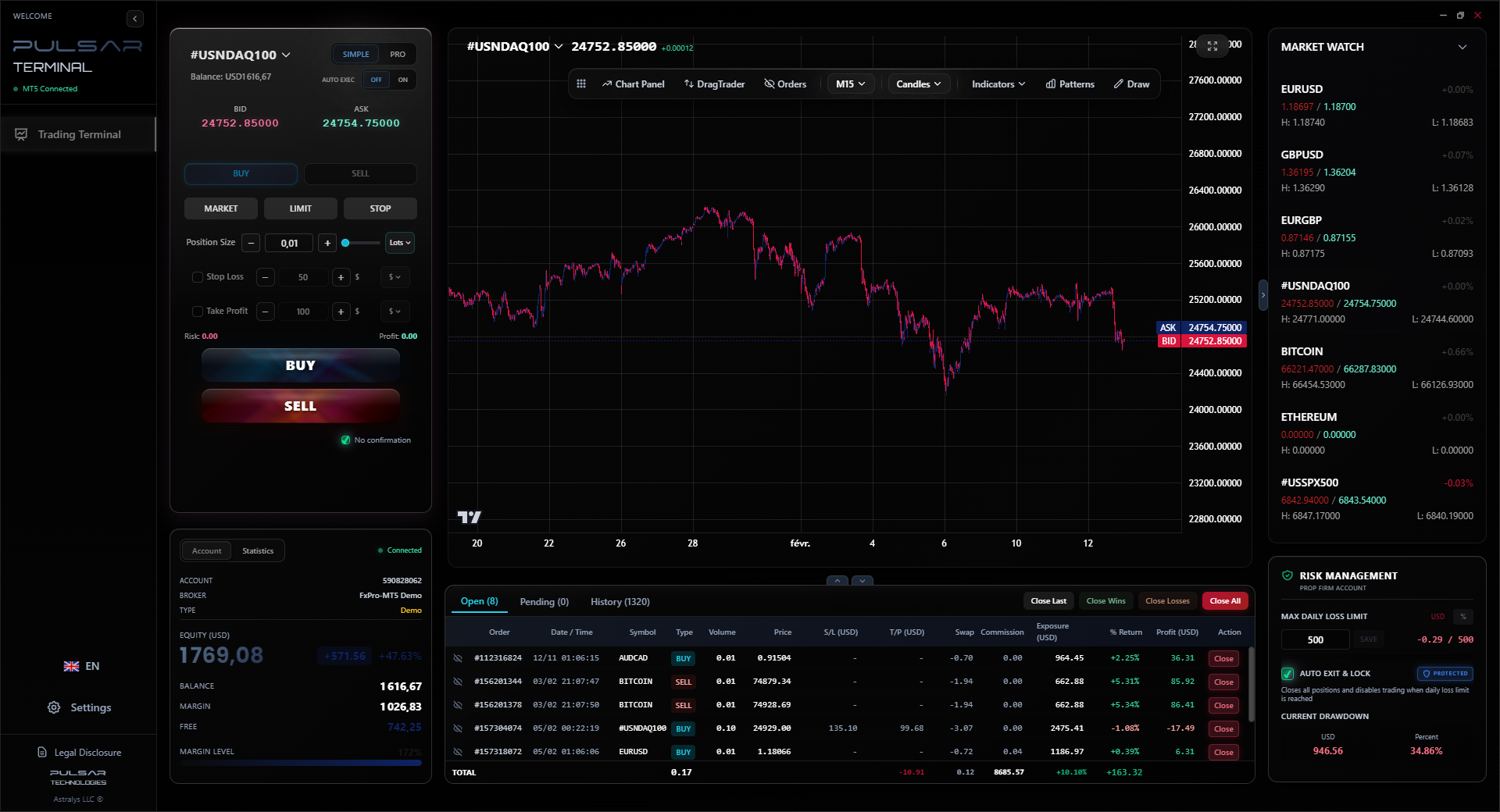
Once you have a strategy, executing it precisely is key. Tools like Pulsar Terminal let you set multi-level take-profits and stop-losses directly on your MT5 chart, turning your plan into automated action.
Pulsar Terminal
L'outil MT5 tout-en-un : ordres glisser-déposer, multi-TP/SL, trailing stop, grid trading, Volume Profile et protection prop firm. Utilisé quotidiennement par 1 000+ traders.
So, is the UNISA forex course worth R6,000?
Yes, if:
- You are a complete beginner who needs a structured, academic foundation and gets lost in free online info.
- You value a formal certificate from a respected institution.
- You want a course that incorporates the South African regulatory and market context.
- You learn better with deadlines, assignments, and a set curriculum.
No, skip it if:
- You already understand basic economics and charting. You can learn the specifics yourself.
- Your R6,000 would be better spent as actual trading capital in a live account (after thorough demo practice, of course).
- You expect it to be a guaranteed path to profits. It's not.
The Hybrid Approach (What I'd Do): If I were starting today, I'd use free resources to learn the absolute basics. Then, I might consider the UNISA course to solidify that knowledge and get the credential. But I'd pair it with immediate demo trading to bridge the theory-practice gap. The course is the map. Trading, even on demo, is the journey.
Remember, the biggest cost in trading isn't a course fee. It's the losses you incur from not knowing what you're doing. Whether you pay R6,000 to UNISA or invest hundreds of hours in self-study, the price of education is always paid. The only question is how.
💡 Conseil de Winston
Spend R6000 on a course? Fine. But never risk more than R60 on a single trade idea until your strategy has survived 100 trades. Scale slowly.
FAQ
Q1Is the UNISA forex course recognized by the FSCA?
No. The UNISA course is an educational qualification. The FSCA regulates financial service providers (brokers, advisors), not educational courses. The course teaches you about trading, but it does not license you to give financial advice or act as a broker.
Q2Can I get a job with the UNISA forex course certificate?
It can help, but it's not a direct ticket. The certificate shows initiative and foundational knowledge. You might find it useful for roles at brokerages (like client support), financial journalism, or as a stepping stone while you build a personal trading track record. For most trading jobs at banks or funds, they'd typically look for a full finance degree or proven, verifiable profitability.
Q3How does the UNISA course compare to online 'guru' courses?
There's no comparison in terms of credibility. UNISA is a public university. Its course is based on academic principles, not marketing hype. Online guru courses often sell dreams of quick riches with flashy cars. The UNISA course is drier, more theoretical, and more honest about the complexities involved. It's education vs. entertainment.
Q4What is the pass rate for the UNISA forex course?
UNISA doesn't publicly publish specific pass rates for individual short courses. As a university-level programme, it requires you to study and pass assignments and an exam. It's not a 'pay-and-pass' scheme. You'll need to put in the work to understand the material.
Q5Does the course cover trading platforms like MetaTrader?
The course focuses on the principles of analysis (fundamental and technical). It may introduce trading platforms at a conceptual level, but it is unlikely to provide in-depth, hands-on training on MetaTrader 4 or 5. You will likely need to learn platform mechanics separately through broker tutorials or your own exploration.
Q6Are the profits from forex trading taxable in South Africa?
Yes. The South African Revenue Service (SARS) views trading profits as income. You are legally required to declare your net profits (profits minus losses and expenses) in your annual tax return. Keep detailed records of all your trades. This is a crucial real-world detail every South African trader must know.
La leçon du Prof. Winston
Points clés:
- ✓Structured theory is worth R6000 if you're a true beginner.
- ✓Always verify your broker's FSCA FSP number.
- ✓Never trade USD/ZAR without a stop-loss.
- ✓Risk a maximum of 1-2% of your capital per trade.
Cet article vous a-t-il été utile ?
Cliquez sur une étoile
Analyses Trading Hebdo
Analyses et stratégies hebdo gratuites. Pas de spam.
À propos de l'auteur
David van der Merwe
Trader des Marchés Émergents
Trader basé à Johannesbourg avec 11 ans d'expérience sur les devises des marchés émergents. Spécialisé dans les paires ZAR, le trading régulé par la FSCA et l'analyse du marché sud-africain.
Commentaires
Avertissement sur les risques
Le trading d'instruments financiers comporte des risques importants et peut ne pas convenir à tous les investisseurs. Les performances passées ne garantissent pas les résultats futurs. Ce contenu est fourni à titre éducatif uniquement et ne constitue pas un conseil en investissement. Effectuez toujours vos propres recherches avant de trader.
Vous aimerez aussi

Cara Trading Forex Sukses: 7 Prinsip dari Trader Profesional
Cara trading forex sukses dengan 7 prinsip trader pro: manajemen modal, disiplin, journal trading, backtest. Data nyata, bukan janji profit palsu.
Jam Trading Forex Terbaik untuk Trader Indonesia: Panduan Lengkap dengan Tabel Waktu
Panduan jam trading forex untuk trader Indonesia. Tabel 4 sesi dunia, jam emas 20:00-00:00, sesi mana yang harus dihindari. Data akurat + tips dari trader berpengalaman.
Top 5 Sàn Forex Uy Tín Nhất 2026: Review Jujur dari Trader Indonesia
Top 5 sàn forex uy tín 2026 untuk trader Indonesia. Review jujur: spread, deposit, withdraw, dukungan lokal. Exness, XM, IC Markets & lebih.
Obtenir Pulsar Terminal
Tous ces calculateurs sont intégrés dans Pulsar Terminal avec des données en temps réel de votre compte MT5. Dimensionnement de position en un clic, gestion automatique des risques et calculs instantanés.
Obtenir Pulsar Terminal