


Most traders think they know what moves gold prices, but they're usually wrong.

David van der Merwe
Trader des Marchés Émergents ·  South Africa
☕ 9 min de lecture
Ce que vous apprendrez :
Most traders think they know what moves gold prices, but they're usually wrong. They'll tell you it's inflation or jewelry demand, then wonder why their trades keep getting stopped out. The truth is, gold in the forex market (XAU/USD) dances to a very specific tune, and if you don't understand the real drivers, you're just gambling with your rands. I've traded gold through bull markets, crashes, and everything in between from right here in South Africa, and I'm going to show you the five factors that actually matter, not the textbook theories.
Here's the first thing you need to get straight: when you trade XAU/USD, you're not just trading gold. You're trading the relationship between gold and the US dollar. It's quoted as dollars per ounce for a reason. About 70-80% of gold's daily moves can be traced directly back to USD strength or weakness.
Think of it like a seesaw. When the dollar gets strong (DXY index goes up), gold priced in dollars usually goes down. It becomes more expensive for buyers using euros, yen, or rands, so demand drops. When the dollar weakens, the opposite happens. I learned this the hard way in early 2023. Gold was in an uptrend, and I was bullish. I bought at $1,820, expecting a run to $1,900. Then the US Fed started talking tough on inflation again. The dollar ripped higher. My gold trade didn't just stall, it reversed hard. I got stopped out at $1,785 for a R4,500 loss. I was right about gold's fundamentals, but completely wrong about the dollar's momentum.

Warning: Never analyze gold in isolation. Your first chart check every morning should be the US Dollar Index (DXY). If you don't understand what's moving the dollar, you don't understand what's moving gold.
This relationship isn't perfect 100% of the time. During extreme 'risk-off' panic, both the dollar and gold can rise as safe havens. But those are exceptions. For your day-to-day swing trading, the inverse correlation is your most reliable guide.
“When you trade XAU/USD, you're not just trading gold. You're trading the relationship between gold and the US dollar.”
This is the big one that catches new traders. It's not just interest rates, it's real interest rates. That's the nominal interest rate (what the bank pays) minus the current inflation rate. The formula is simple, but its effect is huge.
Real Yield = Nominal Interest Rate - Inflation Rate
Gold doesn't pay you a dividend or interest. It just sits there. So, when real interest rates are high (like when the Fed has rates at 5% and inflation is at 3%, giving a 2% real yield), why would you hold a zero-yielding asset? Money flows into bonds instead. When real rates are low or negative (inflation is higher than the interest rate), holding cash or bonds loses you purchasing power. That's when gold shines.
Let me give you a real example from my journal. In late 2025, the market started pricing in Fed rate cuts. Inflation was still sticky around 3%. That meant real rates were about to fall. I bought XAU/USD at $2,150. I didn't buy because of war headlines, I bought because the math was shifting. That trade ran to over $2,400. The fundamental driver wasn't emotion, it was cold, hard arithmetic.
You can track this by watching the US 10-Year Treasury Inflation-Protected Securities (TIPS) yield. A falling TIPS yield is often a green light for gold. Ignore this, and you're trading blind.

💡 Conseil de Winston
Gold's trend is set in the bond market, not the jewelry shop. Watch the 10-year TIPS yield. When it falls, gold often rises. It's that simple.
“I was right about gold's fundamentals, but completely wrong about the dollar's momentum. It cost me R4,500.”
Okay, this is the one everyone knows about. War breaks out, a bank fails, or there's political chaos, and gold spikes. It's the ultimate 'safe haven' play. But most traders get the timing and the trade management completely wrong.
These events don't create sustained trends; they create violent, sharp spikes. The initial move is often a knee-jerk reaction that gets bought or sold heavily. I've been caught fading these spikes too early more times than I care to admit. In March 2023, during the US regional banking scare, gold gapped up $50 on the open. I thought, 'This is overdone,' and shorted it. It then proceeded to run another $80 against me before I bailed out. A painful, expensive lesson.

Pro Tip: When trading fear spikes, don't chase the initial move. Wait for the first pullback and test of support. The emotional money rushes in at the top, the smart money buys the dip. Use a wider stop-loss, because volatility is insane. And have an exit plan ready - these moves can reverse just as fast.
Also, remember the South African context. Local political uncertainty or rand volatility doesn't directly move XAU/USD (which is in dollars). But it might mean you, as a ZAR-based trader, seek out gold as a personal hedge. That's a different kind of decision from a pure forex trade.
💡 Conseil de Winston
Fear spikes are for exiting, not entering. The public buys the headline. The professional sells it to them. Wait for the pullback.
“The emotional money rushes in at the top of a fear spike; the smart money buys the dip.”
The Big Buyers
Forget about jewelry demand from India and China for your short-term trades. That's a seasonal, slow-moving factor. The central bank demand is what's changed the game recently. Since 2022, central banks (especially from China, India, and the East) have been net buyers on a massive scale. They're not trading; they're diversifying reserves away from the US dollar. This creates a constant, underlying bid for physical gold that puts a floor under the price.
This doesn't give you a clear entry signal for Tuesday morning, but it shapes the entire multi-year trend. It's why sell-offs have been shallow and bought aggressively. You're not just trading against hedge funds; you're trading against entities that buy by the ton.
The South African Gold Trade
Here's a local angle we understand: physical gold. As a South African, you might buy Krugerrands. That market has its own dynamics (VAT exemptions, spreads from dealers). But a surge in local physical buying can be a sentiment indicator. If people are queueing at the SA Mint, it often means there's broad-based fear in the local economy. That sentiment can correlate with a stronger global bid for gold. It's not a direct trigger, but it's part of the mood music.
When considering a broker for trading the paper version (XAU/USD), this physical backdrop is why I prefer brokers with strong regulation and clear execution. You want to know your Exness or IC Markets trade reflects the real market, especially when central banks are active.
“The emotional money rushes in at the top of a fear spike; the smart money buys the dip.”
A Constrained Supply
Gold mining supply is relatively inelastic. It takes years to bring a new major mine online. South Africa, once the world's top producer, now faces deep-level mining challenges, high costs, and energy issues. This declining local production is a global microcosm: the easy gold has been found. Stagnant or falling mine supply means new gold isn't flooding the market to cap prices. It's a background bullish factor.
The USD/ZAR Wildcard
This is critical for us. You fund your trading account in rands. When you convert ZAR to USD to trade XAU/USD, the exchange rate is a hidden profit or loss driver.
Let's say you put in R10,000 when USD/ZAR is at 18.00. That gives you about $555. You trade gold and make a 10% dollar profit, so you now have $610. But if, in that time, the rand has strengthened to 17.00, when you convert your $610 back, you get only R10,370. Your brilliant 10% trade in dollars becomes a measly 3.7% gain in rands.
The reverse is also true. A weaker rand can turbocharge your rand returns on a winning dollar trade. You must watch the USD/ZAR pair as closely as you watch XAU/USD. It's part of your position sizing and risk calculation.

Example: In January 2026, gold corrected from its highs but the rand was appreciating sharply. A trader making a small dollar profit on a gold short could have seen it magnified into a great rand profit due to the currency move. It works both ways.
💡 Conseil de Winston
The rand giveth, and the rand taketh away. Your brilliant USD gold trade can be ruined by ZAR strength. Always do the currency math on your potential return.
“You're not just trading against hedge funds; you're trading against central banks that buy by the ton.”
So, how do you use this mess of information? You don't need all five factors screaming 'BUY' at once. You need a framework to weigh the evidence.
- Primary Filter (The Big One): What are real interest rates doing? Is the Fed in a hiking, holding, or cutting cycle? What's the inflation trend? This sets your core bias (bullish if real rates are falling, bearish if rising).
- Confirmation (The Timing Tool): What is the US Dollar Index doing? Is it confirming or contradicting your primary bias? A falling dollar confirms a gold bull view. A strong dollar warns you to be cautious, even if real rates are falling.
- Catalyst (The Trigger): Is there a geopolitical event or a key economic data release (US Non-Farm Payrolls, CPI) that could act as a trigger for the move you're expecting? This is where you look for your entry.
- Local Check (The Rand Reality): What is USD/ZAR doing? Does it help or hurt my potential rand return? Should I adjust my position size calculator input because of currency risk?
I used this framework in October 2025. Primary filter: The Fed was done hiking, cuts were on the horizon (bullish). Confirmation: The dollar was starting to roll over (bullish). Catalyst: I waited for a pullback after an initial spike. I went long XAU/USD at $2,280. Local check: The rand was stable. I held through the insane run to $4,300+, taking partial profits along the way. It was the trade of a lifetime, and it came from following the process, not the hype.
Finally, manage your risk like your life depends on it. Gold is volatile. Use sensible use. The FSCA caps use for major brokers here, and that's for your protection. A 20:1 use on gold is more than enough to blow up an account if you're reckless. Always know where your margin call level is before you enter.
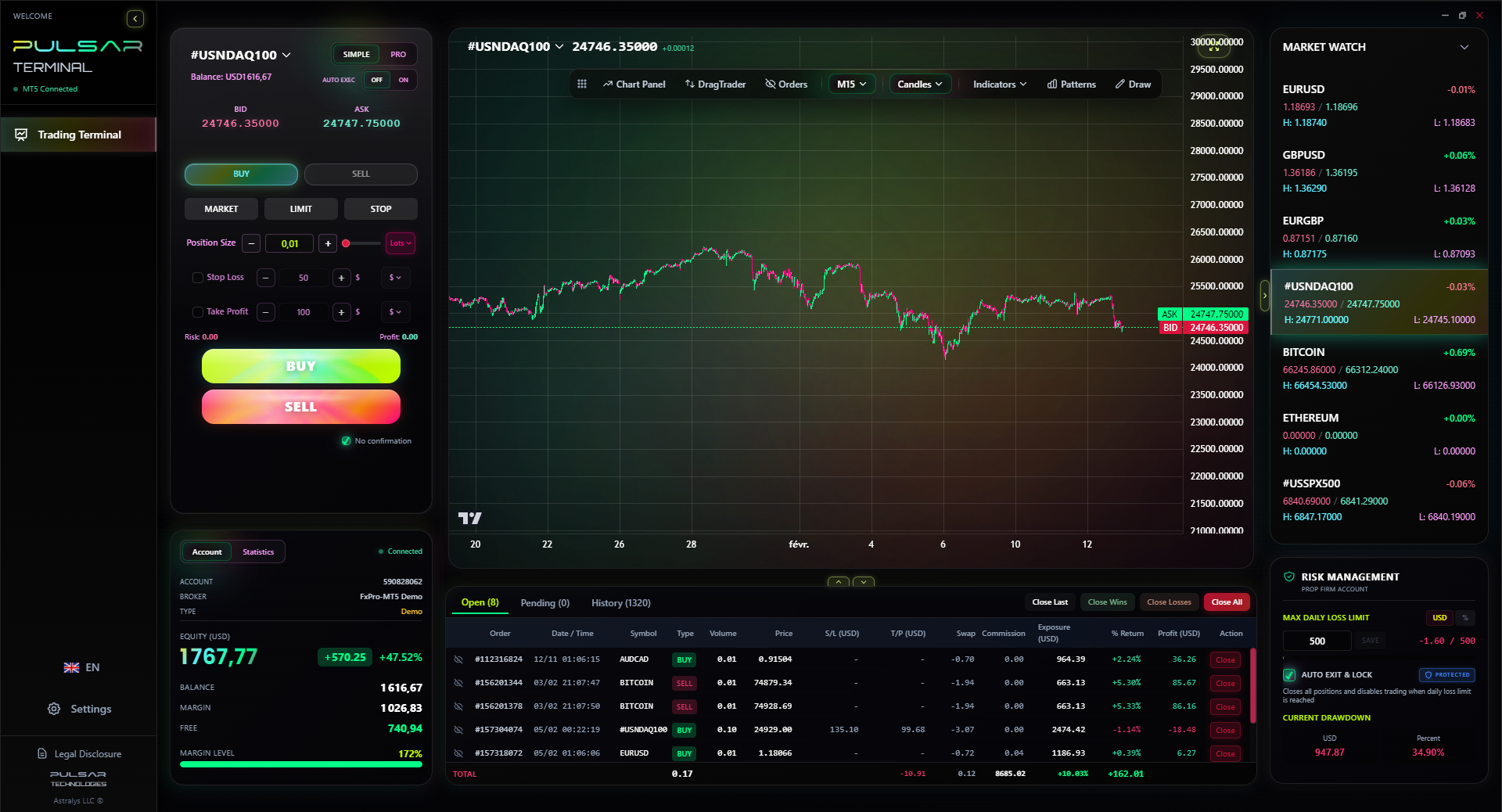
Managing a volatile trade like gold requires precise order tools, and Pulsar Terminal's drag-and-drop orders and multi-take-profit features let you lock in profits at key levels without the stress.
Pulsar Terminal
L'outil MT5 tout-en-un : ordres glisser-déposer, multi-TP/SL, trailing stop, grid trading, Volume Profile et protection prop firm. Utilisé quotidiennement par 1 000+ traders.
FAQ
Q1Is trading gold (XAU/USD) legal in South Africa?
Yes, trading gold as a CFD (like XAU/USD) through a broker regulated by the Financial Sector Conduct Authority (FSCA) is perfectly legal for individuals. Trading forex pairs involving the ZAR for speculation is restricted, but XAU/USD is a commodity pair quoted in USD, so it falls under allowed CFD trading. Always verify your broker's FSCA license number.
Q2Why does a strong US dollar usually mean weaker gold prices?
Because gold is priced in US dollars globally. When the dollar strengthens, it takes fewer dollars to buy an ounce of gold, so the price tends to fall. More importantly, it makes gold more expensive for buyers using other currencies (like euros or rands), which can dampen demand. It's a fundamental liquidity and demand relationship.
Q3What's more important for gold, the nominal interest rate or inflation?
The interaction between them, known as the real interest rate, is what matters. A high nominal rate with even higher inflation (negative real yields) is bullish for gold. A moderate nominal rate with very low inflation (positive real yields) is bearish. Watch the US 10-Year TIPS yield as a direct gauge of real rates.
Q4As a South African, how does the USD/ZAR rate affect my gold trading profits?
It affects your bottom line directly. You convert ZAR to USD to trade. If you make a profit in USD but the rand has strengthened against the dollar in that time, your rand profit will be reduced (or could even become a loss). Conversely, a weaker rand can boost your rand returns. It's a second layer of currency risk you must consider.
Q5What's a typical spread for trading XAU/USD with a South African broker?
Spreads vary widely. On a standard commission-free account, expect average spreads between 25 and 40 pips (points). On a raw spread account with a commission, you might see spreads as low as 0.0 pips plus a commission of $5-$7 per round lot. Brokers like FP Markets or XM offer competitive conditions. Always check live spreads during your usual trading hours.
Q6Can I use technical analysis for trading gold, or is it all fundamentals?
You absolutely must use both. The fundamentals (dollar, real rates) tell you the direction of the major trend. Technical analysis - using tools like the RSI indicator for overbought/oversold levels or the MACD indicator for momentum - helps you find precise entry and exit points within that trend. Gold respects key support and resistance levels, especially during non-news times.
Q7Is now (2026) a good time to start trading gold?
Gold is always trading, and there are always opportunities. After the historic run-up past $5,000, volatility is high, which means both greater risk and greater potential reward. It's a fantastic time to learn and paper trade. Start small, focus on understanding the drivers in this guide, and never risk money you can't afford to lose. The market will still be here when you're ready.
La leçon du Prof. Winston
Points clés:
- ✓Real interest rates drive the long-term trend.
- ✓The US Dollar provides daily trading direction.
- ✓Geopolitics creates spikes, not sustained trends.
- ✓Always adjust for USD/ZAR risk on your final profit.
Cet article vous a-t-il été utile ?
Cliquez sur une étoile
Analyses Trading Hebdo
Analyses et stratégies hebdo gratuites. Pas de spam.
À propos de l'auteur
David van der Merwe
Trader des Marchés Émergents
Trader basé à Johannesbourg avec 11 ans d'expérience sur les devises des marchés émergents. Spécialisé dans les paires ZAR, le trading régulé par la FSCA et l'analyse du marché sud-africain.
Commentaires
Avertissement sur les risques
Le trading d'instruments financiers comporte des risques importants et peut ne pas convenir à tous les investisseurs. Les performances passées ne garantissent pas les résultats futurs. Ce contenu est fourni à titre éducatif uniquement et ne constitue pas un conseil en investissement. Effectuez toujours vos propres recherches avant de trader.
Vous aimerez aussi

Cara Trading Forex Sukses: 7 Prinsip dari Trader Profesional
Cara trading forex sukses dengan 7 prinsip trader pro: manajemen modal, disiplin, journal trading, backtest. Data nyata, bukan janji profit palsu.
Jam Trading Forex Terbaik untuk Trader Indonesia: Panduan Lengkap dengan Tabel Waktu
Panduan jam trading forex untuk trader Indonesia. Tabel 4 sesi dunia, jam emas 20:00-00:00, sesi mana yang harus dihindari. Data akurat + tips dari trader berpengalaman.
Top 5 Sàn Forex Uy Tín Nhất 2026: Review Jujur dari Trader Indonesia
Top 5 sàn forex uy tín 2026 untuk trader Indonesia. Review jujur: spread, deposit, withdraw, dukungan lokal. Exness, XM, IC Markets & lebih.
Obtenir Pulsar Terminal
Tous ces calculateurs sont intégrés dans Pulsar Terminal avec des données en temps réel de votre compte MT5. Dimensionnement de position en un clic, gestion automatique des risques et calculs instantanés.
Obtenir Pulsar Terminal