


I lost R4,200 in a single afternoon on USD/ZAR.

David van der Merwe
Trader des Marchés Émergents ·  South Africa
☕ 12 min de lecture
Ce que vous apprendrez :
- 1The Seven Majors: Your Core Trading Instruments
- 2The ZAR Reality: You're Trading Exotics
- 3The Real Costs: Spreads, Commissions & SA use Limits
- 4Picking Your Broker: FSCA Regulation is Non-Negotiable
- 5A Practical Strategy: Trading Majors from South Africa
- 6Pitfalls That Wreck South African Traders
- 7Where to Go From Here
I lost R4,200 in a single afternoon on USD/ZAR. I thought I was being clever, trading the local pair I saw on the news. The spread was 15 pips, the price jerked around like a startled springbok, and my stop-loss got hunted before the real move even started. That loss taught me a brutal lesson: understanding what the major currency pairs in forex are, and why they’re different from our beloved but wild rand pairs, is the first step to surviving. Let's break down the real majors, the costs, and the local rules so you don't learn the hard way like I did.
When traders talk about the major currency pairs in forex, they're referring to a specific club. These are the seven most traded pairs globally, and they all have one thing in common: the US Dollar (USD). They're the blue-chip stocks of the forex world - highly liquid, with relatively predictable behaviour and tighter costs.
Here’s the official list, the workhorses of the market:
- EUR/USD (Euro / US Dollar): The king. The most traded pair on the planet. It represents the two largest economic blocs, so liquidity is massive and spreads are often razor-thin. It's my personal favourite for testing new strategies because the noise-to-signal ratio is usually better.
- USD/JPY (US Dollar / Japanese Yen): A close second. This pair is a barometer for global risk sentiment and is heavily influenced by the interest rate differential between the US and Japan. When markets get scared, money often flows into the yen.
- GBP/USD (British Pound / US Dollar): Known as 'Cable'. It can be a bit more volatile and news-driven than the EUR/USD, especially around Brexit-esque political events. It moves with conviction, which is great if you're right, painful if you're wrong.
- USD/CHF (US Dollar / Swiss Franc): The 'Swissie'. The Swiss franc is considered a safe-haven currency. In a market panic, USD/CHF often trends down as money seeks shelter in Switzerland. It's like the defensive midfielder of the majors.
- AUD/USD (Australian Dollar / US Dollar): A commodity currency. Its health is tied to China's demand for Australian iron ore and coal. I watch Chinese economic data as much as Australian data when trading this.
- USD/CAD (US Dollar / Canadian Dollar): Another commodity pair, but this one dances to the tune of oil prices. Canada is a major oil exporter, so when crude rallies, the CAD often strengthens (USD/CAD goes down).
- NZD/USD (New Zealand Dollar / US Dollar): The 'Kiwi'. Influenced by dairy prices and global risk appetite. It's the smallest of the majors and can sometimes exhibit wider swings.

Example: Let's say the EUR/USD bid/ask is 1.0850 / 1.0851. That's a 1 pip spread. Now check a typical USD/ZAR quote: 18.5000 / 18.5015. That's a 15 pip spread. You're already 15 pips in the red the moment you enter that ZAR trade. On a standard lot, that's R1,500 gone before the market even moves for you.
The key takeaway? These majors offer efficiency. The tight spreads mean your trade doesn't start with a massive handicap. For a South African trader, focusing here first builds a foundation of discipline before you venture into the more volatile exotic pairs like our own ZAR crosses. If you're new, I'd stick to the EUR/USD guide to get your feet wet.

💡 Conseil de Winston
Liquidity is your best friend and your worst enemy's enemy. The majors give you the former. Stick with friends.
This is the part that stings a bit for us locals. While the EUR/USD is the most traded pair globally, it's also the most traded pair here in South Africa. But our home currency, the Rand, doesn't play in the major league. Pairs like USD/ZAR, EUR/ZAR, and GBP/ZAR are classified as exotic currency pairs.
That label comes with baggage:
- Lower Liquidity: There are simply fewer buyers and sellers at any given moment compared to EUR/USD. This can lead to...
- Wider Spreads: As we saw in the example, spreads of 10, 15, even 20 pips are normal. This massively increases your transaction cost.
- Gap Risk: The Rand can jump or drop significantly when local markets open after a weekend or when major local news (like a SARB interest rate decision or a budget speech) hits. Your stop-loss might not save you.
I learned this the expensive way. I shorted USD/ZAR at 18.70, placing a stop at 18.85. The spread was 12 pips, so I was already down R1,200 on entry. Overnight, some political commentary spooked the market. It opened Monday at 18.95 - gapping right through my stop. I was filled at 18.95, for a loss of 25 pips plus the 12-pip spread. That's 37 pips, or R3,700 on a mini lot, on a trade that never had a chance.

Warning: Trading ZAR pairs with the same position size calculator settings you use for majors is a recipe for disaster. The volatility is higher. You must use a smaller position size to account for the wider stops you'll need.
This isn't to say don't trade them. Many successful South African traders specialise in ZAR. But you must respect that you're in a different, wilder environment. It's the difference between swimming in a pool and swimming in the ocean off Muizenberg - the techniques are similar, but the risks are on another level.
“Trading ZAR pairs with the same position size you use for majors is a recipe for disaster.”
Knowing what the major currency pairs in forex are is useless if you don't understand what it costs to trade them. Let's talk numbers, because this is where brokers make their money and where traders get squeezed.
Spreads: Your Invisible Tax
The spread is the difference between the buy (ask) and sell (bid) price. On majors, this is typically low. For example, a top-tier broker like IC Markets might offer EUR/USD spreads from 0.1 pips on their Raw Spread account. But that account charges a commission. A spread-only account might have the spread at 1.0 pips with no commission. You need to do the math on your typical trade size to see which is cheaper.
The Commission Model
Brokers like Pepperstone or IC Markets often have two account types: Standard (wider spread, no commission) and Raw/Pro (tight spread, plus commission). The commission is usually per lot, per side. If it's $7 per lot, and you buy 1 standard lot (100,000 units), you pay $7 to open and $7 to close.
On a 1.0 pip spread account, that 1-pip cost on EUR/USD is $10. So often, the commission-based account is cheaper for larger volumes. For a beginner trading mini lots (0.1), the spread-only account might be simpler.
The FSCA use Cap
This is critical for South Africans. Since 2021, the Financial Sector Conduct Authority (FSCA) has capped use for retail traders at 30:1 on major forex pairs if you're with an FSCA-licensed broker.
What does 30:1 mean? With R10,000 in your account, you can control a position worth R300,000. It's still powerful, but it's a far cry from the 500:1 or 'unlimited' use offered by some offshore brokers. This cap is a good thing. It's a forced risk management tool. I've seen too many traders blow up using 500:1, where a 0.2% move against you wipes out your entire account.
Overnight Financing (Swap Rates)
If you hold a position past 5pm New York time (which is late night for us), you pay or receive a swap fee. This is based on the interest rate differential between the two currencies. It can add up if you're a long-term swing trading holder. Always check the swap rates on your platform before holding for days or weeks.
💡 Conseil de Winston
A 15-pip spread isn't a cost, it's a trench you have to climb out of before the battle even starts. Choose your battlefield wisely.
Your broker is your gateway to the market. In South Africa, this choice is framed by one essential rule: only use an FSCA-regulated broker.
Why? The FSCA ensures client funds are segregated. That means your money is held in a separate bank account from the broker's operating funds. If the broker goes under (it happens), your money should be safe. An unregulated offshore broker offers no such protection. They might also offer crazy use that will help you lose money faster.
Here’s a quick comparison of some popular brokers accessible to South Africans:
| Broker | FSCA Regulated? | Min. Deposit (ZAR approx.) | Avg. EUR/USD Spread | Good For... |
|---|---|---|---|---|
| Exness | Yes (via local entity) | As low as R70 | From 0.1 pips (Raw) | Beginners, very low minimum deposit. |
| IC Markets | Yes | ~R1,500 ($100) | From 0.1 pips (Raw) | Serious traders, low costs, great execution. |
| Pepperstone | Yes | R0 (sometimes) | From 0.0 pips (Razor) | All-rounder, strong reputation. |
| XM | Yes | ~R150 ($10) | From 0.6 pips | Educational resources, variety of account types. |
My advice? Start with a demo account at one or two of these. Get a feel for their trading platform (most use MT4/MT5). Then, fund a live account with an amount you can afford to lose completely - I'd say nothing less than R5,000 if you want to practice real position size calculator management without being forced into tiny, meaningless trades.

Pro Tip: Don't get seduced by 'zero spread' claims without checking the commission. Also, test their customer support with a question before you deposit. If they're slow or unhelpful when you're giving them money, imagine what they'll be like when you need to withdraw it.
“The goal isn't to get rich tomorrow; it's to still be in the game next year.”
So you're set up with an FSCA broker, you understand the costs. How do you actually approach these major pairs from our timezone (GMT+2)?
Session Overlap is Key
The best volatility for majors occurs during the session overlaps:
- London Open (10:00 SAST): This is often where the first real direction of the day is established. EUR/USD, GBP/USD get active.
- London & New York Overlap (15:00 - 17:00 SAST): This is the most liquid, volatile period. The majority of daily volume happens here. It's great for momentum but can be choppy.
Trying to trade the Asian session (our early morning) on EUR/USD is often a recipe for boredom and slow, grinding moves.
Start with One Pair
Don't try to watch all seven majors. Pick one. I strongly recommend starting with EUR/USD. Its liquidity makes its technical levels relatively clean. Learn its average daily range (about 70-100 pips). Use a simple strategy combining price action with one or two indicators like the RSI indicator for overbought/oversold clues.
Risk Management on Autopilot
This is the most important part. On every single trade:
- Decide your stop-loss distance in pips before you enter.
- Decide what percentage of your account you're willing to risk (1% is a standard, conservative start).
- Use a position size calculator to determine your lot size based on steps 1 and 2.
For example: Account: R20,000. Risk per trade: 1% = R200. Stop-loss: 50 pips on EUR/USD. Pip value for a standard lot is $10 (~R185). To risk R200, you can trade a position size of roughly 0.11 lots. That's your ticket. No emotion.
This discipline is what separates the 5% who are consistently profitable from the 95% who blow up. Tools that help you set and manage these orders precisely are useful. Managing multiple take-profit levels or a trailing stop manually is stressful and error-prone.
💡 Conseil de Winston
The FSCA's 30:1 use cap isn't a limitation, it's a seatbelt. You only complain about it if you were planning to crash.
I've made most of these mistakes. Let me save you the tuition fees.
1. Trading ZAR Pairs Like Majors: This is the big one. Using tight stops on USD/ZAR because 'that's what I use on EUR/USD.' The market will swallow your stop and reverse. You need wider stops, which means smaller position sizes.
2. Ignoring the Spread on Entry: Entering a ZAR pair with a 15-pip spread means you need a 15-pip move just to break even. That's a huge headwind. On majors, this is less of an issue, but you still need to factor it in, especially for scalping strategy.
3. Over-leveraging, Even at 30:1: Just because you can use 30:1 doesn't mean you should. Using full use on every trade is a guaranteed path to a margin call. I use 10:1 or less on my standard trades.
4. Chasing News on Rand Pairs: SARB announcements, political noise - they cause spikes, but retail traders are the last to the party. By the time you get the news and enter, the big players are already taking profits. I got caught in this trap more times than I can count.
5. Not Accounting for Tax: In South Africa, your forex trading profits are taxable as income. Keep careful records of all your trades from day one. The South African Revenue Service (SARS) doesn't accept 'I lost my spreadsheet' as an excuse.
The core lesson? Treat trading like a business. The majors are your stable, core products. The exotics (like ZAR) are your high-risk, high-potential reward ventures. You wouldn't bet your entire business capital on the risky venture, so don't do it with your trading account.
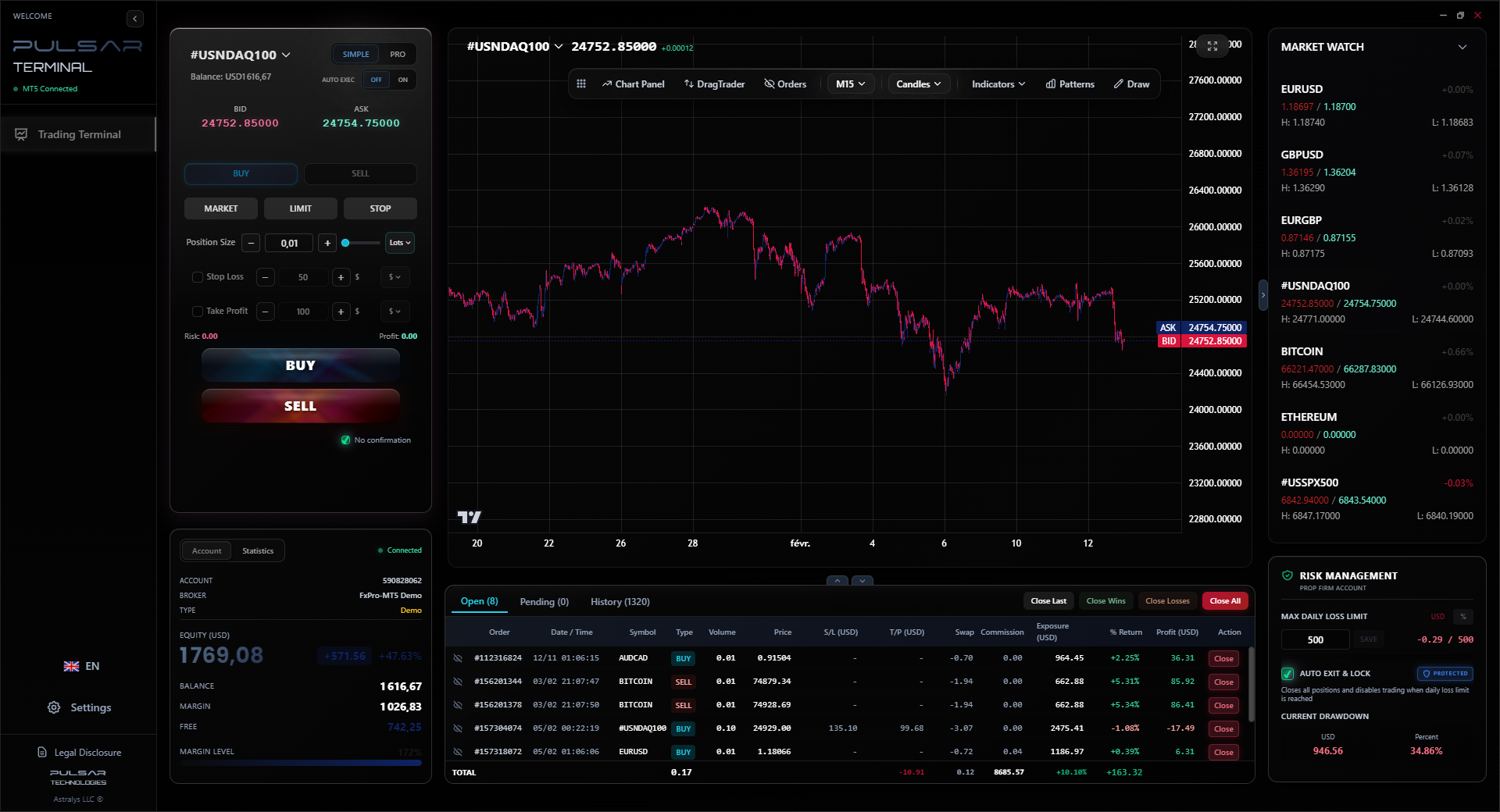
Precise order management and automated risk tools are key to surviving volatile markets, which is exactly what Pulsar Terminal builds into your MT5 platform.
Pulsar Terminal
L'outil MT5 tout-en-un : ordres glisser-déposer, multi-TP/SL, trailing stop, grid trading, Volume Profile et protection prop firm. Utilisé quotidiennement par 1 000+ traders.
“Understanding the majors is the map before the journey.”
Understanding what the major currency pairs in forex are is your foundation. It's the map before the journey. For a South African trader, the path to consistency involves respecting that foundation while cautiously exploring our unique local opportunities.
Start here:
- Open a demo account with an FSCA-regulated broker like Pepperstone or IC Markets.
- Trade only EUR/USD for a month. Practice your entry, exit, and most importantly, your risk calculation on every single demo trade.
- Keep a journal. Note why you took each trade, your emotional state, the outcome. Review it weekly.
- Only move to live trading with money you can afford to lose, and stick to your 1% risk rule like your life depends on it.
- When you're consistently profitable on majors in demo, then and only then, consider dipping a toe into a ZAR pair with a tiny, calculated position size.
The forex market isn't going anywhere. The EUR/USD will be trading long after we're gone. There's no rush. The goal isn't to get rich tomorrow; it's to still be in the game next year, and the year after that. Build your skills on the stable, liquid majors first. That's how you last long enough to learn all the other lessons this market has to teach.
FAQ
Q1Is forex trading legal in South Africa?
Yes, it is completely legal, but you must use a broker licensed by the Financial Sector Conduct Authority (FSCA). This is non-negotiable for your protection.
Q2What is the most traded forex pair in South Africa?
Even for South African traders, the EUR/USD is the most traded pair globally and locally due to its high liquidity and lower costs. The most traded pair involving the Rand is USD/ZAR, but it's classified as an exotic pair.
Q3What use can I get in South Africa?
The FSCA caps use for retail traders at 30:1 on major currency pairs. Some international brokers may offer higher use, but using an FSCA-licensed broker is strongly advised for fund safety.
Q4Why are spreads on USD/ZAR so much wider than on EUR/USD?
USD/ZAR is an exotic pair with lower liquidity. Fewer participants mean brokers take on more risk when quoting prices, which they offset with a wider spread. It's a fundamental cost of trading emerging market currencies.
Q5What's a good starting capital for forex trading in South Africa?
While you can start with as little as R70-R150 on a micro account, a more realistic amount that allows for proper risk management is between R5,000 and R20,000. This lets you trade sensible position sizes without being wiped out by a single small loss.
Q6How are forex profits taxed in South Africa?
Profits from forex trading are generally considered taxable income by SARS. You must declare them and keep detailed records of all your trades for tax purposes. It's wise to consult with a tax professional familiar with trading.
Q7Should I start by trading the South African Rand (ZAR) pairs?
No, I don't recommend it. Start with a major pair like EUR/USD. The lower spreads, higher liquidity, and more predictable volatility provide a much better learning environment. ZAR pairs are for more experienced traders who can handle the extra risk and cost.
La leçon du Prof. Winston
Points clés:
- ✓The 7 majors all include the USD & offer high liquidity.
- ✓ZAR pairs are exotics: wider spreads, higher risk.
- ✓FSCA caps retail use at 30:1 for your safety.
- ✓Always calculate position size based on a 1-2% risk rule.
- ✓Start with EUR/USD, not USD/ZAR.
Cet article vous a-t-il été utile ?
Cliquez sur une étoile
Analyses Trading Hebdo
Analyses et stratégies hebdo gratuites. Pas de spam.
À propos de l'auteur
David van der Merwe
Trader des Marchés Émergents
Trader basé à Johannesbourg avec 11 ans d'expérience sur les devises des marchés émergents. Spécialisé dans les paires ZAR, le trading régulé par la FSCA et l'analyse du marché sud-africain.
Commentaires
Avertissement sur les risques
Le trading d'instruments financiers comporte des risques importants et peut ne pas convenir à tous les investisseurs. Les performances passées ne garantissent pas les résultats futurs. Ce contenu est fourni à titre éducatif uniquement et ne constitue pas un conseil en investissement. Effectuez toujours vos propres recherches avant de trader.
Vous aimerez aussi

Cara Trading Forex Sukses: 7 Prinsip dari Trader Profesional
Cara trading forex sukses dengan 7 prinsip trader pro: manajemen modal, disiplin, journal trading, backtest. Data nyata, bukan janji profit palsu.
Jam Trading Forex Terbaik untuk Trader Indonesia: Panduan Lengkap dengan Tabel Waktu
Panduan jam trading forex untuk trader Indonesia. Tabel 4 sesi dunia, jam emas 20:00-00:00, sesi mana yang harus dihindari. Data akurat + tips dari trader berpengalaman.
Top 5 Sàn Forex Uy Tín Nhất 2026: Review Jujur dari Trader Indonesia
Top 5 sàn forex uy tín 2026 untuk trader Indonesia. Review jujur: spread, deposit, withdraw, dukungan lokal. Exness, XM, IC Markets & lebih.
Obtenir Pulsar Terminal
Tous ces calculateurs sont intégrés dans Pulsar Terminal avec des données en temps réel de votre compte MT5. Dimensionnement de position en un clic, gestion automatique des risques et calculs instantanés.
Obtenir Pulsar Terminal