


I remember staring at my screen in late 2022, watching EUR/USD rip through my stop-loss.

Olumide Adeyemi
Pionnier du Trading en Afrique de l'Ouest ·  Nigeria
☕ 10 min de lecture
Ce que vous apprendrez :
- 1Backtesting Isn't Magic, It's Just Smart Homework
- 2Why This Matters Double for Nigerian Traders
- 3How to Actually Do It: Manual vs. Automated
- 4The Traps: Overfitting, Bias, and Slippage
- 5Practical Tools and Platforms You Can Use Here
- 6The Bridge: Forward Testing Before You Risk Real Naira
- 7Managing Expectations: The Backtesting Mindset
I remember staring at my screen in late 2022, watching EUR/USD rip through my stop-loss. I was down ₦450,000 on a single trade, convinced my 'sure thing' strategy was bulletproof. I hadn't tested it. Not really. I'd just eyeballed a few past charts and called it research. That loss, more than any win, taught me the brutal, non-negotiable value of one thing: proper backtesting. It's the difference between gambling and trading. For Nigerian traders navigating volatile markets and tight margins, understanding what backtesting in forex trading truly is might be the most important skill you never learn from a YouTube guru.
Let's cut through the jargon. What is backtesting in forex trading? It's simply running your trading rules against old market data to see what would have happened. Think of it like a football coach watching last season's matches to plan for the next. You're not predicting the future, you're stress-testing your ideas against history.
For us in Nigeria, this is critical. Our market participation is exploding - reports suggest over 300,000 retail traders now - and with that comes a flood of untested, 'get-rich-quick' strategies shared on WhatsApp and Telegram. Backtesting is your filter. It answers the basic questions: Would this setup have made money last year? How often did it lose? What was the worst losing streak?
Without this, you're just hoping. And hope is not a strategy. I learned that the hard way. My early 'strategy' was buying anytime the price touched a moving average on the 1-hour chart. It felt right. A quick, lazy backtest over a few weeks showed some wins. But when I finally sat down and properly tested it across 5 years of data, the truth was ugly: a 34% win rate and a drawdown that would have wiped out 65% of my account. That's the power of real backtesting. It replaces feelings with facts.

Warning: A common mistake is 'confirmation bias' testing - you only look at the charts where your idea worked and ignore the piles of times it failed. Proper backtesting requires looking at all the data, especially the ugly losses.

💡 Conseil de Winston
If your backtest looks too perfect, it's wrong. Real trading is messy. Look for the jagged equity curve, not the smooth one.
“Backtesting is the difference between gambling and trading.”
Our trading environment has unique pressures that make backtesting not just useful, but a survival tool.
The 10% Tax Reality
First, the FIRS wants its 10% capital gains tax on your gross profits. This changes your math completely. A strategy that shows a 15% annual return in a backtest might only net you 5% after taxes and spreads. If you don't factor this in from the start, you're backtesting a fantasy. You need your edge to be strong enough to survive the government's cut and your broker's spread.
High use, Fast Blow-Ups
Brokers here offer use like 1:1000 or even 'unlimited' (looking at you, Exness). That's a double-edged sword sharper than a razor. A small strategy flaw that causes a 2% loss in a low-use account becomes a 20% account wipeout here. Backtesting shows you the maximum consecutive losses (the drawdown) so you can set your position size calculator to survive it. I once backtested a scalping method that seemed profitable, but the test revealed it had a 7-trade losing streak. At 1:500 use, that streak would have triggered a margin call. The test saved me from real bankruptcy.
Information Overload and Scarcity
We're bombarded with 'signals' but starved of disciplined methodology. Backtesting builds your own internal confidence. When the market gets volatile and your cousin is sending you panic messages, you can hold steady because you've seen your strategy weather 50 similar storms in the past. You've done the homework.

Example: Let's say you backtest a swing trading strategy on GBP/NGN pairs. Over 500 simulated trades, it has a 55% win rate, an average win of ₦8,000, and an average loss of ₦5,000. Your expected profit per trade, before costs, is (0.55 * 8000) - (0.45 * 5000) = ₦2,150. Now deduct estimated spreads and the 10% tax on wins. That's your real edge. If it's negative, the strategy is dead on arrival.
“A strategy that's profitable 'on paper' but bleeds money after costs and taxes is worse than useless - it's expensive.”
There are two main ways, and you'll probably need both.
Manual Backtesting (The Grind)
This is where you start. You open a chart, scroll back in time, and move candle-by-candle, recording every trade your rules would have triggered. Use MT4/MT5's strategy tester in 'visual' mode or just a plain chart.
- Pros: It burns the strategy into your brain. You see the context - was there news? Was the market trending or choppy? You develop an instinct no software can give you.
- Cons: It's painfully slow. Testing 100 trades can take days. It's also prone to human error and bias ("Oh, I wouldn't have taken that trade..." – yes, you would have).
I manually tested my first serious strategy on XAU/USD (gold). It took me three full weekends. But by the end, I knew every quirk, every failure condition. That knowledge was priceless.
Automated Backtesting (The Scale)
This is using software - like MT4's Expert Advisor (EA) backtester or third-party tools - to run your rules across years of data in minutes.
- Pros: Speed, objectivity, and statistical depth. You can get 10 years of data on EUR/USD in an hour. You'll get precise metrics: profit factor, Sharpe ratio, max drawdown.
- Cons: It requires you to code your rules into a language like MQL4/5, or use a strategy builder. The big risk is 'overfitting' - creating a strategy so perfectly tuned to past data that it fails miserably in the future. Also, it can't judge market 'feel'.

Pro Tip: Start manual to deeply understand your strategy. Then, if possible, learn to automate it to test over a much larger data sample. The combination is deadly effective. Many brokers like IC Markets and Pepperstone offer strong MT4/MT5 platforms perfect for this.
“A strategy that's profitable 'on paper' but bleeds money after costs and taxes is worse than useless - it's expensive.”
This is where most traders, including my past self, mess up. Backtesting gives you a beautiful, fictional story if you're not careful.
1. Overfitting (Curve-Fitting)
You tweak your strategy parameters until the backtest curve looks like a smooth rocket ship to the moon. Maybe you set your RSI indicator to 28 and 72 instead of 30 and 70, and suddenly profitability jumps. That's likely overfitting. You've fitted the strategy to the random noise of the past, not the underlying edge. The fix? Test on 'out-of-sample' data. Use 2018-2022 data to build the strategy, then test it on unseen 2023-2024 data. If it still works, you might have something.
2. Survivorship Bias
You test only on major pairs that exist today, like EUR/USD. But what about currencies that have collapsed or pairs your broker delisted? Your test ignores those catastrophic events. Always consider the worst-case historical scenario.
3. Ignoring Real-World Costs
This is a huge one for Nigeria. Your backtest must include:
- The Spread: Not the ideal, but the typical spread at your broker at the time of day you trade. If you're a night scalping trader, spreads widen. Use 2-3 times the quoted average.
- Commission: If you use an ECN account like those from Exness or IC Markets, add the commission per trade.
- Slippage: Your order won't always fill at the exact price, especially in fast markets or with large sizes. Assume a 0.5-1 pip slippage on market orders.
- Tax: Model the 10% hit on your gross profits.
A strategy that's profitable 'on paper' but bleeds money after costs is worse than useless - it's expensive.
💡 Conseil de Winston
Spend 95% of your time finding and testing an edge, 5% executing it. Most people do the opposite and pay for it.
“The goal isn't to find a holy grail, but to understand your strategy's character - its soul and its likely losing streaks.”
You don't need expensive software. Here’s what works locally:
MetaTrader 4/5 Strategy Tester: It's free, built into the platform you likely already use. It's clunky but powerful for EA backtesting. You can download decades of free historical data for most pairs.
TradingView's Bar Replay: The Premium plan lets you replay historical price action bar-by-bar. Excellent for manual testing with good charting tools.
Third-Party Backtesting Software: Tools like Soft4FX or Forex Tester 5 are paid but offer more advanced features and easier manual testing interfaces.
Broker-Specific Demo Accounts: Open a demo with a broker known for good data, like XM or Pepperstone, and use it as a 'forward test' lab after your backtest.
The key is to start simple. Use MT4. Pick one currency pair. Test 100 trades manually. The discipline you learn is more valuable than any fancy software output.
| Tool | Best For | Cost for Nigerians |
|---|---|---|
| MT4/5 Strategy Tester | Automated EA testing & basic metrics | Free with broker account |
| TradingView Bar Replay | Manual, visual backtesting | ~$15/month (Premium) |
| Forex Tester 5 | Dedicated manual backtesting | One-time fee (~$399) |
| Broker Demo Account | Forward testing / validation | Free |
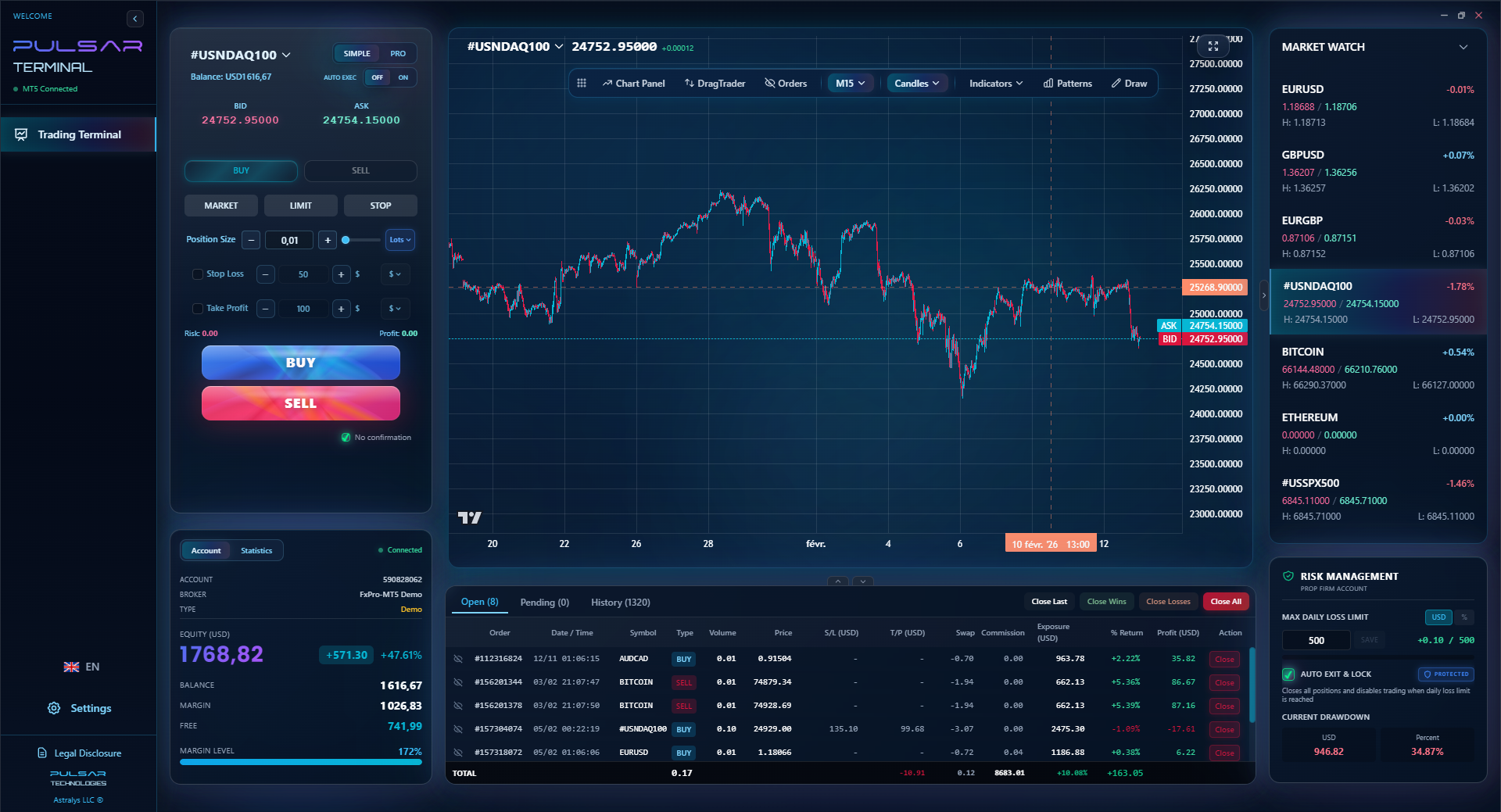
Once you have a backtested strategy, precise and disciplined execution is key. Pulsar Terminal automates complex order types and risk management directly on your MT5, turning your plan into consistent action.
Pulsar Terminal
L'outil MT5 tout-en-un : ordres glisser-déposer, multi-TP/SL, trailing stop, grid trading, Volume Profile et protection prop firm. Utilisé quotidiennement par 1 000+ traders.
“The goal isn't to find a holy grail, but to understand your strategy's character - its soul and its likely losing streaks.”
A great backtest is just the first audition, not the show. You must forward test (paper trade) in real-time market conditions.
Why? Because a backtest can't simulate your psychology. It can't simulate the feeling of seeing a trade go ₦50,000 against you and sticking to the plan. It can't simulate internet lag or power outages in Lagos.
Here's my process:
- Backtest: 5+ years of data, with all costs included. Profit factor > 1.5, max drawdown < 20%. That's the first filter.
- Forward Test on Demo: Trade the strategy in real-time on a demo account for at least 50-100 trades. No cheating, no skipping trades. Treat it like real money. I forward tested for 3 months once before going live.
- Live Trading with Micro Lots: Start trading with the smallest possible position size. Your goal isn't profit, it's validation. Can you execute exactly as tested? Only scale up after another 50 profitable live trades.
This bridge is where 90% of strategies fail. The backtest was optimistic. The forward test reveals the truth. I had a MACD indicator crossover strategy that backtested wonderfully. In forward testing, I discovered the signals often came during London lunchtime lulls with terrible spreads, gutting the profitability. Killed it before it cost me a kobo.
Warning: Never, ever skip forward testing. The market's present volatility is never exactly like the past. Nigeria's FX turnover jumped over 56% recently - current conditions are unique. Test in them first.
💡 Conseil de Winston
The single most important backtest metric is maximum drawdown. If you can't emotionally and financially handle that loss, the strategy is useless to you.
“Never skip forward testing. The market's present volatility is never exactly like the past.”
The goal of backtesting isn't to find a 'holy grail' with 90% wins. That doesn't exist. The goal is to find a statistically sound edge and, more importantly, to understand the strategy's character.
You need to know its soul: Is it a high-frequency scalper that needs 100 trades a month to work? Or a swing trader that needs patience through 5 losing trades to catch one big winner? This knowledge stops you from abandoning a good strategy at the wrong time.
It also builds humility. You see every brutal loss your system would have taken. When that loss happens in real life, you're not surprised. You're prepared. You've already 'experienced' it financially and emotionally in the test.
Finally, backtesting teaches you that performance is a distribution, not a destination. One year your strategy might make 25%, the next it might lose 5%. The backtest shows you the range of possible outcomes so you don't freak out during the inevitable down periods. You planned for this. You sized your positions for this. That's what professional risk management looks like, and it starts with a proper backtest.
FAQ
Q1Is backtesting a guarantee of future profits in forex?
Absolutely not. It's the biggest misconception. Backtesting shows you how a strategy performed in the past. Markets change, volatility shifts, and black swan events happen. It's a tool for evaluating probability and risk, not a crystal ball. A good backtest increases your odds, but it never guarantees a win.
Q2How much historical data do I need for a reliable backtest?
More is better, but quality matters. Aim for at least 5 years of data to see how the strategy behaves across different market cycles (bull, bear, sideways). Include periods of high volatility (like the COVID crash or major Naira devaluations) to see if your strategy survives stress. For a scalping strategy, you might need 1-2 years of high-quality tick data, which is harder to get.
Q3What's the difference between backtesting and forward testing (paper trading)?
Backtesting uses historical data to simulate past performance. Forward testing uses a demo account to trade your strategy in real-time, current markets. You need both. Backtesting gives you statistical depth; forward testing reveals real-world execution issues, psychological pressures, and how the strategy handles today's market liquidity and spreads.
Q4As a Nigerian trader, how do I factor in the 10% capital gains tax in my backtest?
You must build it into your profit calculations. After your backtesting software gives you gross profit, you manually apply a 10% reduction to that gross profit figure. Better yet, if you can code, add it as a 'commission' on winning trades only. A strategy with a thin 5% gross return is actually a 4.5% net loss after tax and costs - useless.
Q5Can I backtest on my phone?
Not effectively. Serious backtesting requires a desktop platform like MT4/MT5 on a computer, where you can analyze large datasets and use strategy testers. Mobile apps are for monitoring and execution, not deep analysis. Invest the time at a proper desk.
Q6What's a 'good' profit factor from a backtest?
Profit factor (Gross Profit / Gross Loss) is key. Anything above 1.0 means you made more than you lost. For a strategy to be strong after real costs, aim for a backtested profit factor above 1.5. A PF of 1.1 is too thin and will likely fail in live trading. My live strategies all backtested with a PF between 1.7 and 2.3.
Q7How do I get historical data for exotic pairs like GBP/NGN?
This can be tricky. Your broker's MT4/5 platform might have limited history for exotics. You can sometimes download data from sources like Dukascopy or TrueFX, but ensure the format is compatible. Often, the most practical approach is to use the deepest data you can get from your broker and acknowledge the limitation. Focus on major pairs for initial strategy development where data is plentiful.
La leçon du Prof. Winston
Points clés:
- ✓Backtest over 5+ years of data minimum
- ✓Always include spreads, commissions, and 10% tax
- ✓Maximum drawdown is your most critical metric
- ✓Forward test on demo before risking real money
- ✓Profit factor below 1.5 is likely too weak
Cet article vous a-t-il été utile ?
Cliquez sur une étoile
Analyses Trading Hebdo
Analyses et stratégies hebdo gratuites. Pas de spam.
À propos de l'auteur
Olumide Adeyemi
Pionnier du Trading en Afrique de l'Ouest
L'un des formateurs de trading forex les plus actifs au Nigeria. 8 ans d'expérience de trading depuis Lagos. Spécialisé dans les stratégies à petit capital et les challenges de prop firms pour les traders africains.
Commentaires
Avertissement sur les risques
Le trading d'instruments financiers comporte des risques importants et peut ne pas convenir à tous les investisseurs. Les performances passées ne garantissent pas les résultats futurs. Ce contenu est fourni à titre éducatif uniquement et ne constitue pas un conseil en investissement. Effectuez toujours vos propres recherches avant de trader.
Vous aimerez aussi

Cara Trading Forex Sukses: 7 Prinsip dari Trader Profesional
Cara trading forex sukses dengan 7 prinsip trader pro: manajemen modal, disiplin, journal trading, backtest. Data nyata, bukan janji profit palsu.
Jam Trading Forex Terbaik untuk Trader Indonesia: Panduan Lengkap dengan Tabel Waktu
Panduan jam trading forex untuk trader Indonesia. Tabel 4 sesi dunia, jam emas 20:00-00:00, sesi mana yang harus dihindari. Data akurat + tips dari trader berpengalaman.
Top 5 Sàn Forex Uy Tín Nhất 2026: Review Jujur dari Trader Indonesia
Top 5 sàn forex uy tín 2026 untuk trader Indonesia. Review jujur: spread, deposit, withdraw, dukungan lokal. Exness, XM, IC Markets & lebih.
Obtenir Pulsar Terminal
Tous ces calculateurs sont intégrés dans Pulsar Terminal avec des données en temps réel de votre compte MT5. Dimensionnement de position en un clic, gestion automatique des risques et calculs instantanés.
Obtenir Pulsar Terminal