


Ask any new trader what they want from a broker, and 'tight spreads' is usually the first thing they shout.

David van der Merwe
Trader des Marchés Émergents ·  South Africa
☕ 9 min de lecture
Ce que vous apprendrez :
Ask any new trader what they want from a broker, and 'tight spreads' is usually the first thing they shout. I was the same. I chased spreads like a dog after a car, not knowing what I'd do if I actually caught one. The truth is, the 'best' spread isn't just the lowest number you see on a screen. It's the one that gives you the best overall value for your specific trading style, and in South Africa, that calculation has a few extra local twists.
Let's get this straight first. The spread is simply the difference between the buy (ask) and sell (bid) price. It's how most brokers make their money. You pay it the moment you open a trade. If EUR/USD is quoted at 1.0850/1.0852, the spread is 2 pips. Simple.
The myth is that a 0.0 pip spread is always better than a 1.5 pip spread. That's marketing nonsense. A broker offering 'zero spread' accounts will almost always charge a separate commission per lot. Another broker might have a slightly wider raw spread but charge no commission. You have to add it all up.
Here's a mistake I made early on. I signed up with a flashy international broker advertising 'raw spreads from 0.0 pips'. Sounded like a dream. What I didn't factor in was the $7 round-turn commission per standard lot and, crucially, the terrible ZAR/USD conversion rate they used to fund my account. That 'best' spread was utterly negated by hidden fees on deposit and withdrawal. The real cost was higher than my local Exness account with a 1.2 pip spread but no commission and free ZAR deposits.
Forget the advertised spread. You need to know your cost per trade. Here's the formula I use for any broker I test:
Total Cost = (Spread in pips * Pip Value) + Commission + Any Financing/Currency Conversion Fees
Commission-Based vs. Spread-Only Accounts
Let's compare a typical ECN account (commission) vs. a Standard account (wider spread, no commission). We'll trade 1 mini lot (0.1) of EUR/USD with a $1,000 account.
| Account Type | Spread | Commission | Total Cost (USD) | Cost as % of $1k Account |
|---|---|---|---|---|
| ECN/Pro | 0.2 pips | $3.50 per lot | (0.2 * $1) + $3.50 = $3.70 | 0.37% |
| Standard | 1.5 pips | $0 | (1.5 * $1) = $1.50 | 0.15% |
See the surprise? For a smaller trade size, the 'wider' spread account was actually cheaper. The ECN account only becomes cheaper when your trade size is large enough for the low spread to outweigh the fixed commission.

Example: For that ECN cost to drop below R1.50, you'd need to trade roughly 0.25 lots (25,000 units), where the commission cost per pip drops significantly. Most retail traders, especially starting out, aren't trading that size.
This is why your position size calculator is your best friend. It forces you to work with real numbers, not broker hype.

💡 Conseil de Winston
A spread is a toll, not a penalty. Your job is to find the fairest toll road for your journey, not to spend hours looking for a road that doesn't exist.
“The 'best' spread isn't the lowest number you see on a screen. It's the one that gives you the best overall value for your specific trading style.”
This is the heart of the matter for us. Trading USD/ZAR, EUR/ZAR, or GBP/ZAR is a different beast entirely from the major pairs.
Spreads on ZAR pairs are inherently wider. Why? Lower liquidity and higher volatility. A 'good' spread on USD/ZAR might be 80-120 pips during the London session. I've seen it blow out to 300+ pips around local bank holidays or major SA news events. If you're used to 1-pip spreads on EUR/USD, this will give you a heart attack.
You need a completely different position size calculator setting for these. A 100-pip stop-loss on USD/ZAR is tight. A 100-pip spread? That's just the cost of entry. I learned this the hard way in 2018. I put a swing trade on USD/ZAR, thinking my 150-pip stop was safe. I entered during a slightly thin period with a 95-pip spread. The market moved 40 pips against me immediately after entry, but because I was already down 95 pips just on the spread, I was stopped out almost instantly. The trade idea was later correct, but my spread management killed it. The 'best' spread here isn't the absolute lowest, it's the most consistent during your trading hours. A broker that shows 70 pips but frequently has 'requotes' or slippage is worse than one with a stable 90-pip spread.
Brokers know you're hunting for the best spread. Some play fair. Others get creative. Here’s what to scrutinize:
1. Averages vs. Reality: That 'average spread of 0.8 pips' is often calculated over 24 hours, including the dead-quiet Tokyo session. What matters is the spread at 10:00 AM SAST when you're actually trading. Check live spreads yourself during your trading window.
2. Dynamic Widening: Some brokers have gorgeous spreads until volatility picks up. Then they widen excessively. Compare how different brokers handle spreads during news events like SARB interest rate announcements. A good test is to watch XAU/USD (gold) during US NFP data releases.
3. The Deposit/Withdrawal Trap: This is a huge one for South Africans. A broker might have great spreads but charge 3.5% for a credit card deposit in ZAR or use a poor exchange rate. That R1,000 deposit immediately becomes R965 worth of trading power. I’ve found that brokers with local presence, like some reviewed on our site (IC Markets, XM), often offer free or low-cost ZAR bank transfers, which saves more money than shaving 0.1 pip off a spread.

Warning: If a broker's offer seems too good to be true - unbelievably low spreads on ZAR pairs with no commission - it probably is. They might be a market maker trading against you, which creates a massive conflict of interest. Always check their regulation (FSCA is ideal for SA).
💡 Conseil de Winston
If you're trading ZAR pairs, your first technical indicator should be the clock. Liquidity, and therefore a fair spread, is a function of time.
“I lost more money from poor execution and high withdrawal fees with 'low-spread' brokers than I ever saved.”
The optimal spread is dictated by your strategy, not the other way around.
For Scalpers: Yes, you need the tightest possible all-in cost. Every pip counts because your profit targets are small. A scalping strategy on EUR/USD might aim for 5-10 pips. A 2-pip spread eats 20-40% of your potential profit. You'll likely need an ECN account with low commission, and you must trade during high-liquidity sessions. For scalping, the tools in your platform matter immensely for fast execution.
For Swing Traders: You're holding for days or weeks, aiming for 100+ pip moves. A 2-pip vs. a 1-pip spread is almost irrelevant. A 1-pip saving on a 100-pip target is just 1%. Focus more on swap rates (overnight financing) and broker reliability. A swing trading approach benefits more from a stable platform and good customer service than an ultra-tight spread.
For News Traders: You need a broker that offers guaranteed stop-losses (often for a fee) or at least minimal slippage. Spreads will widen massively right before and after news. The 'best' spread here is one that returns to normal quickly after the event. Trying to trade the SARB announcement with a tight-spread ECN account can be suicidal due to slippage.
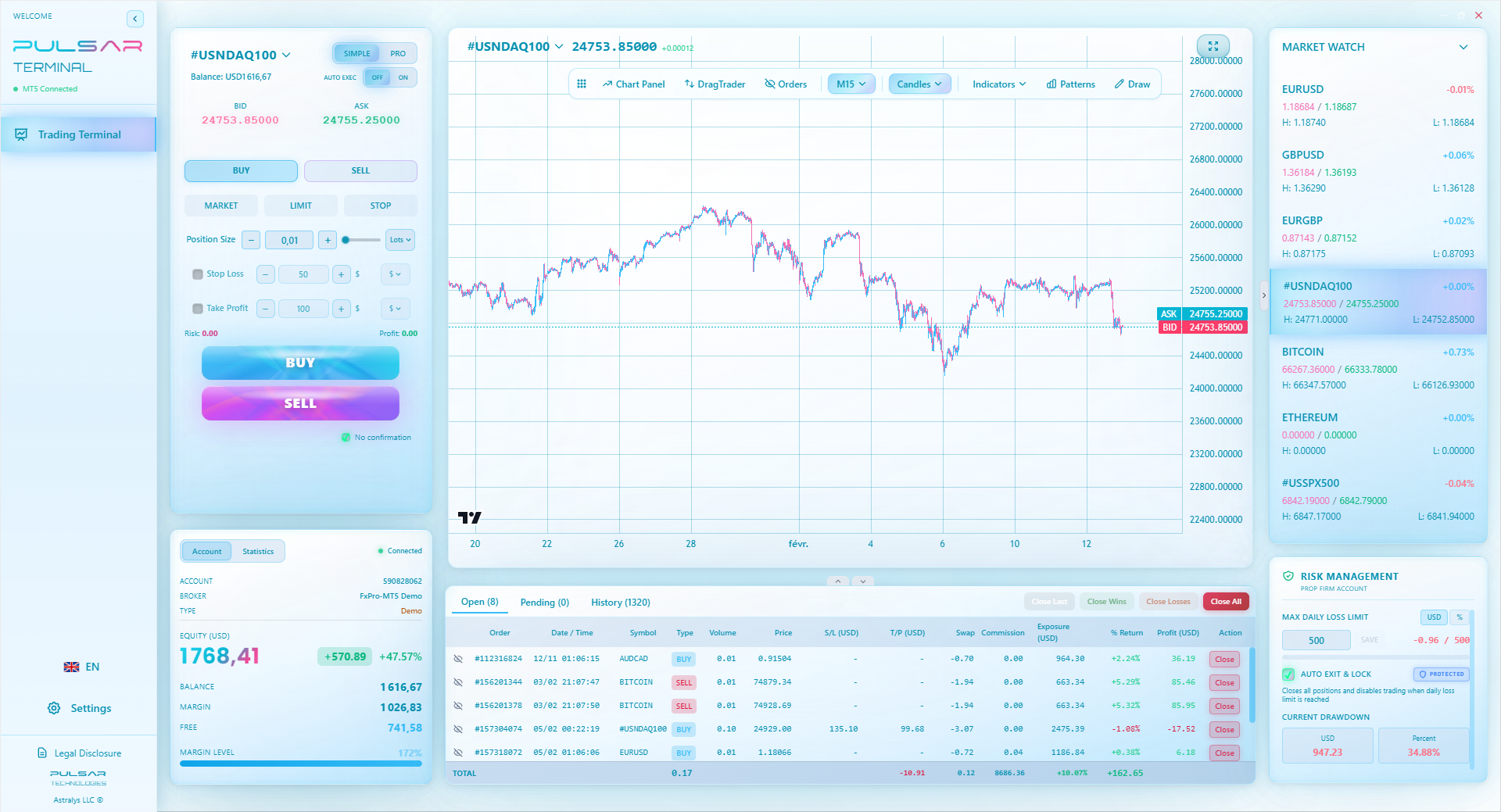
When every pip counts for your strategy, precise order entry and management tools become non-negotiable, which is where a platform enhancer like Pulsar Terminal shines.
Pulsar Terminal
L'outil MT5 tout-en-un : ordres glisser-déposer, multi-TP/SL, trailing stop, grid trading, Volume Profile et protection prop firm. Utilisé quotidiennement par 1 000+ traders.
After 12 years and plenty of wasted money, here's what I've settled on. It works for me as a hybrid swing and day trader.
I use two brokers. It sounds like overkill, but it gives me flexibility.
Broker 1 (Primary): A well-regulated broker with decent spreads (1-1.5 pips on majors) but excellent ZAR deposit/withdrawal terms and reliable execution. I use this for 90% of my trading, especially swing trades and larger positions on majors. The slightly higher spread is a insurance premium I'm happy to pay for stability and easy access to my money. I often use brokers like Pepperstone for this role.
Broker 2 (Specialist): A true ECN broker for when I want to scalp or take a very precise, short-term entry on a major pair. I keep a smaller amount of capital here. I use this maybe 10% of the time.
For ZAR pairs? I'm extremely cautious. I only trade them when liquidity is highest (London overlap) and I use a position size calculator that factors in a minimum 80-pip spread for USD/ZAR. My stop-losses are never less than 200 pips. It forces me to be very selective.

Pro Tip: Don't just look at the spread column. Open a demo account and place a mock trade. See the exact buy/sell price, check if there's any 'execution delay,' and try to close it immediately. The difference between the open and close price on a zero-movement trade is your real spread cost, including any hidden slippage.
💡 Conseil de Winston
The only spread that matters is the one between your entry and your stop-loss. Manage that distance correctly, and the broker's spread becomes background noise.
“For a South African trader, the best spread is the one that offers the lowest *total cost of trading*.”
So, what is the best spread in forex? It's not a single number.
For a South African trader, the best spread is the one that offers the lowest total cost of trading for your specific strategy, on your chosen pairs, while providing reliable execution and fair local banking services.
For a swing trader on EUR/USD, a 1.5-pip spread with free deposits might be perfect. For a scalper, a 0.3-pip spread plus a $5 commission might be the winner. For anyone trading USD/ZAR, a consistent 90-pip spread from a reputable broker is far better than a 70-pip spread from a shady one that requotes you constantly.
Chasing the lowest number is a rookie error. I know, because I was that rookie. I lost more money from poor execution and high withdrawal fees with 'low-spread' brokers than I ever saved. Your goal isn't to find the broker with the best spread. It's to find the broker that provides the best overall value, so you can focus on what actually matters: your trading decisions.
Start with your strategy. Calculate your typical trade size and target. Then work backwards to find the broker whose cost structure aligns with your reality. That's how you find your best spread.
FAQ
Q1Is a zero-spread account really better?
Not necessarily. Zero-spread accounts always charge a commission. For small trade sizes, a standard account with a slightly wider spread but no commission is often cheaper. You must calculate the total cost (spread cost + commission) for your typical trade size.
Q2What is a good spread for USD/ZAR?
During active trading hours (London session), a spread between 80 and 120 pips is considered normal and competitive for USD/ZAR. Be wary of brokers offering much lower spreads, as they may have poor execution or hidden fees. Expect spreads to widen significantly around South African news events.
Q3How do I avoid spread widening during news?
You can't avoid it entirely - it's a function of market liquidity. You can manage it by using a broker that offers guaranteed stop-losses (for a premium) or by simply not trading during major economic announcements. Placing orders far in advance of news carries a high risk of slippage.
Q4Do spreads change based on my account size?
Generally, no. The spread quoted is usually the same for all retail clients. However, some brokers offer 'VIP' or 'institutional' accounts with better spreads for very large deposit sizes (e.g., $50,000+). For most traders, your account size won't affect the spread you see.
Q5Why is the spread on my MT4/5 platform different from the broker's website?
Broker websites often display 'typical' or 'average' spreads from a previous period. The spread on your live trading platform is the real-time, actual spread. Always trust the platform data. The website figure is just marketing.
Q6As a beginner, should I prioritize low spreads?
No. As a beginner, you should prioritize a reputable, well-regulated broker with a user-friendly platform and good educational resources. The difference between a 1-pip and 2-pip spread is negligible when you're learning risk management and strategy. Focus on not blowing up your account first.
La leçon du Prof. Winston
Points clés:
- ✓Calculate total cost, not just spread.
- ✓ZAR pairs need 80-120 pip spread buffers.
- ✓Your trading style dictates the optimal spread.
- ✓Local banking fees can outweigh spread savings.
- ✓Stability is better than a temporarily low number.
Cet article vous a-t-il été utile ?
Cliquez sur une étoile
Analyses Trading Hebdo
Analyses et stratégies hebdo gratuites. Pas de spam.
À propos de l'auteur
David van der Merwe
Trader des Marchés Émergents
Trader basé à Johannesbourg avec 11 ans d'expérience sur les devises des marchés émergents. Spécialisé dans les paires ZAR, le trading régulé par la FSCA et l'analyse du marché sud-africain.
Commentaires
Avertissement sur les risques
Le trading d'instruments financiers comporte des risques importants et peut ne pas convenir à tous les investisseurs. Les performances passées ne garantissent pas les résultats futurs. Ce contenu est fourni à titre éducatif uniquement et ne constitue pas un conseil en investissement. Effectuez toujours vos propres recherches avant de trader.
Vous aimerez aussi

Cara Trading Forex Sukses: 7 Prinsip dari Trader Profesional
Cara trading forex sukses dengan 7 prinsip trader pro: manajemen modal, disiplin, journal trading, backtest. Data nyata, bukan janji profit palsu.
Jam Trading Forex Terbaik untuk Trader Indonesia: Panduan Lengkap dengan Tabel Waktu
Panduan jam trading forex untuk trader Indonesia. Tabel 4 sesi dunia, jam emas 20:00-00:00, sesi mana yang harus dihindari. Data akurat + tips dari trader berpengalaman.
Top 5 Sàn Forex Uy Tín Nhất 2026: Review Jujur dari Trader Indonesia
Top 5 sàn forex uy tín 2026 untuk trader Indonesia. Review jujur: spread, deposit, withdraw, dukungan lokal. Exness, XM, IC Markets & lebih.
Obtenir Pulsar Terminal
Tous ces calculateurs sont intégrés dans Pulsar Terminal avec des données en temps réel de votre compte MT5. Dimensionnement de position en un clic, gestion automatique des risques et calculs instantanés.
Obtenir Pulsar Terminal