


I remember staring at my screen in October 2016, watching the USD/ZAR rocket from around 13.80 to past 14.50 in what felt like minutes.

David van der Merwe
Trader des Marchés Émergents ·  South Africa
☕ 9 min de lecture
Ce que vous apprendrez :
I remember staring at my screen in October 2016, watching the USD/ZAR rocket from around 13.80 to past 14.50 in what felt like minutes. My phone was buzzing with margin call alerts. I was over-leveraged on a small account, trying to make a quick buck. That move wiped out a chunk of South African retail traders - some reports said up to 40% of accounts. It was a brutal, expensive lesson that made our regulators sit up. Fast forward to today, and the game has changed. The lowest use in forex for you and me, the retail traders, isn't a broker's choice anymore. It's the law.
Let's cut to the chase. If you're trading with an FSCA-regulated broker in South Africa, the lowest use you can get on major forex pairs like EUR/USD or GBP/USD is 30:1. That's not a suggestion; it's a hard cap set by the Financial Sector Conduct Authority. They brought this rule in a few years back, basically mirroring what Europe's ESMA did.
Think of 30:1 as the new baseline, the absolute minimum risk setting the regulator allows for retail clients. It means for every R1,000 in your trading account, you can control a position worth R30,000. Before this, it was the wild west. I've seen brokers, especially the offshore ones, offer 500:1, 1000:1, even 'unlimited' use. Tempting, right? But that's how accounts blow up in seconds during a flash crash like the one we saw on the Swiss Franc.
The FSCA's logic is simple: protect the little guy. They figure if they limit how much rope you have, you're less likely to hang yourself with it. For more volatile stuff, the caps get even tighter. Want to trade crypto CFDs? Get ready for a maximum of 2:1 use. That's practically trading with your own cash.

Warning: Any broker offering you, a retail trader, use higher than 30:1 on majors is NOT regulated by the FSCA. You might be dealing with an offshore entity, which means your funds aren't protected under South African law if things go south.
Now, there's a loophole, but it's not for most of us. If you can prove you're a 'professional client' - think a minimum portfolio of R7 million or years of professional experience - you can apply for higher use. But for 99% of traders reading this, 30:1 is your world.
I get it. When you start, low use feels like a handicap. You see stories of traders turning R5,000 into R50,000 overnight and think you need 500:1 to do that. Here's the truth: those stories usually end with "and then I lost it all the next week."
A Lesson from My Trading Journal
Let me give you a real example from my own books. Back in 2019, I took a swing trading position on XAU/USD (gold). My analysis was solid, but the entry was a bit early. With 50:1 use (this was pre-cap), a 1.5% move against me triggered a margin call. I was forced out at a loss of R2,300. The trade then reversed and went on to hit my original target. Had I used 20:1 use, that same adverse move would have only used 30% of my margin. I could have weathered the storm and banked a R4,000 profit. The higher use didn't help me make more; it helped me lose faster.
Low use forces discipline. It makes you focus on your position size calculator and proper risk management. You can't just YOLO into a trade with your entire account. You have to be selective, patient, and precise. It turns trading from a casino game into a business.

Pro Tip: Use the 30:1 cap to your advantage. Build a strategy that works within these confines. If your strategy can't turn a profit with 30:1 use, it's not a good strategy. It's just a gamble waiting for a lucky streak.

💡 Conseil de Winston
use is a multiplier for your mistakes as much as your genius. The lower the use, the slower you can be wrong, and that's a gift. It gives you time to think.
“The 30:1 use cap isn't a limitation to fight against. It's a framework to build within.”
Just because use is capped doesn't mean all FSCA brokers are the same. Where they compete is on other costs that eat into your profits, mainly the spread and commissions.
Here’s a quick look at some major players for us South Africans:
| Broker (FSCA Regulated) | Typical EUR/USD Spread | Key Feature for Low-Cost Trading |
|---|---|---|
| IC Markets | As low as 0.0 pips + commission | Raw spread account, great for scalping strategy |
| Pepperstone | 0.0 pips + commission on Razor account | Tight spreads, reliable execution |
| XM | From 0.6 pips on Zero account | No commission on that account, good for smaller accounts |
| Tickmill | 0.11 pips avg. + $3 commission per lot | Very competitive effective cost |
Notice something? The use column is missing. Because for retail traders, it's the same everywhere: 30:1. So your decision shifts. You're not shopping for the highest use; you're shopping for the lowest cost of doing business.
A broker like IC Markets review might offer 0.0 pip definition spreads, but they charge a commission per lot. Another, like XM review, might have a slightly higher spread but no commission. You need to do the math based on your typical trade size. For a standard 1-lot (100,000 units) trade, a difference of 0.5 pips is $5. That adds up fast.
Minimum deposits also vary. Some brokers let you start with as little as R500 or $10, which is fantastic for testing the waters without risking your rent money.
This is where the rubber meets the road. Let's make this practical. You have R10,000 in your account. use is 30:1. What does that actually mean for your risk?
Step 1: Maximum Position Size Your maximum buying power is Account Balance x use. R10,000 x 30 = R300,000. In forex terms, that's roughly 3 standard lots (since 1 standard lot on EUR/USD is about €100,000, but let's keep it in Rands for simplicity).
Step 2: The Smart Position Size (The 1% Rule) Just because you can doesn't mean you should. Most pros risk 1-2% of their account on a single trade.
- 1% of R10,000 = R100.
Let's say you're buying USD/ZAR at R18.50, and you place your stop loss 50 cents away at R18.00. That's a 50 cent or 500 pip definition risk.

Example: Risk per Unit = Stop Loss Distance = R0.50 Position Size = Account Risk / Risk per Unit Position Size = R100 / R0.50 = 200 units.
With 30:1 use, the margin required for 200 units of USD/ZAR is tiny. The point is, you're using a fraction of your available power to protect your capital. This is the golden rule that prevents a margin call. I learned this the hard way early on by ignoring it. I once risked 8% on a "sure thing" in the EUR/USD guide. It wasn't a sure thing. I lost R800 in an afternoon and felt sick. Never again.
💡 Conseil de Winston
Never choose a broker based on their maximum use offer. That's like choosing a car based on its top speed. You'll never use it legally, and it only increases the chance of a fatal crash.
“High use is a trap. It will magnify your losses just as fast as it magnifies your gains.”
You'll see them advertised everywhere: "Trade with 1:1000 use!" "Unlimited Margin!" These are usually brokers based in offshore jurisdictions like the Seychelles, Vanuatu, or St. Vincent. They are not regulated by the FSCA.
What does that mean for you?
- No Local Protection: If the broker goes bankrupt or decides to freeze your withdrawals, you have little to no recourse. The FSCA can't help you.
- Funds Not Segregated: FSCA rules require client money to be held in separate, protected accounts. Offshore brokers aren't bound by this. Your deposit could be mixed with the company's operating cash.
- The Psychological Trap: The high use is a trap. It will magnify your losses just as fast as it magnifies your gains. It encourages terrible habits that will destroy your account eventually.
I tried an offshore broker for a month in my third year of trading, lured by the 500:1 use. I made 30% in the first week scalping strategy. I felt like a genius. The next week, two bad trades wiped out 60%. The emotional rollercoaster was insane. I withdrew what was left and never looked back. The "freedom" of high use is an illusion. The 30:1 cap, frustrating as it may seem, is a guardrail that keeps you on the road.
So, how do you make decent returns with "only" 30:1 use? You adapt. You can't rely on use to do the heavy lifting; your strategy has to.
Focus on Risk-to-Reward: This becomes your new best friend. You need to aim for trades where your potential profit is 1.5 to 3 times your potential loss. If you're only risking 1% per trade but winning 3% on your winners, you can be wrong half the time and still be profitable.
Consider Longer Timeframes: Swing trading over days or weeks often works better with moderate use. You're aiming for larger moves (200-300 pips) so you don't need a huge position size to make it worthwhile. My most consistent profits have come from swing trades on the XAU/USD guide, holding for a week or two, targeting 150-200 pips.
Use Tools to Manage What You Have: Since you can't just throw use at a problem, you need to be smarter with order management. This is where good trading software shines.
Mind Your Currency Pairs: Trading exotics like USD/ZAR or USD/TRY can be tempting for the big swings, but the spreads are wider. Sometimes, the cost of the trade on a volatile pair can eat up your profit before it even starts. Majors and minors like EUR/USD, GBP/JPY, or AUD/CAD often have much tighter spread definition, making them more efficient to trade with lower use.
💡 Conseil de Winston
Your strategy should be profitable at 10:1 use. If it needs 100:1 to work, you're not trading, you're just betting with borrowed money.
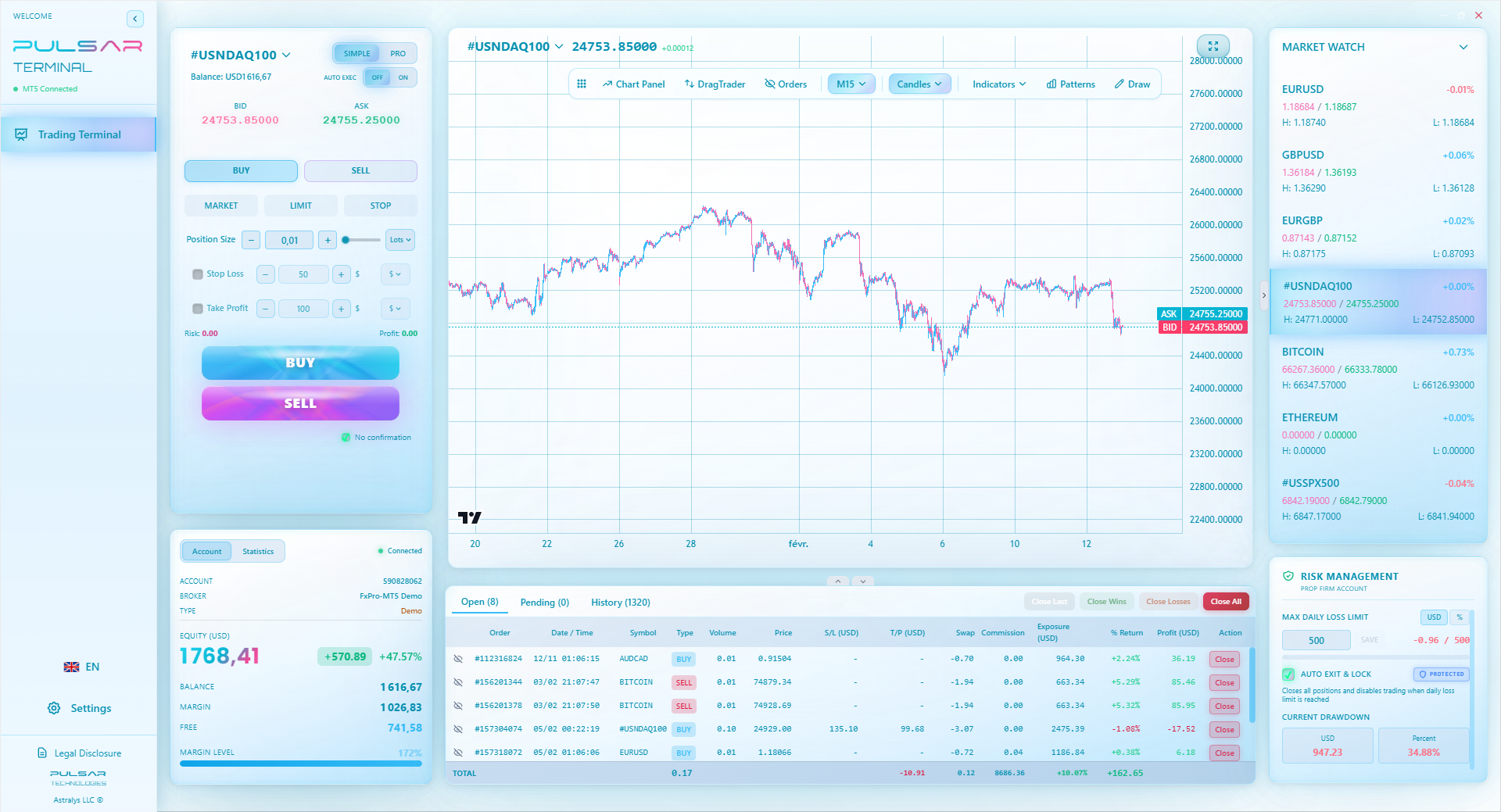
When you're trading with limited leverage, precise order management is key, and Pulsar Terminal's drag-and-drop orders and multi-TP/SL tools on MT5 help you execute your plan without hesitation.
Pulsar Terminal
L'outil MT5 tout-en-un : ordres glisser-déposer, multi-TP/SL, trailing stop, grid trading, Volume Profile et protection prop firm. Utilisé quotidiennement par 1 000+ traders.
“If your strategy can't turn a profit with 30:1 use, it's not a good strategy. It's a gamble.”
Let's wrap this up. The question "what is the lowest use in forex" has a clear, regulatory answer for South Africa: 30:1 on major pairs for retail traders.
This isn't a limitation to fight against. It's a framework to build within. It forces you to develop the skills that actually matter in trading: analysis, patience, risk management, and emotional control. The traders who succeed in this environment are the ones who treat it like a marathon, not a sprint.
Choose an FSCA-regulated broker you trust, like Pepperstone review or any of the other solid options. Focus on minimizing your trading costs (spreads/commissions). Use a position size calculator for every single trade. And respect the 1% risk rule like your financial life depends on it - because it does.
The goal isn't to get rich tomorrow with one massive, leveraged bet. The goal is to still be in the game next year, and the year after that, consistently growing your account. The 30:1 use cap, ironically, might just be the thing that saves your trading career before it even begins.
FAQ
Q1Can I get use higher than 30:1 in South Africa?
Yes, but not as a standard retail trader. You must qualify as a 'professional client' with your FSCA-regulated broker. This usually requires proving you have significant trading experience (like 2+ years in the industry) and a large financial portfolio (often over R7 million in net worth or assets). For most of us, 30:1 is the fixed limit.
Q2Why did the FSCA lower the use to 30:1?
Primarily to protect retail investors. Studies and real events (like the 2016 ZAR flash crash and the 2015 Swiss Franc event) showed that excessive use was a leading cause of catastrophic losses for everyday traders. The cap is designed to reduce the speed at which you can lose money, forcing better risk management.
Q3Is it illegal to use an offshore broker for higher use?
It's not strictly illegal for you as a South African resident to use an offshore broker. However, it is illegal to move funds offshore for trading purposes without using an authorized dealer (like your bank or a licensed forex broker). More importantly, it's extremely risky. You lose all the protections of FSCA regulation, including segregated funds and a local dispute resolution process.
Q4What's the use for trading gold or crypto?
The FSCA sets lower caps for more volatile assets. For commodities like gold (XAU/USD), the maximum is usually 20:1. For cryptocurrency CFDs (like Bitcoin), the maximum use is just 2:1. This reflects the higher inherent risk and wild price swings in these markets.
Q5How does 30:1 use compare to other countries?
South Africa's 30:1 cap is aligned with major regulated jurisdictions like the European Union (ESMA) and the UK (FCA). Australia's ASIC also implemented similar restrictions. In contrast, less regulated regions like offshore islands or some parts of Asia may offer 500:1 or 1000:1. The US has even stricter rules, with a maximum of 50:1 on majors but only for professional traders; retail is capped lower.
Q6If I have a small account (e.g., R5,000), is 30:1 enough?
Absolutely, and it's safer. With R5,000 at 30:1, you control R150,000. A sensible 1% risk is R50 per trade. On a standard EUR/USD trade, that could equate to a 5-pip stop loss on a mini lot (10,000 units), or a more reasonable 50-pip stop on a 1,000 unit micro lot. It forces you to trade smaller, which is the right way to grow a small account. Trying to use 500:1 on a R5k account is a recipe for instant ruin.
La leçon du Prof. Winston
Points clés:
- ✓FSCA caps retail use at 30:1 for major forex pairs.
- ✓Risk a maximum of 1-2% of your account per trade.
- ✓Offshore high-use brokers offer zero local protection.
- ✓Focus on risk-to-reward ratios of 1:1.5 or better.
- ✓Tight spreads matter more than high use.
Cet article vous a-t-il été utile ?
Cliquez sur une étoile
Analyses Trading Hebdo
Analyses et stratégies hebdo gratuites. Pas de spam.
À propos de l'auteur
David van der Merwe
Trader des Marchés Émergents
Trader basé à Johannesbourg avec 11 ans d'expérience sur les devises des marchés émergents. Spécialisé dans les paires ZAR, le trading régulé par la FSCA et l'analyse du marché sud-africain.
Commentaires
Avertissement sur les risques
Le trading d'instruments financiers comporte des risques importants et peut ne pas convenir à tous les investisseurs. Les performances passées ne garantissent pas les résultats futurs. Ce contenu est fourni à titre éducatif uniquement et ne constitue pas un conseil en investissement. Effectuez toujours vos propres recherches avant de trader.
Vous aimerez aussi

Cara Trading Forex Sukses: 7 Prinsip dari Trader Profesional
Cara trading forex sukses dengan 7 prinsip trader pro: manajemen modal, disiplin, journal trading, backtest. Data nyata, bukan janji profit palsu.
Jam Trading Forex Terbaik untuk Trader Indonesia: Panduan Lengkap dengan Tabel Waktu
Panduan jam trading forex untuk trader Indonesia. Tabel 4 sesi dunia, jam emas 20:00-00:00, sesi mana yang harus dihindari. Data akurat + tips dari trader berpengalaman.
Top 5 Sàn Forex Uy Tín Nhất 2026: Review Jujur dari Trader Indonesia
Top 5 sàn forex uy tín 2026 untuk trader Indonesia. Review jujur: spread, deposit, withdraw, dukungan lokal. Exness, XM, IC Markets & lebih.
Obtenir Pulsar Terminal
Tous ces calculateurs sont intégrés dans Pulsar Terminal avec des données en temps réel de votre compte MT5. Dimensionnement de position en un clic, gestion automatique des risques et calculs instantanés.
Obtenir Pulsar Terminal