


If you ask most people in Lagos what forex trading is, they'll tell you it's a quick way to make millions from your phone.

Olumide Adeyemi
Pionnier du Trading en Afrique de l'Ouest ·  Nigeria
☕ 11 min de lecture
Ce que vous apprendrez :
- 1The Core Meaning: It's Just Buying and Selling Money
- 2How Forex Works in Nigeria: Rules, Taxes, and Reality
- 3What It Really Costs: From Spreads to Your First Deposit
- 4Trading the Naira and Other Popular Pairs
- 5use: Your Best Friend and Worst Enemy
- 6From My Trading Journal: What Worked and What Blew Up
- 7Your First Steps as a Nigerian Trader
If you ask most people in Lagos what forex trading is, they'll tell you it's a quick way to make millions from your phone. That's the myth, and it's why so many accounts get blown. The real meaning of a forex trade isn't about getting rich quick, it's about exchanging value, managing risk, and understanding a global market that never sleeps. I've seen both sides, and today, I'm setting the record straight on what it really means to trade forex from Nigeria, from the Naira's wild swings to the actual taxman knocking on your door.
At its heart, the meaning of a forex trade is simple: you're buying one currency while simultaneously selling another. You're betting that the currency you're buying will increase in value relative to the one you're selling. We do this in pairs, like EUR/USD or, more relevant for us, USD/NGN.
Think of it like this. You see the Naira is weak at ₦1,500 per dollar. You believe new CBN policies will strengthen it. So, you sell USD/NGN (you sell dollars, buy Naira). If the rate moves to ₦1,200, you've made a profit. You bought Naira cheap and sold it back when it was stronger. That's a forex trade.
The market is massive and decentralized. It's not like the Nigerian Stock Exchange with a single building. It's a global network of banks, institutions, and individuals trading 24 hours a day, five days a week. For us in Nigeria, this means you can be trading the Aussie dollar at 2 AM Lagos time if you want. The liquidity is insane - trillions of dollars daily - which is why spreads (the cost of trading) can be so tight on major pairs.

Example: You buy 1 standard lot (100,000 units) of EUR/USD at 1.0850. The price rises to 1.0900. That's a 50-pip move. Since a standard lot means each pip is worth roughly $10, your profit is 50 pips * $10 = $500. Not bad. But remember, if it moved 50 pips against you, you'd lose $500 just as fast. That's the game.
Understanding this basic mechanism is more important than any fancy strategy. It's the foundation. Everything else - use, margin, analysis - is built on this simple act of exchange. If you don't get this, you're just gambling. I learned that the hard way early on, confusing a lucky guess with a real trade.
“The real meaning of a forex trade isn't about getting rich quick, it's about exchanging value and managing risk.”
Trading forex is legal for individuals here. Let's get that out of the way. But the environment has its own unique flavour, shaped heavily by the Central Bank of Nigeria (CBN) and our economic realities.
The Regulatory Scene
We don't have a local SEC-style watchdog specifically for retail forex brokers. The CBN focuses on the big picture: Naira stability and managing forex reserves. So, most brokers serving Nigerian traders are internationally regulated entities from places like Cyprus (CySEC) or the Seychelles (FSA). You need to do your homework on your broker's license. I stick with well-reviewed international firms like Exness or IC Markets that have a solid track record here.
The Taxman Cometh
This is where many get a nasty surprise. Profits from forex trading are subject to Capital Gains Tax (CGT). The rate is 10%. It's your responsibility to declare this to the Federal Inland Revenue Service (FIRS). I keep a detailed trade journal for this exact reason. If you make a ₦5 million profit in a year, be ready to set aside ₦500,000. Ignoring this is asking for trouble.
Funding Your Account
This can be a hurdle. With limits on international spending using Naira cards (sometimes as low as $50 a month), you need smart workarounds. Many brokers now offer local bank deposit options in Naira, which they convert. Others use payment processors. I've used domiciliary account transfers, but the fees add up. E-wallets like Skrill are an option, but not always the most cost-effective. Always check the deposit and withdrawal methods before you sign up.
The market itself is huge for Africa. Turnover hit $8.6 billion in 2025. You're participating in a major financial arena, not some backwater. Act like it.

💡 Conseil de Winston
The market's job is to take your money. Your job is to not give it to them. Every rule you create - stop losses, position sizing - is a barrier against your own generosity.
“A 50-pip move that made you $500 can, with high use, wipe out 50% of your money just as fast.”
Let's talk numbers, because empty promises don't pay bills. Your trading costs eat into profits, and your starting capital determines if you can even survive the learning curve.
Trading Costs:
- Spreads: This is the main cost for most. It's the difference between the buy (ask) and sell (bid) price. On EUR/USD, a good raw spread can be 0.1 pips. On a standard account, maybe 1.5 pips. That difference is money out of your pocket before you even start.
- Commissions: Some accounts (often called ECN or Raw) charge a commission per lot traded instead of a wide spread. Something like $7 per round lot is standard.
- Swap Fees: If you hold a position overnight, you pay or receive interest. This can be significant on some pairs.
Starting Capital: Yes, some brokers let you start with $1. Please don't. It's a gimmick. You can't practice proper risk management with that. You'll overtrade just to see meaningful gains. I started with $200 and blew it in a month because the pressure to turn it into something big was overwhelming.
A more realistic starter amount is $500-$1000 (roughly ₦750k - ₦1.5m). This lets you use sensible position size calculator logic without risking 20% of your account on a single trade. With a $500 account, risking 1% ($5) per trade, you can actually learn without one bad week wiping you out.
Here’s a quick comparison of common costs:
| Cost Type | Low-Cost Example | Standard Account Example | Impact on a 1-lot EUR/USD Trade |
|---|---|---|---|
| Spread | 0.1 pips | 1.5 pips | $1 vs. $15 cost to open |
| Commission | $7 per lot | $0 | Added $7 |
| Total Cost | $8 | $15 | The "raw" account is cheaper for active traders. |
The key is to match the account type to your style. A casual swing trading approach might be fine with a slightly wider, commission-free spread. A scalping strategy needs the tightest spreads possible.
“A 50-pip move that made you $500 can, with high use, wipe out 50% of your money just as fast.”
As a Nigerian trader, you have a front-row seat to one of the most volatile currencies in the world: our own Naira. Trading USD/NGN is a unique beast.
USD/NGN: This isn't your typical forex pair. Liquidity can dry up, spreads can be enormous (think 50-100 pips or more), and the price is heavily influenced by CBN directives, oil prices, and pure market sentiment. It's not for beginners. I once took a position based on a rumour of a new forex injection, only for the CBN to do the opposite. The 80-pip spike against me in minutes was a brutal lesson in local market risk.
Major Pairs: This is where most Nigerian traders should focus, especially early on.
- EUR/USD: The most liquid pair in the world. Tighter spreads, clearer trends. It's my bread and butter for testing new strategies. Check out our deep dive on EUR/USD guide for specifics.
- GBP/USD: More volatile than EUR/USD, can offer bigger moves.
- USD/JPY: Influenced by Bank of Japan policy and US Treasury yields.
- XAU/USD (Gold): Hugely popular here as a hedge against inflation and Naira weakness. It acts differently to currencies, so study it separately. Our XAU/USD guide explains its quirks.
Stick to the majors and maybe one or two minors when starting. You don't need to trade everything. Master the rhythm of EUR/USD first. Its average daily range and liquidity make it a better teacher than the wild swings of USD/NGN.
“Your first goal is not to make profit. Your first goal is to survive for 6 months without blowing your account.”
Here’s the biggest trap for new traders in Nigeria: insane use offers. I’ve seen ads screaming "1:2000 use!" That's not a tool, it's a weapon pointed at your own account.
What use really means: It's a loan from your broker to control a larger position with less of your own money. For example, with 1:100 use, you can control a $10,000 position with just $100 of your own capital (your margin).
The Problem: That 50-pip move that made you $500 on a standard lot earlier? With a $100 margin at 1:100 use, that same move against you would wipe out 50% of your money. At 1:500 use, a 20-pip move could trigger a margin call.

Warning: High use magnifies losses faster than it magnifies gains. It accelerates the path to a zeroed account. I used 1:500 when I started, thinking it was the key to fast profits. I learned it was the key to fast losses instead.
A sensible approach: For beginners, I wouldn't go above 1:30, even if your broker offers more. Use a position size calculator religiously. If your risk per trade is 1% of your $1,000 account ($10), and your stop-loss is 20 pips away, the maximum position size you should take is tiny - not a full lot. use lets you take that sensible, small position. It shouldn't be used to take a massive, reckless one.
Think of use like a powerful car engine. A skilled driver uses it for controlled acceleration. A novice just crashes. Be the skilled driver.
💡 Conseil de Winston
A 50-pip loss on a well-sized trade is a cost of doing business. A 50-pip loss that wrecks your account is a failure of arithmetic. Use the calculator, every time.
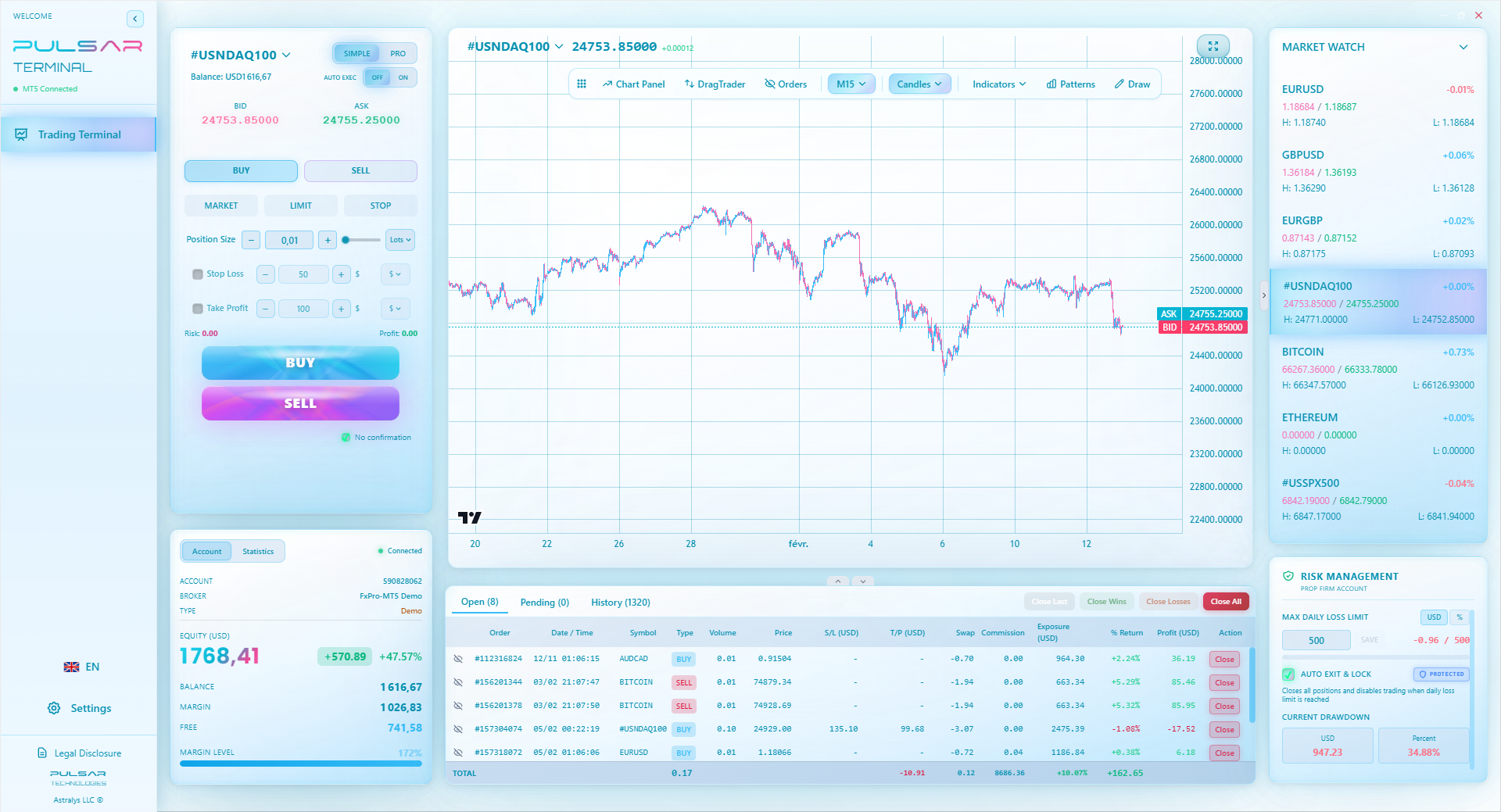
Managing multiple take-profit levels and trailing stops manually is stressful, but tools like Pulsar Terminal automate these risk management tasks directly on your MT5 chart.
Pulsar Terminal
L'outil MT5 tout-en-un : ordres glisser-déposer, multi-TP/SL, trailing stop, grid trading, Volume Profile et protection prop firm. Utilisé quotidiennement par 1 000+ traders.
“Your first goal is not to make profit. Your first goal is to survive for 6 months without blowing your account.”
Theory is cheap. Let me show you the meaning of forex trades through my own wins and mess-ups. These are real trades from my history.
The Good (A Lesson in Patience):
- Pair: EUR/USD
- Thesis: Price was consolidating after a strong downtrend, hugging a key resistance level at 1.0750. I waited for a clear rejection candle on the 4-hour chart.
- Entry: Sold at 1.0748. Stop Loss: 1.0800 (52 pips risk). Take Profit: 1.0650 (98 pip target).
- Result: Price drifted down over three days and hit my take profit. Profit: 98 pips * $10 per pip on my 0.5 lot size = $490.
- Why it worked: I had a clear plan (resistance level), defined risk (1.5% of my account), and the patience to wait for the setup. I used the RSI indicator to confirm bearish momentum was building.
The Bad (A Lesson in Humility):
- Pair: USD/NGN
- Thesis: Heard "reliable" gossip that a major dollar inflow was coming next week. No chart analysis, just a hunch.
- Entry: Bought USD/NGN at ₦1,480. No stop loss (my first mistake). Position size was way too big.
- Result: The inflow didn't materialize. The Naira strengthened sharply on other news. I watched in horror as it fell to ₦1,420. I finally panicked and sold at ₦1,425. Loss: 55 pips, but on a huge position. I lost over $1,200 in a day.
- Why it failed: No technical basis, no risk management, trading on rumours. I broke every rule. It was a costly reminder that the market doesn't care about your gossip.
These trades show the difference. One is a calculated business transaction. The other is gambling. Know which one you're doing.
“Trading USD/NGN is a unique beast. It's not for beginners.”
Ready to move from theory to practice? Here's a no-nonsense roadmap.
- Education Before Deposit: Spend a month on demo accounts. Learn how to place orders, set stops, read basic candlestick patterns. Understand what a pip definition and spread definition are, cold.
- Choose a Reputable Broker: Look for strong international regulation, low and transparent costs, and reliable deposit/withdrawal methods for Nigeria. Read our reviews on XM or Pepperstone to see what to look for.
- Start Small with Real Money: Fund your account with an amount you can afford to lose completely - that starter $500 I mentioned. This is tuition fee money, not get-rich-quick money.
- Develop a Simple Plan: Will you focus on EUR/USD daily charts? Will you use support/resistance with the MACD indicator for confirmation? Write down your rules for entering, exiting, and managing risk.
- Keep a Journal: Record every trade: reason, entry/exit, emotion, screenshot. This is your most valuable tool for improvement.
- Manage Your Psychology: This is 80% of the game. Greed, fear, and hope will destroy your plan if you let them. The trade journal helps you see your emotional patterns.

Pro Tip: Your first goal is not to make profit. Your first goal is to survive for 6 months without blowing your account. If you can do that while sticking to a plan, you're ahead of 90% of beginners.
Forex trading here is a marathon on a bumpy road. It's a skill that takes years to build. But understanding the true meaning of each trade - as a disciplined, risk-managed decision - is what separates the survivors from the statistics.
FAQ
Q1Is forex trading legal and safe in Nigeria?
Yes, it's legal for individuals to trade forex. 'Safe' depends on you. The activity itself is legal, but the market is high-risk. There's no local regulator specifically protecting retail forex traders, so your safety comes from choosing internationally regulated brokers, educating yourself, and practicing strict risk management. Don't trust unlicensed 'investment managers' promising guaranteed returns.
Q2How much money do I need to start forex trading in Nigeria?
While you can technically start with $10, I strongly advise against it. A more realistic amount that allows for proper practice and risk management is between $500 and $1000 (approximately ₦750,000 to ₦1.5 million). This lets you trade sensible position sizes and absorb small losses without blowing your account on one bad trade.
Q3Do I pay tax on my forex trading profits in Nigeria?
Yes. Profits are subject to Capital Gains Tax (CGT) at a rate of 10%. It is your responsibility to declare this income and pay the tax to the Federal Inland Revenue Service (FIRS). Keep detailed records of all your trades for tax purposes.
Q4What is the best currency pair for beginners in Nigeria?
Start with major pairs like EUR/USD or GBP/USD. They have the highest liquidity, which means tighter spreads and more predictable price movements. Avoid trading USD/NGN as a beginner. It's highly volatile, influenced by local politics and CBN policies, and has very wide spreads, making it much riskier to learn on.
Q5What does use mean, and how much should I use?
use is a tool that lets you control a large position with a small amount of your own capital (margin). While brokers may offer 1:500 or even 1:1000, using that much is extremely dangerous. For beginners, I recommend using no more than 1:30 use. It's enough to be effective but limits your risk of a catastrophic loss from a small price move.
Q6Can I use my local Nigerian bank account to fund my forex trading?
Often, yes, but not always directly in Naira to an international broker. Many brokers now offer local Naira deposit options through payment partners. You can also use domiciliary accounts, e-wallets (like Skrill), or specific fintech solutions. Always check the deposit/withdrawal methods a broker supports for Nigerian clients before signing up.
Q7What's the biggest mistake new Nigerian forex traders make?
Two tied for first place: using excessive use and trading without a stop-loss. High use turns small market noise into account-destroying losses. Not using a stop-loss is like driving without brakes - you have no way to limit your loss if the trade goes wrong. Always use a stop-loss on every single trade.
La leçon du Prof. Winston
Points clés:
- ✓Forex is buying one currency, selling another. Master that first.
- ✓10% Capital Gains Tax applies to your profits. Plan for it.
- ✓Start with $500+, not $10. Survival requires capital.
- ✓Use use under 1:30. Higher ratios are demolition tools.
- ✓Trade EUR/USD first. Avoid USD/NGN's wild volatility.
Cet article vous a-t-il été utile ?
Cliquez sur une étoile
Analyses Trading Hebdo
Analyses et stratégies hebdo gratuites. Pas de spam.
À propos de l'auteur
Olumide Adeyemi
Pionnier du Trading en Afrique de l'Ouest
L'un des formateurs de trading forex les plus actifs au Nigeria. 8 ans d'expérience de trading depuis Lagos. Spécialisé dans les stratégies à petit capital et les challenges de prop firms pour les traders africains.
Commentaires
Avertissement sur les risques
Le trading d'instruments financiers comporte des risques importants et peut ne pas convenir à tous les investisseurs. Les performances passées ne garantissent pas les résultats futurs. Ce contenu est fourni à titre éducatif uniquement et ne constitue pas un conseil en investissement. Effectuez toujours vos propres recherches avant de trader.
Vous aimerez aussi

Cara Trading Forex Sukses: 7 Prinsip dari Trader Profesional
Cara trading forex sukses dengan 7 prinsip trader pro: manajemen modal, disiplin, journal trading, backtest. Data nyata, bukan janji profit palsu.
Jam Trading Forex Terbaik untuk Trader Indonesia: Panduan Lengkap dengan Tabel Waktu
Panduan jam trading forex untuk trader Indonesia. Tabel 4 sesi dunia, jam emas 20:00-00:00, sesi mana yang harus dihindari. Data akurat + tips dari trader berpengalaman.
Top 5 Sàn Forex Uy Tín Nhất 2026: Review Jujur dari Trader Indonesia
Top 5 sàn forex uy tín 2026 untuk trader Indonesia. Review jujur: spread, deposit, withdraw, dukungan lokal. Exness, XM, IC Markets & lebih.
Obtenir Pulsar Terminal
Tous ces calculateurs sont intégrés dans Pulsar Terminal avec des données en temps réel de votre compte MT5. Dimensionnement de position en un clic, gestion automatique des risques et calculs instantanés.
Obtenir Pulsar Terminal