


You've seen those diagonal lines on every trading chart, right? The ones everyone talks about but few actually use correctly.

Olumide Adeyemi
Pionnier du Trading en Afrique de l'Ouest ·  Nigeria
☕ 10 min de lecture
Ce que vous apprendrez :
- 1The Absolute Basics: What You're Actually Drawing
- 2How to Draw a Valid Trend Line (The 3-Touch Rule)
- 3Trading with Trend Lines: Entries, Exits, and Nigerian Context
- 4Common Mistakes Nigerian Traders Make (And How to Avoid Them)
- 5Combining Trend Lines with Other Tools
- 6The Nigerian Reality: Regulations, Tax, and Your Profits
- 7The Break and Retest: An Advanced Money-Making Pattern
You've seen those diagonal lines on every trading chart, right? The ones everyone talks about but few actually use correctly. What is a trend line in forex, really? Is it just connecting dots, or is there a method to the madness that can actually make you money here in Nigeria? I've watched traders in Lagos and Abuja blow accounts because they drew these lines wrong, and I've also used them to bank consistent profits. Let's cut through the noise.
A trend line is not art. It's a simple, straight line that connects significant price points to show you which way the wind is blowing. Forget the fancy terms for a second. If the price is making higher lows, you draw a line under those lows - that's an uptrend line. If it's making lower highs, you draw a line above those highs - that's a downtrend line. That's it. The core idea is that price tends to respect these lines, treating them as dynamic floors (support) or ceilings (resistance).
Most Nigerian traders get this wrong from the start. They draw a line through the wicks of two random candles and call it a day. That's a surefire way to get stopped out. The key is to connect the closing prices of the swings, not the extreme spikes. Think of it as drawing a line of best fit for the market's momentum. When you get it right, it gives you a huge edge in spotting where buyers or sellers might step in next. For a deeper look at foundational concepts, check out our guide on pips.

Warning: Drawing a trend line through the bodies of candles is a rookie mistake. Your line should touch the extremes of the wicks at the swing points, acting as a boundary the price tested but couldn't break.
Here's where I see most people fail. Two points make a line, but in trading, two points make a guess. You need a third touch to confirm you've found something real. Let me give you a real example from my own trading.
Back in early 2024, I was watching GBP/NGN on the daily chart. I spotted two higher lows in January. I drew a tentative uptrend line. The price came back down in February, kissed that line almost perfectly, and bounced. That was my third touch - confirmation. I entered a long position near that bounce. That trade ran for over 800 pips because the trend line held as support. If that third touch had broken the line, I would have scrapped the idea immediately.
The Practical Steps
- Identify the Swing: On your chart, find the most obvious peak (high) or trough (low). This is your first point.
- Find the Next One: Look for the next subsequent peak or trough in the same direction. Connect these two.
- Wait for Confirmation: Do not trade based on this line yet. Wait for price to return and test it a third time. If it respects the line (bounces off it), you have a valid trend line.
This process requires patience, something that's in short supply when you're watching the Naira fluctuate. But it separates the pros from the gamblers. For strategies that work with these concepts, our guide on swing trading is a great next step.

💡 Conseil de Winston
A trend line is a hypothesis, not a guarantee. The market votes on its validity with every touch. If it breaks on the third test, your hypothesis was wrong. Scrap it and move on.
“Two points make a line, but in trading, two points make a guess. You need a third touch to confirm you've found something real.”
Okay, you've drawn a valid line. Now what? You use it to find high-probability trades. In an uptrend, you look to buy near the trend line support. In a downtrend, you look to sell near the trend line resistance. It sounds simple, but execution is everything.
Your entry should be as the price is bouncing off the line, not before. I use a simple pin bar or engulfing candle right at the line as my trigger. Your stop loss goes just below the trend line for a long trade, or just above it for a short trade. If the trend line breaks, your thesis is wrong - get out.
Now, let's talk Nigeria. With use offered up to 1:1000 by brokers like Exness or HFM, a small break of a trend line can cause a margin call lightning fast if your position size is too big. You must use a position size calculator. In 2023, I got cocky trading USD/NGN. I had a perfect downtrend line, entered a sell, but my lot size was too large for my account. The price spiked 50 pips against me, broke the trend line briefly, and hit my stop. I lost 8% of my account in minutes. The trend resumed downward immediately after, but I was already out. Lesson learned: the trend line defines your risk, so size accordingly.
Take-profit targets can be set at the next historical resistance (for longs) or support (for shorts), or you can trail your stop behind the trend line as it extends. This is where a tool that automates trailing stops becomes useful.
I've mentored traders from Port Harcourt to Kano, and the errors are universal. Let's kill these bad habits.
1. Forcing the Line: The market doesn't care about your line. If you're bending and twisting your trend line to make it fit three points, it's invalid. The points should be clear and obvious. If it's not clear, there's no trade.
2. Ignoring Timeframes: A trend line on a 5-minute chart is noise. A trend line on a daily or weekly chart is power. Always start your analysis on the higher timeframes (like the 4-hour or daily) to find the major trend, then use lower timeframes for entry. The EUR/USD guide shows this multi-timeframe approach in action.
3. Treating a Break as an Instant Reversal: This is a critical one. When a major trend line breaks, it doesn't mean "sell immediately" in an uptrend. It means the trend has weakened. It often leads to a period of consolidation or a retest of the broken line from the other side. Jumping in too early is a great way to get chopped up. Wait for confirmation, like a close below the line on your timeframe.
4. Drawing Too Many Lines: Your chart should not look like a spiderweb. Two or three clean, major trend lines are more useful than twenty messy ones. Clarity beats complexity every time.

Pro Tip: Zoom out on your chart. If your trend line disappears or looks irrelevant on a higher timeframe, it probably is. The most significant trends are visible from a distance.
💡 Conseil de Winston
In Nigeria, with high use on offer, a broken trend line can wipe you out. Your position size should be calculated so that a break and stop loss costs you no more than 1-2% of your account. No trend line is worth betting the farm on.
“The trend line defines your risk, so size your position like your financial life depends on it - because it does.”
Trend lines are powerful alone, but they're killers when combined with other indicators. I don't use many, but two are essential.
Trend Lines + Horizontal Support/Resistance: Where a diagonal trend line meets a strong horizontal price level, you have a confluence zone. This is a high-probability area for a bounce or a break. It's like finding a trade where two independent pieces of analysis agree.
Trend Lines + Momentum Indicators: I use the RSI indicator or MACD for this. In a healthy uptrend bouncing off a trend line, you want to see the RI showing bullish divergence or coming out of oversold territory. It confirms the buying pressure. If the price hits the uptrend line but the RSI is making a lower high (bearish divergence), that's a major warning sign the bounce might fail.
Here’s a table of how I combine them:
| Tool | How I Use It With a Trend Line | Nigerian Market Note |
|---|---|---|
| Horizontal Levels | Look for confluence at round numbers or old swing points. | With USD/NGN, watch for confluence at big round numbers like 1500, 1550, etc. |
| RSI (14) | Check for divergence at the trend line touch. | Helps filter false breaks during high Naira volatility. |
| Moving Average (e.g., 50 EMA) | If the trend line and a key MA are close together, strength is amplified. | Great for confirming the trend on major pairs like GBP/USD. |
This multi-tool approach stops you from taking blind trades just because price touched a line.
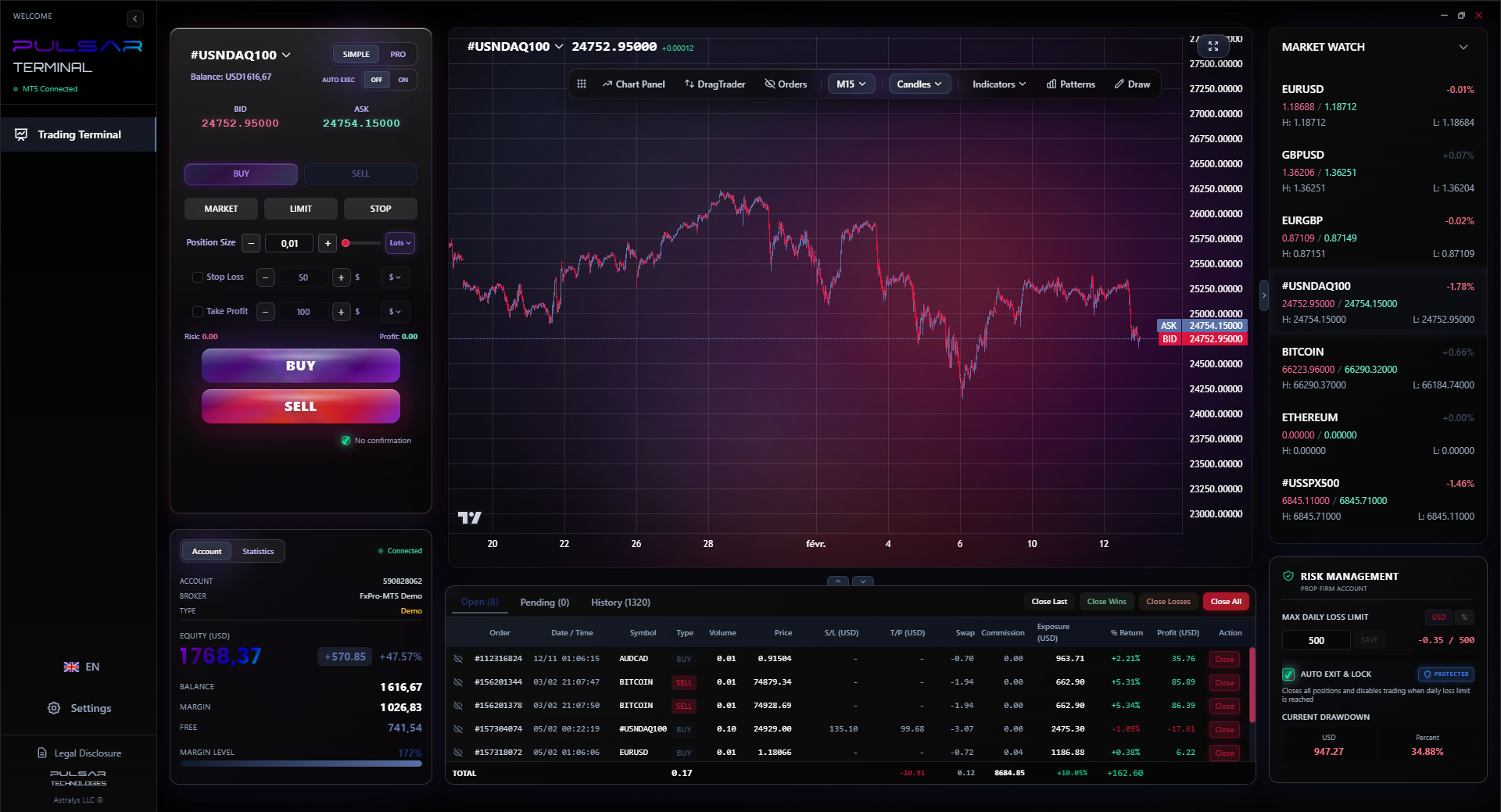
Manually trailing your stop behind a trend line is tedious and error-prone; Pulsar Terminal automates this and other advanced order types directly on your MT5 platform.
Pulsar Terminal
L'outil MT5 tout-en-un : ordres glisser-déposer, multi-TP/SL, trailing stop, grid trading, Volume Profile et protection prop firm. Utilisé quotidiennement par 1 000+ traders.
You can't talk trading in Nigeria without addressing the legal and financial landscape. It's changed. As of the Investments and Securities Act (ISA) 2025, you must use a broker registered with the SEC Nigeria or a reputable international one. Most of us use international brokers like IC Markets, XM, or Pepperstone because of their tighter spreads and regulation under bodies like ASIC or FSCA.
Now, the tax man. The Federal Inland Revenue Service (FIRS) wants 10% Capital Gains Tax on your gross trading profits. Yes, 10%. If you make 1,000,000 Naira in profit this year, you owe 100,000 Naira. You must keep careful records of all your trades - entries, exits, and profits. A trend line might help you make money, but a spreadsheet will keep you from trouble with the authorities.
Also, remember the spread costs. When you're looking for a bounce off a trend line on a pair like EUR/USD, a 1.4 pip spread (common with some brokers) eats into your profit immediately. This is why I prefer raw spread accounts from brokers like IC Markets, where you pay a small commission but get spreads from 0.0 pips. On a scalping strategy, this difference is massive. Always factor in the cost of doing business before you even draw your line.
💡 Conseil de Winston
The most powerful trend lines are the ones everyone can see. If your line is so obscure you have to explain it, it's probably useless. The market respects simple, obvious geometry.
“A false break isn't the market lying to you; it's the market testing your conviction and hunting for easy stop losses.”
This is one of the most reliable patterns in trading, and it revolves entirely around a broken trend line. Don't chase the initial break. Instead, wait for the retest.
Here's how it played out on XAU/USD (Gold) last year, a popular asset for Nigerians hedging against the Naira.
- Break: A strong daily uptrend line on XAU/USD was decisively broken with a large bearish candle.
- Wait: I did nothing. I watched.
- Retest: Over the next week, price rallied back up to kiss the underside of that former support line (now acting as resistance).
- Entry: It formed a bearish rejection candle right at that line. That was my signal to sell.
- Result: Gold fell over $150 from that retest point.
The psychology is simple. The break shakes out weak hands. The retest is the market giving those who missed the break a "second chance" to get in, which often creates a strong move. This pattern requires patience, but the risk/reward is excellent because your stop loss can be tight, just above the retest point. For more on trading volatile instruments like this, see our XAU/USD guide.

Example: You see a break of a key downtrend line on USD/NGN. Price rallies 200 pips away. It then pulls back 150 pips to retest the broken line. A bullish candle forms at that retest. Your entry is on that candle, with a stop loss 50 pips below the retest, aiming for a target of at least 300 pips (a 1:6 risk/reward ratio).
FAQ
Q1How many points do I need to draw a trend line?
You need two points to draw it, but you need a third touch to confirm it's valid and tradeable. Trading off a two-point line is speculation; trading off a three-point line is analysis.
Q2On which time frame should I draw trend lines?
For the most reliable signals, start on the daily or 4-hour chart. These higher timeframes filter out market noise. You can then draw corresponding lines on lower timeframes (like 1-hour) for more precise entries, but the major trend direction should come from the bigger picture.
Q3What does it mean when a trend line is broken?
It means the prevailing trend's momentum has weakened. It does NOT automatically mean the trend has reversed. Often, it leads to a period of sideways movement (consolidation) or a retest of the broken line. Always wait for additional confirmation, like a strong close beyond the line, before acting.
Q4Can I use trend lines for scalping in the Nigerian market?
You can, but be very careful. On very low timeframes (like 1 or 5-minute), trend lines are less reliable and can be broken by simple spreads or minor news. If you scalp, use them on the 15-minute chart as a guide for the minor trend and combine them with other tools like the RSI indicator for entry signals.
Q5How do I handle a false break of a trend line?
A false break (or "stop hunt") is when price briefly wicks beyond the line then snaps back. To manage this, place your stop loss not directly on the other side of the line, but a small buffer away (a few pips beyond a recent swing). Also, wait for the candle to close beyond the line before considering it a true break.
Q6Are trend lines effective on USD/NGN given its volatility?
Yes, but you must use wider timeframes and be prepared for wider stop losses. The fundamental pressures on the Naira can cause explosive moves that break technical levels. A trend line on the USD/NGN daily chart can identify major shifts in sentiment, but always pair it with prudent risk management to avoid a margin call.
Q7Do I pay tax on profits from trading with international brokers?
Yes. According to Nigerian law, you are required to pay a 10% Capital Gains Tax on your gross trading profits to the FIRS, regardless of whether your broker is based locally or internationally. Keep detailed records of all your transactions.
La leçon du Prof. Winston
Points clés:
- ✓A valid trend line requires three touches for confirmation.
- ✓Always place your stop loss on the other side of the trend line.
- ✓Combine trend lines with horizontal levels for high-probability trades.
- ✓In Nigeria, account for the 10% capital gains tax on all profits.
Cet article vous a-t-il été utile ?
Cliquez sur une étoile
Analyses Trading Hebdo
Analyses et stratégies hebdo gratuites. Pas de spam.
À propos de l'auteur
Olumide Adeyemi
Pionnier du Trading en Afrique de l'Ouest
L'un des formateurs de trading forex les plus actifs au Nigeria. 8 ans d'expérience de trading depuis Lagos. Spécialisé dans les stratégies à petit capital et les challenges de prop firms pour les traders africains.
Commentaires
Avertissement sur les risques
Le trading d'instruments financiers comporte des risques importants et peut ne pas convenir à tous les investisseurs. Les performances passées ne garantissent pas les résultats futurs. Ce contenu est fourni à titre éducatif uniquement et ne constitue pas un conseil en investissement. Effectuez toujours vos propres recherches avant de trader.
Vous aimerez aussi

Cara Trading Forex Sukses: 7 Prinsip dari Trader Profesional
Cara trading forex sukses dengan 7 prinsip trader pro: manajemen modal, disiplin, journal trading, backtest. Data nyata, bukan janji profit palsu.
Jam Trading Forex Terbaik untuk Trader Indonesia: Panduan Lengkap dengan Tabel Waktu
Panduan jam trading forex untuk trader Indonesia. Tabel 4 sesi dunia, jam emas 20:00-00:00, sesi mana yang harus dihindari. Data akurat + tips dari trader berpengalaman.
Top 5 Sàn Forex Uy Tín Nhất 2026: Review Jujur dari Trader Indonesia
Top 5 sàn forex uy tín 2026 untuk trader Indonesia. Review jujur: spread, deposit, withdraw, dukungan lokal. Exness, XM, IC Markets & lebih.
Obtenir Pulsar Terminal
Tous ces calculateurs sont intégrés dans Pulsar Terminal avec des données en temps réel de votre compte MT5. Dimensionnement de position en un clic, gestion automatique des risques et calculs instantanés.
Obtenir Pulsar Terminal