


Here's a number that should make you sit up: over 70% of retail forex traders lose money.

David van der Merwe
उभरते बाजार के ट्रेडर ·  South Africa
☕ 11 मिनट पढ़ने
आप क्या सीखेंगे:
- 1What Exactly Is Autotrader Forex Trading? (It's Not Magic)
- 2The South African Rulebook: FSCA, SARS, and SARB
- 3The Real Costs: What You'll Actually Pay in ZAR
- 4Picking Your Tools: Brokers & Platforms That Work
- 5Building or Choosing Your Autotrader: A Practical Plan
- 6Pitfalls to Avoid: How South African Traders Get Burned
- 7Your First Steps to Automated Trading
Here's a number that should make you sit up: over 70% of retail forex traders lose money. I was part of that statistic for my first three years. The turning point? When I stopped trying to outsmart the market with my emotions and let a system do the work. In South Africa, autotrader forex trading isn't just about fancy robots; it's about surviving a volatile market with discipline. This guide cuts through the hype. We'll talk real ZAR costs, FSCA rules you can't ignore, and how to set up automation that actually works for our unique market conditions.
Let's clear this up first. When we say 'autotrader forex trading' in South Africa, we're not talking about a single magic box that prints money. We're talking about using software to execute trades based on predefined rules, without you clicking the buy/sell button every time.
It comes in a few flavours:
1. Expert Advisors (EAs) on MT4/MT5: This is the classic. You buy or code a 'robot' that runs on your MetaTrader platform. It scans the charts and places trades automatically. I've tested dozens. Some are brilliant, most are junk sold with backtested fantasy results.
2. Copy Trading/Signal Services: Platforms like ZuluTrade or the MQL5 Signals service let you automatically mirror the trades of another trader. You're renting their strategy. The catch? You need to pick the right person to copy, and their risk appetite might not match yours.
3. No-Code Strategy Builders: Tools like Capitalise.ai or cTrader Automate let you build your own logic using simple 'if-then' rules or even plain English. This is powerful because you encode your edge, not someone else's.

Warning: The biggest myth is 'set and forget.' No autotrader runs perfectly forever. Market conditions change (look at USD/ZAR volatility), and your bot needs monitoring and occasional tweaks. Treat it like a employee, not a pension fund.
My first foray into this was a disaster. I bought a popular EA in 2018 for $500. It worked great in a ranging market for two months, netting me about R12,000. Then the trend shifted, and it didn't have a trend-following module. It blew through those profits and my initial R5,000 deposit in three weeks because I wasn't watching it. The lesson? Understand what your autotrader does, and know when to pull the plug.
“Automation is about removing emotion, enforcing discipline, and managing risk – things we South African traders need more than most.”
You can't talk trading here without understanding the regulatory landscape. Getting this wrong is more expensive than any bad trade.
The FSCA is Your First Checkpoint
The Financial Sector Conduct Authority (FSCA) is our main watchdog. Any broker operating here should be licensed by them. This isn't just a nice-to-have; it ensures client funds are segregated. If a broker goes under, your money isn't part of their bankruptcy estate.
The FSCA also caps use for retail traders at 30:1. That means with R10,000, you can control a position worth R300,000. Some international brokers might offer more, but if they're not FSCA-regulated, you're stepping outside our safety net. I stick with FSCA-regulated entities like FP Markets or the local guys like Khwezi Trade for my main accounts.
SARS Wants Its Share
This is where many traders get a nasty surprise. The South African Revenue Service (SARS) views frequent trading profits as ordinary income, not capital gains. That means your profits are added to your salary and taxed at your marginal rate (up to 45%).
You must declare all trading profits, even from offshore brokers. I keep a careful spreadsheet: every trade, deposit, withdrawal, and statement. Come tax season, it's a lifesaver. If you're running an autotrader making hundreds of trades a month, your trade history is your tax file.
The SARB's Tightening Grip
Here's a critical 2025/2026 update. The South African Reserve Bank (SARB) has quietly tightened exchange controls. If you're using an international broker and want to withdraw profits back to SA, the process is now stricter. Your local bank (the 'authorized dealer') must check your tax compliance with SARS before sending large amounts back.
For transfers over R1 million, the paperwork is significant. Over R10 million? You're looking at a major process needing government approval. This makes a strong case for using a good local, FSCA-regulated broker for your core ZAR-based trading activities.

💡 विंस्टन की सलाह
A bot is only as smart as the person who built it. If you don't understand the logic behind every trade it places, you're not trading, you're gambling with extra steps.
“The biggest myth is 'set and forget.' No autotrader runs perfectly forever. Treat it like an employee, not a pension fund.”
Forget the 'trade from R100' ads. Let's break down what it really costs to run an autotrader sustainably.
Capital: You need enough to survive drawdowns. A realistic starting point is R5,000-R20,000. Why? If you're scalping with an EA, you need buffer for a string of losses. Starting with R500 is a recipe for a quick margin call.
Broker Costs: This is where your autotrader's profitability lives or dies.
| Cost Type | Typical Range (Major Pairs) | Why It Matters for Autotrading |
|---|---|---|
| Spreads | 0.0 - 1.5 pips | A scalping EA making 50 trades a day gets murdered by a 1.5-pip spread. You need tight spreads like those from IC Markets or Pepperstone. |
| Commissions | $3 - $10 per lot | Common on 'raw spread' accounts. Factor this into your strategy's expected profit per trade. |
| Swap/Overnight Fees | Variable | If your bot holds trades for days, these add up. Check your broker's swap rates. |
Software & Infrastructure:
- VPS (Virtual Private Server): Essential. You can't run your MT4 robot on your laptop that you turn off at night. A VPS keeps it running 24/7. Costs about $20-$50/month.
- EA or Signal Costs: One-time purchase ($50-$500) or monthly subscription ($30-$100).

Example: Let's say your EA trades 10 lots total per day on EUR/USD. At a $3.50 commission per lot (like Pepperstone's Razor account), that's $35/day in commissions alone. That's over R21,000 a month at current rates just in fees. Your strategy must overcome that.
My own cost lesson: I ran a grid trading EA on USD/ZAR. The spreads were wide (2-3 pips), and the swap fees for holding ZAR positions were brutal. The bot was technically profitable on spread capture, but the swap fees ate 60% of the gains. I didn't check that beforehand. Always use a position size calculator that includes all costs.
“The biggest myth is 'set and forget.' No autotrader runs perfectly forever. Treat it like an employee, not a pension fund.”
Not all brokers are autotrader-friendly. You need reliability, fast execution, and the right platform.
Top Platform Choice: MetaTrader 4/5. It's the universal standard for a reason. The MQL4/MQL5 language lets you code or run any EA. Most brokers support it. XM and Exness have solid MT4/5 offerings with low minimum deposits, which is great for testing.
What to look for in a broker:
- FSCA Regulation: Non-negotiable for your primary account.
- MT4/5 or cTrader Support: cTrader is excellent for automation too, with its cAlgo platform.
- Low Latency & Reliable Servers: Ask if they have a local server. Ping matters for scalping bots.
- Reasonable Minimum Deposit: Don't be seduced by $0. Deposit an amount you can actually trade with. Khwezi Trade's R500 minimum is sensible.
- Allow EAs & No Restrictions: Some brokers ban certain EAs (like high-frequency arbitrage bots). Check their policy.
A note on 'Prop Firm' Challenges: Many traders use autotraders to pass prop firm evaluations. This requires extreme discipline on daily loss limits. If you're going this route, you need a bot with iron-clad risk management built in, not just trade signals.

Pro Tip: Before depositing real money, test your autotrader on the broker's demo server for at least a month. Demo and live spreads/execution can differ, especially on exotic pairs like USD/ZAR. I once had an EA that was 90% profitable on demo but failed on live because the live spreads were 0.3 pips wider, turning all its tiny profit targets into losses.
💡 विंस्टन की सलाह
The rand's mood swings are legendary. Any autotrader you run on USD/ZAR needs breathing room - wider stops and a heart rate monitor for you. Don't let a robot trade a volatile pair with a scalper's tight leash.
“If you see a '100% win rate' bot, run. It's a scam. Period.”
Here's my step-by-step approach, learned from expensive mistakes.
Step 1: Define Your Strategy's Soul. What market condition does it exploit? Range-bound? Trend-following? Don't say 'all.' My failed EA tried to do everything and did nothing well. Start simple. Maybe it's just an automated version of your best swing trading setup using the MACD indicator.
Step 2: Backtest, But Don't Trust It Blindly. Use MT4's Strategy Tester. But beware of 'curve-fitting' – making a strategy that perfectly fits past data but fails in the future. Always backtest over multiple years and different market phases (high volatility, low volatility).
Step 3: Forward Test on Demo. This is the 'out-of-sample' test. Let it run on current, unseen data. Monitor its drawdown, win rate, and profit factor (gross profit / gross loss). A profit factor above 1.2 is a decent start.
Step 4: Go Live with Micro Lots. Start trading with the smallest possible position size. The psychology is different when real money is on the line, even if it's just R10 a trade. Watch it for at least 100 trades.
Where to get EAs/Signals:
- Code it yourself: Learn MQL4. It's the best way to truly own your edge.
- Marketplace (MQL5.com): Thousands of EAs and signals. Check the verified live performance stats, not just the flashy backtest. Read the reviews.
- Copy Trading: For signals, I've had mixed results. I once copied a top-ranked trader on a platform who had a 80% win rate. It worked until they hit a 15-trade losing streak that wiped out my account. Their risk per trade was 5%, which I didn't adjust for. My fault entirely.
The key is transparency. You must know the logic. If it's a black box, you can't fix it when it breaks.
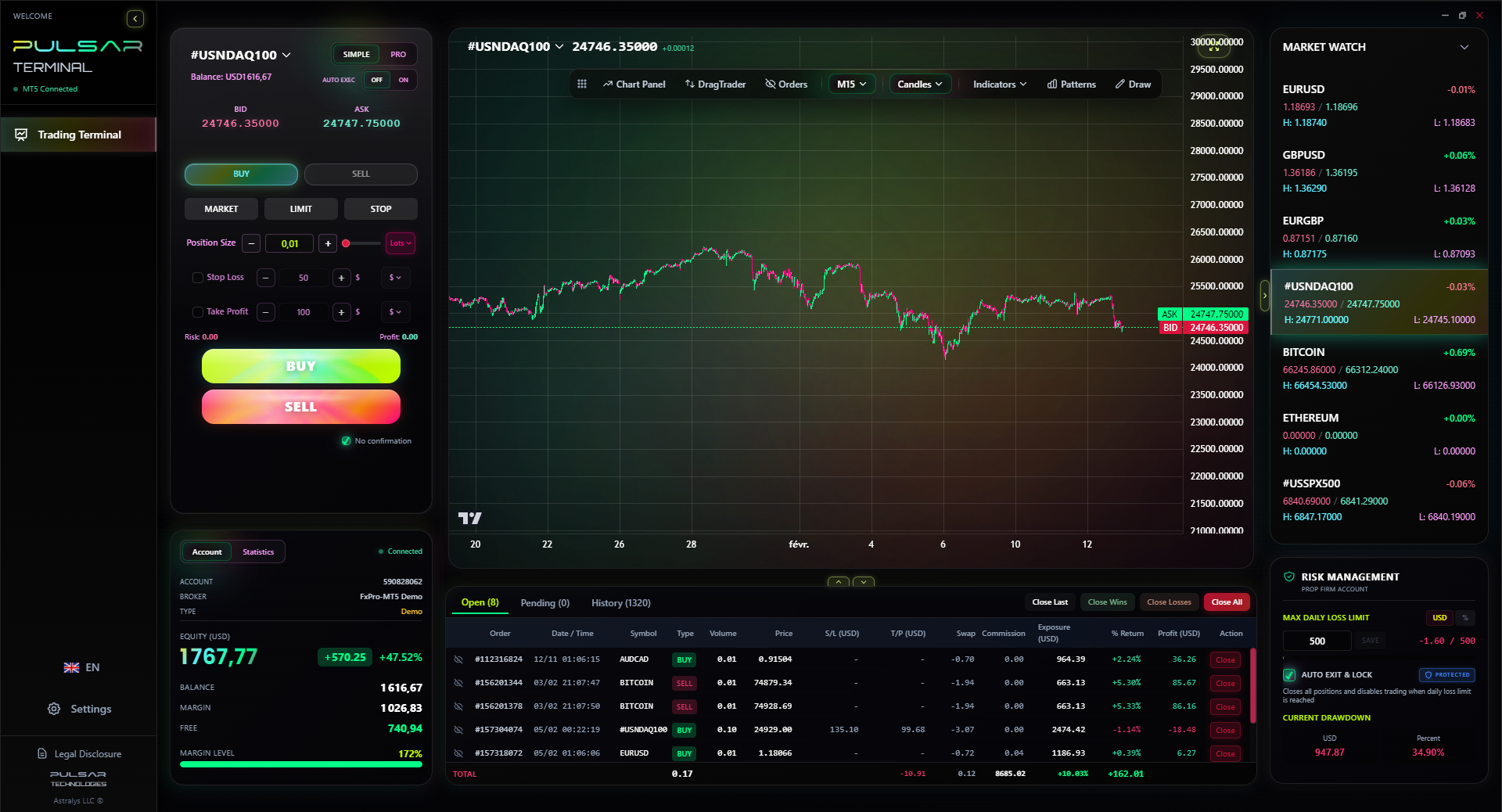
Managing complex bot strategies with multiple orders and safety nets is far easier with a tool like Pulsar Terminal, which lets you set master stop-losses and advanced risk rules directly on your MT5 platform.
“If you see a '100% win rate' bot, run. It's a scam. Period.”
Let me save you some money and frustration.
1. Chasing '100% Win Rate' Bots: If you see this, run. It's a scam. Period. Every strategy has losing periods. My best-performing EA has a 55% win rate. It works because the average winning trade is much bigger than the average loser.
2. Ignoring ZAR Volatility: USD/ZAR isn't EUR/USD. It can gap significantly overnight due to local political or economic news. An EA with tight stop-losses can get slaughtered. You need wider stops or a filter that avoids trading around major SA news events (SARB interest rate announcements, budget speeches).
3. Over-Optimizing: Tweaking your bot to perfection on last year's data guarantees failure this year. Keep it strong. Simple strategies often survive longer.
4. Neglecting Technology: Your home internet fails, your laptop updates and restarts – your bot is offline. That's why a VPS is critical. It's a small cost for peace of mind.
5. Tax Confusion: Not setting aside money for tax. If you make R100,000 profit, SARS sees it as income. Set aside 25-30% immediately in a separate account. Don't get caught at year-end.
The most common technical mistake? Not understanding how your EA handles multiple orders. If it opens a grid of 20 trades, does it have a master stop-loss for the entire basket? I learned this the hard way during a flash crash. The EA kept placing buy orders all the way down, exhausting my margin, with no overall risk limit. A proper grid trading bot needs that global safety net.
💡 विंस्टन की सलाह
Your most important automated tool isn't the EA. It's the spreadsheet where you track every trade, fee, and tax liability. Profitability is measured in net returns, after all costs.
“SARS views profits from frequent forex trading as ordinary income. Set aside 25-30% for tax immediately.”
Ready to start? Don't rush. Follow this sequence.
- Education First: Understand basic forex concepts – what a pip is, how spreads work. Then learn about the RSI indicator, moving averages, support/resistance. You can't automate what you don't understand manually.
- Pick a Regulated Broker: Open a demo account with an FSCA-regulated broker that supports MT4/5. I'd suggest starting with FP Markets or XM for their demo reliability.
- Manual Trading: Trade manually on demo for a few months. Find one or two setups that consistently work for you. Write down the exact rules.
- Learn to Automate That Single Setup: This is the golden path. Use a no-code tool like Capitalise.ai (it integrates with some brokers) to automate your simple strategy. For example: 'Buy EUR/USD if the 50 EMA crosses above the 200 EMA on the 1-hour chart, place a stop loss of 20 pips.'
- Forward Test for a Month: Run it on demo, tracking every trade.
- Go Live Small: Fund your live account with an amount you can afford to lose (that R5,000-R10,000 range). Trade with micro lots (0.01). The goal here is to validate the process, not get rich.
Automation is a marathon, not a sprint. It took me 18 months from my first disastrous EA purchase to having a small portfolio of three strong automated strategies that now provide a steady secondary income. The journey is about removing emotion, enforcing discipline, and managing risk – things we South African traders, facing a volatile rand and economic uncertainty, need more than most.
FAQ
Q1Is autotrader forex trading legal in South Africa?
Yes, it's completely legal. The key is to use a broker that is licensed by the Financial Sector Conduct Authority (FSCA). The autotrading software itself is just a tool; what matters is that you're trading through a regulated financial service provider.
Q2How much money do I need to start autotrading forex?
While some brokers allow deposits as low as R100, a realistic amount to properly test a strategy and withstand normal losses is between R5,000 and R20,000. Starting with too little means a small string of losses will wipe you out, preventing you from properly evaluating your autotrader's long-term performance.
Q3Do I need to pay tax on profits from an autotrader?
Absolutely. SARS views profits from frequent forex trading as ordinary income, not capital gains. You must declare all profits in your annual tax return, and it will be taxed at your marginal income tax rate. Keep detailed records of all trades, deposits, and withdrawals.
Q4What's the best platform for autotrading in South Africa?
MetaTrader 4 (MT4) or MetaTrader 5 (MT5) are the most widely supported and powerful platforms for automation. They use the MQL programming language, giving you access to thousands of Expert Advisors (EAs). Most FSCA-regulated brokers, like those listed in our broker reviews, offer MT4/5.
Q5Can I use an autotrader from my phone?
You can monitor and sometimes adjust settings from a phone app, but you should not run the autotrader directly from your phone. For 24/7 reliability, you must run your trading platform and EA on a Virtual Private Server (VPS), which is a dedicated online computer that never sleeps or loses connection.
Q6Are 'fully automated' trading bots that promise high returns a scam?
99% of the time, yes. Any service promising guaranteed profits or a 100% win rate is a major red flag. Legitimate autotrading is about systematically executing a strategy with defined risk. It still involves losses. Always be skeptical, test extensively on demo first, and never invest more than you can afford to lose.
प्रो. विंस्टन का पाठ
:
- ✓Test any EA for 100+ trades on demo before risking a cent.
- ✓FSCA regulation is non-negotiable for your primary trading account.
- ✓Factor in ALL costs: spread, commission, swap, VPS, and tax.
- ✓Simple, strong strategies outlive over-optimized, complex ones.
यह लेख कितना उपयोगी था?
रेट करने के लिए स्टार पर क्लिक करें
साप्ताहिक ट्रेडिंग विश्लेषण
मुफ़्त साप्ताहिक विश्लेषण और रणनीतियाँ। कोई स्पैम नहीं।
लेखक के बारे में
David van der Merwe
उभरते बाजार के ट्रेडर
जोहानसबर्ग स्थित ट्रेडर, इमर्जिंग मार्केट करेंसीज में 11 साल का अनुभव। ZAR पेयर्स, FSCA-विनियमित ट्रेडिंग और दक्षिण अफ्रीकी मार्केट एनालिसिस में विशेषज्ञ।
टिप्पणियाँ
आपको यह भी पसंद आ सकता है

Cara Trading Forex Sukses: 7 Prinsip dari Trader Profesional
Cara trading forex sukses dengan 7 prinsip trader pro: manajemen modal, disiplin, journal trading, backtest. Data nyata, bukan janji profit palsu.
Jam Trading Forex Terbaik untuk Trader Indonesia: Panduan Lengkap dengan Tabel Waktu
Panduan jam trading forex untuk trader Indonesia. Tabel 4 sesi dunia, jam emas 20:00-00:00, sesi mana yang harus dihindari. Data akurat + tips dari trader berpengalaman.
Top 5 Sàn Forex Uy Tín Nhất 2026: Review Jujur dari Trader Indonesia
Top 5 sàn forex uy tín 2026 untuk trader Indonesia. Review jujur: spread, deposit, withdraw, dukungan lokal. Exness, XM, IC Markets & lebih.
All these calculators are built into Pulsar Terminal with real-time data from your MT5 account. One-click position sizing, automatic risk management, and instant calculations.
