


Ever placed a stop loss, watched the market whip right through it, and then reverse to hit your target? You're not alone.

David van der Merwe
उभरते बाजार के ट्रेडर ·  South Africa
☕ 11 मिनट पढ़ने
आप क्या सीखेंगे:
- 1What Exactly is the ATR?
- 2How to Calculate and Set Up Your ATR
- 3The #1 Use: Setting Intelligent Stop Losses
- 4Setting Realistic Profit Targets
- 5The Critical Link: ATR and Position Sizing
- 6ATR in the South African Trading Context
- 7Mistakes I've Made & Pro Tips
- 8Taking It Further: Volatility Bands and Ratios
Ever placed a stop loss, watched the market whip right through it, and then reverse to hit your target? You're not alone. I've been there, sitting in my flat in Sandton, feeling that particular brand of frustration. The problem wasn't my direction, it was my sizing. I was using a fixed number of pips for my stop on every pair, from the calm EUR/USD to the wild USD/ZAR. That's a sure way to get stopped out by noise. The tool that fixed this for me, and the one I want to walk you through, is the Average True Range, or ATR. It's not a crystal ball, but it's the single best measure of market volatility we have, and it changed how I manage risk completely.
The Average True Range is a technical indicator that measures market volatility. It was developed by J. Welles Wilder Jr. back in the 1970s. Here's the key thing to get straight from the start: the ATR does not tell you which direction the market is going. It tells you how far it's likely to move, on average, over a given period.
Think of it like measuring the waves at the beach. The ATR doesn't tell you if the tide is coming in or going out (the trend). It tells you how high the waves are crashing (the volatility). This is crucial because trading a calm pair like EUR/CHF requires a completely different approach to trading a volatile one like USD/ZAR or GBP/JPY.
The indicator calculates the "True Range" first, which is the greatest of:
- Current High minus Current Low
- Current High minus Previous Close (absolute value)
- Current Low minus Previous Close (absolute value)
It then takes an average (usually a 14-period simple moving average) of these True Range values. The result is the ATR line you see on your chart, expressed in pips or points.

Example: If USD/ZAR has an ATR value of 250 pips on the daily chart, it means the pair, on average, moves 250 pips from its daily low to its daily high (or vice versa). Placing a 50-pip stop loss on that pair is almost guaranteed to fail.
I learned this the hard way early on. I was scalping strategy EUR/USD with a 10-pip stop and doing okay. I got cocky and tried the same method on GBP/JPY. The ATR on GBP/JPY was over 100 pips at the time. My 10-pip stop was gone in seconds, not minutes. The ATR would have shown me that insanity before I even placed the trade.

💡 विंस्टन की सलाह
Stop thinking in fixed pips. Start thinking in multiples of the ATR. It's the difference between guessing the weather and reading the barometer.
You don't need to do the math manually. Every trading platform, from MT4 to TradingView, has the ATR built in. On MT4/MT5, you find it in the Navigator window under Indicators > Oscillators. The default setting is 14 periods.
The Period Setting (It's Not Just 14)
The 14-period default is standard, but it's not a holy number. The period refers to the number of candles used in the calculation. A lower period (like 7) will make the ATR more sensitive to recent volatility. A higher period (like 21) will give you a smoother, slower-reacting average.
I personally use a 20-period ATR on my daily charts for swing trading setups. It filters out some of the noise a 14-period might give me. For intraday stuff, I stick with 14. The best advice? Test different settings on your preferred timeframes and see what feels right for your trading style.
What the ATR Value Means
When you apply the indicator, it plots a line at the bottom of your chart. The value of that line is the current ATR. If your chart is on a 1-hour timeframe, a value of 15 means the pair moves an average of 15 pips per hour. On a daily chart, a value of 80 means an 80-pip average daily range.
This is where local context matters. Check the ATR on USD/ZAR right now. Then check it on EUR/USD. The difference is staggering. Trading the ZAR pairs without respecting their inherent volatility is a fast track to blowing up your account. A good broker like Exness or IC Markets will show you these pairs, but it's on you to understand the risk.
“The ATR doesn't tell you which way the market is going. It tells you how far it's likely to move, and that's often more important.”
This is, hands down, the most practical use of the ATR for a retail trader. Instead of guessing a stop loss distance, you base it on current market volatility.
The basic formula is: Stop Loss Distance = ATR Value × Multiplier
A common multiplier is 1.5 or 2. Let's say you're looking at a buy setup on USD/ZAR on the 4-hour chart. The 14-period ATR is 180 pips. Using a multiplier of 1.5, your stop loss should be placed at least 270 pips (180 x 1.5) away from your entry price.

Warning: This feels huge, right? It is. That's the point. It forces you to either (a) use much smaller position sizes to keep your rand risk manageable, or (b) reconsider if the trade has enough potential reward to justify that wide a stop. This alone will save you from countless premature stop-outs.
I have a rule: I never set a stop loss closer than 1x the current daily ATR. If the daily ATR is 200 pips, my stop is at least 200 pips away. This means my position size has to be smaller. I use a position size calculator religiously. For a R10,000 account risking 1% (R100), a 200-pip stop means I can only trade 0.05 lots on USD/ZAR. It keeps me in the game.
This method adapts. When volatility contracts (low ATR), your stops can be tighter. When it expands (high ATR), your stops must widen. It's dynamic, just like the market.
You can use the same logic for profit targets. If the market moves, on average, 80 pips a day (daily ATR = 80), then a profit target of 200 pips on a daily trade is statistically less likely than a target of 60 pips.
Many traders use multiples of the ATR for targets. For example, a common approach is to aim for a 1:2 or 1:3 risk-to-reward ratio based on your ATR stop. If your ATR stop is 100 pips, your first profit target might be at 200 pips (2x ATR).
Here's a real trade I took last month on Gold (XAU/USD):
- Entry: $2,155
- Daily ATR: $35
- My Stop (1.5x ATR): $52.50 below entry at $2,102.50
- My Target (2.5x ATR): $87.50 above entry at $2,242.50
It hit the target in a week. The ATR gave me a framework that was based on the market's own behavior, not my greed. For more on trading gold, our XAU/USD guide breaks down its unique rhythms.
Remember, the ATR for profit targets is a guide, not a law. You should also consider taking profit at key support/resistance levels or using a trailing stop. Speaking of trailing stops, automating them based on ATR can be a game-saver, which is why I love tools that can do it for me.
💡 विंस्टन की सलाह
Your first calculation for any trade should be: (Account Risk %) / (ATR Stop in Pips). That tells you your maximum lot size. Do it every time.
“Trading the ZAR pairs without respecting their inherent volatility is a fast track to blowing up your account.”
This is where the magic happens for risk management. The ATR directly informs how much you should trade. A wider ATR stop means a smaller position size to keep your monetary risk constant.
Let's do a comparison for a South African trader with a R20,000 account, risking 1% per trade (R200).
| Currency Pair | Daily ATR (Pips) | Proposed Stop (2x ATR) | Position Size (Lots) to Risk R200 |
|---|---|---|---|
| EUR/USD | 70 pips | 140 pips | 0.14 lots (140 pips * ~R1.42/pip = ~R199) |
| USD/ZAR | 250 pips | 500 pips | 0.04 lots (500 pips * ~R0.50/pip* = ~R200) |
Note: The ZAR pip value fluctuates. This uses an approximate rate for illustration.
See the dramatic difference? To risk the same amount of money, you trade 3.5 times less volume on the volatile ZAR pair. If you traded 0.14 lots on USD/ZAR with a 500-pip stop, you'd be risking over R700! That's 3.5% of your account on one trade. Do that a few times, and you'll get a margin call.
I automate this now. I know my risk in rands, I check the ATR for my chosen stop distance, and I let my calculator tell me the exact lot size. It removes emotion. Brokers like Pepperstone and XM offer great tools, but the discipline has to come from you.
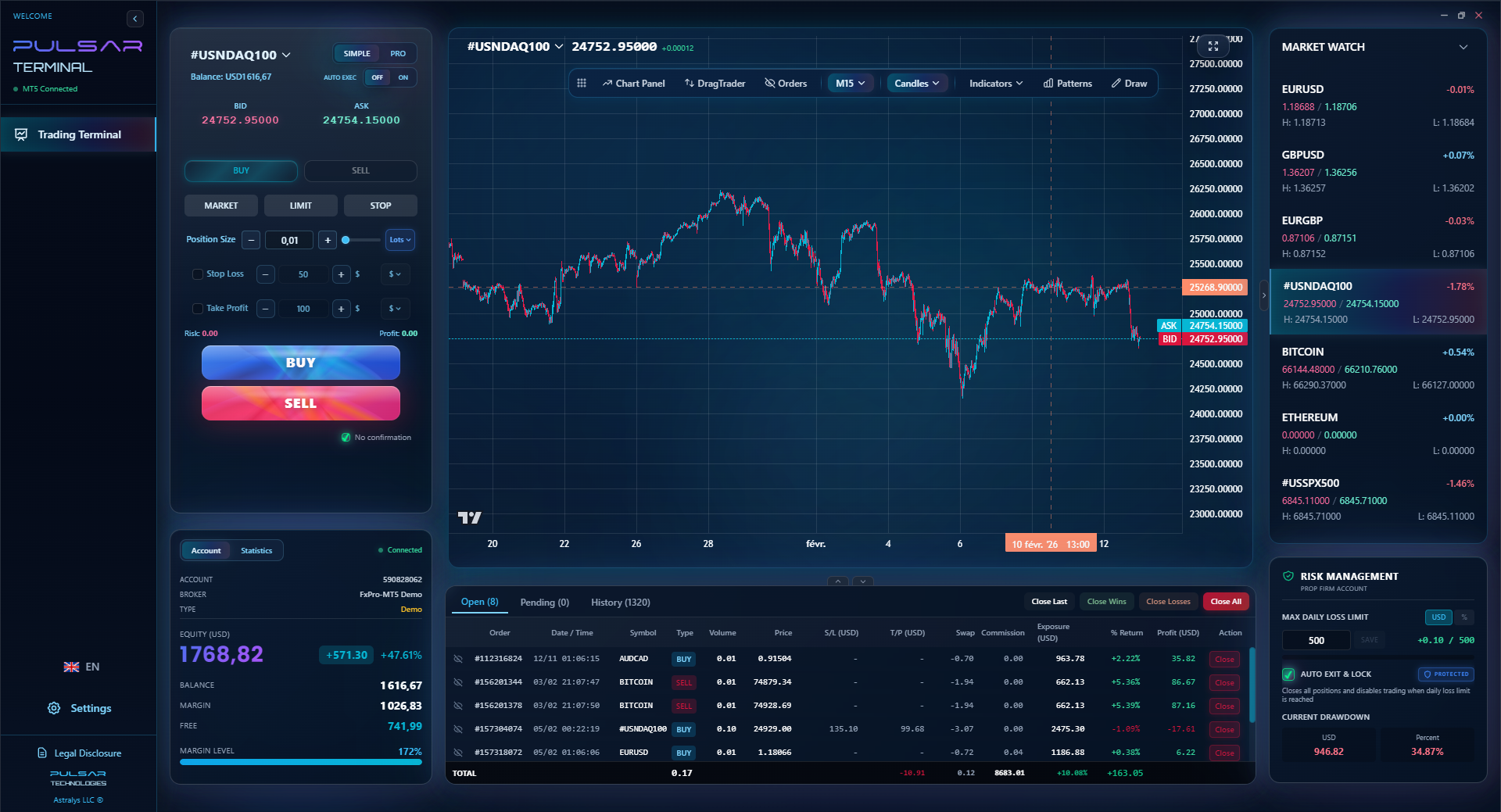
Manually adjusting stops based on a moving ATR is a chore; Pulsar Terminal lets you set dynamic, ATR-based trailing stops and breakeven points automatically on your MT5 charts.
Trading from South Africa adds specific layers to using the ATR effectively.
ZAR Pairs and Volatility
Pairs like USD/ZAR, EUR/ZAR, and GBP/ZAR are notoriously volatile. Their ATR values are consistently higher than majors. This isn't just a "feel," it's quantifiable. You must check the ATR before trading these pairs. A high ATR often means wider spreads too, which eats into your potential profit. Always factor that in.
Regulation and use
Remember, the FSCA caps use at 30:1 for retail clients. This is actually a blessing in disguise when using ATR. High use on a volatile pair with a wide ATR stop is a lethal combination. The 30:1 limit forces a degree of sanity on your position sizing. If you're using an international broker offering higher use, impose the 30:1 limit on yourself. Trust me.
Local Broker Considerations
When choosing a broker, check their typical spreads on volatile pairs during your trading hours. A broker might have a tight 1-pip spread on EUR/USD but a 90-pip spread on USD/ZAR. That 90 pips is a huge chunk of your potential profit and must be considered alongside the ATR. Use the broker data in our research section as a starting point.
My biggest local lesson? I once traded EUR/ZAR around a major SARB announcement. The ATR was already high, and the news spiked it further. My "volatility-based" stop was still too tight. The news volatility exceeded the recent average. Now, before major local events, I double my ATR multiplier for stops or just stay out.
“Using a standard 50-pip stop on USD/ZAR is like using a teaspoon to bail out a sinking boat.”
Common Pitfalls
- Using ATR in Isolation: The ATR doesn't give direction. Pair it with your trend or momentum indicators. A high ATR in a strong trend might mean a great breakout continuation. A high ATR at a range top might mean a reversal is coming.
- Ignoring Timeframe Context: A 15-pip ATR on the 5-minute chart is normal. A 15-pip ATR on the daily chart indicates incredibly low volatility and a potential big move is brewing.
- Forgetting to Adjust: Volatility regimes change. The ATR in 2023 is different from 2024. Don't set your stops based on last month's ATR. Use the current, live value.

Pro Tip: Use the ATR to identify "quiet" markets. When the ATR drops to multi-period lows, it often precedes a large, directional move (a volatility expansion). This is a great time to be alert for breakout setups, but wait for the breakout to actually happen before jumping in.
A Simple ATR Trading Filter
I add this to my checklist:
- For any trade: Is my stop loss at least 1x the current ATR on my entry timeframe? (No → Adjust trade or skip).
- For ZAR pairs: Is my stop loss at least 1.5x the current ATR? (No → Definitely skip).
This filter has probably saved me more money than any "magic" entry signal ever made. It forces patience and precision. For spotting those entry signals, combining ATR with classic tools like the RSI indicator or MACD indicator can be powerful.
💡 विंस्टन की सलाह
A shrinking ATR isn't boring. It's the market coiling. Watch it. The big moves come from the quietest ranges.
Once you're comfortable with the basic ATR, you can explore derivatives of it.
ATR Bands/Channels: These are plotted by adding and subtracting a multiple of the ATR from a moving average (often a 20-period EMA). For example, a "2x ATR Band" plots a line 2 ATR values above the EMA and 2 ATR values below it. These bands dynamically expand and contract with volatility and can act as support/resistance or visual guides for extreme moves. A touch of the upper band might not be a sell signal, but it shows the price is stretched relative to its recent average movement.
ATR Ratio: This compares the current ATR to its historical average (e.g., a 100-period average of the ATR itself). A ratio above 1 means current volatility is above the longer-term average. A ratio below 1 means it's quieter than usual. This helps identify those high-probability low-volatility compression periods I mentioned.
The core idea remains: let the market's own volatility tell you how to trade it, don't impose your arbitrary rules on the market. It's a humbling but profitable shift in mindset.
FAQ
Q1What is a good ATR value for forex trading?
There's no 'good' or 'bad' ATR value. It's a relative measure. A value of 10 pips is low for USD/ZAR but high for EUR/CHF on the same timeframe. The key is to compare the ATR across different pairs and timeframes to understand relative volatility. A 'good' use is knowing that a pair with a 200-pip daily ATR needs a much wider stop than one with a 50-pip ATR.
Q2How do I use ATR for scalping in South Africa?
For scalping, use the ATR on a lower timeframe like the 1-minute or 5-minute chart. Your stop loss should still respect the current volatility. If the 5-min ATR is 5 pips, a 2-pip stop will likely get hit by noise. Use a multiplier (e.g., 1x to 1.5x the 5-min ATR) for your stop. Also, be aware that ZAR pairs have higher ATRs even on low timeframes, making them inherently riskier for scalping due to wider spreads and stops.
Q3Can the ATR predict market direction?
No, the ATR cannot and does not predict direction. It is a pure volatility indicator. A rising ATR tells you volatility is increasing, but the price could be skyrocketing up or crashing down. You must use other tools like trend lines, price action, or momentum indicators to determine direction.
Q4What's the best ATR period setting?
The default 14-period is a solid starting point. The 'best' setting depends on your strategy. Short-term traders might prefer 7 or 10 for faster reactions. Longer-term swing traders might use 20 or 21 for a smoother, more stable measure of average volatility. Test different settings in a demo account to see which aligns best with your holding period.
Q5Why is the ATR so important for trading USD/ZAR?
USD/ZAR is fundamentally more volatile than major pairs due to liquidity and local economic factors. Its ATR is consistently much higher. Using a standard 50-pip stop on USD/ZAR is ineffective because its average daily range can be 4-5 times that size. The ATR gives you the objective data to set stops and size positions appropriately for this volatility, which is essential for survival.
Q6How does ATR help with FSCA use limits?
The FSCA's 30:1 use limit acts as a natural brake. When you use ATR to set wider, more sensible stops on volatile pairs, your position size gets smaller. The 30:1 limit prevents you from over-leveraging that smaller position to a dangerous level. It encourages the smaller, more sustainable position sizes that ATR-based risk management demands.
प्रो. विंस्टन का पाठ
:
- ✓Never set a stop loss closer than 1x the current ATR on your entry timeframe.
- ✓Position size must shrink as the ATR (and your stop) expands.
- ✓A high ATR requires wider stops, not bigger bets.
- ✓The 14-period default is a start, but adjust for your strategy (7 for scalping, 20+ for swings).
- ✓ZAR pairs have ATR values 3-5x higher than EUR/USD. Trade accordingly.
यह लेख कितना उपयोगी था?
रेट करने के लिए स्टार पर क्लिक करें
साप्ताहिक ट्रेडिंग विश्लेषण
मुफ़्त साप्ताहिक विश्लेषण और रणनीतियाँ। कोई स्पैम नहीं।
लेखक के बारे में
David van der Merwe
उभरते बाजार के ट्रेडर
जोहानसबर्ग स्थित ट्रेडर, इमर्जिंग मार्केट करेंसीज में 11 साल का अनुभव। ZAR पेयर्स, FSCA-विनियमित ट्रेडिंग और दक्षिण अफ्रीकी मार्केट एनालिसिस में विशेषज्ञ।
टिप्पणियाँ
आपको यह भी पसंद आ सकता है

Cara Trading Forex Sukses: 7 Prinsip dari Trader Profesional
Cara trading forex sukses dengan 7 prinsip trader pro: manajemen modal, disiplin, journal trading, backtest. Data nyata, bukan janji profit palsu.
Jam Trading Forex Terbaik untuk Trader Indonesia: Panduan Lengkap dengan Tabel Waktu
Panduan jam trading forex untuk trader Indonesia. Tabel 4 sesi dunia, jam emas 20:00-00:00, sesi mana yang harus dihindari. Data akurat + tips dari trader berpengalaman.
Top 5 Sàn Forex Uy Tín Nhất 2026: Review Jujur dari Trader Indonesia
Top 5 sàn forex uy tín 2026 untuk trader Indonesia. Review jujur: spread, deposit, withdraw, dukungan lokal. Exness, XM, IC Markets & lebih.
All these calculators are built into Pulsar Terminal with real-time data from your MT5 account. One-click position sizing, automatic risk management, and instant calculations.
