


Where do you actually find decent forex analysis that's relevant to trading from South Africa? You're not alone in asking.

David van der Merwe
उभरते बाजार के ट्रेडर ·  South Africa
☕ 11 मिनट पढ़ने
आप क्या सीखेंगे:
Where do you actually find decent forex analysis that's relevant to trading from South Africa? You're not alone in asking. Most 'global' analysis sites barely mention the rand, and the fancy tools often cost a fortune in USD. The truth is, the best analysis for us isn't always a standalone website. It's a mix of what your broker gives you, a few specific free tools, and knowing where to look for ZAR-specific insights. Let me break down what actually works, what's a waste of time, and how to build your own analysis toolkit without breaking the bank.
When we talk about the best forex analysis sites, we're usually picturing a magical website that tells us exactly when to buy or sell. Sorry to disappoint, but that doesn't exist. What does exist are tools that help you make your own decisions. Think of them in three buckets.
First, there's broker-provided analysis. This is the stuff you get for free when you open an account. Brokers like IG or AvaTrade have entire research departments pumping out daily reports, technical outlooks, and video updates. It's convenient, but remember: it's generic. They're talking to a global audience.
Second, you have independent platforms and communities. TradingView is the giant here. It's less of a 'site that gives you answers' and more of a super-powered charting tool where you can see what other traders are plotting. You can find some solid ZAR/USD chart ideas there if you filter properly.
Third, there are news and data aggregators. These sites, like ForexFactory or even Reuters, give you the raw material - economic calendars, news headlines, central bank statements. The analysis part is up to you. This is where most pros live; they get the data fast and interpret it themselves.

Warning: Be extremely wary of any 'analysis site' that promises guaranteed signals or profits. The FSCA issued over a hundred warnings in 2025 alone, many targeting social media gurus and cloned websites selling snake oil. If it sounds too good to be true from a guy on Telegram, it is.

💡 विंस्टन की सलाह
The most expensive analysis is the one that makes you hesitate. Find your two core sources, trust your plan, and execute. Overthinking costs more pips than being wrong.
“The best analysis for South African traders isn't a single website; it's a hybrid toolkit of global data and local context.”
You don't need to pay $200 a month for analysis when you're starting. These are the free resources I use every week, and they're more than enough to build a solid view.
TradingView is non-negotiable. The free version lets you draw trendlines, use basic indicators like the RSI indicator and MACD indicator, and see community ideas. The key for us is to add the ZAR pairs. Search for USDZAR or EURZAR, and you'll find charts with local traders commenting. I once caught a great setup on EUR/ZAR by seeing a consistent divergence pattern on the 4-hour chart that a user named 'JHB_Trader' had highlighted.
ForexFactory's Economic Calendar is my bible for fundamental analysis. You can filter for 'ZAR' and 'USD' to see only high-impact events that will move your pairs. The real magic is in the comments section on major events (like SARB interest rate decisions). It's chaotic, but you get a raw, unfiltered sense of market sentiment.
Your Broker's Portal. Seriously, don't sleep on this. Brokers want you to trade, so they give you good tools. XM and Exness, for example, have daily market analysis videos and written reports. Pepperstone offers excellent technical analysis webinars. It's all there in your client dashboard. I make it a habit to skim my broker's morning report while having my coffee - it takes two minutes and frames the day.
SARB and National Treasury Websites. For pure, unadulterated fundamental data on the rand, go straight to the source. The South African Reserve Bank's statements and quarterly bulletins give you the 'why' behind big moves. It's dry reading, but understanding the local economic context is a massive edge.
Using These Tools Together
Here's my typical Monday morning routine: I open TradingView to see the weekly closes on my watchlist (USD/ZAR, EUR/ZAD, GBP/ZAR). I then check ForexFactory to see what's scheduled for the week - is there a US CPI print or a local budget speech? Finally, I log into my broker platform (I use IC Markets) and read their weekly outlook to see if their analysts spotted something I missed. This 15-minute triage gives me a complete picture.
“Paying for signals is often just paying someone to read your broker's free report back to you.”
Not all broker research is created equal. Some are great for beginners, others are better for data depth. Here’s a quick look based on my experience and what I hear from other traders in SA.
| Broker | Strength in Analysis | Best For | The Catch |
|---|---|---|---|
| IG | In-depth fundamental reports, great educational content. | Traders who want to understand the 'story' behind the move. | Their proprietary platform is great, but MT4/MT5 integration is secondary. |
| Pepperstone | Excellent technical analysis, clean charting tools on cTrader. | Scalping strategy traders who need fast, clean data. | The very best research might be behind higher account tiers. |
| XM | Tons of daily video and written analysis, very accessible. | New traders who need hand-holding and regular updates. | Can feel a bit 'spammy' with promotional content mixed in. |
| AvaTrade | Good all-rounder with AvaTradeGO app having built-in news and signals. | Mobile traders who do analysis on the go. | The fixed spreads can be wider, affecting your position size calculator results. |
| FP Markets | Raw data access, good for ECN-style trading with integrated news. | Experienced traders building their own systems. | Might be overwhelming for a complete beginner. |
My personal take? I started with XM's daily videos when I was learning. It was comforting. Now, I prefer the raw economic data feeds and clean charts from Pepperstone and IC Markets. It's a progression. The best broker analysis site for you is the one you'll actually use consistently.

Pro Tip: Open a demo account with 2-3 brokers just to test their research portals. It's free, and you can see which style of analysis - technical, fundamental, or a mix - resonates with your trading personality before you deposit a cent.
“Paying for signals is often just paying someone to read your broker's free report back to you.”
This is the big one, hey? Finding good analysis on the rand. Most global sites treat USD/ZAR as an afterthought, a 'volatile exotic.' You need to get creative.
Understand What Moves the Rand. It's not just US data. You have to watch:
- Commodity Prices: Platinum, gold, iron ore. The rand is a commodity currency. A 10% jump in gold often lifts the ZAR. I tracked this correlation for months.
- Local Politics & Eskom: Sadly, load-shedding announcements and political stability reports are real market movers.
- SARB vs. Fed Policy: The interest rate differential is key. When the US pauses hikes but SARB is still hawkish, ZAR can strengthen.
Where to Find This Info:
- Bloomberg/Reuters (Free Headlines): You don't need a terminal. Their free websites have breaking news on SA bonds, commodities, and politics.
- Local Financial News: Business Day, Moneyweb, Fin24. The analysis here is written for a South African audience, so they explain the local impact.
- TradingView, Filtered: Use the #USDZAR or #ZAR hashtags. You'll find charts from other locals who are focused on the same things you are.
I learned this the hard way. In early 2025, I was only watching US inflation for my USD/ZAR trade. I got stopped out when a massive, unexpected platinum sector strike hit the news. The global analysis sites didn't mention it. The local news did. Now I have a Fin24 tab open next to my charts.

Example: Let's say gold jumps from $2,150 to $2,300/oz. Historically, USD/ZAR might drop (ZAR strengthens) by 50-100 pips, all else being equal. If you're long USD/ZAR and gold rallies, that's a red flag you need to check your local news sources immediately.
💡 विंस्टन की सलाह
For ZAR pairs, the local news headline at 2 PM will move the market more than a perfect Fibonacci retracement you spent all morning drawing. Balance your technicals with local fundamentals.
“Your R500 monthly subscription fee is better off in your trading account as a risk buffer than in a guru's pocket.”
This is the million-rand question. Should you subscribe to a premium service costing $50-$300 a month? My short answer: probably not when you're starting, and only maybe later if you're very specific about what you need.
The Case Against Most Paid Services: The market is flooded with 'signal services' and 'premium analysis groups' that are just repackaged broker reports. You're paying for someone else to read the news to you. I wasted about R800 per month ($45) on one for three months. Their 'analysis' was just a screenshot of a basic Moving Average crossover on EUR/USD, something I could see myself in 10 seconds. Their ZAR coverage was non-existent.
When a Paid Tool Might Make Sense:
- Advanced Charting Software: If you graduate from TradingView's free tier and need more indicators or backtesting power, paying for a Pro plan can be an investment in your own education.
- Specialized Data Feeds: If you're moving into algorithmic trading or need ultra-fast news feeds, then a professional data subscription becomes a cost of doing business.
- Reputable Educational Platforms: Paying for a structured course from a known educator (not a 'guru') is different from paying for daily signals. You're buying knowledge, not tips.
For 95% of South African retail traders, the free tools from your broker, combined with TradingView and disciplined use of an economic calendar, are completely sufficient. Use your money for a larger trading capital buffer instead. That extra R500 a month is better off in your account to help you avoid a margin call than in a signal seller's pocket.
“Your R500 monthly subscription fee is better off in your trading account as a risk buffer than in a guru's pocket.”
Information is useless without a system to process it. Here’s a simple, effective routine you can adapt. It prevents you from drowning in data.
The Daily Check (10-15 mins):
- Pre-Market: Open your broker's platform. Check the daily report. Note any major technical levels they mention for your pairs.
- Economic Calendar: Scan ForexFactory. Mark any medium or high-impact events for the next 24 hours. Is there a SARB speech? US Retail Sales?
- Price Action: Look at your charts. Did price open at a key level? Use your position size calculator to adjust your risk for the expected volatility of the day.
The Weekly Review (30-45 mins, Sunday evening):
- Big Picture: On a weekly chart, what's the trend? Draw your key support and resistance lines.
- Fundamental Backdrop: What are the major themes? (e.g., "Risk-off sentiment, strong USD, local commodity prices weak"). Write down one sentence.
- Plan Your Week: Based on steps 1 & 2, which pairs look most interesting? Maybe EUR/USD is at a key Fib level, and USD/ZAR is testing a major weekly support. Decide where you'll look for setups.
The Mistake I Made: I used to have 20+ tabs open: news, Twitter, Telegram groups, multiple analysis sites. I was paralyzed. My routine now uses just three core resources, and my trading has become calmer and more profitable. The goal isn't to consume all analysis; it's to filter out the noise and focus on the 2-3 pieces of information that actually matter for your trade.
This is where a tool that organizes your workflow is gold. Having your analysis, charting, and order management in one logical flow saves your sanity.
💡 विंस्टन की सलाह
A simple routine done consistently beats a brilliant, complex analysis done sporadically. Your discipline is a better predictor of success than any website's forecast.
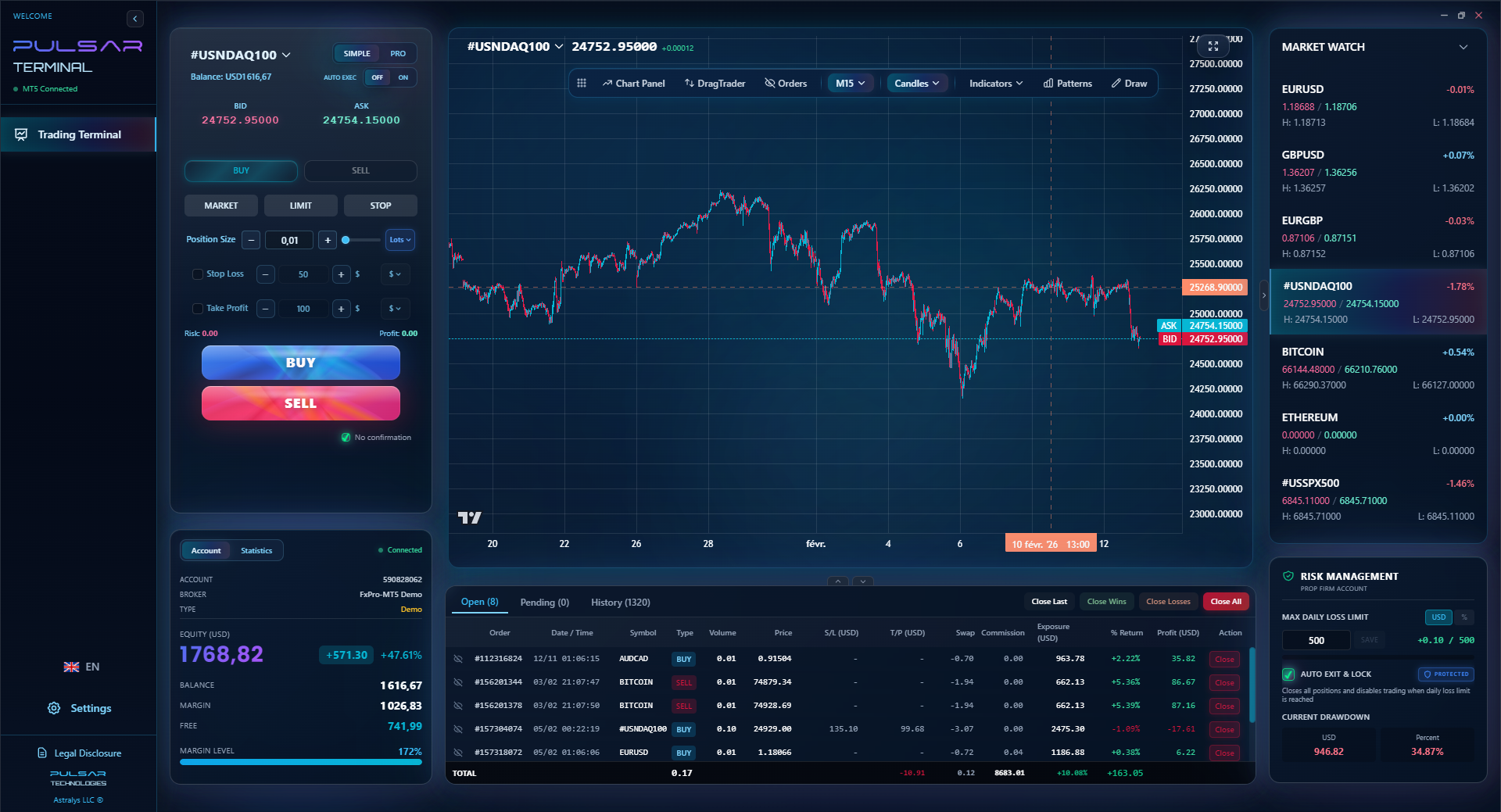
Once your analysis gives you a clear level, executing the trade with precision is key. Pulsar Terminal lets you place drag-and-drop orders and manage complex multi-TP/SL strategies directly on your MT5 charts, turning your analysis into action without the clutter.
“Analysis paralysis isn't a lack of information; it's a lack of a system to filter it.”
We all make these mistakes. Recognizing them is half the battle.
Analysis Paralysis. This is the big one. You read five conflicting analyses: two are bullish, three are bearish. You freeze and miss the move. Solution: Have a primary source. Let your own chart analysis be the final judge. Use other analysis only to ask, "What am I missing?" not "What should I do?"
Chasing 'Expert' Opinions. That analyst on TV sounds so confident! But they're often talking their book or have a different time horizon. I once entered a swing trading short on GBP/ZAR because a famous analyst was bearish on the pound. He was right on a monthly chart, but my swing trade got slaughtered by a 300-pip intraweek rally. Our timeframes didn't match.
Ignoring the Spread on ZAR Pairs. Your beautiful analysis on USD/ZAR shows a perfect 15-pip profit target. But if the spread is 10 pips (common with exotics), your risk/reward is destroyed before you start. Always factor in the real cost of trading. A broker like Pepperstone might show a 5-pip spread on USD/ZAR, which is decent for the pair, but you must check this live, not just the advertised minimum.
Over-Reliance on Back-Tests. Just because an RSI indicator strategy worked 80% of the time in 2023 doesn't mean it will work now. Markets change. The SARB's intervention policy or a new global crisis changes how ZAR reacts. Use past analysis as a guide, not a guarantee.
Remember, analysis is just the map. You still have to drive the car. No amount of perfect weather analysis helps if you don't know how to steer.
FAQ
Q1What is the single best free analysis site for a beginner in South Africa?
Hands down, start with your broker's analysis portal combined with TradingView's free charts. For example, if you're with XM or Exness, use their daily videos and reports to understand the market narrative, then use TradingView to practice drawing the levels they mention on your USD/ZAR chart. It's free, integrated, and teaches you to connect the dots yourself.
Q2How can I get reliable analysis on the South African Rand (ZAR)?
You need a hybrid approach. Use global calendars (ForexFactory) for timing of US and SA data releases. Then, use local news sources (Moneyweb, Business Day) to understand the local context behind the data - like Eskom updates or mining sector news. Finally, monitor commodity charts (gold, platinum) on TradingView, as they often lead ZAR moves. No single 'global' site does this well.
Q3Are the analysis tools from FSCA-regulated brokers good enough?
Yes, generally they are very good and, crucially, they are regulated. Brokers like IG, Pepperstone, and AvaTrade invest heavily in research. Their analysis is professional and designed to be useful for trading. The key is to use it as a source of information, not as a signal service. They won't say 'buy here,' but they will say 'support is at 18.50 and the focus is on the SARB decision.' That's valuable.
Q4Should I pay for a forex signal service based on their analysis?
I strongly advise against it, especially as a beginner. The FSCA constantly warns against these. Most are scams or underperform simple index funds. The analysis is often vague or copied. Your R500-R2000 monthly fee is better used as additional trading capital. Real trading skill comes from doing your own analysis, not following someone else's.
Q5What time should I do my market analysis in South African time?
Do your main planning between 6:00 PM and 8:00 PM SAST. This is after the US/European markets have closed (so you see the daily candles complete) and before the Asian session kicks off. It's quiet. Your morning check (6:00 AM - 7:00 AM SAST) should just be a quick scan for any overnight surprises and to confirm your plan ahead of the European open.
Q6How do I know if the analysis I'm reading is biased?
Look for the source. Is it from a broker's research team (potential bias towards generating trading activity)? Is it from a news site selling a subscription? Good analysis presents facts and multiple scenarios. Biased analysis uses extreme language ('guaranteed,' 'massive move') and only presents one outcome. If there's no discussion of where the analysis could be wrong, be skeptical.
प्रो. विंस्टन का पाठ
:
- ✓Use your FSCA broker's free research portal as your primary analysis hub.
- ✓Always factor in the wide spreads (5-14 pips) on ZAR pairs before taking a trade.
- ✓Supplement global data with local SA news sources for a true ZAR edge.
- ✓Build a 15-minute daily analysis routine and stick to it religiously.
यह लेख कितना उपयोगी था?
रेट करने के लिए स्टार पर क्लिक करें
साप्ताहिक ट्रेडिंग विश्लेषण
मुफ़्त साप्ताहिक विश्लेषण और रणनीतियाँ। कोई स्पैम नहीं।
लेखक के बारे में
David van der Merwe
उभरते बाजार के ट्रेडर
जोहानसबर्ग स्थित ट्रेडर, इमर्जिंग मार्केट करेंसीज में 11 साल का अनुभव। ZAR पेयर्स, FSCA-विनियमित ट्रेडिंग और दक्षिण अफ्रीकी मार्केट एनालिसिस में विशेषज्ञ।
टिप्पणियाँ
आपको यह भी पसंद आ सकता है

Cara Trading Forex Sukses: 7 Prinsip dari Trader Profesional
Cara trading forex sukses dengan 7 prinsip trader pro: manajemen modal, disiplin, journal trading, backtest. Data nyata, bukan janji profit palsu.
Jam Trading Forex Terbaik untuk Trader Indonesia: Panduan Lengkap dengan Tabel Waktu
Panduan jam trading forex untuk trader Indonesia. Tabel 4 sesi dunia, jam emas 20:00-00:00, sesi mana yang harus dihindari. Data akurat + tips dari trader berpengalaman.
Top 5 Sàn Forex Uy Tín Nhất 2026: Review Jujur dari Trader Indonesia
Top 5 sàn forex uy tín 2026 untuk trader Indonesia. Review jujur: spread, deposit, withdraw, dukungan lokal. Exness, XM, IC Markets & lebih.
All these calculators are built into Pulsar Terminal with real-time data from your MT5 account. One-click position sizing, automatic risk management, and instant calculations.
