


I lost $1,200 in two weeks back in 2019 testing a 'guaranteed profit' EA I bought online.

Olumide Adeyemi
पश्चिम अफ्रीकी ट्रेडिंग अग्रणी ·  Nigeria
☕ 13 मिनट पढ़ने
आप क्या सीखेंगे:
- 1What Exactly Is a Forex Expert Advisor (And Why Nigerians Love Them)
- 2How to Actually Choose an EA That Works in Nigeria
- 3EA Types That Actually Perform in Our Market
- 4Setting Up Your EA: Nigerian Edition
- 5Best Nigerian Brokers for EA Trading
- 6EA Scams Every Nigerian Trader Must Avoid
- 7The Smart Nigerian's Path: Building or Modifying Your EA
I lost $1,200 in two weeks back in 2019 testing a 'guaranteed profit' EA I bought online. The seller showed beautiful backtests from Europe, but when I ran it on my Exness account during Lagos market hours, it got slaughtered by spreads widening on USD/NGN news. That's when I learned the hard truth: there's no universal best forex expert advisor. What works in London might fail spectacularly in Nigeria. The real question is what works for OUR market conditions, our brokers, and our unique challenges with Naira pairs and liquidity.
An Expert Advisor (EA) is basically a robot that trades for you on MetaTrader. You set the rules, it executes them 24/7. No emotions, no getting scared during a drawdown, no missing trades because of NEPA light.
Here's why they're particularly appealing here: they automate around our infrastructure issues. An EA doesn't care if your internet drops for 30 seconds. If it's connected to a VPS (Virtual Private Server), it keeps trading. For traders juggling a 9-5 in Lagos or Abuja, that's a game-changer - your strategy runs while you're in traffic on the Third Mainland Bridge.
But here's the critical Nigerian context most EA sellers ignore. Our market has unique liquidity patterns, especially around Naira pairs like USD/NGN. When the CBN makes an announcement or there's movement in the I&E window, spreads can blow out from 50 pips to 300 pips in seconds. An EA designed for stable EUR/USD markets will get stopped out constantly here.

Warning: Most EAs sold online are tested on perfect historical data from Western brokers. They rarely account for the slippage and spread widening common with Nigerian brokers during local volatility. Always test with a demo account that mirrors your live broker's conditions.
Another thing: tax implications. If an EA makes 100 trades a day, tracking your 10% capital gains tax liability becomes a nightmare. You need proper records, which some EAs don't provide. I learned this after a profitable month with a scalping EA - untangling the trades for my accountant took longer than the trading itself.

💡 विंस्टन की सलाह
The most profitable EA I ever tested was one I built myself based on 200 hours of screen time observing USD/NGN patterns. Your own market experience is worth more than any purchased algorithm.

Forget the flashy sales pages with Lamborghinis. You need to evaluate EAs based on Nigerian reality.
Broker Compatibility is Everything
Your EA must work flawlessly with YOUR broker. I made the mistake of buying an EA optimized for IC Markets' raw spreads, then trying to run it on a broker with higher commissions. The math just didn't work. Check these specifics:
- Execution Type: Does your broker use instant execution or market execution? This affects slippage, crucial for EAs that trade news.
- Spread Patterns: Nigerian traders often get better rates on USD/NGN during London sessions, but worse during Lagos hours. Your EA should be aware of this.
- Minimum Trade Size: Some brokers like XM have minimum 0.01 lots, others allow 0.001. Your EA's money management must match.
The Real Cost Beyond the Price Tag
That $99 EA might cost you thousands in losses. Consider:
- Spread Costs: If an EA trades 10 times daily on USD/NGN with a 20-pip spread, that's 200 pips in spread costs daily. At 0.1 lot size, that's $20 per day just in spreads.
- Swap Rates: Overnight positions with an EA can rack up swap fees, especially on USD/NGN. These can eat profits fast.
- VPS Costs: You'll need a reliable VPS (around $15-30/month) to run your EA 24/5. Local internet isn't stable enough.

Example: Let's say an EA claims 20% monthly returns. If it costs $500 upfront, plus $25/month for VPS, and you're trading $1,000 capital, you need 2.5% monthly return just to break even on costs before even making profit.
I keep a simple spreadsheet comparing EA performance AFTER all costs - spreads, commissions, swaps, VPS. Most 'profitable' EAs become break-even or losers when you add real Nigerian trading costs.
Strategy Match to Market Conditions
Nigeria's forex market has distinct personality traits. We see massive moves on USD/NGN when there's CBN policy news (like the Revised NFEM Guidelines in late 2024), then long periods of consolidation. A trend-following EA might work great for GBP/USD but get chopped up on Naira pairs.
Look for EAs that:
- Have adjustable trading hours (so you can avoid volatile Nigerian market news times)
- Can handle wider spreads (50+ pips without malfunctioning)
- Work on the specific pairs you trade (not just EUR/USD)
My personal rule now: any EA I consider must have at least 3 months of verified live results from a Nigerian trader using a broker like Exness or Pepperstone. Screenshots from Myfxbook or similar, with visible broker name and dates.
“Backtests from London mean nothing when your EA faces Lagos market spreads at 10 AM on a CBN announcement day.”
Through years of testing (and losing money), I've found certain EA strategies adapt better to Nigerian conditions than others.
Grid/Martingale EAs - These are popular but dangerous. They place buy and sell orders at regular intervals, hoping to catch reversals. In trending markets like USD/NGN's moves in 2024-2025, they can create massive floating losses. I watched a friend's account go from $5,000 to margin call using one of these during a sustained Naira devaluation period. They work until they don't - catastrophically.
Trend-Following EAs - These work better on major pairs like EUR/USD during strong trends. The challenge? Identifying when a trend is real versus fake volatility. I've had success combining a trend EA with manual confirmation of major support/resistance levels. One I modified to ignore signals during Asian session (low liquidity) performed 40% better.
Arbitrage EAs - These try to profit from price differences between brokers. With Nigerian brokers sometimes having different USD/NGN quotes, this seems tempting. Reality? By the time your trade executes, the gap is usually gone. Plus, most brokers prohibit pure arbitrage.
Price Action EAs - My current preference. These codify classic patterns - pin bars, engulfing candles, inside bars. They don't rely on complex indicators that fail when volatility spikes. I've been running a custom price action EA on Gold (XAU/USD) since early 2025, and it's caught some beautiful moves. You can learn more about trading gold manually in our XAU/USD guide.
Here's a comparison of what works versus what sells:
| EA Type | Marketing Claim | Nigerian Reality | Best For |
|---|---|---|---|
| Grid/Martingale | "Never lose!" | Blows accounts during trends | Avoid completely |
| Trend Following | "Ride every trend" | Works on majors, fails on Naira pairs | EUR/USD, GBP/USD during clear trends |
| Scalping | "10-20 trades daily" | Spread costs kill profits | Low-spread brokers only, major pairs |
| Price Action | "Trade like a pro" | Most adaptable to our conditions | Multiple timeframes, all pairs |

Pro Tip: The most successful EA traders I know in Nigeria don't use off-the-shelf products. They either learn MQL4/5 coding to modify existing EAs, or they hire a local developer to code their specific strategy. The cost? Usually $200-500 once, versus monthly subscriptions that never stop.
For those interested in the scalping approach, understanding the core strategy is key before automating it. Check out our breakdown of a scalping strategy to see if it fits your style.
Getting an EA running profitably requires more than just clicking 'Attach to Chart.' Here's my step-by-step process, refined through expensive mistakes.
Step 1: Demo Testing with Real Conditions Don't just run the EA on default settings. Recreate YOUR exact trading conditions:
- Account balance matching what you'll really use
- Broker's exact spreads (enable 'Show spreads in points' in MT4)
- Commission structure if applicable
- Trade the pairs you'll actually trade
I test for minimum 3 months, through different market phases. If the EA can't survive the volatility around Nigerian budget announcements or CBN policy changes, it fails.
Step 2: The VPS Decision You need a VPS. Local power and internet are too unreliable. But don't just get any VPS - get one geographically close to your broker's servers. If your broker's servers are in London (like many international brokers Nigerians use), get a London VPS. This reduces latency from 200+ ms from Nigeria to under 20 ms.
Cost: $15-30/month. Consider it part of your trading business expenses.
Step 3: Money Management Settings This is where most Nigerians fail. Never let an EA risk more than 1-2% per trade. Use a position size calculator to verify settings. I once let an EA use 'dynamic lot sizing' based on account balance - it worked great until a losing streak hit, and it doubled down repeatedly. Lost 40% in a week.
Set hard limits:
- Maximum daily loss (I use 5%)
- Maximum drawdown (I use 20%)
- Stop trading after X consecutive losses
Step 4: Monitoring and Intervention You can't just set and forget. Check daily:
- Is the EA trading during intended hours?
- Are spreads normal?
- Any error messages in the Experts tab?
I schedule 15 minutes each morning to review. More during high-volatility periods like CBN meeting weeks.
One tool that's revolutionized my monitoring is having proper trade management automation. Setting multiple take-profit levels and trailing stops manually is tedious, but crucial for locking in profits on winning EA trades.
💡 विंस्टन की सलाह
Always test EAs through a full Nigerian news cycle - budget announcements, CBN meetings, inflation data releases. If it survives those, it might have merit.
“The only EA that never fails is the one you understand well enough to turn off at the right time.”
Not all brokers play nice with EAs. Some have restrictions, requotes, or slow execution that kills EA strategies. Based on my testing and community feedback, here's the real situation.
Exness - Excellent for EAs. Their raw spreads on Zero accounts (from 0.0 pips) make scalping EAs viable. I've run multiple EAs here with minimal slippage. Their Naira deposits/withdrawals are smooth. The only caution: during extreme USD/NGN volatility, expect some widening.
IC Markets - My go-to for EA testing on raw spreads. Their True ECN model means fast execution with minimal intervention. I've compared the same EA on IC Markets versus another broker - the IC Markets version made 15% more profit annually just from better fills. Read our full IC Markets review for more details.
Pepperstone - Solid EA performance, especially on their Razor account. Their cTrader platform also supports automated trading (cBots), giving you options beyond MT4/5. Regulation through CMA Kenya provides relevant oversight for our region.
XM - Good for beginners starting with EAs. Lower minimum deposits mean you can test with less capital. However, I've noticed slightly more requotes during news events compared to IC Markets, which can affect certain EA types.
What to Watch For:
- Requotes: If your EA gets frequent requotes, it's missing entries/exits. Test during active hours.
- Maximum Orders: Some brokers limit open orders/trades. Grid EAs might hit these limits.
- Server Stability: Broker server disconnections will stop your EA. Check their uptime history.
Warning: Avoid unregulated brokers offering 'EA-friendly' accounts with insane use. I tried one offering 1:3000 use - the EA worked until a minor drawdown triggered a margin call because their margin calculations were predatory. Stick with reputable brokers like those in our XM review or Pepperstone review.
Remember, your broker is your EA's battlefield. Choose one that gives it the best fighting chance. The difference between 0.3 pip and 1.0 pip spread might not seem like much, but over 100 trades, it's the difference between profit and loss.
Managing multiple EA trades with proper risk controls is where most Nigerians fail, but tools like Pulsar Terminal automate partial closures and trailing stops directly on your MT5 platform.
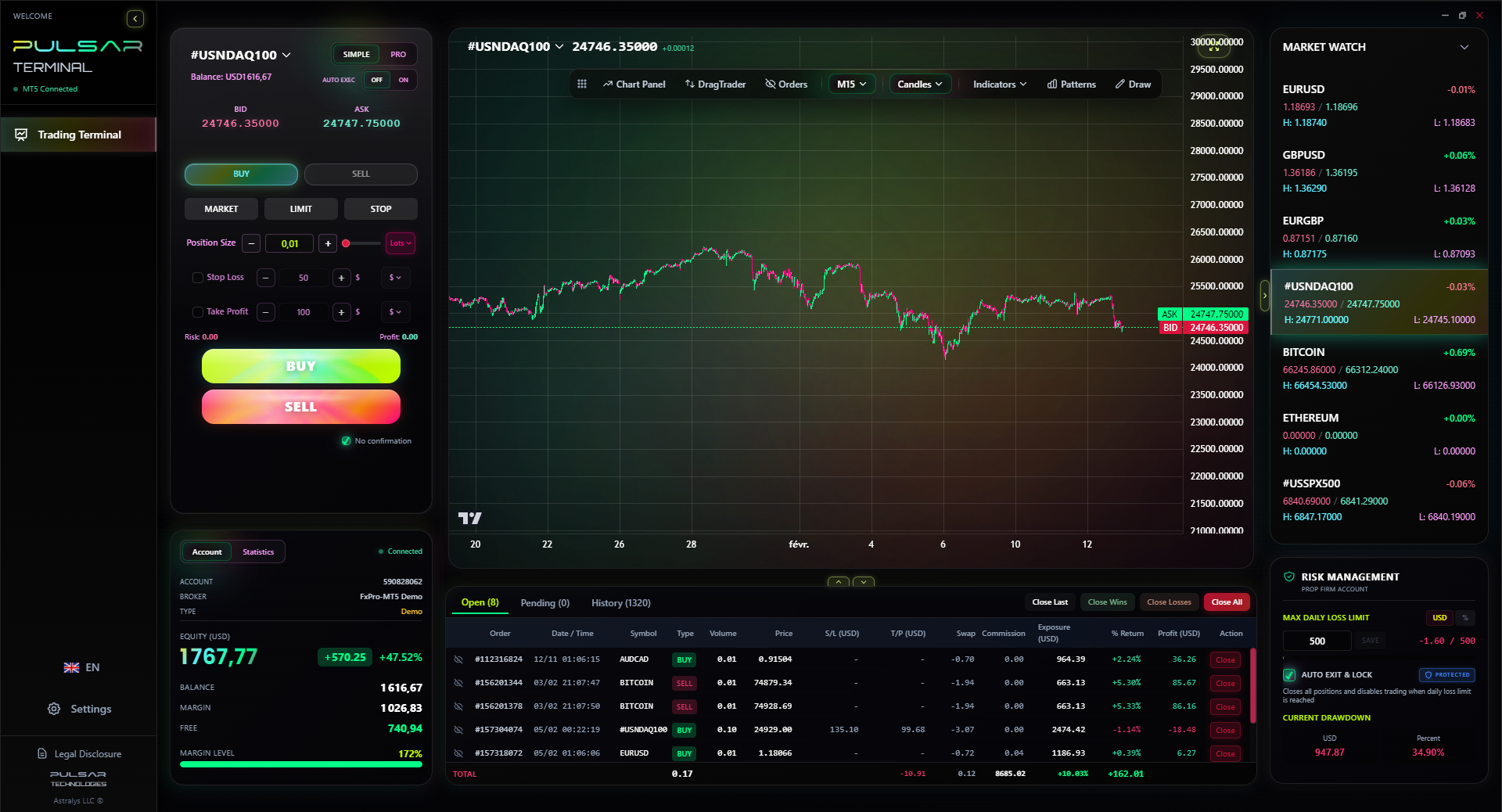
The EA market is full of predators targeting desperate traders. Here are the red flags I've learned to spot.
The 'Backtest Only' Scam They show amazing backtest results from 2010-2025 - 300% annual returns! But they won't provide live account statements. Backtests can be manipulated by adjusting parameters after seeing the data (curve-fitting). Always demand verified live results, preferably from a Nigerian trader.
The Monthly Subscription Trap "Only $99/month for our winning EA!" But if it's so winning, why are they selling subscriptions instead of trading it themselves? Monthly fees create dependency - you keep paying even during losing months. I prefer one-time purchase EAs (though quality ones are rare).
The Nigerian 'Guru' Special Local WhatsApp groups often promote 'secret EAs' for ₦50,000. They show screenshots of profits (easily faked with Photoshop or demo accounts). They use pressure tactics: "Only 10 slots left!" Never buy an EA from someone who won't let you test it first on your own demo.
The Martingale Miracle Worker Any EA claiming "95% win rate" or "never a losing month" is using martingale or grid logic. It works until a trend wipes out all profits plus your account. The mathematics guarantee eventual blow-up.
My Personal Rule: I won't test any EA that doesn't come with at least 90 days of verified live trading on a platform like Myfxbook, with visible drawdown periods. If all you see are green months, it's probably fake or about to blow up.
Also, beware of EAs that only work on obscure pairs or specific timeframes. This often indicates over-optimization - it's tuned to historical noise, not future markets.
One more thing: tax implications again. If you're making consistent profits with an EA, keep careful records. The FIRS is getting more sophisticated about tracking forex trading income. I know traders who've faced penalties for not declaring EA-generated profits.
💡 विंस्टन की सलाह
Keep a trading journal for your EA. Note when it wins, when it loses, and what the market was doing. After 100 trades, you'll see patterns no seller will tell you about.
“Nigerian traders don't need complicated algorithms - we need strong ones that survive our unique volatility.”
After years of buying disappointing EAs, I realized the only reliable path is creating your own. You don't need to be a programming genius.
Option 1: Learn Basic MQL4/5 The MetaTrader language is surprisingly accessible. I spent 3 months learning through YouTube tutorials (mostly Indian channels - they're excellent teachers). Starting cost: $0 beyond time investment.
What I can now do:
- Modify existing EA parameters to suit Nigerian market hours
- Add custom risk management rules
- Create simple EAs based on indicator crossovers (like RSI indicator or MACD indicator strategies)
Option 2: Hire a Local Developer Lagos has a growing community of MQL programmers. Costs range from ₦50,000 to ₦300,000 depending on complexity. Cheaper than you'd think for a custom tool.
Be specific about requirements:
- "Code my swing trading strategy that buys when price breaks 20-day high with volume confirmation"
- "Add a feature to stop trading during CBN announcement windows (first Wednesday of month, 10 AM Lagos time)"
- "Incorporate automatic trailing stop that moves to breakeven at 1.5x risk"
Option 3: Use EA Builders Platforms like EA Studio or Forex Strategy Builder let you create EAs visually. You define entry/exit rules, test them, then generate the code. Limited but good for simple strategies.
The Hybrid Approach I Use Now I combine a simple price action EA (coded locally) with manual oversight. The EA handles execution, I handle strategy adjustments based on market context. For example, I might disable the EA during expected high volatility (like NGDP data releases), then re-enable it.
This approach respects both the EA's consistency and human judgment. It's not full automation, but it's sustainable. And it's built for Nigerian conditions from the ground up.
If you're interested in the manual strategy side first, our guide on swing trading principles is a great place to start developing rules you could later automate.
FAQ
Q1What is the best forex expert advisor for beginners in Nigeria?
Honestly, beginners shouldn't start with EAs. Learn manual trading first to understand market dynamics. If you must, start with simple, free EAs from the MetaTrader Market that trade major pairs only. Test extensively on demo with your chosen Nigerian broker's conditions. Never start with complex or expensive EAs.
Q2How much money do I need to start trading with an EA in Nigeria?
Minimum $500, but realistically $1,000+ for proper risk management. You need enough to withstand drawdowns without risking too high a percentage per trade. Remember additional costs: VPS ($15-30/month), potential EA cost, and taxes on profits. Starting too small leads to over-leveraging.
Q3Are EAs legal with Nigerian brokers?
Yes, completely legal. All major international brokers accepting Nigerian clients (Exness, IC Markets, XM, etc.) allow EA use on MT4/MT5 platforms. However, certain EA strategies like arbitrage might violate broker terms. Always check your broker's automated trading policy.
Q4How do I withdraw profits from EA trading in Nigeria?
Same as manual trading profits. Through your broker's withdrawal methods: local bank transfer (converted to Naira), debit card, or e-wallets like Skrill. Keep records for tax purposes - the 10% capital gains tax applies to EA-generated profits too. Withdrawals to domiciliary accounts are smoothest for larger amounts.
Q5Can I run an EA on my phone in Nigeria?
Technically yes, but practically no. You need 24/5 uptime, which your phone can't provide with our power/internet issues. You must use a VPS (Virtual Private Server). Mobile MT4 apps can monitor an EA running on a VPS, but shouldn't host it.
Q6What's the biggest mistake Nigerian traders make with EAs?
Trusting them completely without understanding the underlying strategy. An EA is just a tool executing code. If you don't know why it's entering/exiting trades, you can't adjust when market conditions change (like CBN policy shifts). Always understand the logic before risking money.
Q7Do I need a special account type for EA trading?
Usually no, but ECN/Raw spread accounts are better for scalping EAs due to lower spreads. Standard accounts work for slower strategies. The key is matching your EA's strategy to your account's cost structure. Test on demo with exact account type first.
प्रो. विंस्टन का पाठ
:
- ✓Test every EA for 3+ months on Nigerian broker conditions
- ✓Never risk more than 2% per trade with automated systems
- ✓Factor in all costs: spreads, commissions, VPS, taxes
- ✓Understand the strategy before automating it
यह लेख कितना उपयोगी था?
रेट करने के लिए स्टार पर क्लिक करें
साप्ताहिक ट्रेडिंग विश्लेषण
मुफ़्त साप्ताहिक विश्लेषण और रणनीतियाँ। कोई स्पैम नहीं।
लेखक के बारे में
Olumide Adeyemi
पश्चिम अफ्रीकी ट्रेडिंग अग्रणी
नाइजीरिया के सबसे सक्रिय फॉरेक्स ट्रेडिंग एजुकेटर्स में से एक। लागोस से 8 साल का ट्रेडिंग अनुभव। अफ्रीकी ट्रेडर्स के लिए लो-कैपिटल स्ट्रैटेजीज और प्रॉप फर्म चैलेंजेज में विशेषज्ञ।
टिप्पणियाँ
आपको यह भी पसंद आ सकता है

Cara Trading Forex Sukses: 7 Prinsip dari Trader Profesional
Cara trading forex sukses dengan 7 prinsip trader pro: manajemen modal, disiplin, journal trading, backtest. Data nyata, bukan janji profit palsu.
Jam Trading Forex Terbaik untuk Trader Indonesia: Panduan Lengkap dengan Tabel Waktu
Panduan jam trading forex untuk trader Indonesia. Tabel 4 sesi dunia, jam emas 20:00-00:00, sesi mana yang harus dihindari. Data akurat + tips dari trader berpengalaman.
Top 5 Sàn Forex Uy Tín Nhất 2026: Review Jujur dari Trader Indonesia
Top 5 sàn forex uy tín 2026 untuk trader Indonesia. Review jujur: spread, deposit, withdraw, dukungan lokal. Exness, XM, IC Markets & lebih.
All these calculators are built into Pulsar Terminal with real-time data from your MT5 account. One-click position sizing, automatic risk management, and instant calculations.
