


You've seen the ads.

David van der Merwe
उभरते बाजार के ट्रेडर ·  South Africa
☕ 10 मिनट पढ़ने
आप क्या सीखेंगे:
- 1The Mentorship Scam Industrial Complex
- 2What Real Mentorship Actually Looks Like (The Boring Truth)
- 3South African Realities: ZAR, Regulation, and Time Zones
- 4Self-Mentorship: The Ultimate Goal
- 5Red Flags vs. Green Flags in a Mentor
- 6Alternative 'Mentors' You Already Have (For Free)
- 7Making the Decision: A Practical Plan for South Africans
You've seen the ads. The Lamborghinis, the private jets, the 'secret system' that prints money. Every guru claims to be the best forex mentor in the world, and they're all targeting you. Let me stop you right there. Chasing that fantasy is the fastest way to blow up your account. The real 'best mentor' isn't a person selling a dream; it's a combination of disciplined process, local market savvy, and brutally honest self-review. I've seen too many South African traders lose their shirts buying promises instead of education. Let's set the record straight on what mentorship actually means when you're trading from SA.
First, let's call it what it is. The online 'forex guru' space is a multi-billion rand industry built on selling hope, not results. They follow a predictable script: flashy cars (usually rented), edited screenshots of 'trades,' and a limited-time offer for a 'masterclass' that costs more than your monthly salary.
I fell for it early on. Paid R15,000 for a 'signals group' from a 'mentor' with a huge YouTube following. The first week, he called a USD/ZAR trade that hit. We were all heroes. The next ten trades? All losers. When questioned, he blamed 'market volatility' and our 'lack of discipline.' The reality was he had no edge, just a good marketing team. He wasn't a mentor; he was a salesman. The FSCA can't protect you from these guys if they're operating from another country, which they usually are.
Their entire business model relies on you failing quietly. If you succeed, you stop paying for signals or monthly subscriptions. But if you fail, you're more likely to buy their 'advanced course' to fix your problems. It's a vicious cycle. Real mentorship should make you independent, not permanently dependent on someone else's Telegram channel.

Warning: Any 'mentor' who guarantees profits or shows only winning trades is lying. Period. The market doesn't guarantee anything. If their strategy was so foolproof, they'd be using bank capital, not selling R5,000 courses to beginners.
True guidance starts with risk management, not magic indicators. A real professional will spend more time talking about your position size calculator settings and maximum daily loss than about some mythical 100-pip setup.

💡 विंस्टन की सलाह
The market's tuition fees are high, but its lessons are the only ones that stick. Pay them first on a demo account.
Forget the hype. Real mentorship is painfully unsexy. It's the grind. A true guide does three things: provides structure, enforces accountability, and helps you build self-awareness. They're more like a tough sports coach than a motivational speaker.
A good mentor will dissect your losing trades with more enthusiasm than your winners. They'll ask why your stop-loss was where it was. They'll question your entry timing on that EUR/USD scalp. They'll make you journal every single trade - entry, exit, reasoning, emotional state. This is how you build a repeatable process.
The Framework Over The Signal
The value isn't in being told 'buy here.' It's in being taught how to decide to buy there. What confluence of factors are you looking at? Is it price action at a key level, confirmed by a specific RSI indicator divergence, and aligning with a broader market theme? A mentor gives you the framework to assess this yourself.
I once worked with a trader who was brilliant at analysis but a disaster at execution. He'd identify perfect setups on XAU/USD but then hesitate, chase the entry, and get stopped out. His 'mentor' was just sending him more setups. The real solution? We used a trading simulator for two weeks where he had to verbalize his entire process out loud before clicking buy. It exposed his hesitation flaw. That's mentorship - fixing the engine, not just adding more fuel.

Pro Tip: Seek someone who trades a similar style to your goals. A long-term swing trader has little to learn from a scalping specialist, and vice-versa. Their market rhythm, risk per trade, and psychology are completely different.
“Real mentorship should make you independent, not permanently dependent on someone else's Telegram channel.”
A generic 'world's best' mentor from the US or UK might not cut it for you. Your trading life in SA has unique wrinkles. A worthwhile local guide understands these in their bones.
Trading the ZAR Pairs: USD/ZAR, EUR/ZAR, GBP/ZAR. These are your home turf. They can be wildly volatile, especially around local political announcements or SARB interest rate decisions. A good mentor should understand this liquidity profile and how it differs from major pairs. I learned this the hard way trying to apply standard EUR/USD volatility measures to USD/ZAR; the stop-losses were laughably tight.
The FSCA and Broker Choice: Your mentor should have a strong opinion on regulation. Trading with an unregulated offshore bucket shop because they offer 1:1000 use is a rookie mistake. They should be able to discuss the pros and cons of reputable, FSCA-regulated brokers like those reviewed on this site (Exness, IC Markets) versus going international. Your capital protection is non-negotiable.
The SA Time Zone: You're trading London's open at 10:00 AM SAST and New York's open at 4:00 PM SAST. This affects your lifestyle and strategy choice. A swing trading approach that doesn't require staring at screens at midnight might be more sustainable than a scalping method that needs you active during low-liquidity Asian sessions. A mentor who gets this will help you build a strategy that fits your life, not destroy it.

Example: Let's talk costs. If a mentor charges R20,000, that's not just a fee. That's trading capital. That's 20 trades with a R1,000 risk per trade. You need to be certain the education will prevent more than R20,000 in future losses. Often, a R500 book and disciplined practice will do more.
Here’s the secret no guru will tell you: the end goal is to fire your mentor. The best forex mentor in the world is the one who works you out of a job. You need to become your own toughest critic and coach.
This starts with brutal, quantitative journaling. Not just 'I felt good.' I mean a spreadsheet: date, instrument, long/short, entry price, exit price, P&L in Rands, spread cost, reason for entry (e.g., '1H trendline break'), reason for exit. Over time, this data is gold. You'll see you lose more on Tuesday afternoons. Or that your win rate on GBP pairs is 20% lower. This is self-mentorship.
Your charts are another mentor. Learn to read price action naked - no indicators. What do rejection wicks at a prior high tell you? Where is the market finding acceptance? Tools like Volume Profile can show you where big players are active. This is how you develop your own eye for the market.
I have a rule: for every hour I spend watching a mentor's video or reading a trading book, I spend three hours reviewing my own charts and trades. External input is just fuel; the engine is your own review process. This is how you build conviction, and conviction is what keeps you in a winning trade and gets you out of a loser before it triggers a margin call.
💡 विंस्टन की सलाह
A mentor's most valuable gift isn't a trade idea; it's the question they make you ask yourself that you've been avoiding.
“The end goal is to fire your mentor. The best forex mentor in the world is the one who works you out of a job.”
Let's make this simple. Use this checklist before you hand over any Rand.
| Red Flags (Run Away) | Green Flags (Maybe Worth It) |
|---|---|
| Guarantees of profit or specific returns. | Focuses on risk management and probability. |
| Only shows winning trades/pasted statements. | Openly discusses their losses, drawdowns, and mistakes. |
| Pressure to sign up 'today before price increases.' | Offers transparent, fixed pricing with no sleazy upsells. |
| Style is all motivation, no concrete mechanics. | Provides clear frameworks, checklists, and repeatable processes. |
| Asks you to copy their trades blindly. | Teaches you how to find and execute your own trades. |
| Vague about their own live trading track record. | Can articulate their edge, its win rate, and its average risk/reward. |
| Dismisses regulation or recommends unregulated brokers. | Emphasizes capital safety and sustainable practice. |
A green flag mentor might say, 'My trend-following method wins about 40% of the time, but my average winner is 2.5 times my average loser. I risk 1% per trade, and my worst drawdown was 15% over six weeks.' That's real. That's accountable. The guy screaming about his new Ferrari can't give you numbers like that.
Also, look for community. Does the mentor build a group where students challenge each other and share trade reviews? Or is it a one-way broadcast where only the guru speaks? The former has value; the latter is a cult.
Building a disciplined, self-reliant process is key, and tools like Pulsar Terminal for MT5 help enforce that discipline with visual trade planning and automated risk management rules.
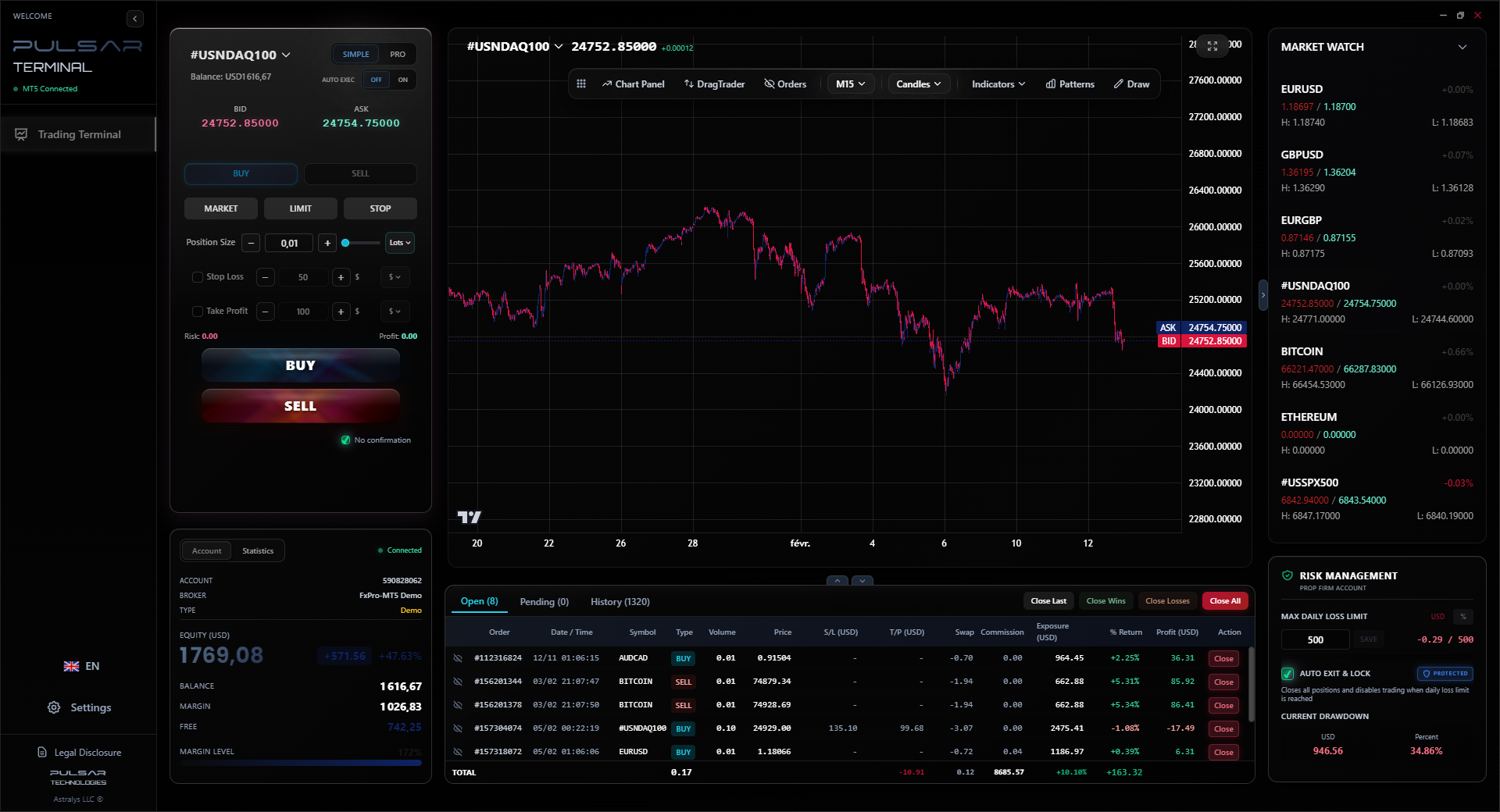
You might not need to pay anyone. The best forex mentor in the world might be a collection of tools and disciplines you already have access to.
1. The Market Itself: This is your primary teacher. Every loss is tuition. Did you get stopped out? Why? Was your level wrong, or was your timing off? The market gives you immediate, unbiased feedback if you're willing to listen. Paper trading is a great way to pay this tuition with fake money.
2. A Trading Journal: As mentioned, this is your personal coach. It's where you spot your patterns - both good and bad. There's no hiding from the data.
3. A Trusted Trading Peer: Find one other serious trader. Not a buddy to complain with, but someone to hold you accountable. Share your journals weekly. This peer pressure is powerful. You'll work harder on your analysis if you know someone competent is going to review it.
4. Reputable, Non-Hype Resources: There are fantastic books (e.g., 'Trading in the Zone' by Mark Douglas for psychology) and legitimate educational sections from major brokers. The analysis from some banks and research houses can teach you how to think about macro themes.
5. Technology: A strong trading platform can enforce discipline. Tools that help you pre-plan trades, visualize risk, and automatically execute plans remove emotion. This is where a structured process becomes real.
Before you spend a cent, exhaust these free resources. They will teach you more than 90% of the paid gurus out there.
“Before you spend a cent, exhaust free resources. They will teach you more than 90% of the paid gurus.”
Alright, so after all this, you still think you need a paid mentor. Fine. Here's a step-by-step plan to do it without getting scammed.
Step 1: Self-Assessment First. What exactly do you need? Are you clueless on fundamentals? Can't manage your emotions? Don't know how to backtest? Pinpoint the one biggest hole in your game. Don't look for a guru to teach you 'everything.'
Step 2: The Due Diligence Deep Dive.
- Verify FSCA Status: If they're South African-based and 'managing' money or giving specific advice, check the FSCA FSP register. If they aren't on it, that's a major red flag.
- Track Record Ask: Ask for a verified, long-term track record (like a MyFxBook link for several years). If it's just screenshots, ignore it.
- Talk to Alumni: Find past students on social media or forums. Ask them the hard questions: 'Did it change your results? What was the biggest lesson? Would you do it again?'
Step 3: Start Small. Does the mentor offer a low-cost introductory course, book, or webinar? Buy that first. See if their teaching style resonates with you before you commit to the R50,000 'platinum package.'
Step 4: Define Success. What does 'worth it' mean? Is it achieving a consistent 1.5% return per month? Is it finally having a written trading plan? Set this metric before you start. If after 6 months you haven't hit it, the mentorship has failed. Be willing to walk away.
Remember, the goal is competence, not dependency. The moment you find yourself waiting for your mentor's 'weekly outlook' to know what to do, you've failed the course. You should be generating your own ideas and using them as a sounding board, not a crutch.
FAQ
Q1Is it illegal to get forex mentorship in South Africa?
No, it's not illegal to seek education or mentorship. However, if the 'mentor' is providing specific financial product advice or discretionary management for a fee, they legally need to be a licensed Financial Service Provider (FSP) with the FSCA. Most online gurus are not, which limits your legal recourse if things go south.
Q2How much should I expect to pay a forex mentor in South Africa?
Prices range from a few hundred Rand for a basic ebook to over R100,000 for 'elite' programs. There is zero correlation between price and quality. A R500,000 course from a flashy Instagram guru is almost certainly worse value than a R5,000 course from a low-key professional trader who focuses on process. Never spend money that would cripple your trading capital.
Q3Can a mentor help me pass a prop firm challenge?
A good one can, but not by giving you signals. They can help you design a challenge-ready strategy with strict enough risk management (often below 0.5% per trade) and the psychological discipline to grind through the drawdown phase. The strategy must be yours and repeatable. Beware of mentors who sell 'challenge-passing' services - prop firms are cracking down on this, and it's a good way to get your account banned.
Q4What's more important for a beginner: a mentor or a demo account?
A demo account, 100 times out of 100. You need to understand how a platform works, what a pip move feels like, and how emotions affect you with fake money before you involve a mentor or real cash. A mentor can't help you if you don't know the basics of placing a trade. Spend at least 3-6 months on demo first.
Q5I found a mentor with verified profitable trades. Is that enough?
It's a start, but it's not enough. A great trader can be a terrible teacher. The key question is: can they articulate how and why they make decisions in a way you can learn from? Can they structure that knowledge into a curriculum? Many profitable traders have an intuitive feel they can't easily pass on. Ask for samples of their teaching material before you buy.
Q6Should my mentor trade the same instruments I want to (like USD/ZAR)?
It's a significant advantage, but not an absolute requirement. A mentor skilled in price action on EUR/USD can teach you principles applicable to USD/ZAR. However, they must understand the unique volatility, liquidity quirks, and macroeconomic drivers of the Rand. If they only trade majors, their advice on position sizing for ZAR pairs might be dangerously off.
प्रो. विंस्टन का पाठ
:
- ✓Judge mentors on risk management talk, not profit promises.
- ✓Verify FSCA status for any SA-based advisor.
- ✓Your trading journal is your most honest mentor.
- ✓Spend 3x more time reviewing your trades than watching guru videos.
यह लेख कितना उपयोगी था?
रेट करने के लिए स्टार पर क्लिक करें
साप्ताहिक ट्रेडिंग विश्लेषण
मुफ़्त साप्ताहिक विश्लेषण और रणनीतियाँ। कोई स्पैम नहीं।
लेखक के बारे में
David van der Merwe
उभरते बाजार के ट्रेडर
जोहानसबर्ग स्थित ट्रेडर, इमर्जिंग मार्केट करेंसीज में 11 साल का अनुभव। ZAR पेयर्स, FSCA-विनियमित ट्रेडिंग और दक्षिण अफ्रीकी मार्केट एनालिसिस में विशेषज्ञ।
टिप्पणियाँ
आपको यह भी पसंद आ सकता है

Cara Trading Forex Sukses: 7 Prinsip dari Trader Profesional
Cara trading forex sukses dengan 7 prinsip trader pro: manajemen modal, disiplin, journal trading, backtest. Data nyata, bukan janji profit palsu.
Jam Trading Forex Terbaik untuk Trader Indonesia: Panduan Lengkap dengan Tabel Waktu
Panduan jam trading forex untuk trader Indonesia. Tabel 4 sesi dunia, jam emas 20:00-00:00, sesi mana yang harus dihindari. Data akurat + tips dari trader berpengalaman.
Top 5 Sàn Forex Uy Tín Nhất 2026: Review Jujur dari Trader Indonesia
Top 5 sàn forex uy tín 2026 untuk trader Indonesia. Review jujur: spread, deposit, withdraw, dukungan lokal. Exness, XM, IC Markets & lebih.
All these calculators are built into Pulsar Terminal with real-time data from your MT5 account. One-click position sizing, automatic risk management, and instant calculations.
