


If you're searching for the best forex trading app in India, you're probably looking in the wrong place.

Rajesh Sharma
वरिष्ठ फॉरेक्स विश्लेषक ·  India
India
☕ 10 मिनट पढ़ने
आप क्या सीखेंगे:
- 1The Legal Minefield Comes First
- 2Redefining 'Best App' for the Indian Context
- 3Top Contenders & The Unvarnished Reviews
- 4Critical Features Everyone Ignores (Until It's Too Late)
- 5My Personal Setup (And The Costly Mistakes That Built It)
- 6The Verdict: Safest vs. Most Powerful
- 7Your Action Plan: What To Do This Week

If you're searching for the best forex trading app in India, you're probably looking in the wrong place. Most of the slick, globally advertised apps are a direct ticket to getting your bank account frozen or your profits confiscated. The 'best' app for you isn't about who has the prettiest charts; it's about who can legally get your money in and, more importantly, get it back out. I've seen too many traders in Mumbai and Delhi get burned chasing low spreads on illegal platforms. Let's cut through the noise and talk about what actually works on the ground here.
Forget everything you've heard from YouTube gurus. In India, you can't just download any international app and start trading forex pairs. The Reserve Bank of India (RBI) and the Securities and Exchange Board of India (SEBI) have very specific, and frankly, restrictive rules. You are only allowed to trade currency derivatives (like USD/INR futures and options) on SEBI-recognized exchanges like the NSE and the BSE. Trading international forex pairs like EUR/USD or GBP/JPY with an overseas broker? That's a grey area at best, and outright illegal for many brokers to solicit Indian clients. I made this mistake early on, funding an account with a fancy European broker. Withdrawing my 50,000 INR profit was a month-long nightmare of compliance questions and finally, a wire that got flagged by my bank. The 'best' app is useless if it operates in a shadowy legal zone that puts your capital at risk.
What You're Actually Allowed to Trade
Let's be crystal clear. As an Indian resident, your straightforward, legal path is:
- USD/INR, EUR/INR, GBP/INR, JPY/INR futures and options on Indian exchanges.
- Cross-currency futures (like EUR/USD, GBP/USD) on Indian exchanges, though liquidity can be thin.
That's largely it. Trading the spot EUR/USD market through an app like MetaTrader with an offshore broker? You're stepping outside the officially sanctioned system. Many do it, but you need to understand the risks: potential tax complications, zero legal recourse if the broker scams you, and the ever-present threat of regulatory crackdowns on payment channels.

Warning: Using international forex apps often requires funding via international wire transfer or cryptocurrency. Your Indian bank may question or reject these transactions, labeling them as 'remittances for prohibited foreign exchange transactions.' I've had students get their accounts temporarily frozen for this.


So, given the constraints, what makes the best forex trading app in India? It flips the script. In London or New York, 'best' might mean advanced order types or integration with social trading. In India, the hierarchy of needs is different.
- Legal & Operational Safety: Does the app connect you to a SEBI-registered broker for exchange-traded derivatives? This is non-negotiable for peace of mind.
- Cost Efficiency: Brokerage, exchange fees, and taxes (like the Securities Transaction Tax - STT) eat into profits. The app's parent broker needs to be competitive.
- Reliability & Execution: Can you get orders filled quickly during volatile RBI announcement times? Slippage on the USD/INR can be brutal.
- Funds Management: How easy and fast are deposits (via UPI, Net Banking) and withdrawals? A 3-day withdrawal is better than a 3-week one.
- Charting & Tools: This comes last. You need clean charts, basic indicators, and a stable platform.
I learned this the hard way. I was obsessed with finding an app that had a specific footprint chart tool. I chose a broker with a clunky app but 'advanced' charts. Their execution was so slow that a planned 20-pip profit on USD/INR futures turned into a 5-pip loss because my market order filled 25 pips away from where I clicked. The tool was useless because the foundation - execution - was rotten.

💡 विंस्टन की सलाह
Your first metric for any trading app shouldn't be its charts, but the average time for a withdrawal. If it's over 48 hours for a domestic broker, walk away.
“The 'best' app for you isn't about who has the prettiest charts; it's about who can legally get your money in and, more importantly, get it back out.”
Let's look at popular platforms used for trading currency derivatives in India. Remember, these are primarily stockbrokers whose apps also allow currency trading.
| App/Broker | The Good (For Forex) | The Bad & The Ugly |
|---|---|---|
| Zerodha Kite | Dominant market share, reliable execution on NSE, super clean interface. Low brokerage. Funds management is seamless. | Charting tools are basic. Can feel oversimplified for advanced technical analysis. No MT5/MT4. |
| Upstox Pro | Very competitive pricing, good for scalpers due to low costs. App is fast and intuitive. | Customer service can be hit or miss. Some reports of occasional app glitches during high volatility. |
| Angel One | strong research and market analysis built in. Good for traders who want fundamental cues on INR. | The app can feel cluttered. Brokerage plans can be confusing; you might pay more if you don't choose the right plan. |
| ICICI Direct Markets | Trust of a major bank. Integrated with your banking, so funds are instant. | Among the highest brokerage fees. You're paying for the brand name, which kills returns for active forex traders. |
| MetaTrader 5 via an Int'l Broker | Gold standard for charts, tools, EAs. Access to global forex pairs. | THE BIG ONE: Legal grey area for Indian residents. Funding/withdrawal hassles. No recourse with SEBI. |
My personal workhorse for INR pairs is Zerodha Kite. It's boring. It doesn't have 100 indicators. But it works, every single time. My deposits via UPI are instant, and I can withdraw profits to my bank account in under 3 hours. For the legal, exchange-traded forex market in India, that reliability is a killer feature. If you're determined to trade global pairs, you'll be looking at international brokers like Exness or IC Markets offering MT5, but you must accept the associated risks.
You'll obsess over charts. Don't. First, scrutinize these boring but vital features in any app you consider.
Tax Reporting (P&L Statements): In India, you're dealing with Capital Gains Tax. A good app should generate a ready-to-use P&L statement for the financial year, categorizing trades as short-term or long-term. Manually calculating this from hundreds of forex futures trades is a special kind of hell. I spent 4 days doing it once. Never again.
Contract Notes & Speed: You must receive a detailed contract note for every trade by law. Does the app push it instantly? Can you easily find it later? When there's a dispute about a fill price (and there will be), this is your only evidence.
Margin Calculator: Trading USD/INR futures? The margin required changes daily. A built-in, real-time position size calculator or margin calculator within the app is crucial to avoid a margin call. Guessing margin is a surefire way to get liquidated.
Order Types: Beyond simple market and limit orders, can you place a Cover Order (CO) or Bracket Order (BO) easily? These are essential for automated stop-loss placement in the volatile currency market. If placing a stop-loss is a 3-click process, you're more likely to skip it - a fatal error.

Pro Tip: Before you fund an account, test the withdrawal process with a small amount. Deposit 1000 INR. Try to withdraw 900 INR the next day. The speed and ease of this test tell you more about the broker's health and ethics than any sales brochure.
💡 विंस्टन की सलाह
In India, the spread on USD/INR futures is often irrelevant. Focus on brokerage costs and execution reliability. A 1-pip cheaper spread means nothing if your order fills 10 pips late.

“Mobile is for monitoring and managing existing trades, not for complex entry executions.”
Here's my honest, current setup for trading in India. It's not sexy, but it's built on years of losing money the wrong way.
For USD/INR Futures (My Bread & Butter): I use the Zerodha Kite app on a tablet for monitoring and quick orders. But for analysis, I use their web platform on a desktop. The bigger screen is critical for reading price action on the 15-minute and 1-hour charts I use for my swing trading approach. I keep it simple: price action, volume, and a couple of moving averages. I got lost for a year trying to use complex indicators on the USD/INR; they lag too much.
The Mistake That Cost Me 80,000 INR: I once tried to scalp EUR/INR futures using a mobile-only setup. The screen was too small, my finger slipped placing a stop-loss, and I ended up doubling my position by mistake. A sudden spike triggered the massive, unintended stop-loss. The loss was instant and entirely due to the wrong tool for the job. Mobile is for monitoring and managing existing trades, not for complex entry executions.
For Global FX (The Informed Risk): I maintain a small account with an FCA-regulated broker for occasional trades on XAU/USD or EUR/USD. I use their MT5 mobile app strictly for alerts and checking prices. All actual analysis and trading are done on the desktop version. Funding this account is a hassle involving international wire transfers, and I only risk capital I am prepared to lose entirely due to legal ambiguity.

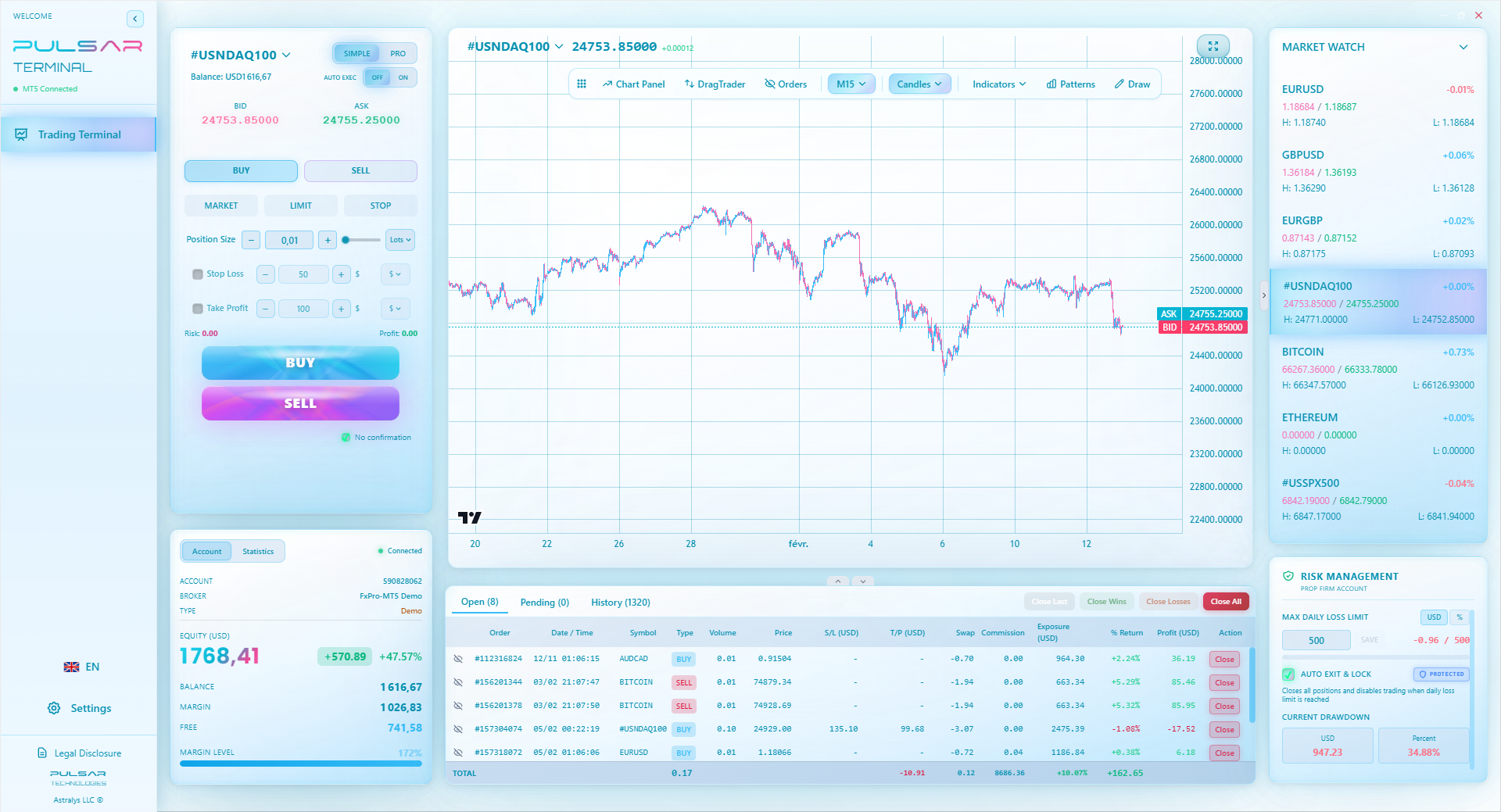
Managing complex trades on mobile is risky, but tools like Pulsar Terminal bring desktop-level order management—like one-click trailing stops and multi-TP/SL brackets—directly to your MT5, which is crucial when you can't be at your desk.
So, what's the best forex trading app in India? It depends on what you value most.
The Safest, Most Practical Choice (For 95% of Traders): Zerodha Kite or Upstox Pro. They are legal, integrated into the Indian financial system, and get the boring stuff (execution, withdrawals, taxes) brilliantly right. You trade USD/INR futures with peace of mind. This is where you should start.
The 'Power User' Compromise (Accepting The Risk): If you absolutely must trade global pairs with advanced tools, you'll need MT5 or cTrader from an international broker like Pepperstone or XM. Understand this is a personal risk decision. Your 'app' experience might be great, but the surrounding framework (banking, regulation) is fragile. Never put more than a small percentage of your total capital here.
There is no perfect answer. The Indian regulatory environment forces a trade-off: safety and convenience for a limited product range, or global access paired with operational risk and hassle. The best app is the one that aligns with your risk tolerance and keeps you trading legally another day. Starting with a SEBI-registered broker's app isn't giving up; it's building a foundation that won't collapse under you.
💡 विंस्टन की सलाह
If you're using an international app, always take screenshots of your order tickets and account balance. They are your only proof if the platform glitches or the broker disputes your trade.
“The Indian regulatory environment forces a trade-off: safety and convenience for a limited product range, or global access paired with operational risk and hassle.”
- Stop downloading random international apps. It's a compliance rabbit hole.
- Open a demo account with Zerodha and Upstox. Trade USD/INR futures on their apps for a week. Get a feel for the execution speed and interface. Don't trade real money yet.
- Learn the specifics of the USD/INR contract. What's the lot size? (It's $1000). What's the tick value? How is the settlement price calculated? This is your new trading instrument, so master its mechanics.
- Paper trade a simple strategy. Use just the RSI indicator or MACD indicator on a 1-hour chart. Focus on the process, not the fake profit.
- Only then, fund the account of the platform you liked best with a small, risk-capital amount - maybe 10,000 INR. Your goal for the first month is not to make money, but to successfully place trades, manage them, and withdraw your capital profitably. If you can't do that, nothing else matters.
The search for the best forex trading app in India ends when you realize the platform is just the vehicle. Your knowledge, discipline, and respect for the local rules are the engine. Choose a vehicle that's street-legal here, even if it doesn't have the flashiest paint job.

FAQ
Q1Is MetaTrader 5 (MT5) illegal to use in India?
No, the MT5 software itself is not illegal. However, using it to trade international forex markets with an overseas broker often violates RBI guidelines on remittances. Using MT5 with a SEBI-registered Indian broker (if they offer it for permitted instruments) is legal, but very few do.
Q2What is the minimum deposit to start trading forex in India legally?
For trading USD/INR futures on the NSE, the margin required can start from around 8,000 - 12,000 INR per lot, depending on broker and volatility. So practically, you need at least 15,000-20,000 INR to start with sensible risk management.
Q3Can I trade Forex with 500 rupees in India?
Not in any meaningful or legal way. The minimum contract size for USD/INR futures is $1000, with margin requirements far above 500 INR. Any app or broker offering forex trading with 500 INR is almost certainly operating outside regulatory boundaries and is likely a scam.
Q4Do Indian forex traders pay tax?
Yes. Profits from trading currency derivatives on Indian exchanges are treated as 'Business Income' or 'Speculative Business Income' and are taxed according to your income slab. You must file ITR-3. International trading profits are also taxable, but reporting them is complex and raises red flags about how you remitted the funds.
Q5Which is better for forex trading in India: Zerodha or Upstox?
There's no universal 'better.' Zerodha Kite is generally more polished and reliable. Upstox Pro can be cheaper for high-volume scalpers. You must try both demos. For most beginners, Zerodha's user-friendliness and environment (like their educational content) make it a slightly better starting point.
Q6Can I use TradingView for forex trading in India?
You can use TradingView for charting and analysis. However, to execute trades, you need to connect it to a broker. Most brokers integrated with TradingView are international, putting you back in the legal grey area for execution. For Indian exchange-traded derivatives, you'll likely execute trades on your broker's native app (like Kite) while using TradingView on another screen for analysis.
प्रो. विंस्टन का पाठ
:
- ✓Legal safety trumps all features for Indian traders.
- ✓Test withdrawals before making large deposits.
- ✓USD/INR futures margin starts at ~₹8,000 per lot.
- ✓Desktop is for analysis, mobile is for monitoring.
यह लेख कितना उपयोगी था?
रेट करने के लिए स्टार पर क्लिक करें
साप्ताहिक ट्रेडिंग विश्लेषण
मुफ़्त साप्ताहिक विश्लेषण और रणनीतियाँ। कोई स्पैम नहीं।
लेखक के बारे में
Rajesh Sharma
वरिष्ठ फॉरेक्स विश्लेषक
भारतीय और दक्षिण एशियाई बाज़ारों में 10 साल से अधिक का ट्रेडिंग अनुभव। NSE करेंसी डेरिवेटिव्स से शुरुआत करके अंतरराष्ट्रीय फॉरेक्स में आए। USD/INR और इमर्जिंग मार्केट पेयर्स में विशेषज्ञता।
टिप्पणियाँ
आपको यह भी पसंद आ सकता है

Cara Trading Forex Sukses: 7 Prinsip dari Trader Profesional
Cara trading forex sukses dengan 7 prinsip trader pro: manajemen modal, disiplin, journal trading, backtest. Data nyata, bukan janji profit palsu.
Jam Trading Forex Terbaik untuk Trader Indonesia: Panduan Lengkap dengan Tabel Waktu
Panduan jam trading forex untuk trader Indonesia. Tabel 4 sesi dunia, jam emas 20:00-00:00, sesi mana yang harus dihindari. Data akurat + tips dari trader berpengalaman.
Top 5 Sàn Forex Uy Tín Nhất 2026: Review Jujur dari Trader Indonesia
Top 5 sàn forex uy tín 2026 untuk trader Indonesia. Review jujur: spread, deposit, withdraw, dukungan lokal. Exness, XM, IC Markets & lebih.
All these calculators are built into Pulsar Terminal with real-time data from your MT5 account. One-click position sizing, automatic risk management, and instant calculations.
