


If you're searching for the 'best forex trading apps India 2024,' you're probably about to make your first big mistake.

James Mitchell
वरिष्ठ ट्रेडिंग विश्लेषक
☕ 13 मिनट पढ़ने
आप क्या सीखेंगे:
- 1Why Most Indian Traders Get This Wrong From The Start
- 2Understanding India's Forex Rules (It's Not What You Think)
- 3Key Features Real Traders Need (Not Just Fancy Charts)
- 4Top Platforms & Apps: A 2024 Breakdown for Indian Traders
- 5The Real Costs: What Eats an Indian Trader's Account
- 6Step-by-Step: Choosing Your App in 2024
- 7Common Pitfalls & How to Avoid Them
- 8Final Verdict & Moving Forward

If you're searching for the 'best forex trading apps India 2024,' you're probably about to make your first big mistake. You're focusing on the shiny tool instead of the hand that holds it. The app doesn't make you money; your process does. I've seen traders with the slickest platforms blow six-figure accounts because they treated trading like a video game. Let's set the record straight. This isn't just a list of apps. It's a survival guide for the Indian trader, explaining what actually matters in 2024: regulation you can trust, costs that don't eat you alive, and a platform that doesn't get in your way.
The biggest myth in Indian forex trading is that you need to find a secret, unregulated broker with 1000:1 use to make it. That's a one-way ticket to losing everything. The real game is played in the margins, literally. Your broker's spread and your own position size are the two variables you control before you even place a trade. Ignore them, and you're gambling.
I learned this the hard way early on. I was trading USD/INR through an international broker, thrilled with the 'low' 3-pip spread they advertised. I didn't do the math. On a ₹10 lakh position, that 3-pip spread was a ₹300 cost just to enter the trade. I had to be right by more than 3 pips just to break even. I was scalping for 5-10 pip moves, so nearly half my potential profit was gone before the market even moved. I was fighting an uphill battle with a 50-pound backpack.

Warning: If you don't know how to calculate your cost per trade in rupees before you click 'buy,' you are not a trader. You are a donor.
The Indian context adds another layer. You're often trading USD/INN, EUR/INR, or other pairs through international brokers because local options are limited by the RBI. This means you're dealing with currency conversion fees, sometimes slower withdrawal times, and you absolutely must verify the broker's regulatory status. That 'best forex trading apps India 2024' search result promising instant withdrawals and crazy bonuses? It's probably an offshore bucket shop waiting to take your deposit.
The right starting point isn't the app with the most indicators. It's the broker with transparent pricing, solid regulation, and a platform stable enough to execute your plan when the market gets volatile. Everything else is just noise.

💡 विंस्टन की सलाह
Your broker's customer service number is a risk management tool. Save it before you place your first trade.

Let's clear the air. In India, trading forex on margin with international brokers operates in a grey area. The RBI restricts trading in currency derivatives to exchanges like the NSE and BSE for pairs like USD/INR, but it doesn't explicitly ban residents from trading major pairs (like EUR/USD) with brokers regulated abroad. This isn't legal advice - you must do your own due diligence - but this is the practical reality for most serious retail traders.
The Regulatory Reality Check
You have zero protection from SEBI or the RBI when you trade with an overseas entity. Your only protection is the regulator of the broker you choose. This makes your broker selection the single most important risk management decision you'll make. I only consider brokers regulated by top-tier authorities like ASIC (Australia), FCA (UK), CySEC (Cyprus), or the MAS (Singapore). These regulators enforce client fund segregation, which means your money is held in separate bank accounts and can't be used for the broker's operations.
The use Trap
Here's where Indian traders get sucked in. Offshore brokers will offer you 500:1 or even 1000:1 use. It sounds like a shortcut to riches. It's actually a shortcut to a margin call. Let me give you a real number. At 500:1 use, a mere 0.2% move against you wipes out your entire margin. The market can move that in seconds during news. High use doesn't increase your potential profit percentage; it increases the speed at which you can go bankrupt. I never use more than 20:1, even if my broker offers 500:1. Discipline is choosing the smaller weapon.
Your goal isn't to find a broker that breaks the rules for you. It's to find a reputable broker that gives you fair access to the global markets, and then to impose your own, stricter rules on top of theirs.

“High use doesn't increase your potential profit percentage; it increases the speed at which you can go bankrupt.”
When evaluating the best forex trading apps India 2024 has to offer, forget the marketing fluff. You need a tool that helps you manage risk and execute efficiently. Here’s what actually matters:
- Reliable Order Execution: This is non-negotiable. Does the app freeze during high volatility? Are your stop-loss orders honored, or do you get slipped? A 5-pip slip on your stop can turn a small loss into a disaster. I test this with a small live trade during a major news event (like NFP) before committing serious capital.
- Easy Risk Inputs: The app must let you set stop-loss and take-profit orders in rupees or as a percentage of account risk, not just pips. If you have to pull out a calculator to figure out your position size, you're in a bad app. A good position size calculator built into the order ticket is worth more than 100 fancy indicators.
- Clear Cost Display: The app should show you the exact spread, any commission, and the total cost of the trade in your account currency before you confirm. No hidden fees.

Pro Tip: The best trading app is often a combination. Use a strong desktop platform like MT5 for your main analysis and trade planning, and a reliable mobile app for monitoring and adjustments on the go. Don't try to do complex analysis on a 6-inch screen.
For Indian traders, also check for convenient deposit/withdrawal methods. Do they support UPI or local bank transfers? How long do withdrawals take? I once waited 7 business days for a withdrawal from a broker with 'great' charts. Never again. Liquidity is your lifeblood; you need reliable access to your money.
Many of the advanced features professional traders rely on, like automated trailing stops or multi-level take-profit orders, aren't native to basic MT4/MT5. That's where specialized tools come in, but the foundation has to be rock-solid first.
Here’s a look at the main contenders. Remember, the 'best' app is the one that best fits your specific strategy (are you a scalping fiend or a swing trading patient hunter?).
| Platform/App | Best For | Key Consideration for Indian Traders |
|---|---|---|
| MetaTrader 5 (MT5) | Most traders. Superior to MT4. Better timeframes, more indicators, built-in economic calendar. | The industry standard. Most international brokers offer it. Ensure the specific broker's MT5 server is stable for India. |
| cTrader | ECN-style trading & raw spreads. Incredibly clean interface and precise order execution. | Fewer brokers offer it, but if you find a good ECN broker with it, the trading experience is excellent. |
| Broker-Proprietary Apps (e.g., from Pepperstone, IC Markets) | Convenience & integration. Often have smoother deposits/withdrawals and customer support. | Can be hit or miss. Test their charting and order types thoroughly. Don't assume they're as powerful as MT5. |
My Experience: I run most of my analysis on MT5 desktop. The charting is deep, and I know it inside out. For example, when trading XAU/USD (Gold), I rely on MT5's custom timeframes and the MACD indicator setup I've perfected over years. But my broker's proprietary app is what I have on my phone. Why? Because it gives me one-tap access to my account balance, open P&L, and lets me quickly adjust a stop-loss if I'm away from my desk. I don't use it to find trades, I use it to manage them.
Mobile-only trading is a path to poor decisions. The screen is too small to see the full context. You'll miss key support and resistance levels on higher timeframes. Use mobile as a management tool, not your primary weapon.
Finding the right broker for these platforms is key. You can read our detailed reviews to compare your options, like our Exness review, IC Markets review, or Pepperstone review to see who offers stable MT5 access for Indian clients.
💡 विंस्टन की सलाह
If you can't explain your entire trading strategy on the back of a napkin, it's too complicated. Complexity is the enemy of execution.

“Your goal for the first month is not to make money. It's to verify everything works perfectly with real money.”
This is the boring stuff that will save you. Let's talk numbers in Rupees.
1. The Spread: This is your main cost. If the buy price for EUR/USD is 1.0850 and the sell is 1.0848, the spread is 2 pips. On a standard lot (€100,000), that 2-pip spread costs you $20. In rupees (at ~₹83/$), that's ₹1,660 gone the moment you enter the trade. If you're trading a mini lot (€10,000), it's ₹166. You need the market to move in your favor just to cover this.
2. Overnight Financing (Swap): If you hold a trade past 5 PM EST, you pay or receive a swap fee. For Indian traders holding USD/INR or other pairs where you're buying a high-interest currency, this can add up or chip away at profits. Your trading app must clearly show the swap rate before you hold overnight.
3. Payment Processing Fees: This is a silent killer. Depositing ₹50,000 via international wire might cost you ₹500-₹1000 in bank fees. That's a 1-2% loss before you even trade. Some brokers absorb these fees for deposits above a certain amount, or offer local payment partners. This is a critical filter in your 'best forex trading apps India 2024' search.

Example: Let's say you make 10 trades a week, each with a 2-pip spread cost of ₹166 (on a mini lot). That's ₹1,660 per week in spread costs alone. Over a year (50 weeks), that's ₹83,000. Your trading strategy needs to generate at least ₹83,000 in net profit just to cover your spread costs. Most traders never do this math.
I keep a simple spreadsheet. One column is 'Strategy P&L.' The next column is 'Costs (Spread + Commissions).' The final column is 'Net P&L.' If the net column isn't consistently green, my strategy is broken, or my costs are too high. It's that simple.
Manually calculating risk for every trade is error-prone; tools like Pulsar Terminal automate precise position sizing and stop-loss placement directly on your MT5 charts.
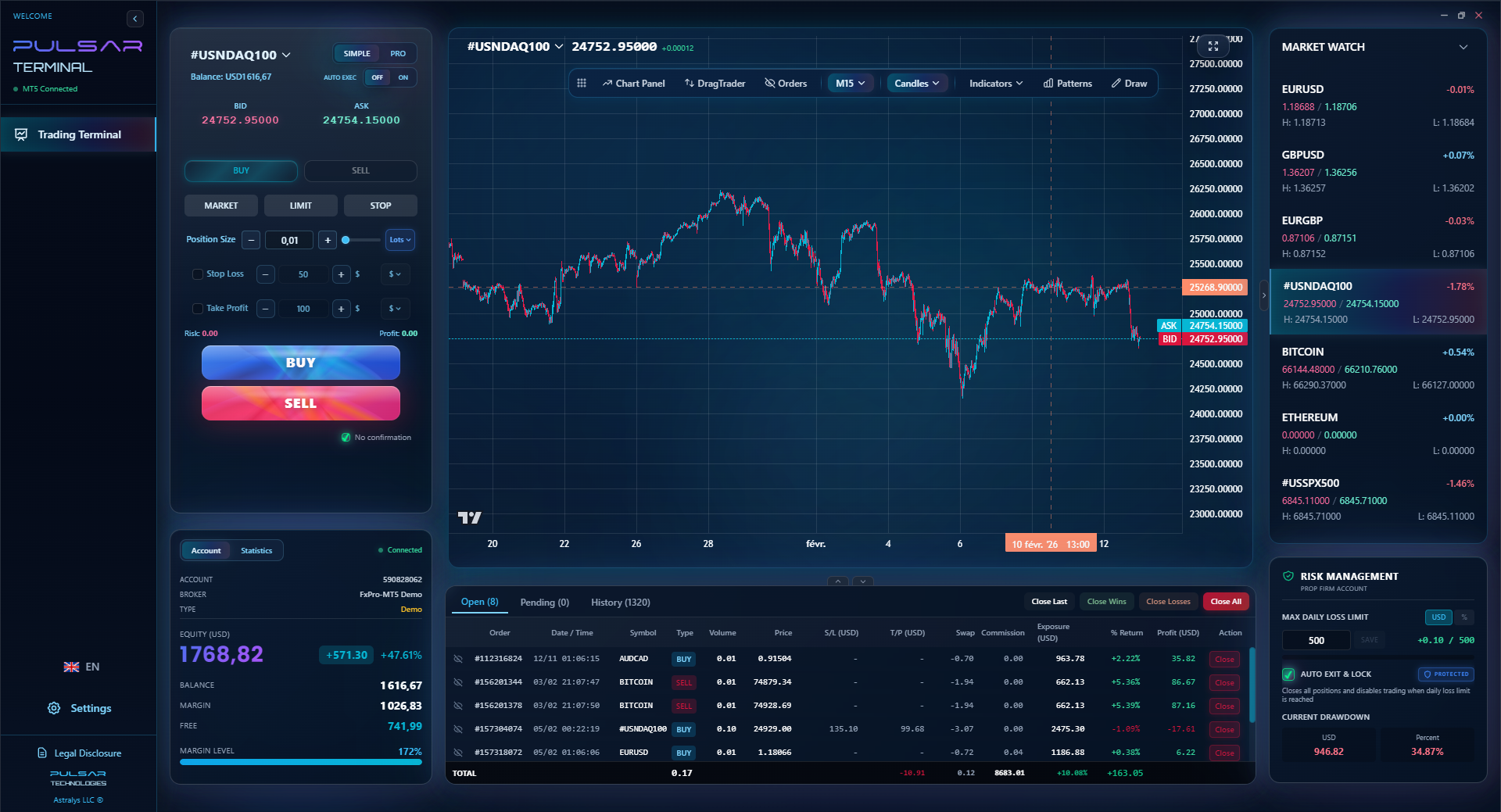
Here's my exact process. Skip a step at your own peril.
Step 1: Regulation First. Make a list of 5 brokers regulated by ASIC, FCA, CySEC, or MAS. Ignore any not on this list. Read their terms, specifically about client fund segregation.
Step 2: Cost Audit. For each broker, find their typical spread for EUR/USD and USD/INR (if offered). Do they charge commissions? What are their deposit/withdrawal methods and fees for India? Use a demo account to verify these costs live.
Step 3: Platform Test. Download their MT5 or proprietary app. On demo, do this:
- Place a trade. Is the order ticket intuitive? Can you easily set a stop-loss in rupees?
- During a mildly volatile period (London open), place a limit order and see how fast it fills.
- Try to withdraw ₹5,000 from the demo (just go through the process). See what hoops they make you jump through.
Step 4: Start Microscopically. Once you choose, fund the account with the minimum possible amount you can trade with. Not your life savings. Not ₹5 lakh. Maybe ₹10,000. Your goal for the first month is not to make money. It's to verify everything from Step 3 works perfectly with real money. Test the deposit, test a few trades, test a withdrawal. Only then consider adding more capital.
This process might take you two weeks. Good. If you're impatient about this, you'll be reckless with your trades. Trading is a marathon of careful decisions, starting with your broker choice.

“The app contributes about 10% to your success. The other 90% is your trading plan and your emotional control.”
I've made these mistakes so you don't have to.
Pitfall 1: Chasing the 'Zero Spread' Dream. Some brokers advertise 'zero spread' accounts. They make money on commissions instead. This can be cheaper for high-volume traders, but often it's not. A 'zero spread' with a $5 commission per lot might be more expensive than a 1-pip spread. Do the math every time.
Pitfall 2: Ignoring the Timezone. The forex market is most liquid during the London and New York overlaps. If you're only trading during Indian market hours (late night to early morning GMT), liquidity in major pairs can be thinner, and spreads can widen. Your fancy app won't save you from a wide spread. Adjust your trading hours or pairs accordingly.
Pitfall 3: Overloading the App. Just because your app has 50 technical indicators doesn't mean you should use them. I trade primarily with price action, a couple of moving averages, and the RSI indicator for divergence. More indicators lead to confusion and paralysis. A clean chart is a focused mind.
Pitfall 4: No Connection Plan. What happens if your internet goes out during a trade? Does your broker have a 24/5 phone desk where you can manually close positions? Find out. Have the number saved. I learned this after a monsoon storm took out my connection while I had an open EUR/USD trade. I was lucky it was in profit, but the panic was real. Now I have my broker's emergency number in my phone contacts.
The best forex trading apps India 2024 can provide are the ones that become invisible. They execute your plan flawlessly, show you clear data, and then get out of the way. Your focus should be on your strategy and your psychology, not on fighting your software.
💡 विंस्टन की सलाह
The 'best' app is the one you stop noticing. You should be thinking about the market, not the buttons.

So, what are the best forex trading apps India 2024 should consider? It's not a single answer. For the disciplined retail trader, MetaTrader 5 accessed through a reputable, globally-regulated broker is the most strong, proven foundation. It's the workhorse. Pair it with your broker's reliable proprietary mobile app for account management.
But here's the final, uncomfortable truth: the app contributes about 10% to your success. The other 90% is your trading plan, your risk management (using that position size calculator every single time), and your emotional control. I've seen traders make money on clunky, outdated platforms because they had a rule-based system. I've seen far more lose fortunes on the most advanced platforms because they had no discipline.
Your mission for 2024 shouldn't be to find the perfect app. It should be to build the perfect process. Choose a solid, regulated broker with a stable platform. Keep your costs low and predictable. Risk no more than 1% of your capital on any single trade. Backtest your strategy relentlessly. The app is just the pen. You have to write a coherent story with it.
Start with a demo, graduate to a tiny live account, and focus on consistency over jackpots. The market will be here tomorrow. Make sure your account is too.
FAQ
Q1Is forex trading legal in India?
Trading forex on margin with international brokers operates in a grey area. The RBI restricts trading to currency pairs like USD/INR on Indian exchanges (NSE, BSE). However, many Indian residents trade major pairs (EUR/USD, GBP/USD) with brokers regulated overseas (e.g., in Australia, Cyprus). This is not explicitly illegal but offers no protection from Indian regulators. You are solely reliant on the foreign broker's regulator. You must consult with a financial advisor for your specific situation.
Q2What is the minimum deposit for forex trading in India?
It varies by broker. Many international brokers allow you to open an account with as little as $50-$100 (approx. ₹4,000-₹8,000). However, I strongly advise against starting with the minimum. You need enough capital to trade sensible position sizes while risking only 1% per trade. A deposit of ₹25,000-₹50,000 is a more realistic starting point to properly implement risk management without being over-leveraged.
Q3Which is better for Indian traders, MT4 or MT5?
MT5 is objectively better and is the clear choice for 2024. It's the successor to MT4 with more timeframes, more technical indicators, an embedded economic calendar, and superior backtesting capabilities. While MT4 is still popular, it's legacy software. Any broker offering MT5 is a good sign they're keeping their technology updated. Start with MT5.
Q4How do I deposit money into a forex trading account from India?
Common methods include international bank wire transfers (slow, can have high fees), credit/debit cards (not always supported), and sometimes e-wallets like Neteller or Skrill. The best brokers for Indian traders will offer partnerships with local payment processors to allow deposits via UPI or direct local bank transfer, which is faster and cheaper. Always check the deposit/withdrawal page of your chosen broker first.
Q5Can I use trading robots (Expert Advisors) on my phone?
Technically, some broker apps allow you to activate/deactivate EAs running on a desktop platform from your phone. But you cannot reliably run a complex EA directly on a mobile app. Mobile operating systems are not designed for continuous, uninterrupted operation. EAs should be run on a dedicated desktop computer or a stable VPS (Virtual Private Server) for 24/5 operation. Using your phone for this is a great way to miss signals and lose money.
Q6What is the most important feature in a trading app?
Reliable and transparent order execution. Everything else is secondary. The app must show you the exact price you'll get, execute your orders (especially stop-losses) without major delays or slippage during normal volatility, and clearly display all costs before you confirm the trade. Fancy charts mean nothing if the app fails you when you need to exit a losing trade quickly.
प्रो. विंस्टन का पाठ
:
- ✓Regulation is your first and only line of defense.
- ✓Calculate your cost per trade in rupees before clicking buy.
- ✓Never use more than 20:1 use, regardless of what's offered.
- ✓Mobile is for management, not for analysis.
- ✓Test deposits and withdrawals before committing serious capital.
यह लेख कितना उपयोगी था?
रेट करने के लिए स्टार पर क्लिक करें
साप्ताहिक ट्रेडिंग विश्लेषण
मुफ़्त साप्ताहिक विश्लेषण और रणनीतियाँ। कोई स्पैम नहीं।
लेखक के बारे में
James Mitchell
वरिष्ठ ट्रेडिंग विश्लेषक
न्यूयॉर्क में स्थित, 9 साल से अधिक का ट्रेडिंग अनुभव। प्रमुख USD पेयर्स, प्रॉप फर्म चैलेंजेज और अमेरिकी नियामक परिदृश्य पर फोकस।
टिप्पणियाँ
आपको यह भी पसंद आ सकता है

Cara Trading Forex Sukses: 7 Prinsip dari Trader Profesional
Cara trading forex sukses dengan 7 prinsip trader pro: manajemen modal, disiplin, journal trading, backtest. Data nyata, bukan janji profit palsu.
Jam Trading Forex Terbaik untuk Trader Indonesia: Panduan Lengkap dengan Tabel Waktu
Panduan jam trading forex untuk trader Indonesia. Tabel 4 sesi dunia, jam emas 20:00-00:00, sesi mana yang harus dihindari. Data akurat + tips dari trader berpengalaman.
Top 5 Sàn Forex Uy Tín Nhất 2026: Review Jujur dari Trader Indonesia
Top 5 sàn forex uy tín 2026 untuk trader Indonesia. Review jujur: spread, deposit, withdraw, dukungan lokal. Exness, XM, IC Markets & lebih.
All these calculators are built into Pulsar Terminal with real-time data from your MT5 account. One-click position sizing, automatic risk management, and instant calculations.
