


I lost ₹8,500 in a single week trying to 'trade' digital gold on a popular payments app.

Rajesh Sharma
वरिष्ठ फॉरेक्स विश्लेषक ·  India
India
☕ 10 मिनट पढ़ने
आप क्या सीखेंगे:
- 1The Digital Gold Reality Check: It's Not What You Think
- 2The Hidden Costs That Eat Your Returns
- 3Platform Comparison: It's Not Just About the App
- 4Regulated Alternatives You Should Actually Consider
- 5Tax Implications: Made Painfully Clear
- 6The Final Verdict: Best App for *What*?
- 7Common Pitfalls Every Indian Gold Buyer Should Avoid
I lost ₹8,500 in a single week trying to 'trade' digital gold on a popular payments app. The interface was slick, the buy button was too easy, and I got crushed by a spread I didn't fully understand and a 3% GST hit I'd forgotten about. That experience taught me more about the 'best gold trading app in India' than any shiny ad ever could. It's not about the prettiest app; it's about understanding what you're actually buying, who's regulating it (hint: often, no one), and how the math really works against you. Let's break it down, warts and all.
When you tap 'Buy Gold' on Paytm or PhonePe, you're not trading a financial instrument. You're buying a tiny, non-physical claim on a gram of gold held in a vault by a company like MMTC-PAMP or SafeGold. This is a crucial distinction every Indian investor needs to get straight in their head.
SEBI, our market regulator, has been crystal clear. In late 2025, they put out a press release basically saying, 'This isn't our problem.' Digital gold products are not classified as securities or commodity derivatives. They are unregulated. You don't get SEBI's investor protection if something goes wrong with the custodian. Your safety net is the reputation of the platform and the gold refiner backing it. That's it.
Because of this, the big stock exchanges (NSE, BSE) told their brokers to stop selling it. SEBI also told registered investment advisors to steer clear. Their official stance? If you want regulated exposure to gold, look at Gold ETFs or Sovereign Gold Bonds.

Warning: The convenience of buying gold with your UPI PIN is a double-edged sword. It removes friction, which is great for saving, but terrible for impulsive 'trading.' You're not reacting to live charts; you're making a retail purchase with hefty embedded costs.
This is where my ₹8,500 lesson came from. The buy price you see is not the price you get if you sell immediately. The math is stacked against short-term moves.
The 3% GST Wall
Every single purchase gets hit with a 3% Goods and Services Tax. This isn't a fee; it's part of your purchase price. If you buy ₹10,000 of digital gold, ₹300 is GST. For you to just break even on a sale, the gold price needs to rise enough to cover that ₹300 plus the spread. It's a huge hurdle for anything but a long-term hold.
The Silent Killer: The Buy-Sell Spread
This is the difference between the platform's buying price and selling price. It's often 2% to 5%. Let's use a real example from when I got burned. I bought thinking the spot price was ₹6,200/gram. The app's buy price (including GST) was ~₹6,386. I bought, hoping for a quick pop.
The price moved up a bit, but when I went to sell, their sell price was ₹6,210. My 'trade' was up on the global spot price, but I was still selling at a loss against my all-in buy price. That spread, combined with the GST, wiped me out. I hadn't used a position size calculator because, frankly, I didn't think of this as a 'position' with a spread. Big mistake.

Example:
- Intended Purchase: 1 gram at ₹6,200 spot.
- Real Buy Price (with 3% GST): ₹6,386
- Platform's Sell Price (with a 3% spread): ₹6,210
- Instant Loss if Sold: ₹176 (2.8% loss before gold price even moves).
Storage and Delivery Fees
Many apps offer free storage for a few years (SafeGold gives 24 months, some offer 5 years). After that, they charge a small fee. Want physical delivery? That'll cost you minting charges (8-15% typically) and delivery fees. This makes digital gold a terrible vehicle for anyone who actually wants the metal in hand someday.

💡 विंस्टन की सलाह
If an investment product is advertised during a cricket match more than it's explained in a prospectus, your first question should be 'What's the total cost?' not 'How do I buy it?'
“Digital gold apps are not trading platforms. They are retail stores with a very high markup.”
Looking for the best gold trading app in India means looking past the UI. You need to check who's safeguarding the metal and what the real costs are. Here’s a breakdown of major players.
| Platform | Gold Partner/Custodian | Min. Investment | Key Fee/Condition Notes |
|---|---|---|---|
| Paytm | MMTC-PAMP, Augmont | ₹1 | 3% GST + spread. Classic example of ease over-riding cost awareness. |
| PhonePe | MMTC-PAMP, SafeGold | ₹1 | Similar structure. The integration makes it feel like 'just another payment.' |
| Google Pay | MMTC-PAMP | ₹1 | Straightforward, but same fundamental cost hurdles apply. |
| SafeGold | Self (Refiner/Custodian) | ₹10 | Free storage for 24 months. Often the backend for many other apps. |
| Groww | Augmont Gold | Varies | Also offers SEBI-regulated Gold ETFs, which is a smarter option on the same app. |
| 5Paisa | Partner Custodians | ₹50 | Marketed as an investment, but the same unregulated product. |
My take? The app experience is nearly identical across the board - simple, fast, and designed for accumulation. The real difference is the custodian (MMTC-PAMP is a government joint venture, which adds a layer of comfort for some) and the fine print on storage fees. For pure, set-and-forget fractional buying, it doesn't matter much. For anything resembling active trading, they're all equally bad due to the cost structure.

Pro Tip: If you're using these apps, use them for what they're good for: a digital piggy bank for gold. Set up a small, automatic SIP (like ₹500/week) and forget about it for 5+ years. Trying to scalp digital gold is a surefire way to donate money to the platform via GST and spreads.
If your goal is financial exposure to gold's price movement - not owning a fractional gram in a vault - then you have better, cheaper, and regulated options. SEBI pushes these for a reason.
Gold Exchange Traded Funds (ETFs): These are SEBI-regulated funds that trade on the stock exchange (like NSE). Each unit represents 1 gram of physical gold. You buy and sell them through your demat account just like a stock.
- Costs: The expense ratio is low (often 0.5-1% per year). There's no 3% GST on purchase. The bid-ask spread is usually just a few paisa, not percentages.
- Liquidity: You can buy or sell in real-time during market hours. The price tracks domestic gold prices almost perfectly.
- My Experience: I switched my long-term gold holding to a Gold ETF. For a ₹1 lakh investment, the GST saving alone versus digital gold was ₹3,000 in my pocket from day one.
Sovereign Gold Bonds (SGBs): Issued by the RBI, these are the crown jewel of gold investing in India. You get a fixed 2.5% annual interest on your investment amount, paid semi-annually. At maturity (8 years), you get the value equivalent to the gold price at that time, and the entire capital gain is tax-free.
- The Catch: They have an 8-year lock-in, though you can sell on the exchange after 5 years. They're perfect for a long-term, set-it-and-forget-it core holding.
Futures & Options on MCX: This is for active traders, not investors. You're trading contracts based on gold prices. It's leveraged, complex, and you can lose more than your deposit. I don't recommend this unless you're a seasoned trader who understands margin calls and futures pricing. The volatility can be brutal.
💡 विंस्टन की सलाह
Regulation isn't a barrier to profit; it's a shield against predation. In markets, you want every shield you can get.
“The 3% GST isn't a fee; it's the first brick in a wall your trade needs to climb over just to break even.”
The taxman treats digital gold as a physical asset, like a gold coin. This has major consequences, especially after recent reforms.
- Short-Term Capital Gains (STCG): Hold for 24 months or less? Any profit gets added to your total income and taxed at your slab rate. If you're in the 30% slab, that's a 30% hit on your gains.
- Long-Term Capital Gains (LTCG): Hold for more than 24 months? It's now a flat 12.5% tax on your absolute profit (Selling Price - Buying Price). The benefit of indexation (adjusting purchase price for inflation) is gone. This is a big change that makes long-term holding less tax-efficient than before.
Compare this to Gold ETFs, which follow the same tax rules, or SGBs, which have the tax-free advantage at maturity. The tax treatment is another reason why frequent trading in digital gold is a loser's game. You're facing a high cost to enter, a high cost to exit, and then giving up a chunk of any remaining profit to taxes.
For active traders using international brokers (which is a legal gray area for spot metals), the tax treatment is different and complex, often falling under 'Income from Business & Profession.' That's a whole other article, but it underscores why clarity is key. Know what you're getting into.
So, what's the best gold trading app in India? It depends entirely on your goal.
For a Digital Gold Piggy Bank: Use PhonePe, Paytm, or SafeGold. Pick one, set a tiny SIP, and ignore it for years. The app doesn't matter; the discipline does. Accept the 3% GST as the entry fee for insane convenience.
For Serious Long-Term Investment: Skip the 'best gold trading app' search altogether. Open a demat account with a discount broker and buy a Gold ETF. Better yet, wait for the next RBI tranche and buy Sovereign Gold Bonds. This is the smart money move for 90% of people.
For Active Trading (Price Speculation): You're in the wrong place. Digital gold apps are not trading platforms. If you want to trade gold prices, you're looking at the MCX for domestic futures (high risk) or, more commonly, international Forex brokers offering XAU/USD (gold vs. US dollar).
This is a different world. You'll need a broker like Exness, IC Markets, or Pepperstone that accepts Indian clients. You'll be trading with use, analyzing live charts with tools like the RSI or MACD, and managing risk on a pip and spread basis. The costs are lower (tight spreads, no GST), but the risks are magnitudes higher due to use. It's real trading, not disguised retail buying. I use tools for swing trading XAU/USD, and the mindset is completely different from tapping a 'Buy Gold' button.
💡 विंस्टन की सलाह
The most sophisticated tool in trading isn't an indicator. It's the clear classification of your own activity: are you saving, investing, or speculating? Use the wrong tool for the job and you'll break your financial knuckles.
If you graduate to trading XAU/USD with a broker, managing complex orders and risk on MT5 becomes critical, which is where a tool like Pulsar Terminal shines.
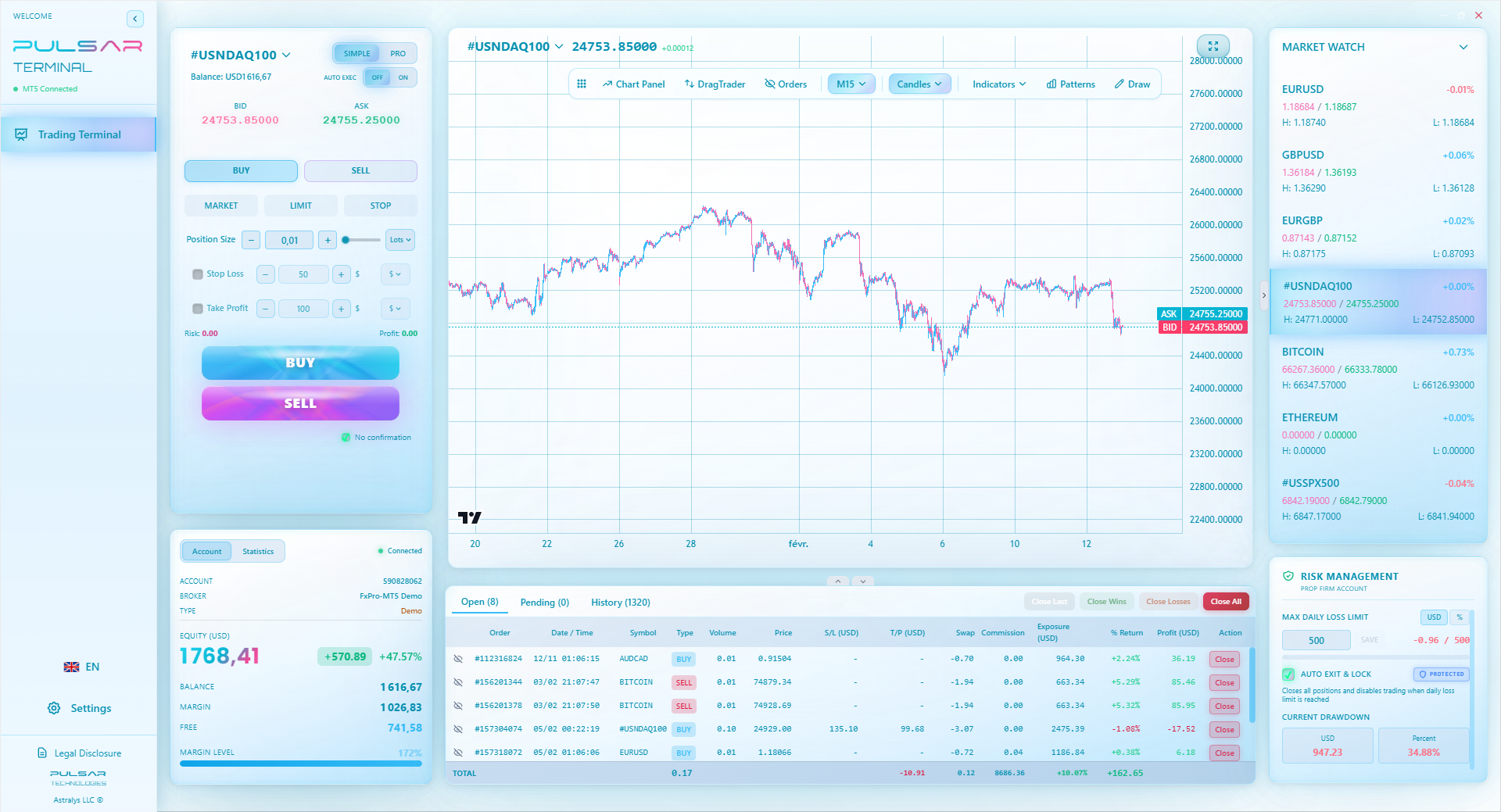
“In the search for the best gold trading app in India, the winner is often the one you don't need - a demat account for a Gold ETF.”
Let me save you some tuition fees (the kind I paid).
- Mistaking Convenience for Efficiency: The easiest app to use is often the most expensive one. Speed of transaction is not a benefit if the transaction itself is costly.
- Ignoring the Total Cost of Ownership: Always think: Buy Price + 3% GST + Sell Price Spread = Your Real Break-Even. It's a big number.
- Trading Without a Time Horizon: Buying digital gold without a minimum 5-year view is probably a waste. The costs overwhelm short-term price swings.
- Overlooking Regulated Options: Because digital gold is marketed so heavily, people forget about ETFs and SGBs. Do your homework. The regulated path is almost always safer and cheaper.
- Confusing Investment with Trading: This was my core mistake. I used an investment/savings product to try and make a quick trade. The product's design punished me for it. Be clear on your intent. If it's trading, use a trading platform and proper instruments.
Your goal should dictate your tool. Don't let a shiny app dictate your goal.
FAQ
Q1Is buying digital gold on Paytm safe?
It's 'safe' in the sense that your gold is held with reputable custodians like MMTC-PAMP. However, it's not 'safe' from a regulatory perspective - SEBI does not regulate these products, so you lack formal investor protection. Your safety relies on the platform and refiner's integrity.
Q2What is the difference between digital gold and Gold ETF?
Digital gold is a direct, fractional claim on physical gold in a vault, bought with high costs (GST, spread) and no regulation. A Gold ETF is a SEBI-regulated security that trades on the stock exchange, tracking gold prices with much lower costs (no GST, tiny spread) and full investor protection.
Q3Can I make quick profits by trading digital gold?
Almost impossible. The 3% GST on purchase and the 2-5% buy-sell spread create an immediate 5-8% hurdle. Gold prices rarely move that much quickly in your favor. Short-term trading in digital gold is a guaranteed way to lose money to fees.
Q4How is digital gold taxed in India?
It's taxed as a physical asset. Profits from sales within 24 months are added to your income and taxed at your slab rate. After 24 months, a flat 12.5% tax is applied to the absolute profit (selling price minus buying price), with no indexation benefit.
Q5What happens to my digital gold if the app shuts down?
Your gold is held by the custodian (e.g., MMTC-PAMP), not the app. Reputable platforms have processes to transfer holdings to another provider or arrange physical delivery. However, as an unregulated product, the process could be messy and is not guaranteed by any regulator.
Q6Should I choose digital gold or Sovereign Gold Bonds (SGBs)?
For any investment horizon over 3-5 years, Sovereign Gold Bonds are superior. They offer a 2.5% annual interest, tax-free gains at maturity (8 years), and are backed by the RBI. Digital gold has no interest and carries tax on all gains.
प्रो. विंस्टन का पाठ
:
- ✓Digital gold carries a 5-8% instant cost hurdle (GST + spread).
- ✓SEBI does not regulate digital gold products.
- ✓Gold ETFs have lower costs and full SEBI protection.
- ✓Sovereign Gold Bonds offer 2.5% interest plus tax-free gains.
यह लेख कितना उपयोगी था?
रेट करने के लिए स्टार पर क्लिक करें
साप्ताहिक ट्रेडिंग विश्लेषण
मुफ़्त साप्ताहिक विश्लेषण और रणनीतियाँ। कोई स्पैम नहीं।
लेखक के बारे में
Rajesh Sharma
वरिष्ठ फॉरेक्स विश्लेषक
भारतीय और दक्षिण एशियाई बाज़ारों में 10 साल से अधिक का ट्रेडिंग अनुभव। NSE करेंसी डेरिवेटिव्स से शुरुआत करके अंतरराष्ट्रीय फॉरेक्स में आए। USD/INR और इमर्जिंग मार्केट पेयर्स में विशेषज्ञता।
टिप्पणियाँ
आपको यह भी पसंद आ सकता है

Cara Trading Forex Sukses: 7 Prinsip dari Trader Profesional
Cara trading forex sukses dengan 7 prinsip trader pro: manajemen modal, disiplin, journal trading, backtest. Data nyata, bukan janji profit palsu.
Jam Trading Forex Terbaik untuk Trader Indonesia: Panduan Lengkap dengan Tabel Waktu
Panduan jam trading forex untuk trader Indonesia. Tabel 4 sesi dunia, jam emas 20:00-00:00, sesi mana yang harus dihindari. Data akurat + tips dari trader berpengalaman.
Top 5 Sàn Forex Uy Tín Nhất 2026: Review Jujur dari Trader Indonesia
Top 5 sàn forex uy tín 2026 untuk trader Indonesia. Review jujur: spread, deposit, withdraw, dukungan lokal. Exness, XM, IC Markets & lebih.
All these calculators are built into Pulsar Terminal with real-time data from your MT5 account. One-click position sizing, automatic risk management, and instant calculations.
