


Here's a number that should make you pause: the average daily forex trading volume in South Africa hit nearly $21.39 billion in 2025.

David van der Merwe
उभरते बाजार के ट्रेडर ·  South Africa
☕ 12 मिनट पढ़ने
आप क्या सीखेंगे:
Here's a number that should make you pause: the average daily forex trading volume in South Africa hit nearly $21.39 billion in 2025. That's a massive, liquid market. Yet, most new traders ask the wrong question. They want the 'best place to buy forex' like they're shopping for a new phone. It doesn't work that way. Your 'best place' is a combination of a legally sound broker, a cost structure that doesn't eat your profits, and a trading environment you can actually control. Let's cut through the marketing and find yours.
When you ask for the best place to buy forex, you're not just looking for a website to click 'buy.' You're looking for three things, whether you know it or not.
First, you need a safe harbour. Your money needs to be with an entity that won't disappear, that segregates client funds, and answers to a real regulator. In South Africa, that's the Financial Sector Conduct Authority (FSCA). Trading with an unlicensed offshore broker might seem exciting with their 1:1000 use, but it's a great way to fund someone else's yacht.
Second, you need a cost-efficient pipeline. Every pip of spread, every commission, every sneaky fee is a direct tax on your potential profit. If you're paying an average spread of 0.6 pips on the EUR/USD when you could be paying 0.24, you're starting every trade in a hole. I've seen traders blow accounts not on bad calls, but on death by a thousand fee-cuts.
Third, you need a functional cockpit. Can you execute your strategy easily? If you're a scalper, can you get in and out fast? If you use a scalping strategy, does the platform allow it, or does it freeze? Your broker's trading platform is your office. You wouldn't work in a shed with a broken chair.

Warning: Don't confuse 'best' with 'most advertised.' The broker with the slickest ads on your rugby stream is often the one with the widest spreads to pay for those ads. Your job is to look behind the curtain.
This is your bedrock. Trading with an FSCA-licensed broker isn't a suggestion; it's your first line of defence. Here’s what it practically means for you.
Client money protection. Regulated brokers must keep your trading capital in separate, ring-fenced bank accounts. It can't be used for the broker's office party. If the broker goes under (it happens), your money should, in theory, be safe from their creditors.
use limits. The FSCA caps use for retail clients at 1:30. I know, I know. You see those international brokers offering 1:500 and you feel like you're missing out. Let me be blunt: if you need 1:500 use to make money, you don't have a strategy, you have a gambling problem. Higher use just speeds up the margin call. 1:30 forces discipline. It's a feature, not a bug.
Legal recourse. If you have a legitimate dispute about withdrawals or platform manipulation, you have a local authority to complain to. Try getting the Seychelles Financial Services Authority on the phone from Johannesburg. It's not happening.
The SARB Allowance Reality
Your broker choice is also tied to the South African Reserve Bank (SARB) rules. You have a R1 million single discretionary allowance per year to move offshore. Need to fund an international broker? That's fine, but it comes out of this allowance. For amounts over R1 million up to R10 million, you need tax clearance from SARS. This is a headache. Using an FSCA-regulated broker that accepts ZAR deposits often simplifies this process massively. No international transfers, no waiting for clearance.
My advice? Start local and FSCA-regulated. Get your feet wet, learn the ropes, and prove you can be consistently profitable with 1:30 use. Then you can consider the complexities of moving larger sums offshore. I made the mistake of starting with a flashy offshore broker early on. The withdrawal process took three weeks and two angry emails. Never again.

💡 विंस्टन की सलाह
Your first R10,000 in the market is tuition, not investment. Expect to learn, not to earn. The broker that survives this learning phase with you is a contender.
“If you need 1:500 use to make money, you don't have a strategy, you have a gambling problem.”
Let's talk about the silent killer: trading costs. You can be right on the direction of the market and still lose money because your costs were too high. Here’s the breakdown you need to scrutinize.
Spreads: This is the difference between the buy and sell price. It's how many brokers make their money. On the EUR/USD, the benchmark pair, you should be looking for an average spread under 0.5 pips on a standard account. Some brokers offer 'raw' accounts with spreads from 0.0 pips, but they charge a commission. You need to do the math.
Commissions: Usually charged per lot (a standard lot is 100,000 units). It might be $3.50 per side ($7 round turn) or a similar figure. Here’s a quick comparison of the all-in cost for a 1-lot trade on EUR/USD:
| Broker Type | Avg. Spread | Commission | Total Cost (in pips)* |
|---|---|---|---|
| Standard Account | 0.8 pips | $0 | 0.8 pips |
| Raw/Razor Account | 0.1 pips | $7 | ~0.7 pips |
*Assuming 1 pip = ~$10 on EUR/USD. Sometimes the 'zero spread' account is actually more expensive!
Overnight Financing (Swap): If you hold a trade past 5pm New York time, you pay or receive a swap fee based on the interest rate differential. Holding a buy position on a currency with a lower interest rate than the one you're selling can get expensive fast. This is crucial for swing trading strategies.
The Hidden One: Currency Conversion. If your account is in ZAR but you're trading USD pairs, the broker converts your margin and P&L. They often add a 1% fee or use a poor exchange rate. This is a killer for South African traders. The solution? Use a broker that offers ZAR-denominated accounts, or fund a USD account directly if you have the allowance.

Example: I once traded gold (XAU/USD) on a platform with a sneaky high spread. I was in a trade for 5 days, made a 150-pip profit, which was about $150. The spread was 50 pips. By the time I entered and exited, I'd already paid $50 in spread. My 'profit' was instantly reduced by a third. I didn't read the fine print. My fault.
You've found an FSCA broker with tight spreads. Great. Now, can you actually trade on their system? This is where demo accounts are non-optional. You need to test two things: the platform itself and the order execution.
The Platform War: MT4/MT5 vs. Proprietary. Most serious traders I know, myself included, end up on MetaTrader 4 or 5. It's the industry standard for a reason. The charting is decent, you can automate strategies with Expert Advisors (EAs), and there's a massive library of custom indicators like the RSI indicator and MACD indicator. Some brokers like IC Markets or Pepperstone offer MT4/MT5 with excellent integration.
Some brokers have their own fancy platforms. They might look slick, but ask yourself: Can I draw a trendline easily? Can I set a stop-loss and take-profit order with one click? Is the market depth information useful? If you ever want to switch brokers, leaving behind a proprietary platform means relearning everything.
Execution Speed & Slippage. This is critical, especially for fast strategies. When you click 'buy,' does the order fill at the price you saw, or does it 'slip' a pip or two? Good brokers offer straight-through processing (STP) or true ECN execution, which matches your order directly with other participants in the market. This usually means faster fills and less chance of the broker trading against you.
I learned this the hard way during a high-volatility news event. I had a pending sell stop order on GBP/USD. The news hit, price spiked down. My order filled, but 8 pips below my intended price. That was R1,200 gone before the trade even started. The broker's excuse? 'Market volatility.' The reality? Poor execution infrastructure. Now I only use brokers known for reliable execution, like the ones in our Pepperstone review.
💡 विंस्टन की सलाह
If you can't explain your broker's entire fee structure on the back of a napkin, you haven't done your homework. Hidden fees are the termites of a trading account.
“Your first broker is rarely your last. The goal is to start somewhere safe and functional.”
I won't give you a 'top 5' list because your needs are unique. Instead, here's a framework to compare a few well-known options that cater to South Africans. Remember, this is a snapshot. You must verify current details on their websites.
The Local FSCA Heavyweight: Sasfin Forex / Standard Bank Forex
- The Good: As local banks, they are deeply regulated, offer ZAR accounts, and feel 'safe.' Ideal for larger, more conservative traders or businesses with real currency conversion needs.
- The Catch: Their platforms are often geared towards corporate clients, not agile retail traders. Spreads are typically much wider than dedicated forex brokers. It's for buying forex for import/export, not for active trading.
The International Broker with Local Presence: e.g., IG, FXCM (historical), Plus500
- The Good: They have FSCA licenses, offer decent platforms, and are globally recognized brands. Good educational resources.
- The Catch: Can be more expensive (wider spreads). Sometimes their product focus is more on CFDs across many assets, not pure forex.
The Specialized Forex/CFD Broker: e.g., Pepperstone, IC Markets (via global entity)
- The Good: These are often the choice for active traders. They offer tight spreads (Pepperstone's Razor account), excellent MT4/MT5 integration, and generally better execution. They may accept ZAR deposits even under their global license.
- The Catch: They might not hold a direct FSCA license, but operate under their ASIC (Australia) or CySEC (Cyprus) regulation. Your funds are still protected under those strong regimes, but your legal recourse is offshore. You must use your SARB allowance to fund them.
The Low-Cost Challenger: e.g., Fusion Markets
- The Good: some of the lowest commissions ($4.50 round turn) and raw spreads in the industry. Perfect for high-volume traders where every pip counts.
- The Catch: Less brand recognition, potentially lighter on educational tools. Again, funding is offshore.
The pattern? There's a trade-off. Maximum local safety and convenience often come with higher costs. Lower costs and better trading tools often require you to navigate offshore funding. Your 'best place' depends on which side of that trade-off you're comfortable with.
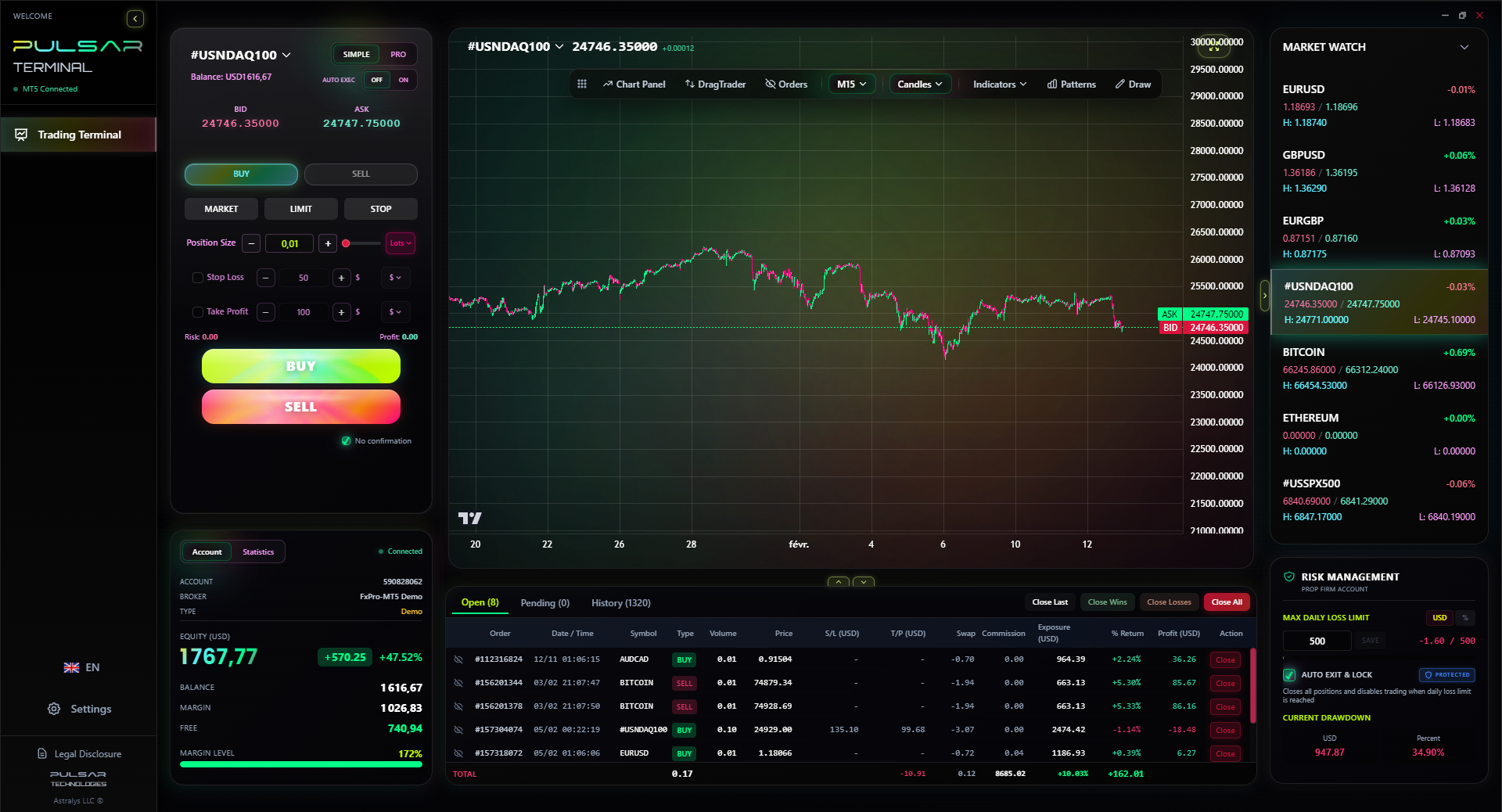
Once you've chosen a broker with MT5, managing complex strategies like multi-level take-profits or prop firm loss limits is where a tool like Pulsar Terminal transforms your efficiency.
Stop browsing 'top 10' lists. Follow this plan instead.
- Define Your Trader Profile. Are you a beginner doing a few trades a week? A high-volume scalper? A swing trader holding for days? Your activity level dictates how important spreads vs. platform stability are. Use our position size calculator to understand what lot size you should really be trading.
- Shortlist 3 Brokers. Pick one from different categories above: one pure FSCA local, one international with FSCA license, and one specialized low-cost broker (like IC Markets or Exness).
- Open Demo Accounts. Not for one hour. For two weeks. Trade your usual strategy on all three. Feel the execution. Test the spreads during London and New York opens. Try to withdraw 'virtual' money. Note the slippage.
- Crunch the Real Numbers. Take your average trade size and frequency. Estimate your monthly cost on each broker's pricing model (spread + commission + any conversion fees). The difference might shock you.
- Make a Safety Call. Based on your capital and risk tolerance, decide: is the absolute safety of a direct FSCA broker worth the potentially higher cost? Or are you comfortable with a top-tier offshore regulator like ASIC to get better trading conditions?
- Start Small. Once you choose, fund the account with the minimum amount you need to trade your strategy properly - no more. Prove to yourself that the deposit, trading, and withdrawal process all work smoothly with real money before committing more capital.

Pro Tip: Your first broker is rarely your last. As you evolve as a trader, your needs change. There's no shame in switching later. The goal is to start somewhere safe and functional, not to find a 'forever home' on your first try.
💡 विंस्टन की सलाह
The 'best' broker for a prop firm trader using a grid system is useless to a discretionary swing trader. Your strategy picks the tool, not the other way around.
“Thinking the broker is your partner is the biggest pitfall. They're a service provider, like your internet company.”
I've made these mistakes. My students have made them. You don't have to.
Chasing Bonuses. A broker offering a 100% deposit bonus is a giant red flag. That 'free money' always comes with impossible withdrawal conditions (like trading volume 100 times the bonus amount). It's a trap to keep you trading and losing. Reputable brokers like XM or others don't need these gimmicks.
Ignoring the spread definition on Exotics. You might get a tight 0.2 pip spread on EUR/USD, but then try to trade USD/ZAR or USD/TRY. The spread could be 50 pips or more. That's not a trade; that's a donation. Know the typical spread for the pairs you actually want to trade.
Not Understanding the Pip Definition for Your Pair. A pip on EUR/USD is $10 per standard lot. A pip on USD/ZAR is roughly R10, but its value fluctuates with the ZAR/USD rate. If you don't know this, you can't manage risk.
Overlooking Inactivity Fees. Life happens. If you need to take a month off, you shouldn't be penalized. Check the fee schedule. Some brokers charge $50 after 3 months of inactivity. That's your money, gone for nothing.
The biggest pitfall? Thinking the broker is your partner. They're not. They're a service provider, like your internet company. You pay for a connection to the market. Your job is to use that connection wisely. Don't blame them for your losses, and don't thank them for your wins. Stay detached and professional.
FAQ
Q1Is forex trading legal and safe in South Africa?
Yes, it's completely legal. Its safety depends almost entirely on you using an FSCA-licensed broker or one regulated by a top-tier international authority like ASIC (Australia) or the FCA (UK). Trading with unregulated 'bucket shops' is where the danger lies.
Q2Can I use international brokers like Pepperstone or IC Markets from South Africa?
Yes, absolutely. Many South African traders do because these brokers often offer superior trading conditions (tighter spreads, better platforms). The key difference is you'll be under their international entity (e.g., regulated by ASIC), not the FSCA. You'll need to use your SARB foreign allowance to fund the account in USD or EUR.
Q3What is the best trading platform for beginners?
MetaTrader 4 (MT4) is still the gold standard for starting out. It's ubiquitous, stable, and there's a mountain of free tutorials and indicators for it. Almost every broker offers it. Get comfortable with MT4 first before even considering anything else.
Q4How much money do I need to start trading forex in South Africa?
You can start with very little - some brokers allow accounts with $100 or even less. But here's the truth: with that amount, proper risk management (risking 1-2% per trade) means your position sizes will be tiny. You're mainly paying for education at that level. A more realistic starter amount to properly practice a strategy is R5,000 - R10,000.
Q5How are my forex trading profits taxed by SARS?
Forex trading profits are considered taxable income by SARS. You must declare your net profit (total profits minus total losses and allowable expenses) in your annual tax return. It's not a capital gain; it's revenue. Keep careful records of all your trades. I recommend consulting a tax professional who understands trading.
Q6What's more important: low spreads or a stable platform?
Stability, 100%. A platform that freezes or requotes you during a fast market will cost you far more than a slightly wider spread ever will. First, find a broker with a rock-solid platform and reliable execution. Then, from among those, choose the one with the most competitive costs.
प्रो. विंस्टन का पाठ
:
- ✓FSCA regulation is your safety net, not an optional extra.
- ✓Calculate your all-in cost per trade: spread + commission + conversion.
- ✓Test execution on a demo during volatile market hours.
- ✓Funding an offshore broker uses your SARB R1m allowance.
- ✓Platform stability trumps slightly lower spreads every time.
यह लेख कितना उपयोगी था?
रेट करने के लिए स्टार पर क्लिक करें
साप्ताहिक ट्रेडिंग विश्लेषण
मुफ़्त साप्ताहिक विश्लेषण और रणनीतियाँ। कोई स्पैम नहीं।
लेखक के बारे में
David van der Merwe
उभरते बाजार के ट्रेडर
जोहानसबर्ग स्थित ट्रेडर, इमर्जिंग मार्केट करेंसीज में 11 साल का अनुभव। ZAR पेयर्स, FSCA-विनियमित ट्रेडिंग और दक्षिण अफ्रीकी मार्केट एनालिसिस में विशेषज्ञ।
टिप्पणियाँ
आपको यह भी पसंद आ सकता है

Cara Trading Forex Sukses: 7 Prinsip dari Trader Profesional
Cara trading forex sukses dengan 7 prinsip trader pro: manajemen modal, disiplin, journal trading, backtest. Data nyata, bukan janji profit palsu.
Jam Trading Forex Terbaik untuk Trader Indonesia: Panduan Lengkap dengan Tabel Waktu
Panduan jam trading forex untuk trader Indonesia. Tabel 4 sesi dunia, jam emas 20:00-00:00, sesi mana yang harus dihindari. Data akurat + tips dari trader berpengalaman.
Top 5 Sàn Forex Uy Tín Nhất 2026: Review Jujur dari Trader Indonesia
Top 5 sàn forex uy tín 2026 untuk trader Indonesia. Review jujur: spread, deposit, withdraw, dukungan lokal. Exness, XM, IC Markets & lebih.
All these calculators are built into Pulsar Terminal with real-time data from your MT5 account. One-click position sizing, automatic risk management, and instant calculations.
