


Here's a statistic that should make you pause: in late 2025, the FSCA banned two individuals for 20 years and fined them over R2.1 million for running an unlicensed forex scheme.

David van der Merwe
उभरते बाजार के ट्रेडर ·  South Africa
☕ 10 मिनट पढ़ने
आप क्या सीखेंगे:
- 1The Legal Reality: Your 'Best Signal App' Could Be a Crime Scene
- 2What Actually Makes a Signal Service Good? (Spoiler: It's Not the Win Rate)
- 3How to Use Signals Without Losing Your Mind (And Your Money)
- 4Where to Trade: FSCA Brokers That Work With Signal Strategies
- 5The Endgame: Building Your Own Signal System
- 6The Final Verdict: Is There a 'Best' App?
Here's a statistic that should make you pause: in late 2025, the FSCA banned two individuals for 20 years and fined them over R2.1 million for running an unlicensed forex scheme. That's the new reality. The hunt for the 'best signal forex app' in South Africa isn't just about win rates anymore, it's a legal minefield. I've paid for subscriptions, followed signals blindly, and learned the hard way that most signal services are a fast track to a margin call. This guide isn't about listing apps, it's about teaching you how to survive the signal game with your capital and your sanity intact, all while staying on the right side of our regulators.
Let's get this out of the way first, because it changes everything. Before October 2024, the signal world was the wild west. Anyone with a Telegram channel could call themselves a guru. Not anymore.
The FSCA dropped a regulatory bomb. They officially declared that providing forex trading signals is a 'financial service' under the FAIS Act. Translation: if the app or person sending you buy/sell alerts doesn't hold a valid Financial Services Provider (FSP) license from the FSCA, they are breaking the law. You, the trader following them, are participating in an illegal financial service.
Think about that for a second. You're not just risking your deposit on a bad trade. You're potentially tying your funds to an entity the FSCA is actively hunting. That R1 million fine they handed out in late 2024? That was just the opening shot.

Warning: Downloading a signal app from an unlicensed international provider might seem harmless. But if that provider is actively marketing to South Africans (and they all are), they are contravening our laws. Your recourse if they vanish with your subscription fee? Effectively zero.
This forces a massive shift in perspective. The first filter for any 'best signal forex app' is no longer its claimed accuracy. It's this: Show me your FSCA FSP number. If they can't or won't, walk away. This immediately eliminates about 95% of the flashy apps you see advertised on social media. That's a good thing. It narrows the field to operators who have undergone some level of scrutiny, who segregate client funds, and who are accountable.
My own lesson here was expensive. Back in 2021, I subscribed to a UK-based signal service with incredible track records. They weren't licensed here, but I thought 'what's the harm?' The harm was that when their signals blew up my account during a volatile USD/ZAR swing, there was absolutely no one to complain to. The FSCA's jurisdiction ended at our border. I was just another statistic.

💡 विंस्टन की सलाह
A signal without a defined stop-loss is not a signal. It's a suggestion for disaster. Never act on it.
“The first filter for any 'best signal forex app' is no longer its claimed accuracy. It's this: Show me your FSCA FSP number.”
Everyone chases the holy grail: the 90% win rate. Let me be brutally honest - if a service prominently advertises a win rate above 70% without showing every single trade, including the losers, they are almost certainly lying or using a deceptive metric. I've been there, dazzled by the percentage.
A good signal service is defined by transparency and risk management, not magic numbers.
The Non-Negotiable Disclosure
A legitimate provider must tell you, for every signal:
- Entry Price: The exact price.
- Stop-Loss (SL): The exact price. No 'mental stops'.
- Take-Profit (TP): The exact price, or a clear strategy (e.g., 'close half at 20 pips, trail the rest').
- Position Size as a % of Capital: This is critical. A signal that says 'buy EUR/USD' is useless. A signal that says 'buy EUR/USD at 1.0850, SL 1.0820 (30 pips), TP 1.0910 (60 pips), risk 1% of your account' is professional. It shows they understand that managing your risk is your job, but providing the framework is theirs. I strongly recommend you cross-check their suggested size with a dedicated position size calculator.
The Cost Structure Red Flag
How they charge matters. Be very wary of:
- 'Percentage of Profits' Only: This incentivizes them to use insane use to generate a big win (and a big fee for them), even if it risks blowing your account. A subscription fee aligns interests better - they keep you as a paying client longer.
- Exorbitant Monthly Fees: R2,000+ per month is common for 'premium' groups. Ask yourself: if their signals are so profitable, why do they need 1,000 subscribers at R2k each? Shouldn't they just be trading their own capital?

Example: Let's say a signal has a 60% win rate, which is realistically good. They risk 1% to make 2% per trade (a 1:2 risk-reward). Over 100 trades, you'd have 60 wins (+120%) and 40 losses (-40%). Net profit: +80%. That's sustainable. A service promising 5% per week is selling fantasy.
The best signal service I ever used was also the most boring. They sent 2-3 signals a week, always with full details, and their weekly email was often titled 'No High-Probability Setups This Week'. That honesty saved me more money than their signals ever made.
“A signal that says 'buy EUR/USD' is useless. A signal that provides entry, stop, target, and risk percentage is professional.”
This is where most traders fail. They think buying signals is a passive income hack. It's not. It's outsourcing your analysis to a stranger. You are still 100% responsible for the execution and the risk. Here's my hard-won integration process.
Step 1: The Paper Trade Mandate. Do not, under any circumstances, fund a live account and start following signals immediately. You must paper trade for at least one month, but ideally three. Track every signal in a spreadsheet: entry, SL, TP, their suggested size, and the outcome. This does two things: it verifies their actual (not back-tested) performance, and it trains you in their rhythm. I skipped this step once, jumped into a live scalping strategy service, and lost R5,000 in two days because I couldn't execute the fast entries on my mobile app during load-shedding.
Step 2: The Broker Fit Check. Your broker must be compatible. If the signals are for major pairs like EUR/USD but your broker has huge spreads on them, you're starting at a loss. If they trade exotics like USD/ZAR, you need a broker with reliable liquidity and execution during our key hours (2-6 PM SAST). Regulated brokers like IC Markets or Pepperstone are popular here for good reason: tight spreads and stable platforms. Check if the signal app can integrate with your broker's platform (MT4/MT5) via copy-trading or alerts. If you're manually entering, the slippage will kill you.
Step 3: You Are the Risk Manager. The signal says 'risk 2%'. You look at your account, see a few losing trades in a row, and decide to risk 0.5% instead. That is your right and your duty. Never let a signal provider's generic risk percentage override your own assessment of your margin call proximity and emotional state. I have a personal rule: if I lose on three consecutive signals from a service, I pause for the week. It protects me from revenge trading on their dime.
💡 विंस्टन की सलाह
If you wouldn't risk your own money on the setup, why would you risk a client's? That's the mindset of a licensed pro versus a gambling guru.
“The true 'best signal forex app' is the one you build in your own head, backed by your own tested strategy.”
You need a broker that's not just FSCA-licensed, but also technically capable. Signal trading often requires fast execution, low latency, and specific platform features. Here’s a breakdown of local-friendly brokers that can handle it.
| Broker | Why It's Good for Signal Trading | Key Consideration |
|---|---|---|
| IC Markets | Raw spreads from 0.0 pips on majors, ultra-fast execution. Perfect for scalping or high-frequency signals. Their MT4/MT5 support is excellent. | Their raw spread account has a commission (e.g., $7 per lot). Ensure your signal strategy accounts for this cost. |
| Pepperstone | Consistently low spreads, great cTrader and MT5 platforms. Strong reliability during volatile news events. | Minimum deposit is typically $200. Their Razor account also uses a commission model. |
| XM Group | Low minimum deposit (from R700), good educational resources if you're using signals to learn. | Spreads on their commission-free accounts are slightly higher (e.g., 0.8 pips on EUR/USD). |
| Exness | Offers unique features like unlimited use (though you should never use the FSCA's 30:1 max) and tight spreads. | Their regulatory status and operational model can be complex; always ensure you're on their FSCA-regulated entity. |
| Khwezi Trade | A local South African broker. ZAR-based accounts, local support, understands our market quirks like load-shedding. | The platform and toolset might not be as advanced as the global giants, but for straightforward execution, it works. |
My personal workhorse for years has been a combination of IC Markets for its raw spreads and a local broker for ZAR deposits and withdrawals. This hybrid approach saves on bank fees. Remember, the spread definition isn't just jargon - it's the direct cost of every trade. A signal that targets 10 pips profit is destroyed by a 3-pip spread.
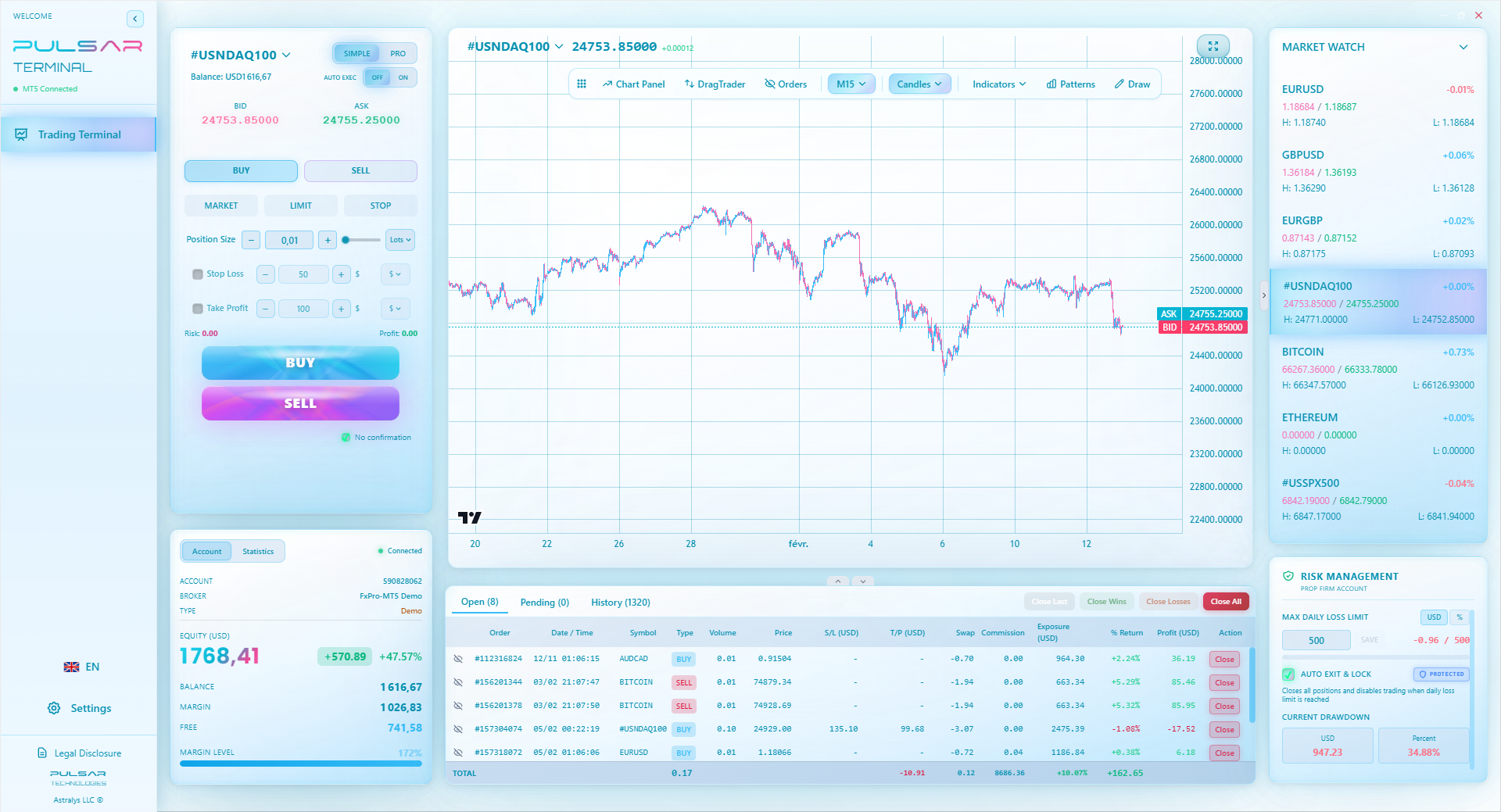
Manually managing multiple signal-based trades with different take-profit levels is a headache; Pulsar Terminal's multi-TP/SL with partial closure feature lets you set a complex profit-taking strategy on a signal trade with a single drag-and-drop order on your MT5 chart.
“The true 'best signal forex app' is the one you build in your own head, backed by your own tested strategy.”
Relying on signals forever is a crutch. The true 'best signal forex app' is the one you build in your own head, backed by your own tested strategy. Use paid signals as a training wheel, not the vehicle.
Start by reverse-engineering the signals you receive. Why did they take that trade? Pull up the chart. Was it a support bounce? A breakout from consolidation? A divergence on the RSI indicator or a crossover on the MACD indicator? Note it down.
I began this process with a swing trading service. I'd get a signal, then spend an hour marking up the chart myself. After six months, I noticed a pattern: 80% of their long entries came after a specific pullback to the 50-period EMA on the 4-hour chart, confirmed by a bullish candle close. That was my 'aha' moment. I wasn't just buying their signal anymore, I was confirming their logic with my own eyes.
This is where technology becomes your ally. Instead of just following alerts, use tools to scan for those conditions yourself. It turns you from a passive consumer into an active trader. The goal is to eventually look at a signal, understand its rationale instantly, and agree or disagree based on your own analysis. That's when you know you're graduating.

Pro Tip: Don't try to build a system from scratch while following signals. It's overwhelming. Pick ONE concept from the signals you see (e.g., 'trading bounces off daily support'). Focus only on learning to identify that one setup yourself across all pairs. Master that first.
💡 विंस्टन की सलाह
The most valuable signal you'll ever get is your own journal telling you to stop trading for the day. Learn to read it.
“Their success is measured by their subscriber count. Your success is measured by your equity curve. Those two things are not the same.”
So, after all this, what's the best signal forex app for a South African trader in 2026?
The honest answer is: there is no single 'best' app. There's only the 'most appropriate tool for your current level.'
For the absolute beginner: Your focus shouldn't be on signals at all. It should be on education and finding a solid, FSCA-regulated broker like XM or AvaTrade to practice on a demo account. Paying for signals now is like paying for driving lessons when you don't know what the brake pedal does.
For the intermediate trader (6-18 months experience): If you must use signals, use them as a learning supplement. Choose one licensed provider with full transparency. Paper trade first. Your goal is dissection, not blind profits. Allocate no more than 10% of your total trading capital to this 'signal learning fund'.
For the advanced trader: You should be weaning off external signals entirely. Your 'app' is your trading platform (MT5, TradingView) augmented with your own custom scripts, alerts, and a strong journal. You might subscribe to a single service for a different perspective, but you're using it to challenge your own bias, not to dictate your trades.
The landscape has permanently changed. The FSCA's crackdown has, ironically, done us a favour. It has forced a move away from shady Telegram gurus towards more professional, accountable entities. The barrier to entry is now a license, not just a YouTube channel. That means the signal providers that survive will, by necessity, have to be better. But never forget: their success is measured by their subscriber count. Your success is measured by your equity curve. Those two things are not the same. Protect your capital, verify the license, and always, always do your own homework.
FAQ
Q1Is it illegal to use an international forex signal app in South Africa?
It is not illegal for you, the trader, to use it. However, it is illegal for the international provider to offer that financial service (signals) to South African residents without an FSCA license. This means you have no regulatory protection if something goes wrong. The FSCA has fined and banned individuals for this. It's a significant risk.
Q2What is the maximum use I can use with a signal app in SA?
The FSCA limits use for retail traders to a maximum of 30:1, regardless of what a signal provider or an international broker might offer you. A responsible, licensed signal service will structure their position sizing suggestions within this legal limit. If a signal tells you to use 100:1 use, they are either ignorant of SA law or reckless.
Q3How much do the best forex signal apps cost?
Costs vary wildly. You can find basic Telegram groups for R500/month, while 'premium' services charge R2,000-R5,000/month. The price has almost no correlation to quality. Some of the worst services I've used were the most expensive. Focus on transparency and risk disclosure, not the monthly fee.
Q4Can I use copy-trading instead of a signal app?
Copy-trading (automatically replicating another trader's orders) is a form of signal service. The same FSCA licensing rule applies to the person being copied. Always check if the 'master trader' or the platform facilitating the copy-trading is licensed by the FSCA before connecting your account.
Q5What time of day are forex signals most active for South Africans?
The most volatile and liquid period is the London-New York session overlap, from about 2 PM to 6 PM South African Standard Time. Many signal providers focusing on majors like EUR/USD will be most active then. For USD/ZAR, liquidity is also strong during local business hours.
Q6Do any signal apps work with gold (XAU/USD) trading?
Yes, many signal providers include commodities. Gold (XAU/USD) is a popular instrument due to its volatility. Crucially, ensure your broker offers competitive spreads and reliable execution on gold, as it often has wider spreads than major forex pairs, which can impact the profitability of short-term signals.
Q7What's the single biggest mistake traders make with signal apps?
Abandoning their own risk management. They see a signal with a 50-pip stop-loss and think 'that's too big,' so they place a 20-pip stop instead. The trade hits their tighter stop, reverses, and then hits the signal's original target. They blame the signal, but the failure was their own deviation from the plan. You must follow the entire plan or not take the trade.
प्रो. विंस्टन का पाठ
:
- ✓FSCA license is non-negotiable for providers (post-Oct 2024).
- ✓Paper trade any service for 3 months minimum.
- ✓Risk management always overrides signal advice.
- ✓Use signals to learn, not just to copy.
- ✓The 30:1 use cap is your friend, not a limit.
यह लेख कितना उपयोगी था?
रेट करने के लिए स्टार पर क्लिक करें
साप्ताहिक ट्रेडिंग विश्लेषण
मुफ़्त साप्ताहिक विश्लेषण और रणनीतियाँ। कोई स्पैम नहीं।
लेखक के बारे में
David van der Merwe
उभरते बाजार के ट्रेडर
जोहानसबर्ग स्थित ट्रेडर, इमर्जिंग मार्केट करेंसीज में 11 साल का अनुभव। ZAR पेयर्स, FSCA-विनियमित ट्रेडिंग और दक्षिण अफ्रीकी मार्केट एनालिसिस में विशेषज्ञ।
टिप्पणियाँ
आपको यह भी पसंद आ सकता है

Cara Trading Forex Sukses: 7 Prinsip dari Trader Profesional
Cara trading forex sukses dengan 7 prinsip trader pro: manajemen modal, disiplin, journal trading, backtest. Data nyata, bukan janji profit palsu.
Jam Trading Forex Terbaik untuk Trader Indonesia: Panduan Lengkap dengan Tabel Waktu
Panduan jam trading forex untuk trader Indonesia. Tabel 4 sesi dunia, jam emas 20:00-00:00, sesi mana yang harus dihindari. Data akurat + tips dari trader berpengalaman.
Top 5 Sàn Forex Uy Tín Nhất 2026: Review Jujur dari Trader Indonesia
Top 5 sàn forex uy tín 2026 untuk trader Indonesia. Review jujur: spread, deposit, withdraw, dukungan lokal. Exness, XM, IC Markets & lebih.
All these calculators are built into Pulsar Terminal with real-time data from your MT5 account. One-click position sizing, automatic risk management, and instant calculations.
