


I was checking the ZAR/USD rate on a Monday morning in late 2024, getting ready to send a payment for some trading software from the States.

David van der Merwe
उभरते बाजार के ट्रेडर ·  South Africa
☕ 12 मिनट पढ़ने
आप क्या सीखेंगे:
- 1What Bidvest Bank Actually Does (And Doesn't Do)
- 2How Bidvest Forex Rates Really Work: The Cost Breakdown
- 3Bidvest vs. Forex Trading Brokers: A Brutally Honest Comparison
- 4Smart Strategies for Using Bidvest (When You Have To)
- 5The Regulatory Tightrope: SARB Rules You Can't Ignore
- 6When to Avoid Bidvest Completely (And What to Use Instead)
- 7The Future of Forex in SA: The Digital Shift
I was checking the ZAR/USD rate on a Monday morning in late 2024, getting ready to send a payment for some trading software from the States. My usual broker's platform showed 18.45. I called Bidvest Bank for a quote on the same R100,000 transfer. The rate they offered? 18.12. That 33-cent difference meant I'd be paying over R1,700 more for the same dollar amount. It wasn't a mistake; it was their business model. Most South Africans interact with Bidvest forex rates when they travel or send money overseas, but very few understand how they're set, why they cost more, and when you should - or shouldn't - use them. Let's clear that up.
First thing, let's kill a common misconception. Bidvest Bank is not a forex trading broker. You can't open a MetaTrader account with them, use up 1:500 on EUR/USD, and try to scalp the NFP news. If that's what you're looking for, you need a regulated broker like Pepperstone or IC Markets.
Bidvest is an authorized dealer. That's a fancy term for a financial institution licensed by the South African Reserve Bank (SARB) to legally buy and sell foreign currency for specific, approved purposes. Think of them as the official gatekeepers for your Rands leaving the country.
Their core services are built around real-world needs:
- Currency Exchange: Walking into a Bidvest branch at OR Tambo to get US dollars for your holiday.
- International Payments: Your business needs to pay a supplier in China R500,000 for imported parts.
- Travel Cards: Loading their Mastercard® World Currency Card™ with Euros before a trip to France.
- Forex Hedging: A company locking in a USD/ZAR rate for the next six months to protect against a weakening Rand.
Their entire operation exists within a tight regulatory box. The SARB gives you, a South African resident, specific allowances. You get a R1 million annual limit on your debit card abroad, a R2 million single discretionary allowance (no tax clearance needed), and a R10 million foreign investment allowance (which requires SARS tax clearance). Bidvest's job is to ensure every transaction they process fits neatly into one of these boxes. They're not facilitating speculation; they're facilitating compliance.

Warning: Trying to use Bidvest's services for speculative forex trading is a fast track to getting your transaction flagged and rejected. They ask for proof - invoices, flight tickets, university acceptance letters. No proof, no currency. That's the law.
“Bidvest's job is to ensure every transaction fits neatly into a SARB-approved box. They're not facilitating speculation; they're facilitating compliance.”
This is where traders need to pay attention, because the pricing mechanics are completely different from what you see on a trading platform.
On TradingView or MT5, you see a bid/ask spread on EUR/USD of maybe 0.6 pips (0.00006). That spread is the broker's primary fee for providing you with a liquid market. With Bidvest, the fee is baked into the exchange rate itself, and it's much, much larger.
Let's use that real example from my introduction.
The Wholesale Rate (Interbank): Let's say the true, mid-market rate for USD/ZAR was 18.30. This is the rate big banks trade at.
Bidvest's Retail Rate: They quoted me 18.12 to buy USD with my ZAR. That's a markup of 0.18 ZAR per dollar.
The Math on a R100,000 Transfer
- At the true rate (18.30): R100,000 / 18.30 = $5,464.48
- At Bidvest's rate (18.12): R100,000 / 18.12 = $5,518.76
- Difference: $54.28 less for me.
In Rand terms, to get that $5,464.48, I'd actually need to pay R100,000 * (18.30/18.12) = R100,993. That R993 is the effective cost.
That's nearly a 1% fee just from the rate adjustment. Then, on top of that, you often have fixed fees. A SWIFT payment can cost R250 to R700. There might be an admin fee. A correspondent bank on the other end might take another $15. Suddenly, that 1% effective cost is looking more like 1.5% or 2%.

Example: For a business making regular payments, Bidvest might offer a "fixed 12-month spread" based on volume. If you're moving R50 million a year, your effective spread might be 0.8%. If you're a small business moving R500,000, it might be 1.5%. You must negotiate. They won't advertise this; you have to ask.
The key takeaway? When you see a Bidvest forex rate, you are not seeing the market rate. You're seeing the market rate plus their profit margin and risk premium, all rolled into one number. Always, always check the mid-market rate on a independent site like XE.com first to see the true cost.

💡 विंस्टन की सलाह
A Bidvest forex rate is a price, not a market. They're selling you a packaged service, not providing a window into the interbank market. Trade accordingly.
“When you see a Bidvest forex rate, you are not seeing the market rate. You're seeing the market rate plus their profit margin and risk premium.”
I see this confusion all the time. A student will say, "The spread on my USD/ZAR trade is so low, why is sending money so expensive?" They're fundamentally different services for different purposes. Here’s the breakdown.
| Feature | Bidvest Bank (Authorized Dealer) | Forex Trading Broker (e.g., XM, Exness) |
|---|---|---|
| Primary Purpose | Currency exchange for travel, gifts, business payments. | Speculative trading on currency price movements for profit. |
| Regulatory Focus | SARB Exchange Control Regulations. Moving real money for real goods/services. | FSCA Conduct of Business rules. Protecting retail traders in a leveraged market. |
| Pricing Model | Large markup built into the exchange rate (e.g., 1-3% effective cost). + Fixed fees. | Tight bid/ask spread (e.g., 0.1-1.0 pips). + Possible commission. |
| use | None. You provide R100,000, you get ~$5,500. | High. You provide R100,000 margin, you might control a $50,000 position (1:5). |
| Currency Pairs | Major physical currencies (USD, EUR, GBP notes). | Hundreds of pairs, including minors and exotics (ZAR/JPY, USD/MXN). |
| Proof Required | Yes. Invoice, ticket, SARS documentation. | No. You can open and close trades at will. |
| Best For... | Getting cash for a holiday. Paying an overseas university. Business imports/exports. | Swing trading the Rand's momentum. Hedging a portfolio. Scalping major news events. |
Here's a personal mistake I made early on. I tried to "arbitrage" this. I thought, "The Bidvest rate to buy physical USD is terrible. I'll just sell USD/ZAR on my broker, take profit, and withdraw the USD." It failed spectacularly. Why? Because the USD I "made" on the broker was electronic, sitting in a segregated account with an entity in Cyprus. To get it to my South African bank account as usable Rands involved a whole other international withdrawal, more fees, and SARB paperwork. The two systems are largely separate. The broker's USD isn't the same as the physical USD you get from Bidvest.
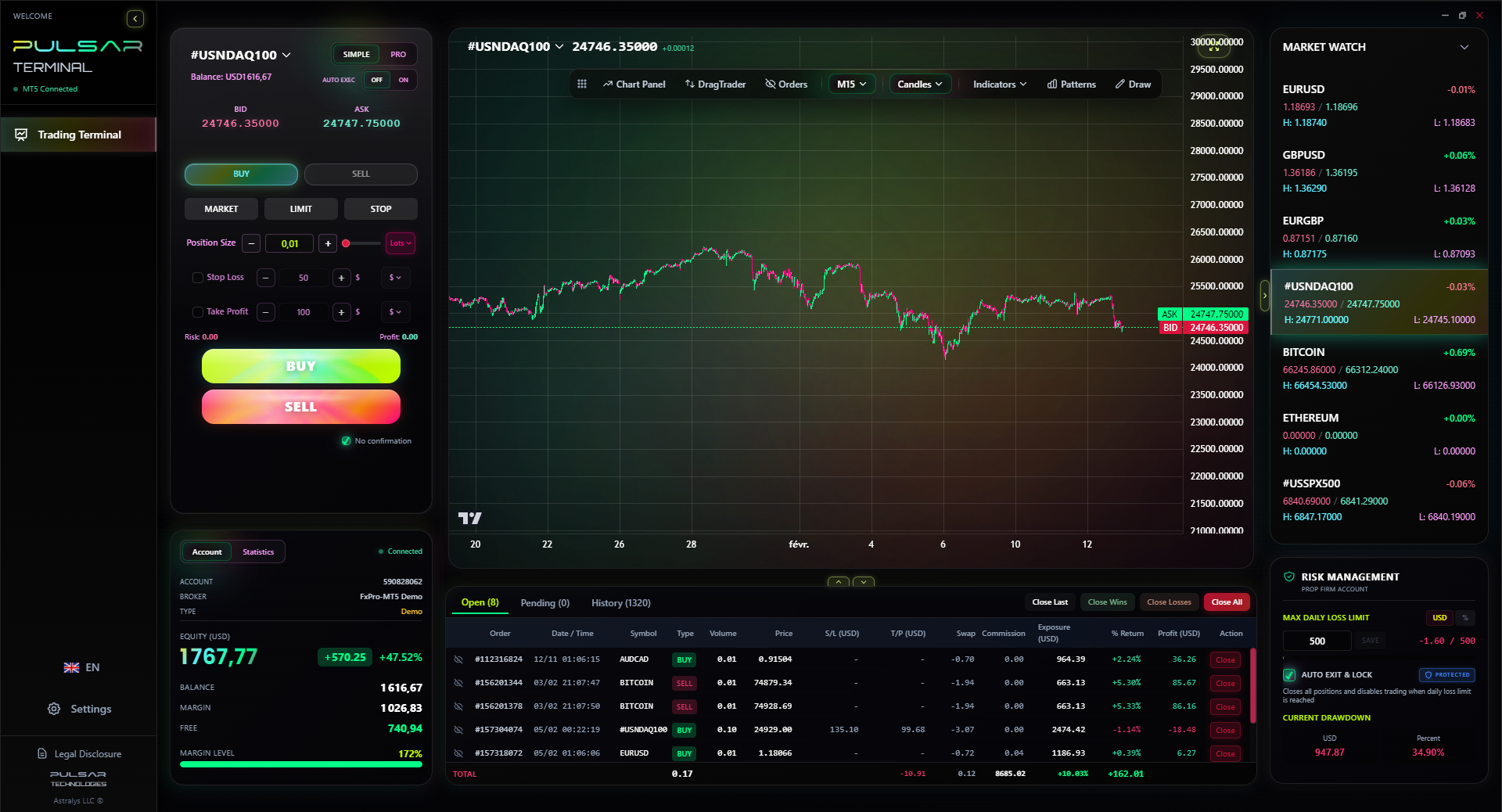
Managing complex trades and risk on MT5 is one thing, but managing the real-world currency conversion for profits is another—tools like Pulsar Terminal help automate the former so you can focus on the latter.
“When you see a Bidvest forex rate, you are not seeing the market rate. You're seeing the market rate plus their profit margin and risk premium.”
So, you need to use Bidvest. Maybe it's for a family member's medical bills overseas, or your kid's tuition. Here’s how to do it without getting ripped off.
For Large, Planned Payments (Tuition, Property)
Do NOT walk in on the day and accept the spot rate. That's for suckers. If you know you need $20,000 in six months for university fees, use a forward contract (a "hedge"). Bidvest offers these. You lock in today's agreed rate for a future date. Is the Rand at 18.00 and looking shaky? Lock it in. You sleep peacefully knowing your cost is fixed, even if the Rand crashes to 20.00 by payment time. The cost for this is built into the forward rate (it won't be the spot rate), but it's insurance.
For Travel: The Card vs. Cash Dilemma
The Mastercard® World Currency Card™ can be a good tool, but you must understand the mechanics. You load it at a fixed rate when you order. That's good if you think the Rand will weaken before your trip. But if the Rand strengthens, you overpaid. My rule? For trips to stable, card-friendly countries (EU, UK, USA), I use my local bank's credit card for big expenses and get a small amount of cash from a local ATM for incidentals. The dynamic currency conversion on the card is often better than Bidvest's pre-fixed cash rate. For the card, load maybe 30% of your budget as a hedge, not 100%.
The Negotiation Game
You have more power than you think, especially for business. If your company moves R5 million a year in forex, you are a valuable client. Call them. Don't just use the online portal. Say, "My current effective all-in cost is 1.8%. I need to get that down to 1.2% or I'm taking my volume elsewhere." They have room to move on the spread for volume clients. They won't volunteer a better rate; you have to demand it.

Pro Tip: Always, always get the final all-in cost in writing before confirming any large transaction. "All-in cost" means: How many Rands will leave my account, and how many foreign currency units will the recipient get, after ALL fees? That's the only number that matters.
💡 विंस्टन की सलाह
Your greatest use with any bank forex desk is your annual volume. If you move more than R1m a year, pick up the phone and negotiate the spread. Silence is expensive.
“The two systems are largely separate. The broker's USD isn't the same as the physical USD you get from Bidvest.”
Trading forex with a broker is one thing. Moving real money across borders is a minefield, and the rules just got tighter. In October 2025, the SARB dropped Exchange Control Circular 16/2025. This changes the game for anyone sending money overseas via Bidvest or any bank.
The big one: Tax Compliance for Non-Residents. Before, you could send money to your cousin in Australia for a gift. Now, Bidvest is legally required to check that your cousin is tax-compliant with SARS before sending the funds. They need a TCS-AIT PIN or a Manual Letter of Compliance. If your cousin hasn't filed SARS returns since leaving SA, that payment isn't going through.
This affects:
- Emigration: Getting your funds out via financial emigration.
- Gifts to family abroad.
- Investments in offshore accounts.
- Paying foreign service providers.
As a trader, this is critical if you ever plan to withdraw profits from an international broker to a foreign account. The broker sends the USD to your UK account. Your UK bank might ask, "Where did this come from?" You'll need to show it's from trading, and you may need to prove your SARS compliance to get it. This is why many South African traders just withdraw back to their local ZAR account - it's simpler, even with the conversion cost.
The R11 million annual allowance (R2m discretionary + R10m investment) still stands, but the paperwork hurdle is higher. The system is designed to trap capital and ensure tax is paid. Navigating this isn't about clever trading; it's about careful paperwork. Get a good forex consultant if your plans are complex.
“The two systems are largely separate. The broker's USD isn't the same as the physical USD you get from Bidvest.”
For certain things, Bidvest is the wrong tool, full stop.
1. For Funding Your Forex Trading Account: This is a classic error. Don't try to send ZAR from your FNB account to your IC Markets account via Bidvest as an "international payment." It will be rejected. Use the payment methods your broker provides for South Africans: Instant EFT via Ozow, Skrill, Neteller, or a direct bank transfer to the broker's local South African affiliate account (many have them). It's faster and 10x cheaper.
2. For Small, Frequent International Transfers: If you're a freelancer getting paid $1,000 a month from the US, Bidvest's fixed fees will kill you. Use a specialized international money transfer service like Wise (formerly TransferWise) or CurrencyFair. Their model is different: they give you a much closer-to-market rate and charge a low, transparent percentage fee. For that $1,000, you might save R300-R400 compared to a bank. I use Wise for all my sub-$5,000 professional payments now.
3. When You Need Speed and Certainty: The SWIFT network (which banks use) can be slow and opaque. Funds can get stuck with correspondent banks. If the payment is urgent, a service like Wise or even cryptocurrency (if both parties are savvy) can be faster, though crypto brings its own volatility risks.
4. For Speculative 'Forex Trading' on the Spot Rate: This bears repeating. If you think the Rand is going to strengthen and want to profit, you don't buy USD from Bidvest and hide it under your mattress. You go to your broker and sell USD/ZAR. If you're right, you profit in Rands in your trading account. The position size calculator is your friend here, not a Bidvest branch manager.
💡 विंस्टन की सलाह
SARB regulations aren't guidelines; they're tripwires. Assume every cross-border payment will be scrutinized. Have your paperwork filed before you need the money.
“The days of blindly trusting your bank's forex desk are over.”
The landscape is changing, and Bidvest knows it. The South African forex market is growing (projected to hit nearly USD 6.9 billion by 2033), and it's becoming digital. Electronic trading platforms and digital payment networks grew 45% in 2025 alone.
What does this mean for you?
For Trading: The shift towards platforms like MetaTrader 5 and algorithmic execution is making real trading cheaper and more accessible. Liquidity is better, spreads are tighter. The tools for serious analysis, like the MACD indicator or RSI, are built into these platforms. The gap between the retail trader and the professional is narrowing, technically.
For Currency Exchange: The Bidvest model of large built-in spreads is under pressure from fintech. Apps and online platforms that offer near-real-time rates with low fees are eating into the traditional bank business for personal and SME payments. Bidvest's long-term play is to lock in large corporate clients with hedging and volume deals, where their regulatory expertise and balance sheet matter.
The Big Unknown: The failed acquisition of Bidvest Bank by Nigeria's Access Bank in early 2026 shows the volatility. Big players see value in SA's financial infrastructure, but the regulatory and economic hurdles are real. For you, the trader or business owner, this means more options, but more complexity. You'll have more ways to move money, but you'll need to be even sharper in comparing the true, all-in cost. The days of blindly trusting your bank's forex desk are over.
The core principle remains: Know what service you're actually buying. Are you exchanging currency for a real purpose, or speculating on a price move? Your answer determines whether you should be looking at Bidvest forex rates or the bid/ask spread on your trading platform. Don't mix the two up, or it'll cost you.
FAQ
Q1Can I use Bidvest Bank for forex trading?
No, absolutely not. Bidvest is an authorized dealer for currency exchange and international payments under SARB regulations. They require proof (invoices, tickets) for every transaction. They do not offer leveraged speculative trading accounts on platforms like MT4/MT5. For that, you need an FSCA-regulated forex broker.
Q2Why are Bidvest's exchange rates worse than the market rate I see online?
The rate you see online (e.g., on Google or XE.com) is the mid-market, interbank rate. Bidvest's rate includes a significant markup (often 1-3%) which is their primary fee for the service, plus they add other fees like SWIFT charges. The quoted rate is the 'all-in' retail rate for physical/transferred currency, not a tradable spot rate.
Q3What's the difference between a Bidvest travel card and using my normal debit card abroad?
The Bidvest Mastercard® World Currency Card™ is pre-loaded with foreign currency at a fixed rate when you buy it. It's useful for budgeting. Your normal South African debit card will dynamically convert each transaction at your bank's rate of the day, which can sometimes be better or worse. The Bidvest card also can't be used in Namibia, Lesotho, or Eswatini. For most travellers, using a credit card with good travel benefits and getting a little local cash from ATMs is simpler.
Q4How much does it cost to send money overseas with Bidvest?
The cost has two parts: 1) The spread built into the exchange rate (the main cost), and 2) Fixed fees (R250-R700+ for SWIFT, possible admin fees). On a R100,000 payment, the total effective cost can easily be R1,500 to R3,000 (1.5%-3%). Always ask for the final 'all-in' cost in writing.
Q5What are the latest SARB rules affecting Bidvest payments?
As of October 2025 (Circular 16/2025), the biggest change is that for many payments to non-residents, the authorized dealer (Bidvest) must now verify the recipient is tax-compliant with SARS. This means providing a TCS-AIT PIN or compliance letter. This affects gifts, investments, and other transfers abroad, making the process more stringent.
Q6Is there a cheaper alternative to Bidvest for international payments?
Yes, for personal and SME payments, fintech services like Wise (TransferWise) or CurrencyFair are almost always cheaper. They use the mid-market rate and charge a low, transparent percentage fee (e.g., 0.5%-1%). For large, complex corporate transactions or hedging, a bank like Bidvest may still be necessary.
प्रो. विंस्टन का पाठ
:
- ✓Bidvest is for currency exchange, not trading. Confuse them at your peril.
- ✓Their 1-3% effective cost is built into the rate, not a separate fee.
- ✓Always negotiate the spread for business volumes over R1 million.
- ✓New 2025 SARB rules require tax compliance for non-resident recipients.
- ✓Use fintech (e.g., Wise) for cheaper personal & SME transfers.
यह लेख कितना उपयोगी था?
रेट करने के लिए स्टार पर क्लिक करें
साप्ताहिक ट्रेडिंग विश्लेषण
मुफ़्त साप्ताहिक विश्लेषण और रणनीतियाँ। कोई स्पैम नहीं।
लेखक के बारे में
David van der Merwe
उभरते बाजार के ट्रेडर
जोहानसबर्ग स्थित ट्रेडर, इमर्जिंग मार्केट करेंसीज में 11 साल का अनुभव। ZAR पेयर्स, FSCA-विनियमित ट्रेडिंग और दक्षिण अफ्रीकी मार्केट एनालिसिस में विशेषज्ञ।
टिप्पणियाँ
आपको यह भी पसंद आ सकता है

Cara Trading Forex Sukses: 7 Prinsip dari Trader Profesional
Cara trading forex sukses dengan 7 prinsip trader pro: manajemen modal, disiplin, journal trading, backtest. Data nyata, bukan janji profit palsu.
Jam Trading Forex Terbaik untuk Trader Indonesia: Panduan Lengkap dengan Tabel Waktu
Panduan jam trading forex untuk trader Indonesia. Tabel 4 sesi dunia, jam emas 20:00-00:00, sesi mana yang harus dihindari. Data akurat + tips dari trader berpengalaman.
Top 5 Sàn Forex Uy Tín Nhất 2026: Review Jujur dari Trader Indonesia
Top 5 sàn forex uy tín 2026 untuk trader Indonesia. Review jujur: spread, deposit, withdraw, dukungan lokal. Exness, XM, IC Markets & lebih.
All these calculators are built into Pulsar Terminal with real-time data from your MT5 account. One-click position sizing, automatic risk management, and instant calculations.
