


Most South African traders think being bullish means buying when a chart looks good.

David van der Merwe
उभरते बाजार के ट्रेडर ·  South Africa
☕ 9 मिनट पढ़ने
आप क्या सीखेंगे:
- 1What 'Bullish' Actually Means (It's Not What You Think)
- 2The Unique Beast: Bullish Dynamics on USD/ZAR & Other ZAR Pairs
- 3How to Spot a Fake Bullish Signal (The Trap Most Fall Into)
- 4How to Trade a Genuine Bullish Trend (Without Blowing Up)
- 5Bullish vs. Bearish: It's About Flow, Not Labels
- 6Local Pitfalls: South African Mistakes with Bullish Trades
Most South African traders think being bullish means buying when a chart looks good. That's the fastest way to lose your rands. The real bullish meaning in forex isn't about hope or green candles; it's about identifying a specific, high-probability market condition where the weight of evidence suggests sustained buying pressure. I'll show you how to separate real bullish setups from the fakeouts that drain accounts, using examples from USD/ZAR and the majors that actually work for our timezone.
In forex, 'bullish' describes a market state where buyers are in control and the price of one currency is expected to rise relative to another. It's not a feeling. It's not a guess. It's a measurable condition of market structure.
For a South African trader, this has a local twist. Being bullish on USD/ZAR means you expect the US dollar to strengthen against the rand. You're buying the pair. But here's the critical part: a few up candles don't make a trend. A real bullish structure shows higher highs and higher lows on a relevant time frame, with pullbacks that get bought aggressively.
I learned this the hard way in 2018. USD/ZAR had a strong run from 13.50 to 14.80. I saw a pullback to 14.20 and thought, 'Bullish trend, great discount.' I bought. It dropped to 13.90. I was 'bullish,' but the market structure had secretly broken. The prior low was 13.50, and my entry violated the sequence of higher lows. That trade cost me 3% of my account. The bullish meaning in forex had left the building, and I was just buying a hope.

Warning: Calling yourself 'bullish' because you want a trade to work is a psychological trap. The market doesn't care what you want. Your job is to identify if the market itself is demonstrating bullish behavior.
True bullish conditions are confirmed by more than just price. You need confluence. Is the pair making those higher highs on the daily chart? Is it holding above key moving averages that other traders watch? Is there a fundamental driver, like the SARB cutting rates while the Fed holds steady? Without this confluence, you're not trading a bullish trend. You're gambling on a bounce.

💡 विंस्टन की सलाह
A trend isn't what you draw on a chart. It's what the market is paying for. If your bullish trendline keeps getting broken on closes, the market is telling you it's not bullish anymore. Listen.
Trading a bullish view on ZAR pairs is a different animal compared to EUR/USD. The spreads are wider, the volatility can be insane, and local news hits harder.
Liquidity and Spreads
A 'bullish breakout' on USD/ZAR can be a fakeout fueled by a temporary liquidity gap. Where EUR/USD might have a 0.8 pip spread, USD/ZAR can sit at 8-12 pips normally, and blow out to 25+ pips during SA political news or SARB announcements. That means your 'bullish' trade is down 25 pips the second you enter. You need a much larger target to overcome that friction. Always check the live spread before clicking buy, not just the advertised 'from' figure. Our spread definition guide breaks down why this is a silent account killer.
Fundamental Drivers
For USD/ZAR, a bullish trend (Dollar up, Rand down) is often driven by a combination of US strength and SA weakness. Watch for:
- US Interest Rates: A hawkish Fed is rocket fuel for USD bulls.
- SA Risk Sentiment: Political instability, load-shedding warnings, or weak commodity prices can hammer the Rand.
- SARB vs. Fed Policy Divergence: This is the big one. If the Fed is hiking and SARB is paused, the interest rate differential narrows, making the Rand less attractive. This creates a sustained bullish trend for USD/ZAR.

Example: Let's say you're bullish USD/ZAR and use a position size calculator. Account: R20,000. Risk per trade: 1% (R200). Stop-loss distance: 50 pips. Pip value for USD/ZAR? Roughly R0.76 per pip on a standard lot (100k). To risk R200, you can only trade a position size where 50 pips * pip value = R200. That's a micro lot. Getting this math wrong is why traders blow up on volatile pairs.
Brokers like Exness and XM are popular here because they offer ZAR accounts and local deposits, but you still must manage the inherent volatility. A bullish trend can reverse on a single tweet from the finance minister.
“Calling yourself 'bullish' because you want a trade to work is a psychological trap. The market doesn't care what you want.”
This is where the money is saved. The market spends most of its time tricking you. Here are the classic fake bullish setups I see every week.
The News Spike Reversal: SARB holds rates, USD/ZAR spikes 100 pips 'bullishly.' Amateurs rush in. Then, over the next hour, it gives back every single pip and closes lower. The spike was stop-hunts and algos, not genuine buying. The real move was the slow fade down. I got caught in this in 2022. Bought the spike at 17.20, watched it hit 17.35, felt like a genius. It closed the day at 16.95. I was stopped out. The bullish candle was a lie.
The Overbought Breakout: The pair has rallied 7 days in a row. The RSI indicator is above 80. It punches to a 'new high.' You buy the breakout. It immediately fails. This isn't a bullish signal; it's exhaustion. The last buyers have just entered. In trending pairs like EUR/USD, this can work. In mean-reverting pairs or after a massive run, it's a trap.
The False Divergence: You see price make a lower low, but the MACD makes a higher low. 'Bullish divergence!' you shout. Sometimes it works. Often, in a strong bear trend, it just indicates a tiny pause before the next leg down. I've lost count of how many times I've bought a 'bullish divergence' on GBP/JPY only for it to slice through the level like butter. The MACD indicator is a tool, not a prophet.

Pro Tip: Wait for the retest. A true bullish breakout on the H4 or daily chart will often pull back to the breakout level (now support) and hold. If you buy the initial spike, you're buying uncertainty. If you buy the successful retest, you're buying confirmed strength. It requires patience, but it filters out most of the noise.
Okay, let's say you've identified a real one. Higher highs, higher lows, fundamental backing. Now what?
1. Entry: Stop Hunting the Hunters. Don't buy at the obvious spot. In an uptrend, the market often dips below the previous 'higher low' to run stops before resuming up. Place your buy order below that obvious support. You might not get filled, but if you do, you have a better price and the stop-hunt is now in your favor. This is a core tenet of my swing trading approach.
2. Position Size: This is Non-Negotiable. Your risk on a bullish trend trade should never exceed 1-2% of your account. Use a calculator. For volatile ZAR pairs, consider 0.5%. A R100,000 account risking 2% is R2000. If your stop is 70 pips away on USD/ZAR, your position size is brutally small. That's the game. Accept it or you'll be another statistic.
3. Manage the Trade, Don't Just Set and Forget.
- Scale Out: Take partial profits at logical targets (e.g., previous swing high). This locks in profit and reduces emotional stress.
- Trail Your Stop: As price moves in your favor, move your stop-loss up to protect profits. Don't let a winning trade turn into a loser.
- Know Your Exit: Before you enter, know where you'll exit if you're wrong (stop-loss) and where you'll take profit if you're right. Write it down.
Automating this management is a game-saver. Manually moving stops for 5 trades while watching the charts is stressful and error-prone.
💡 विंस्टन की सलाह
The most expensive word in a trader's vocabulary is 'should.' 'It should bounce here because it's bullish.' Price doesn't care. Trade what is, not what should be.
“Your job isn't to be right about direction. Your job is to identify what the market is *actually doing* right now.”
New traders get obsessed with the label. 'Am I bullish or bearish?' The professional thinks in terms of flow and evidence.
A market can be bullish on the weekly chart but bearish on the hourly. Which one are you trading? Your scalping strategy might be looking for bearish setups inside a larger bullish trend. That's fine, but you must be aware of the larger context, or you'll be fighting the tide.
The key is to avoid becoming married to your bias. I was stubbornly bullish on gold (XAU/USD) for months in 2023 because of macro factors. I ignored the clear breakdown in market structure on the daily chart. I kept buying dips that kept going lower. My 'bullish' bias cost me over 5% of my account before I finally stepped back. Review the XAU/USD guide to see how to analyze such an asset objectively.
Your job isn't to be right about direction. Your job is to identify what the market is actually doing right now and align your trades with that flow. If the evidence flips from bullish to bearish, you flip. Your ego has no place in the terminal.
This is where a clear, rules-based system beats a 'gut feeling' every time. It tells you when the bullish meaning in forex is present for a trade, and when it's not.
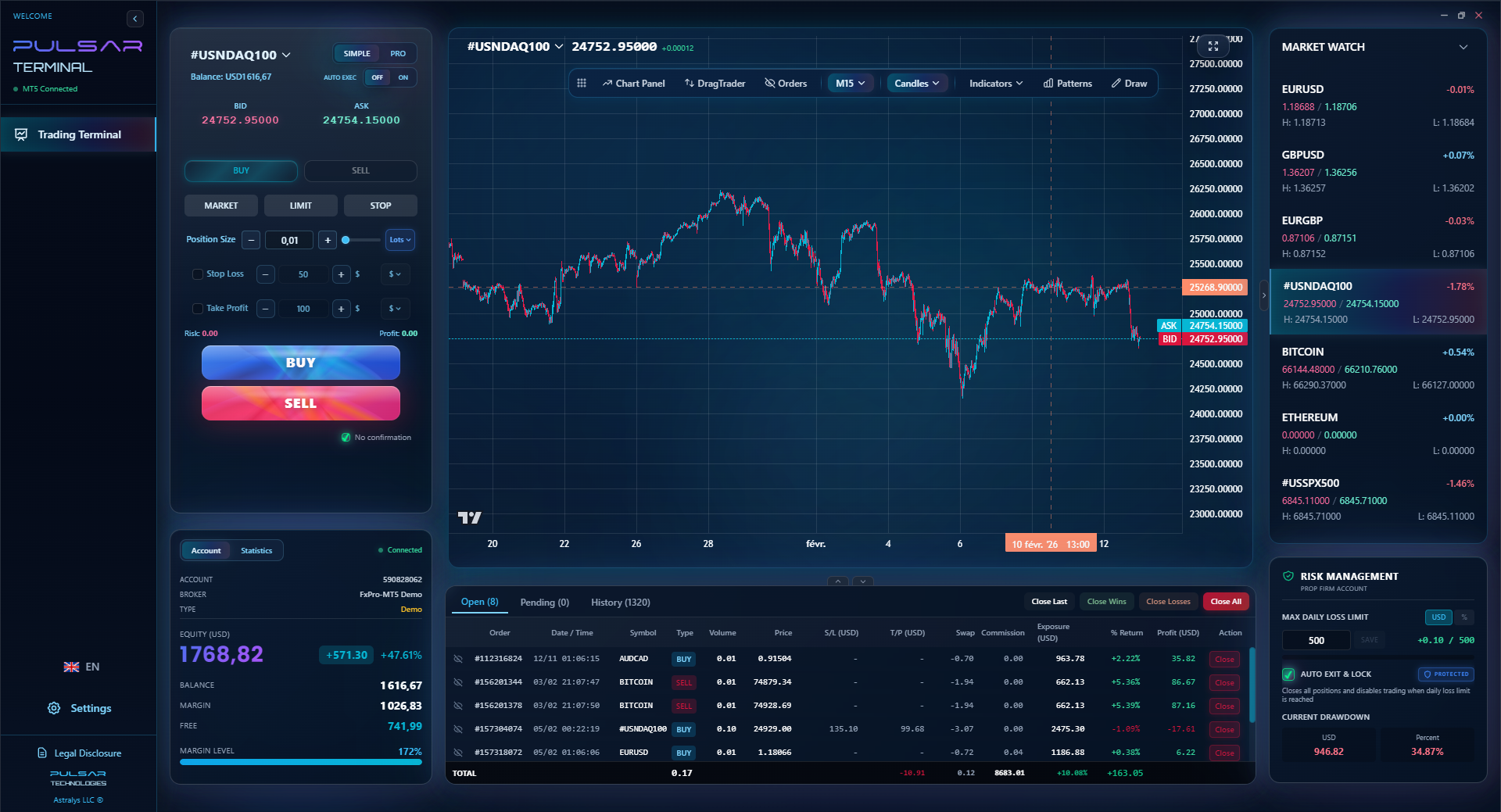
Managing multiple bullish trend trades with manual stops is chaotic; Pulsar Terminal lets you set and automate trailing stops and partial profit-taking across all positions directly from your MT5 charts.
We have unique challenges that can turn a good bullish idea into a loss.
1. Ignoring Load-Shedding & Internet Stability. Your brilliant bullish setup on EUR/USD is playing out. Then, stage 6 hits. Your internet dies. You have no stop-loss. You come back online to a margin call. Solution: Always use a stop-loss that's held on the broker's server, not just on your local chart. Brokers like IC Markets and Pepperstone are reliable in this regard. Consider a UPS for your router.
2. Trading Around SARB Announcements Like an Amateur. The SARB announces a 50bps hike. USD/ZAR drops instantly (Rand strengthens). 'It's a sale!' you think, and buy the dip. But the move was the initial drop. The statement is often more important. If the SARB sounds dovish about future hikes, the trend reverses and USD/ZAR rallies for hours. You bought the initial headline and got run over by the actual message. Wait 30 minutes after the announcement. Let the algos fight it out first.
3. Converting P&L to Rand in Your Head. You make a 50 pip profit on EUR/USD. 'Great, that's about R800!' you think. But if the Rand strengthened during your trade, your profit in Rands is less. Conversely, a loss can be magnified if the Rand weakens. It's mentally messy. Consider trading a ZAR-denominated account if this messes with your psychology, or just focus on the pip count and convert at month-end.
4. Chasing 'Tips' and Hotshots. The local forum guru is 'extremely bullish' on GBP/ZAR. He shows a screenshot of a winning trade. What he doesn't show are the 5 losing trades before it. You follow him into a trade you don't understand. You have no idea where his stop is. This is a recipe for disaster. Do your own analysis. The bullish meaning in forex for his account size and risk tolerance is completely different to yours.
FAQ
Q1What is a simple way to confirm a bullish trend in forex?
Look for a clear sequence of higher highs and higher lows on the daily or H4 chart. Then, check if the price is consistently trading above a key moving average like the 50-period or 200-period EMA. Finally, see if pullbacks are shallow and get bought quickly. All three? That's a strong bullish confirmation.
Q2Is being bullish on USD/ZAR good for South Africa?
Not necessarily. As a trader, your job isn't to be patriotic; it's to make profitable decisions. A bullish USD/ZAR (strong Dollar, weak Rand) can hurt the SA economy by making imports more expensive and fueling inflation. But it can benefit exporters. Your trade has no moral value. It's just a position based on price action.
Q3What's the biggest risk when trading a bullish view?
Becoming emotionally attached to that view. The market doesn't care that you're bullish. If price action breaks the structure (e.g., makes a lower low), your bullish thesis is invalid. The biggest risk is refusing to exit because you're 'still bullish.' This is how small losses become account-blowing ones.
Q4How do I know if a bullish trend is ending?
Watch for failure. The price fails to make a new high. Then, it breaks below the most recent significant higher low. This break of structure is the first major warning. If it's then followed by price breaking below a key rising trendline or moving average, the trend is likely over. Don't wait for all signals; the first break of structure is your cue to get defensive.
Q5Can I use the RSI or MACD to find bullish setups?
Yes, but only as a secondary tool. A common 'bullish' signal is the RSI moving above 50 from below, or a bullish crossover on the MACD. However, these are terrible in strong trends (RSI stays overbought for ages) and produce many false signals in ranging markets. Use them to support a bullish case built on price structure, not as your primary reason to enter. Learn more about the RSI indicator nuances.
Q6What's a good bullish pair for a beginner in South Africa?
Start with a major pair like EUR/USD or GBP/USD during the London or New York overlap. The spreads are tight, liquidity is huge, and charts are clean. Avoid USD/ZAR as a beginner. The wider spreads and volatile, news-driven moves will punish small errors. Master reading bullish structure on the majors first. Check our EUR/USD guide for a detailed walkthrough.
Q7How does swap/rollover interest affect a bullish trade?
If you're bullish on a pair where you're buying the currency with the higher interest rate, you might earn a small daily credit (positive swap). If you're buying the lower-yielding currency, you pay a debit. For long-term bullish positions, this can add up or eat into profits. Check your broker's swap rates before holding a trade for multiple days.
प्रो. विंस्टन का पाठ
:
- ✓Bullish means higher highs & lows, not a feeling.
- ✓USD/ZAR spreads demand larger profit targets.
- ✓Wait for the retest, not the initial breakout.
- ✓Risk never more than 1% on any bullish trade.
- ✓A broken market structure invalidates your bias.
यह लेख कितना उपयोगी था?
रेट करने के लिए स्टार पर क्लिक करें
साप्ताहिक ट्रेडिंग विश्लेषण
मुफ़्त साप्ताहिक विश्लेषण और रणनीतियाँ। कोई स्पैम नहीं।
लेखक के बारे में
David van der Merwe
उभरते बाजार के ट्रेडर
जोहानसबर्ग स्थित ट्रेडर, इमर्जिंग मार्केट करेंसीज में 11 साल का अनुभव। ZAR पेयर्स, FSCA-विनियमित ट्रेडिंग और दक्षिण अफ्रीकी मार्केट एनालिसिस में विशेषज्ञ।
टिप्पणियाँ
आपको यह भी पसंद आ सकता है

Cara Trading Forex Sukses: 7 Prinsip dari Trader Profesional
Cara trading forex sukses dengan 7 prinsip trader pro: manajemen modal, disiplin, journal trading, backtest. Data nyata, bukan janji profit palsu.
Jam Trading Forex Terbaik untuk Trader Indonesia: Panduan Lengkap dengan Tabel Waktu
Panduan jam trading forex untuk trader Indonesia. Tabel 4 sesi dunia, jam emas 20:00-00:00, sesi mana yang harus dihindari. Data akurat + tips dari trader berpengalaman.
Top 5 Sàn Forex Uy Tín Nhất 2026: Review Jujur dari Trader Indonesia
Top 5 sàn forex uy tín 2026 untuk trader Indonesia. Review jujur: spread, deposit, withdraw, dukungan lokal. Exness, XM, IC Markets & lebih.
All these calculators are built into Pulsar Terminal with real-time data from your MT5 account. One-click position sizing, automatic risk management, and instant calculations.
