


I remember staring at the EUR/USD chart on a Tuesday afternoon in 2019, the price hovering around 1.1250.

David van der Merwe
उभरते बाजार के ट्रेडर ·  South Africa
☕ 11 मिनट पढ़ने
आप क्या सीखेंगे:
- 1What Are Buy Limit and Sell Limit Orders? (The Simple Truth)
- 2When to Use Them: Real Scenarios for the SA Trader
- 3Setting the Orders: A Walkthrough with Real Numbers
- 4Mistakes I've Made (So You Don't Have To)
- 5Limit Orders & Your South African Broker: What You Need to Know
- 6Leveling Up: Combining Limit Orders with Other Tools
- 7The Real Benefit: Trading with Discipline and Patience
I remember staring at the EUR/USD chart on a Tuesday afternoon in 2019, the price hovering around 1.1250. My analysis screamed a pullback to 1.1220 was the perfect buy zone, but I had a client meeting. I set a buy limit order at 1.1222 and walked away. Two hours later, my phone buzzed with a trade notification. The order filled perfectly, and the pair rallied 80 pips without me lifting a finger. That was the moment I stopped chasing price and started letting it come to me. Using buy limit and sell limit orders in forex isn't just a technicality, it's a fundamental shift in how you interact with the market.
Let's cut through the jargon. A buy limit order is an instruction you give your broker to buy a currency pair at a specific price or lower. You use it when you believe the price will dip to a certain level and then bounce back up. It's a bargain-hunting tool.
A sell limit order is the opposite. It's an instruction to sell at a specific price or higher. You use this when you think the price will rally to a resistance level and then fall. It's for selling into strength.
The key phrase is "or better." If you set a buy limit at 1.1200, your order will be filled at 1.1200 if price touches it, or potentially at 1.1199 or 1.1198 if the market gaps through your level. Same for a sell limit at 1.1300, it could fill at 1.1301. This is different from a simple stop order, which triggers a market order after price passes a level.

Warning: A common rookie mistake is confusing a Buy Limit (buy low) with a Buy Stop (buy high to catch a breakout). Mixing these up can lead to catastrophic entries. Always double-check your order type before submitting.
Why does this matter for us in South Africa? Because our market hours overlap with massive volatility. The London-New York overlap (3-6 PM SAST) can see prices spike and drop violently. Being able to pre-set your entry means you don't have to be glued to the screen during dinner or while dealing with loadshedding schedules. It brings discipline and removes emotion.

💡 विंस्टन की सलाह
A limit order is a patient fisherman's net, not a hunter's spear. Set it where the fish are, not where you're running.
Catching Pullbacks in a Trend
This is my bread and butter. Let's say USD/ZAR is in a strong uptrend on the daily chart. It's been rallying, but the RSI indicator is showing overbought conditions on the 4-hour chart. Instead of buying at the high and hoping, I identify a key support level or a Fibonacci retracement level (say, the 50% retrace at R18.50). I'll place a buy limit order there. My logic: if the trend is still valid, price should respect that level and bounce. If it blows straight through, my analysis was wrong, and I'm stopped out with a small loss.
I did this with GBP/USD in early 2023. The pair was trending down from 1.2450. I identified a resistance zone at 1.2150 where previous support had turned into resistance. I placed a sell limit order at 1.2145. Price rallied, kissed 1.2148, filled my order, and then tanked 150 pips. I was at my kid's soccer game the whole time.
Fading Extreme Moves
During major news events, price can overshoot. Say the SARB announces a rate hike and ZAR pairs spike irrationally. A sell limit order placed at a historically extreme level can be a great way to fade that move, assuming you have the stomach for the risk. This is more advanced and suits a swing trading approach.
Trading Around Your Schedule
This is the unsung hero for South Africans. Most of us aren't full-time traders. You might work a 9-5. The most volatile, profitable moves often happen when you're busy. Setting limit orders based on your pre-market analysis lets you participate without being physically present. It aligns perfectly with the 24-hour forex market, especially during the London session which starts at 10 AM SAST.

Pro Tip: Never set a limit order based on a round number alone (like 1.1200 exactly). Markets love to hunt for liquidity around these numbers. Place your buy limit a few pips below (1.1195) or your sell limit a few pips above (1.1205). It often gets you a slightly better fill and avoids the common stop-hunting traps.
“Using buy limit and sell limit orders in forex isn't just a technicality, it's a fundamental shift in how you interact with the market.”
Let's get practical. I'll use a scenario with a broker like IC Markets or Pepperstone, both popular here for their tight spreads.
Scenario: You're trading EUR/USD. Current market price is 1.0850. Your analysis shows strong support at 1.0820. You want to buy a dip.
- Open the Order Window: On MT4/MT5, right-click the chart or use the "New Order" button.
- Select Symbol: EUR/USD.
- Set Volume: This is your position size. Let's say you have a R20,000 account and are risking 1% (R200). If your stop loss is 25 pips below your entry at 1.0795, then each pip movement is worth R8 (R200 / 25 pips). On EUR/USD, a standard lot pip is about $10 (roughly R180). So, you'd trade roughly 0.04 lots. Always use a position size calculator.
- Order Type: Select Buy Limit.
- At Price: Enter 1.0820.
- Stop Loss: Enter 1.0795 (25 pips risk).
- Take Profit: Set your target, say 1.0880 (60 pips reward).
- Comment: I always add a note like "BL - S/R Flip" to remember my reasoning later.
- Click "Place".
The order now appears on your chart as a horizontal line at 1.0820. If price falls to that level, your trade will execute automatically with the attached stop loss and take profit.
For a Sell Limit: The process is identical, but you select "Sell Limit" and set the price above the current market price. For example, if EUR/USD is at 1.0850 and you see resistance at 1.0880, you'd place a Sell Limit at 1.0880.

Example: I once got too clever with Gold (XAU/USD). Price was at $1840. I set a buy limit at $1830 and a sell limit at $1850, trying to catch a range break in either direction. The market chopped around, hit $1830, triggered my buy, then immediately reversed and hit $1850, triggering my sell. I was instantly long and short in the same market, locking in a guaranteed loss on the spread. Lesson learned: Don't set opposing limit orders without a clear, singular bias. Pick a direction.
We learn more from our losses. Here are my costly lessons with limit orders.
1. Placing Orders Too Close to the Market: Early on, I'd see a small 5-pip dip and slap a buy limit order in, thinking I was being smart. All I did was catch a falling knife. The real move was another 30 pips down. My order would fill, hit stop loss, and then the real rally would begin. Now, I only place limit orders at significant technical levels confirmed on higher timeframes.
2. Ignoring the News Calendar: This one hurt. I had a beautiful sell limit order set on USD/JPY at a key resistance level for a 50-pip profit. I forgot the US Non-Farm Payrolls report was due. News hit, price gapped through my level, filled my order, and kept racing another 80 pips against me before my stop loss could even trigger at the next available price. I lost double what I planned. Always check the economic calendar. If major news is due, either don't place the order, or use a wider stop loss understanding the risk of a gap.
3. Setting and Forgetting (The Bad Way): You place an order based on Monday's analysis. By Thursday, the market structure has completely changed, but your orphaned order is still sitting there. Price touches it, you get filled into a now-terrible trade. You must review your pending orders daily. Cancel them if your original thesis is invalid.
4. Overcomplicating with Too Many Orders: In my scalping strategy phase, I'd have a grid of 5-6 limit orders on a 15-minute chart, trying to scalp micro-moves. All it did was generate a mountain of commission for my broker and tie up my margin. Keep it simple. One, maybe two, well-planned limit orders per pair is plenty.
These mistakes often stem from not having a clear plan. A limit order is a tool for executing a plan, not a plan itself.
💡 विंस्टन की सलाह
If you find yourself constantly moving your limit order closer to the market, you're not trading a plan, you're chasing a feeling. Cancel the order and walk away.
“A missed trade is not a loss. A bad trade is.”
Not all brokers handle orders the same way. Here’s the lowdown for trading from SA.
Regulation & Safety: Always use an FSCA-regulated broker like those mentioned, or a reputable international one with a strong track record. This ensures your orders are executed fairly and your funds are segregated. I've traded with Exness and XM in the past, and order execution was reliable.
Execution Quality: On major pairs like EUR/USD, most good brokers will fill your limit order at or very near your specified price. However, on less liquid pairs or during high volatility (like SARB announcements on ZAR pairs), you might experience slippage. This is when your order fills at a worse price than you set. A buy limit might fill higher, a sell limit lower. It's a market reality.
Fees: Understand your cost structure. On a raw spread account (like IC Markets'), you pay a commission per lot. Your limit order will incur this commission when it fills. On a spread-only account (like many standard accounts), the cost is baked into the spread. There's no extra fee for placing the pending order itself.
Platforms: MT4 and MT5 are universally excellent for setting these orders. They're stable and the order dialogue is straightforward. Some brokers' proprietary platforms can be clunkier. Stick with what you know.
A Local Quirk – ZAR Accounts: If you fund a ZAR-denominated account, remember that your profit/loss will still be in the currency of the pair (e.g., USD for EUR/USD). Your broker converts it at their rate when crediting your account. This adds a small layer of exchange rate risk. Sometimes it's better to have a USD account and just eat the forex fee on your EFT deposit from your South African bank.
Once you're comfortable with the basics, you can integrate limit orders into more sophisticated strategies.
With Price Action Confirmation: Don't just set a buy limit at a support line. Wait for price to approach that level and look for a bullish pin bar or an engulfing candle on the 1-hour or 4-hour chart. You can then adjust your limit order to the low of that candle for a better entry. This requires more screen time but improves accuracy.
Using the MACD indicator for Confluence: Let's say you have a buy limit at a trendline. Check the MACD on the daily chart. Is it showing bullish divergence (price making a lower low, MACD making a higher low)? If yes, your limit order has stronger confirmation. I used this combo on XAU/USD last year for a 120-pip win.
Partial Entries and Scaling: Instead of one big buy limit order, place two smaller ones. First at a stronger support (S1), second at a deeper support (S2) if the market really sells off. This averages your entry price down if you're early. This is a form of grid trading, but it requires careful risk management so your total exposure doesn't blow up.
Trailing Stop Losses After Entry: This is where tools like Pulsar Terminal shine. Your buy limit fills, the trade goes into profit. Instead of a static take profit, you can activate a trailing stop loss that automatically follows the price up, locking in profits if the trend reverses. Doing this manually is stressful; automation removes the emotion.
Remember, these are advanced concepts. Master the basic, disciplined use of a single buy limit or sell limit order first. Fancy tactics won't save a bad strategy.
💡 विंस्टन की सलाह
The most powerful limit order is the one you have the discipline to cancel when the chart tells you your original idea is dead.
Managing multiple limit orders and their associated stops and targets is complex, but tools like Pulsar Terminal allow you to drag-and-drop entire trade plans with multiple take-profit levels directly onto your MT5 chart.
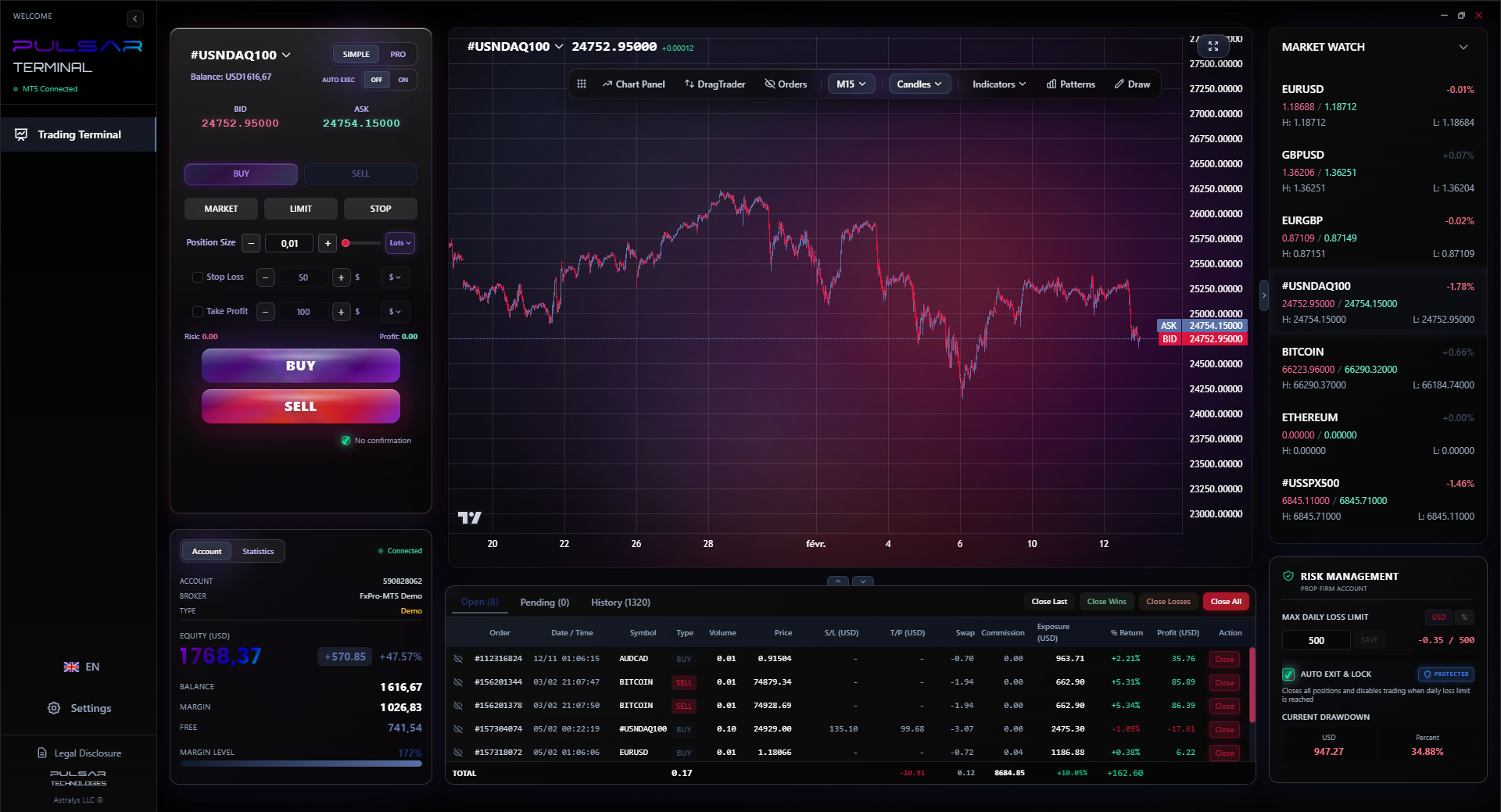
“You're not chasing price anymore. You're inviting it to a party at your price, on your terms.”
After 12 years, the biggest edge buy limit and sell limit orders gave me wasn't technical, it was psychological.
They enforce patience. Instead of FOMO-buying a breakout that's already run 40 pips, you're forced to identify a level and wait. The market might never come to you. And that's okay. A missed trade is not a loss. A bad trade is.
They remove emotional execution. That shaky feeling when you click the buy button at a market top? Gone. The decision is made in the cold light of your analysis, not in the heat of a moving chart.
For the South African trader, they grant freedom. You can do your analysis before work, set your orders, and live your life. You're not a slave to the London open. You're using the market's 24-hour nature to your advantage.
Start small. Take your next trade idea and instead of entering at market, place a limit order. See how it feels. Watch the price dance around your level. You'll learn more about market mechanics from that one pending order than from ten impulsive trades.
It turns trading from a reactive game into a proactive one. You're not chasing price anymore. You're inviting it to a party at your price, on your terms. And sometimes, the best trade is the one the market decides not to give you.
FAQ
Q1What's the difference between a Buy Limit and a Buy Stop order?
A Buy Limit is set BELOW the current market price to buy a dip. A Buy Stop is set ABOVE the current market price to buy a breakout. Mixing them up is a classic and expensive mistake. Buy Limit = bargain hunting. Buy Stop = momentum chasing.
Q2Do buy/sell limit orders expire?
It depends. In MT4/MT5, they are usually "Good 'Til Cancelled" (GTC) by default, meaning they'll stay active until you cancel them or they get filled. However, you can often set an expiry date/time when placing the order. Always check your order's details in the "Trade" tab to see what's active.
Q3Can I modify or cancel a pending limit order?
Yes, absolutely. Right-click on the order line on your chart or find it in the "Trade" tab of your terminal. You can modify the entry price, stop loss, take profit, or cancel it entirely. You should review your pending orders daily.
Q4Is there a guaranteed fill with a limit order?
No. A limit order is only filled if the market price reaches your specified level. If EUR/USD never drops to your buy limit price, the order will just sit there unfilled. There's also no guarantee of the exact fill price during fast markets; slippage can occur.
Q5What happens if the market gaps past my limit order price?
If the market opens or moves so fast it skips your price (e.g., you have a buy limit at 1.1200, but price jumps from 1.1210 to 1.1190), your order will be filled at the first available price after it passes your level, which could be 1.1190. This is why limit orders are risky around major news events.
Q6Are limit orders free to place?
Placing the pending order itself doesn't usually cost anything. You only pay the spread and/or commission when the order is actually filled and becomes a live trade.
Q7What's a good strategy for a beginner to practice with limit orders?
Start with the daily chart. Identify a clear trend. Wait for a pullback to a simple moving average (like the 50-period EMA). Place a buy limit (in an uptrend) or sell limit (in a downtrend) a few pips beyond that EMA. Use a sensible stop loss (e.g., below the previous swing low). This teaches you to trade with the trend and wait for better prices.
प्रो. विंस्टन का पाठ
:
- ✓Buy Limit = Buy at a specified price or LOWER.
- ✓Sell Limit = Sell at a specified price or HIGHER.
- ✓Always check the economic calendar before placing orders.
- ✓Use limit orders to enforce patience and remove emotion.
- ✓Review or cancel pending orders daily.
यह लेख कितना उपयोगी था?
रेट करने के लिए स्टार पर क्लिक करें
साप्ताहिक ट्रेडिंग विश्लेषण
मुफ़्त साप्ताहिक विश्लेषण और रणनीतियाँ। कोई स्पैम नहीं।
लेखक के बारे में
David van der Merwe
उभरते बाजार के ट्रेडर
जोहानसबर्ग स्थित ट्रेडर, इमर्जिंग मार्केट करेंसीज में 11 साल का अनुभव। ZAR पेयर्स, FSCA-विनियमित ट्रेडिंग और दक्षिण अफ्रीकी मार्केट एनालिसिस में विशेषज्ञ।
टिप्पणियाँ
आपको यह भी पसंद आ सकता है

Cara Trading Forex Sukses: 7 Prinsip dari Trader Profesional
Cara trading forex sukses dengan 7 prinsip trader pro: manajemen modal, disiplin, journal trading, backtest. Data nyata, bukan janji profit palsu.
Jam Trading Forex Terbaik untuk Trader Indonesia: Panduan Lengkap dengan Tabel Waktu
Panduan jam trading forex untuk trader Indonesia. Tabel 4 sesi dunia, jam emas 20:00-00:00, sesi mana yang harus dihindari. Data akurat + tips dari trader berpengalaman.
Top 5 Sàn Forex Uy Tín Nhất 2026: Review Jujur dari Trader Indonesia
Top 5 sàn forex uy tín 2026 untuk trader Indonesia. Review jujur: spread, deposit, withdraw, dukungan lokal. Exness, XM, IC Markets & lebih.
All these calculators are built into Pulsar Terminal with real-time data from your MT5 account. One-click position sizing, automatic risk management, and instant calculations.
