


It was March 2023, and I was watching GBP/NGN on my chart.

Olumide Adeyemi
पश्चिम अफ्रीकी ट्रेडिंग अग्रणी ·  Nigeria
☕ 12 मिनट पढ़ने
आप क्या सीखेंगे:
- 1What Are Pending Orders? (It's Not Just Waiting)
- 2The Buy Limit Order: The Patient Hunter
- 3The Buy Stop Order: The Trend Follower
- 4Buy Limit vs Buy Stop: The Head-to-Head
- 5Where Nigerian Traders Blow Their Accounts
- 6The OCO Bracket: Your Secret Weapon
- 7Your 5-Step Checklist Before Hitting 'Place Order'
- 8Stop Trading, Start Ordering
It was March 2023, and I was watching GBP/NGN on my chart. The pair had been in a solid downtrend, but it was bouncing hard off a key support level around ₦980. My analysis screamed for a buy on a pullback to ₦975. Instead of sitting glued to the screen, I placed a buy limit order and went to bed. I woke up to a filled position and a 450-pip rally already in motion. That's the power of understanding order types. Most traders here just hit 'buy' or 'sell' and pray. They don't realize that knowing the difference between a buy limit and a buy stop is often what separates a planned profit from an emotional loss.
Let's clear this up first. A pending order isn't you being indecisive. It's a pre-set instruction you give your broker to execute a trade automatically when the market hits a specific price. You're basically setting a trap for opportunity. In Nigeria, with our power issues and sometimes shaky internet, relying on manual entries is a great way to miss moves or make rushed, emotional decisions. A pending order does the waiting for you.
The four main types are: Buy Limit, Buy Stop, Sell Limit, and Sell Stop. Today, we're focusing on the two 'buy' orders. Think of them as tools for two completely different market scenarios. Using the wrong one is like using a hammer to screw in a lightbulb. You might get it done, but you'll probably break something in the process.

Warning: Not all brokers offer the same order execution. Some, especially offshore ones popular here, might have restrictions or different names for these orders. Always check your broker's specifications on their website or in your XM review or Exness review before planning a complex strategy around them.
A buy limit order is an instruction to buy at a specified price or lower. You use it when you believe the price will dip to a certain level of support and then bounce back up. You're trying to buy the dip.
How it works: Let's say USD/NGN is currently trading at ₦1,450. Your analysis shows strong support at ₦1,430. You think it will fall to that level and then reverse. You place a buy limit order at ₦1,430. If the market price falls to ₦1,430 or below, your broker will execute a buy order. Your entry will be at or better than your specified price.
A Real Trade Example
In early 2024, I was watching XAU/USD (Gold). It was in a strong uptrend but was overextended. Price was at $2050, but I wanted to buy a pullback to the previous resistance-turned-support zone near $2025. I placed a buy limit at $2025.50. Two days later, during Asian session volatility, it hit my order. I didn't need to be awake at 3 AM. That trade went on to hit my first take-profit at $2040. You can read more about setting up these kinds of trades in our XAU/USD guide.
The Psychology: This order fights FOMO (Fear Of Missing Out). It forces you to define your value area and wait for the market to come to you. The risk? The price might never reach your limit, and you miss the move entirely. Or worse, it hits your limit, you buy the dip, and the dip just keeps on dipping because your support level broke. That's why your stop-loss is non-negotiable.

Example: Current EUR/USD Price: 1.0850. Your Buy Limit Price: 1.0800. Your order will only execute if the market falls TO or BELOW 1.0800.

💡 विंस्टन की सलाह
A buy limit is a value play. A buy stop is a momentum play. Confuse the two, and you'll be paying retail prices while the smart money sells to you.
“A buy limit fights FOMO. A buy stop fights the fear of paying up.”
A buy stop order is the opposite. It's an instruction to buy at a specified price or higher. You use this when you believe the price will break through a level of resistance and continue climbing. You're buying the breakout.
How it works: Using USD/NGN again, imagine it's consolidating between ₦1,440 and ₦1,460. You believe a break above ₦1,460 will trigger a massive rally. The current price is ₦1,450. You place a buy stop order at ₦1,461. If the price rises to ₦1,461 or above, your buy order is triggered, and you're in the trade riding the (hopeful) breakout.
The Painful Lesson
I learned this one the hard way with Bitcoin a few years back. BTC was grinding sideways around $9,800. I was convinced a break above $10,200 would send it flying. I placed a buy stop at $10,250. It spiked to $10,240... and then crashed back to $9,500. My order wasn't filled, and I dodged a 7% loss. But then, the real breakout came. It surged past $10,250, triggered my order on the next attempt, and I rode it to $11,400. The lesson? False breakouts are brutal, but a buy stop ensures you only pay up when the market proves the breakout is real.
The Psychology: This order fights the fear of paying up. Many traders hate buying 'high.' They want the cheap price. A buy stop accepts that you will pay a premium to confirm momentum. The major risk is the false breakout, which can leave you buying at the very top before a reversal. This is where confirmation (like a close above the level) and a tight initial stop-loss are critical. For strategies built on breakouts, our guide on swing trading covers the necessary mindset.
Don't just memorize definitions. You need to know which tool to grab from the box and when.
| Feature | Buy Limit Order | Buy Stop Order |
|---|---|---|
| Core Purpose | Buy a pullback/dip in an uptrend. | Buy a breakout/continuation. |
| Order Price vs. Market | Set BELOW current market price. | Set ABOVE current market price. |
| Market View | Bullish, but expecting a short-term decline. | Bullish, expecting a surge past a key level. |
| Trader Personality | The value investor, the patient hunter. | The momentum rider, the trend follower. |
| Biggest Risk | Support breaks, dip becomes a crash. | False breakout, buying at the top. |
| Best For | Range markets, trend retracements. | Breakout strategies, trend initiation. |
Here's a practical Nigerian example. You're trading the USD/NGN pair on your broker's platform. The CBN has just made an announcement, and price is volatile.
- Scenario A (Buy Limit): Price spikes to ₦1,470 on news. You think it's overdone and will fall back to a fair value of ₦1,455 before rising again. Buy Limit at ₦1,455.
- Scenario B (Buy Stop): Price is consolidating at ₦1,450. The news is expected to be bullish for the dollar. You believe if it breaks the ₦1,465 resistance, it will run. Buy Stop at ₦1,466.
Choosing wrong here is costly. Putting a buy limit above the market or a buy stop below it will often result in an immediate, unwanted fill. Always double-check your price relative to the live rate.
“Mastering these orders moves you from a reactive gambler to a proactive planner.”
I've seen these errors wipe out portfolios time and again. Let's be honest, our market has unique challenges.
1. Ignoring the Spread: This is the killer. You set a buy limit at what you think is the perfect support level of ₦1,430.00. But your broker's sell price (the one you buy at) is 5 pips higher. Your actual trigger price is ₦1,430.50. If price taps ₦1,430.10 and reverses, your order won't fill, and you'll miss the trade. Always calculate using the ASK price for buy orders. Understand this fully in our spread definition guide.
2. No Stop-Loss on Pending Orders: You set a buy limit and walk away, thinking you're safe. You're not. If the price hits your limit and falls further, you're in a losing trade with no protection. Always attach a stop-loss to your pending order. Most platforms allow this when you place the order.
3. Chasing with Market Orders: This is the emotional flip side. You have a buy limit set at ₦1,455. Price drops to ₦1,456 and rockets up without hitting your order. In panic, you cancel the limit and buy at market price of ₦1,465. You've just entered 10 pips higher because of FOMO. Stick to your plan. There will always be another trade.
4. Misreading the Trend: Using a buy limit in a strong, clean downtrend is trying to catch a falling knife. You're not buying a dip; you're buying into a selling avalanche. Similarly, using a buy stop in a heavy, range-bound market is just donating money to false breakout hunters. Always know the higher time frame trend. I use the MACD indicator on the 4-hour chart for this clarity.

Pro Tip: Before placing any pending order, zoom out. Look at the weekly and daily charts. Is the market in a clear trend or a range? That single question will tell you which order type has a higher probability of working.
💡 विंस्टन की सलाह
Your pending order is a hypothesis. The market hitting it is the experiment. Your stop-loss is the control. Never run an experiment without a control.
Here's a professional move that most retail traders never use: combining a buy limit and a buy stop on the same chart to capture a move no matter which way it breaks. This is often called an OCO (One-Cancels-the-Other) bracket.
The Setup: The market is in a tight consolidation triangle. You know a big move is coming, but you don't know the direction. Instead of guessing, you set two pending orders.
- A Buy Stop just above the upper trendline (to catch a bullish breakout).
- A Buy Limit just below the lower trendline? Wait, no. For a downside breakout, you'd want a Sell Stop. So the full OCO would be a Buy Stop above and a Sell Stop below.
Let me give you a cleaner example using a buy limit/buy stop combo for a bullish bias. Say EUR/USD is in an uptrend but pulling back. You have two potential entry theories:
- It finds support at 1.0750 and rallies (Buy Limit at 1.0750).
- It breaks above the minor resistance at 1.0850 and accelerates (Buy Stop at 1.0855).
You can place both orders as an OCO group. Whichever price is hit first gets executed, and the other order is automatically cancelled. This manages your risk because you can't be filled on both. Your total risk is the stop-loss on the one executed trade. This is a powerful way to trade key news events or symmetrical triangles without gambling on direction.
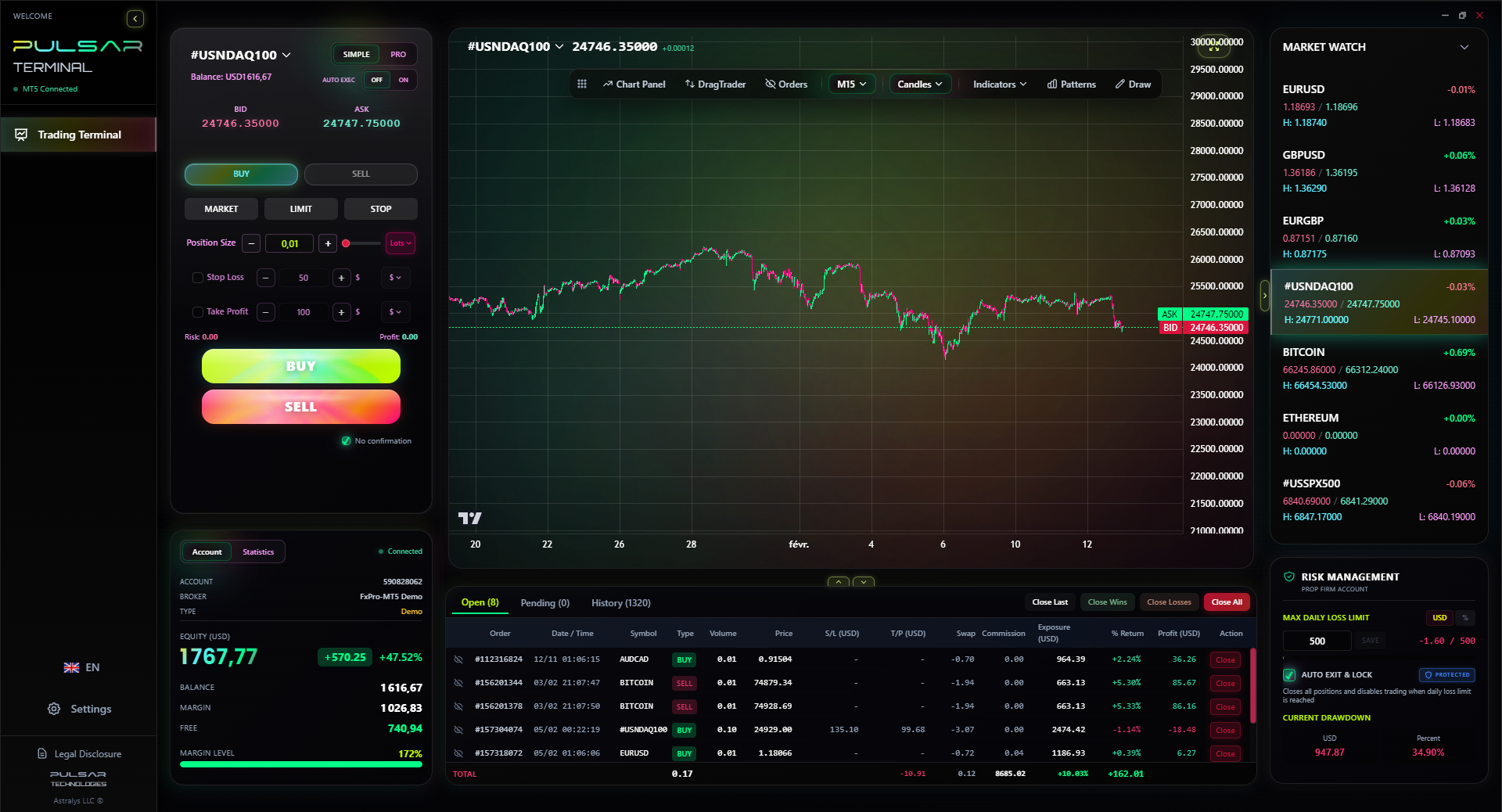
Managing multiple take-profit levels and stops on trades like this can be messy on standard MT5. This is where a tool like Pulsar Terminal shines, letting you drag and drop complex order brackets directly onto your chart.
Managing complex OCO brackets and multiple take-profit levels is clunky in MT5, but Pulsar Terminal lets you drag, drop, and manage them visually right on your chart.
“The goal is to make your trading boring. Remove the emotion, remove the frantic clicking.”
Theory is useless without action. Here’s your drill for every pending order.
- Identify the Structure: Is this a clear support level (use a horizontal line)? A trendline? A Fibonacci retracement level? Write it down.
- Choose Your Weapon: Support/Retracement = Buy Limit. Resistance Breakout = Buy Stop. If you hesitate, look at the higher time frame trend again.
- Calculate the Exact Price: Don't eyeball it. Use the ASK price for buy orders. Factor in a 1-2 pip buffer if you're trading a fast market. Use our position size calculator to determine your lot size based on where your stop-loss will be.
- Set Your Stop-Loss and Take-Profit IMMEDIATELY: Your risk should be defined before the trade is live. Your stop-loss should be based on market structure (e.g., below the swing low for a buy limit), not an arbitrary dollar amount. A common mistake is setting a profit target that's smaller than your risk. Aim for a risk-to-reward of at least 1:1.5.
- Review and Place: Check the order type, price, and lot size one last time. Then submit. Walk away from the screen. The trap is set.
I still remember a trade on EUR/GBP where I messed up step 3. I meant to place a 0.5 lot buy limit. In a hurry, I typed 5.0. The order filled, and my heart stopped. I was risking over 5% of my account on a single trade. I had to scramble to manually close half the position immediately after fill, ruining my plan. Slow down. Double-check. The market isn't going anywhere.
The 'buy limit vs buy stop forex' debate isn't about which is better. It's about which is right for this specific market setup in front of you right now. Mastering these orders moves you from a reactive gambler to a proactive planner.
For the Nigerian trader, this is even more critical. With our unique challenges, you can't afford to babysit the charts 24/7. Pending orders are your automated trading assistants. They execute your plan with discipline, regardless of if NEPA takes the light or you're stuck in Lagos traffic.
Start small. Take a demo account and practice nothing but setting buy limits on pullbacks and buy stops on breakouts for a week. Don't even worry about the profit. Worry about the process. Did the price action behave as you expected when your order was triggered? That's the real lesson.
, the goal is to make your trading boring. Remove the emotion, remove the frantic clicking. A well-placed pending order turns a chaotic market into a structured business operation. And that's how you survive and compound your capital in the long run. For the scalpers reading this, these concepts apply on smaller time frames too, which we detail in our scalping strategy guide. Just remember, the spread becomes an even bigger enemy there.
Now, go look at your charts. Don't look for a trade. Look for a clear level. Then decide: limit or stop? Your future self will thank you for the clarity.
FAQ
Q1Can a buy limit order be placed above the current market price?
Technically, most platforms will let you, but it makes no logical sense and would likely result in an immediate fill at the current (worse) price. A buy limit is designed to get you a better price than the current market, so it should always be placed below.
Q2What happens if the price gaps past my buy stop or buy limit price?
You get filled at the first available price after the gap. If you had a buy stop at ₦1,460 and the market opens at ₦1,470 due to news, your order will be executed at or near ₦1,470. This is called slippage and is a key risk with pending orders around high-volatility events like central bank announcements.
Q3Which is safer, a buy limit or a buy stop?
Neither is inherently 'safer.' Safety comes from your overall trade management. A buy limit risks the trend being broken. A buy stop risks a false breakout. The safety is in your stop-loss, position size, and the strength of the market level you're trading against. Always use a stop-loss.
Q4Do I pay extra fees for using pending orders?
No, brokers do not charge extra fees specifically for placing a pending order. You only pay the spread (or commission if applicable) when the order is actually executed and becomes a live trade.
Q5How long does a pending order stay active?
It depends. You can usually set them as 'Good Till Cancelled' (GTC), which stays active until you cancel it, or 'Good Till Date' (GTD), which expires at a specific time. Some brokers may have policies that cancel orders at the end of the trading day. Always check your broker's rules.
Q6Can I modify or cancel a pending order?
Yes, absolutely. You can usually change the entry price, stop-loss, take-profit, or lot size before it's triggered. You can also cancel it entirely. This is useful if the market structure changes before your order is hit.
प्रो. विंस्टन का पाठ
:
- ✓Buy Limit: Set BELOW price to catch dips.
- ✓Buy Stop: Set ABOVE price to catch breakouts.
- ✓Always attach a stop-loss to pending orders.
- ✓Factor in the spread on your entry price.
- ✓Use OCO brackets to trade volatility without guessing direction.
यह लेख कितना उपयोगी था?
रेट करने के लिए स्टार पर क्लिक करें
साप्ताहिक ट्रेडिंग विश्लेषण
मुफ़्त साप्ताहिक विश्लेषण और रणनीतियाँ। कोई स्पैम नहीं।
लेखक के बारे में
Olumide Adeyemi
पश्चिम अफ्रीकी ट्रेडिंग अग्रणी
नाइजीरिया के सबसे सक्रिय फॉरेक्स ट्रेडिंग एजुकेटर्स में से एक। लागोस से 8 साल का ट्रेडिंग अनुभव। अफ्रीकी ट्रेडर्स के लिए लो-कैपिटल स्ट्रैटेजीज और प्रॉप फर्म चैलेंजेज में विशेषज्ञ।
टिप्पणियाँ
आपको यह भी पसंद आ सकता है

Cara Trading Forex Sukses: 7 Prinsip dari Trader Profesional
Cara trading forex sukses dengan 7 prinsip trader pro: manajemen modal, disiplin, journal trading, backtest. Data nyata, bukan janji profit palsu.
Jam Trading Forex Terbaik untuk Trader Indonesia: Panduan Lengkap dengan Tabel Waktu
Panduan jam trading forex untuk trader Indonesia. Tabel 4 sesi dunia, jam emas 20:00-00:00, sesi mana yang harus dihindari. Data akurat + tips dari trader berpengalaman.
Top 5 Sàn Forex Uy Tín Nhất 2026: Review Jujur dari Trader Indonesia
Top 5 sàn forex uy tín 2026 untuk trader Indonesia. Review jujur: spread, deposit, withdraw, dukungan lokal. Exness, XM, IC Markets & lebih.
All these calculators are built into Pulsar Terminal with real-time data from your MT5 account. One-click position sizing, automatic risk management, and instant calculations.
