


Here's a fact that might surprise you: Nigeria is Africa's largest oil producer, yet most Nigerian traders have no idea how to properly trade crude oil on the forex market.

Olumide Adeyemi
पश्चिम अफ्रीकी ट्रेडिंग अग्रणी ·  Nigeria
☕ 13 मिनट पढ़ने
आप क्या सीखेंगे:
- 1What Are Commodities in Forex? (It's Not What You Think)
- 2CBN Rules and Your Trading: Navigating the Maze
- 3Trading Crude Oil Like a Pro, Not a Novice
- 4Gold and Precious Metals: The Safe Haven Trap
- 5Brokers, Platforms, and the Funding Headache
- 6Risk Management for Volatile Goods
- 7Strategy and Analysis: Keeping It Simple
- 8Common Pitfalls for Nigerian Traders (I've Fallen for Most)
Here's a fact that might surprise you: Nigeria is Africa's largest oil producer, yet most Nigerian traders have no idea how to properly trade crude oil on the forex market. We're sitting on the raw material that moves global markets, but we're busy chasing EUR/USD pips without understanding the asset in our own backyard. Trading commodities in forex isn't just about gold and oil; it's about understanding how global demand, local CBN policies, and your own funding limitations intersect. I've watched traders blow accounts trying to short crude during OPEC meetings they didn't understand, all while missing the real opportunities. Let's fix that.
When we talk about commodities in forex, we're not talking about buying physical barrels of oil or gold bars. That's a different game entirely. In the forex world, you're trading contracts for difference (CFDs) on the price movements of these raw materials. The key pairs you'll see are XAU/USD (gold), XAG/USD (silver), USOIL (West Texas Intermediate crude), and UKOIL (Brent crude).
Here's where Nigerian traders get confused: these aren't currency pairs in the traditional sense. You're not exchanging dollars for 'oil dollars.' You're speculating on whether the dollar price of oil will go up or down. This distinction matters because the fundamentals are completely different. While EUR/USD might react to Fed meetings, USOIL will react to inventory reports from the American Petroleum Institute (API) or geopolitical tensions in the Middle East.
I learned this the hard way early on. I once went long on gold because the USD looked weak, completely ignoring a major central bank announcement about selling reserves. Gold tanked. I lost $400 in an hour. The lesson? Commodities have their own drivers. You need to study them separately. For a deep dive on one of the most popular commodity pairs, check out our dedicated XAU/USD guide.

Warning: Don't assume commodity correlations hold forever. During extreme market stress (like March 2020), everything - gold, oil, stocks - can sell off together as traders rush for cash. Liquidity dries up. Your safe haven isn't always safe.

💡 विंस्टन की सलाह
The spread on commodities is your silent enemy. A 5-pip spread on a 50-pip target trade means you're already down 10% the moment you click 'Buy'. Only enter when the spread is tight and your target is wide.
This is the most critical section for any Nigerian trader. You can have the best strategy in the world, but if you don't understand the local regulatory environment, you'll get stuck at the funding stage. Let's be brutally honest: the Central Bank of Nigeria (CBN) does not regulate or endorse retail forex trading. Your protection is exactly zero naira. However, their policies directly control your ability to get dollars into an international broker.
The Funding Bottleneck
The CBN's capital controls are your biggest hurdle. The $20-$50 monthly limit on naira debit cards for international transactions is a joke for serious trading. It won't even cover a single decent position. Most banks will block transactions to known brokerages outright. This forces traders into the gray market: P2P platforms, crypto conversions, or BDCs. The new 2024 guidelines allowing BDCs to source forex from authorized dealers (with a monthly cap) is a slight improvement, but it's aimed at travel and business, not speculative trading. You're on your own.
What the 'Reforms' Really Mean
The October 2023 unification of rates and the lifting of FX restrictions on 43 items were meant to improve liquidity and let the market find a 'true' price. In practice, the gap between the official and parallel market rates is still a chasm. For you, the trader, this means the cost of acquiring dollars to fund your account is wildly unpredictable. One month your P2P rate might be 1,450 NGN/$, the next it could be 1,650. This eats into your capital before you even place a trade.
The new Electronic Foreign Exchange Matching System (EFEMS) is for interbank trading - think Zenith Bank trading with UBA. It's not for you and me. It won't help you deposit $500 into your Exness account. The real-time reporting rules are for these big players, not for monitoring retail trades.

Pro Tip: Never, ever use a local Nigerian 'investment firm' offering to trade commodities for you. With no SEC regulation, these are often outright scams. Your only semi-safe path is a reputable international broker. Do your homework on brokers like IC Markets or Pepperstone that have a long track record.
“The CBN's capital controls are your biggest hurdle. The $20-$50 monthly limit on naira debit cards is a joke for serious trading.”
As a Nigerian, you have a home-field advantage with crude oil. You hear about OPEC+ decisions on the news before most of the world wakes up. Use that. But listening to the news isn't enough. You need to understand the reports.
Crude oil trading revolves around supply and demand data. The two big ones are the API Weekly Statistical Report (released Tuesday evenings) and the EIA Crude Oil Inventories (released Wednesday afternoons, Nigerian time). A larger-than-expected build (increase) in inventories is bearish for price. A larger-than-expected draw (decrease) is bullish. It's that simple, yet most traders overcomplicate it.
I once made a classic mistake. The API report showed a huge drawdown of 5 million barrels. I immediately bought USOIL. What I missed was that the EIA report, which is more authoritative, came out an hour later showing a surprise build. The price spiked on the API news, then crashed on the EIA data. I got stopped out for a $250 loss. The lesson? Wait for the dust to settle, or better yet, don't trade the news unless you have a proven scalping strategy for such events.
Volatility is your friend and enemy. Oil can move 300-400 pips ($30-$40 per standard lot) in a single day. You must adjust your position size calculator accordingly. Trading a 0.1 lot on oil is not the same as a 0.1 lot on EUR/USD. The potential profit and loss are much larger.
| Factor | Impact on Oil Price | Example |
|---|---|---|
| OPEC+ Production Cut | Bullish | Nov 2024 decision sent prices up 8% in a week. |
| US Shale Production Increase | Bearish | Higher US output often caps price rallies. |
| Geopolitical Tension (Middle East) | Bullish | Attacks on tankers or facilities cause risk premiums. |
| Global Recession Fears | Bearish | Fear of lower demand crushes prices, as seen in 2020. |
| USD Strength | Bearish | Oil is priced in USD. A stronger dollar makes it more expensive for other countries, reducing demand. |
Gold (XAU/USD) is the poster child for commodities in forex. It's liquid, volatile, and traded 24/5. Nigerians love gold, both as jewelry and as an investment. But trading it is different. The biggest myth is that it's a 'safe haven.' It is, but only during specific types of fear: currency devaluation, persistent inflation, or genuine geopolitical crises. During a stock market crash driven by margin calls, gold can fall too, as everyone sells what they can to cover losses.
The real driver of gold in the modern era is real interest rates. That's the nominal interest rate (say, the US Fed rate) minus the inflation rate. When real rates are negative (inflation is higher than interest rates), gold tends to shine. Why hold a bond yielding 2% when inflation is 6%? You're losing 4% per year. Gold, which pays no interest, starts to look better.
I got caught in this trap in 2022. Inflation was soaring, so I went long gold. But I underestimated how aggressively the Fed would hike rates. As real rates started to climb from deeply negative to less negative, gold slumped from over $2,000/oz to near $1,600. My stubbornness cost me. I didn't use a trailing stop, and I ignored the shifting macro picture. A tool that automates trailing stops could have saved me a lot of pain.
Silver (XAG/USD) is gold's wilder cousin. It has industrial uses (electronics, solar panels), so its price is also tied to economic growth expectations. It's more volatile. A 5% daily move for silver is common; for gold, it's a big deal. This makes silver better for short-term swing trading if you have the stomach for it, but you need tighter risk controls to avoid a margin call.
💡 विंस्टन की सलाह
Your first loss is your best loss. If a commodity trade goes against you immediately after entry and you have no logical reason why, just get out. Don't 'wait for the stop.' That waiting cost me more money than any single bad analysis.
“A 100-pip stop loss on EUR/USD is a modest move. A 100-pip stop loss on oil can get hit before you finish your cup of tea.”
Let's cut to the chase. You need an international broker. Full stop. Look for regulation from bodies like the ASIC (Australia), FCA (UK), or CySEC (EU). These provide some level of client fund segregation and dispute resolution. Nigerian traders often ask me about minimum deposits. Some brokers offer accounts from $10, but seriously, what are you going to do with $10? You're just paying for the spread. Start with at least $200-$500 as a realistic learning capital.
Popular Platforms:
- MetaTrader 4/5 (MT4/MT5): The industry standard. Every broker has it. It's reliable and has countless indicators. I use MT5 for commodities because it handles commodities CFDs natively.
- cTrader: Known for razor-sharp spreads and a cleaner interface. Preferred by many scalping pros.
The Funding Workaround (The Reality):
- Cryptocurrency: This is the most common method now. You buy USDT on a local exchange like Binance P2P with naira, then send it to a broker that accepts crypto deposits (many do). The spreads on the crypto exchange and network fees are your 'cost of doing business.'
- P2P Forex: You find someone with dollars who wants naira. You agree on a rate and send to their Nigerian account. Risky due to fraud. Use only highly rated, verified individuals.
- International Money Transfer: If you have a dollar domiciliary account, you can wire out. But getting dollars into that account is the original problem.
Brokers like XM and Exness have worked hard to create local deposit options, but these often depend on third-party payment processors that can be unstable. Always do a test deposit of the smallest amount first.
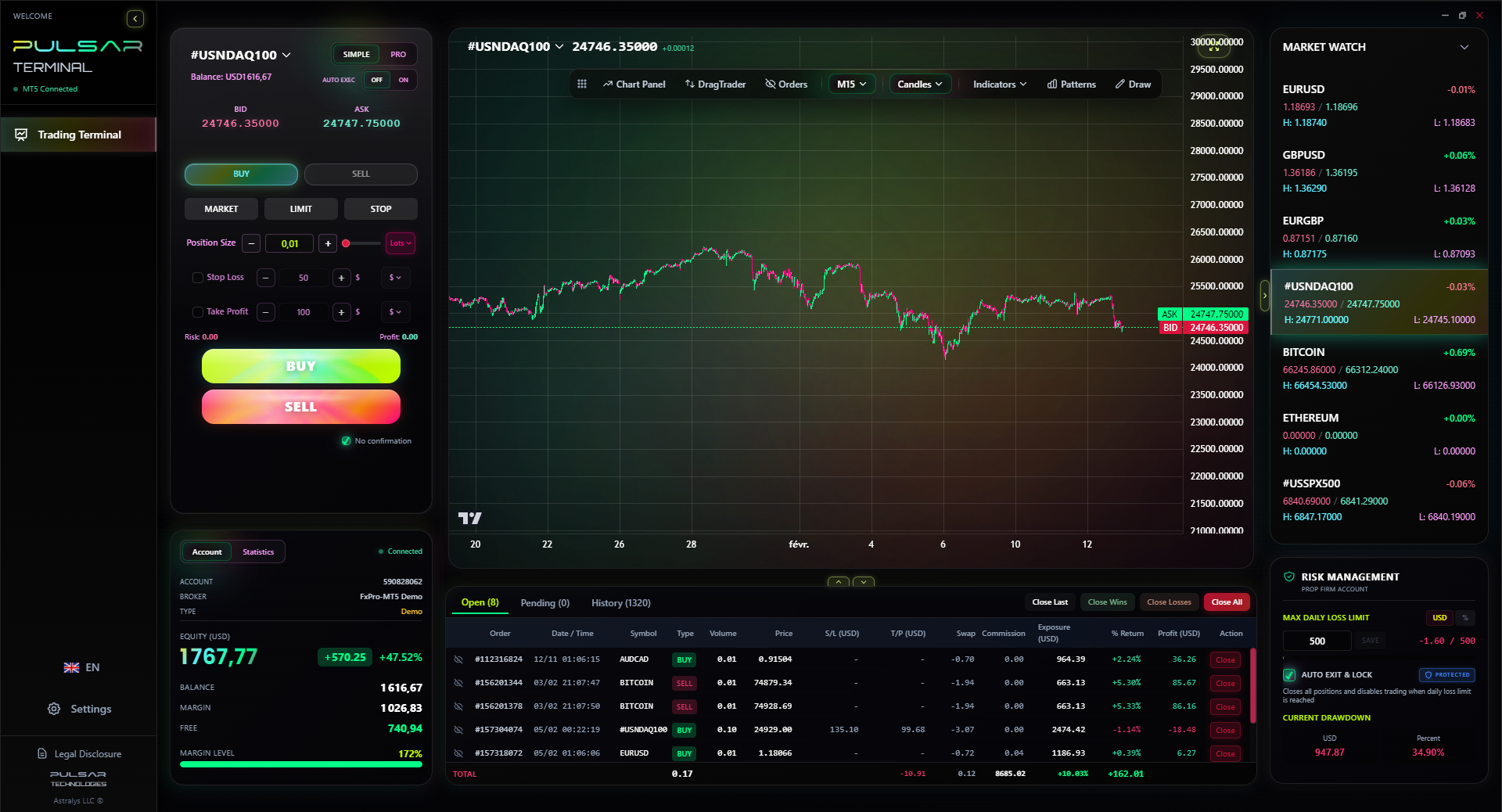
Managing multiple take-profit levels and trailing stops on volatile commodities like oil is a manual headache, but Pulsar Terminal automates it all directly on your MT5 platform.
This is non-negotiable. Commodities will wipe you out faster than any currency pair if you're reckless. A 100-pip stop loss on EUR/USD is a modest move. A 100-pip stop loss on oil can get hit before you finish your cup of tea.
Rule 1: Use a Percentage-Based Model. Never risk more than 1-2% of your account on a single trade. If you have a $1,000 account, your max loss per trade should be $10-$20. Use the position size calculator religiously. With oil at 80.00, a 50-pip stop loss on a 0.1 lot is a $50 risk. That's 5% of a $1,000 account. Too high. You'd need to trade a 0.02 lot instead.
Rule 2: Widen Your Stops. Commodities need room to breathe. Don't place a 20-pip stop on gold. Average daily ranges can be 10 times that. Your stop should be based on market structure - place it beyond the recent swing high or low - not an arbitrary number you're comfortable with.
Rule 3: use is a Poisoned Chalice. Your broker might offer 1:500 on commodities. Using that is suicide. I'd suggest never exceeding 1:10 for commodities when starting. That means to control one standard lot of oil ($100,000 contract), you should have at least $10,000 in margin. This forces you to trade smaller and survive longer.
Rule 4: Mind the Rollover. Commodity CFDs have expiration dates. Your broker will 'roll over' your contract to the next month, which can involve a fee or a price adjustment (contango/backwardation). Don't hold near-term contracts for months unless you understand this cost.

Example: You buy 0.1 lot of UKOIL at $85.00. You place a stop loss at $83.50 (a 150-pip stop). 0.1 lot = 10 barrels. 150 pips = $1.50 per barrel. Your potential loss is 10 barrels * $1.50 = $15. Is that within your 2% risk limit?
“Your first loss is your best loss. If a commodity trade goes against you immediately, just get out.”
Forget the fancy indicators. When trading commodities in forex, price action and supply/demand fundamentals are king. Start with a clean chart.
A Simple Swing Trading Approach:
- Identify the Trend: Use the weekly and daily charts. Is oil making higher highs and higher lows? That's an uptrend. Trade the dips (buy support). In a downtrend, sell the rallies (resistance).
- Find Key Levels: Mark obvious areas of support and resistance where price has reversed before. These are your entry and exit zones.
- Use One Momentum Confirmation: I like the MACD indicator on the 4-hour chart. In an uptrend, I look for the MACD histogram to be above zero and the signal line to cross up. That's my confirmation to enter a buy on a retest of daily support.
- Manage the Trade: Entry at support, stop loss below the recent swing low. Take profit at the next resistance level. A 1:2 risk-to-reward ratio is a good minimum target.
Fundamental Checklist:
- For Oil: Check the weekly API/EIA inventory data. Is there a trend of draws or builds? What is the next OPEC+ meeting date?
- For Gold: What are the US 10-year Treasury yields doing? What is the latest US CPI inflation print? Is there war or serious political instability?
Indicators like the RSI indicator can help identify overbought/oversold conditions within a trend, but never use them alone to reverse against a strong fundamental move. If oil inventories are plummeting and OPEC is cutting, don't go short just because the RSI is at 80.
💡 विंस्टन की सलाह
Fund your trading account with money you are 100% prepared to lose. The stress of trading with rent money or a business capital will guarantee poor decisions. It turns a calculated risk into a desperate gamble.
Let me save you some money and heartache by listing the mistakes I see every day.
1. Trading Without a Dollar Buffer: You fund $500 via crypto. The rate was terrible, so it really cost you 800,000 NGN. You lose $50 on your first trade. You're not down 10%; you're down 80,000 NGN. The psychological pressure is immense. Always factor the acquisition cost into your risk calculus.
2. Chasing 'News' from Social Media: WhatsApp groups are full of 'insiders' with 'OPEC leaks.' It's 99% nonsense. I once bought a rumor from a Telegram group about a Saudi refinery fire. The 'fire' was a small, contained incident that affected nothing. Price spiked 30 pips on the rumor, then reversed. I was left holding a bag. Trust only official sources: Reuters, Bloomberg, the EIA website.
3. Ignoring Time Zones: The London and New York sessions are when liquidity and volatility are highest for commodities. Trading oil at 2 AM Nigerian time is often a waste of time. The big moves happen when the US is awake.
4. Not Accounting for Spread Widening: During news events, the spread on oil can blow out from 5 pips to 50 pips or more. If your stop loss is 20 pips away, you could get filled at a much worse price than you expected (slippage). Either avoid trading minutes before major news or use pending orders with wider stops.
5. Letting Emotions Ride on One Commodity: We feel connected to oil because it's Nigerian. If you're wrong on a crude trade, don't double down to 'prove a point' or because you 'know the industry.' The market doesn't care. I've done this. It never ends well. Follow your rules. Take the loss. Move on.
FAQ
Q1Is forex and commodities trading legal in Nigeria?
Yes, it is legal for individuals to trade with international brokers. However, it is not regulated locally by the Nigerian SEC. The CBN regulates the broader forex market for banks and BDCs, not retail speculative trading. This means you have no local legal protection if something goes wrong with your broker, so choosing a reputable, internationally regulated firm is critical.
Q2What is the best commodity to trade for beginners in Nigeria?
Gold (XAU/USD) is often the most beginner-friendly. It's highly liquid, has relatively stable spreads compared to oil, and its fundamentals (interest rates, inflation) are widely reported. Start by paper trading gold to understand its rhythm before moving to more volatile commodities like crude oil.
Q3How can I fund my international trading account with the CBN restrictions?
The most common and practical method for Nigerians now is via cryptocurrency. You buy USDT (Tether) on a local P2P platform with Naira, then deposit the USDT directly into brokers that accept crypto. Other methods include peer-to-peer forex transfers or using dollar funds from a domiciliary account (if you have one). Direct naira card deposits are almost impossible.
Q4What lot size should I use for trading oil?
Start extremely small. Due to oil's high volatility, a standard lot (100,000 units) is very risky. Begin with a micro lot (0.01) or even a nano lot (0.001) if your broker offers it. This lets you practice real trading with manageable risk. A 100-pip move on a 0.01 lot of oil is only a $1 move, which is a perfect learning environment.
Q5Do I need to pay tax on my commodity trading profits in Nigeria?
The FIRS (Federal Inland Revenue Service) taxes income. If trading is your primary source of income, technically, your profits could be considered taxable income. However, the practical enforcement on individual retail forex traders is virtually non-existent due to the difficulty of tracking offshore broker accounts. It's a gray area. For significant, consistent profits, consulting a tax professional is wise.
Q6What's the difference between USOIL and UKOIL?
USOIL refers to West Texas Intermediate (WTI) crude, a US benchmark priced in Cushing, Oklahoma. UKOIL refers to Brent Crude, a North Sea benchmark that prices about two-thirds of the world's internationally traded oil. Brent is more sensitive to global geopolitical events, while WTI can be more influenced by US inventory data and pipeline flows. Their prices move together but not always in perfect sync.
Q7Can I trade agricultural commodities like cocoa or wheat?
Yes, many international brokers offer CFDs on soft commodities like Cocoa, Coffee, Wheat, and Sugar. However, these markets are often less liquid than oil or gold, leading to wider spreads and more erratic price jumps. They are generally not recommended for beginners. Stick to the majors (Gold, Silver, Oil) until you have considerable experience.
प्रो. विंस्टन का पाठ
:
- ✓Commodities require 3x wider stops than major forex pairs.
- ✓Never risk >2% of capital on a single commodity trade.
- ✓Gold trades on real interest rates, not just 'fear'.
- ✓Use crypto (USDT) for funding; avoid naira cards.
- ✓OPEC decisions move oil more than any technical indicator.
यह लेख कितना उपयोगी था?
रेट करने के लिए स्टार पर क्लिक करें
साप्ताहिक ट्रेडिंग विश्लेषण
मुफ़्त साप्ताहिक विश्लेषण और रणनीतियाँ। कोई स्पैम नहीं।
लेखक के बारे में
Olumide Adeyemi
पश्चिम अफ्रीकी ट्रेडिंग अग्रणी
नाइजीरिया के सबसे सक्रिय फॉरेक्स ट्रेडिंग एजुकेटर्स में से एक। लागोस से 8 साल का ट्रेडिंग अनुभव। अफ्रीकी ट्रेडर्स के लिए लो-कैपिटल स्ट्रैटेजीज और प्रॉप फर्म चैलेंजेज में विशेषज्ञ।
टिप्पणियाँ
आपको यह भी पसंद आ सकता है

Cara Trading Forex Sukses: 7 Prinsip dari Trader Profesional
Cara trading forex sukses dengan 7 prinsip trader pro: manajemen modal, disiplin, journal trading, backtest. Data nyata, bukan janji profit palsu.
Jam Trading Forex Terbaik untuk Trader Indonesia: Panduan Lengkap dengan Tabel Waktu
Panduan jam trading forex untuk trader Indonesia. Tabel 4 sesi dunia, jam emas 20:00-00:00, sesi mana yang harus dihindari. Data akurat + tips dari trader berpengalaman.
Top 5 Sàn Forex Uy Tín Nhất 2026: Review Jujur dari Trader Indonesia
Top 5 sàn forex uy tín 2026 untuk trader Indonesia. Review jujur: spread, deposit, withdraw, dukungan lokal. Exness, XM, IC Markets & lebih.
All these calculators are built into Pulsar Terminal with real-time data from your MT5 account. One-click position sizing, automatic risk management, and instant calculations.
