


Let's be blunt: most traders who chase the evening star forex pattern lose money.

David van der Merwe
उभरते बाजार के ट्रेडर ·  South Africa
☕ 13 मिनट पढ़ने
आप क्या सीखेंगे:
- 1What Exactly Is an Evening Star Pattern?
- 2Spotting the Pattern in the South African Context
- 3How to Trade the Evening Star: A Step-by-Step Plan
- 4The 3 Mistakes That Blow Up Evening Star Trades
- 5Evening Star vs. Doji Star & Shooting Star: Don't Get Confused
- 6Choosing a Broker & Platform in South Africa
- 7Advanced Tips: Boosting Your Odds with Confirmation
- 8How to Fit the Evening Star Into Your Overall Trading Strategy
Let's be blunt: most traders who chase the evening star forex pattern lose money. They see three candles, think they've found a guaranteed reversal, and pile in with a massive position. I've done it myself. The pattern looks obvious in hindsight, but in real-time, it's a trap for the unprepared. This guide isn't about selling you a magic bullet. It's a risk manager's breakdown of how to use the evening star pattern properly within the South African market, with all its quirks like USD/ZAR spreads and FSCA rules. I'll show you the exact setups I've traded, the ones that failed, and how to manage the risk so you don't become another statistic.
Forget the poetic name for a second. An evening star is a specific three-candle formation on a price chart that signals buyers are exhausted and sellers are about to take over. It's a bearish reversal pattern, meaning it shows up after a price rise, hinting the party's over.
Here’s how it breaks down, candle by candle:
- A Large Bullish Candle: This is the final, enthusiastic push of the uptrend. Everyone's feeling good, buying is strong, and the candle closes near its high.
- A Small, Indecisive 'Star' Candle: This is the warning sign. Price gaps up at the open (creating a space between the first and second candle), but then it just... churns. It can be a doji (open and close are nearly the same), a small bullish or bearish candle. The key is it shows momentum has stalled. The buyers from the first candle can't keep pushing.
- A Large Bearish Candle: The confirmation. Price gaps down from the star (another gap), and sellers smash it. This candle should close well below the midpoint of the first bullish candle. This shows sellers aren't just nibbling, they're in control.

Warning: If that third candle doesn't close deep into the body of the first candle, it's not a valid evening star. It's just noise. This is the first filter that eliminates bad setups.
The psychology is simple: greed (candle 1) turns to uncertainty (candle 2), which turns to fear and panic selling (candle 3). That 70.2% success rate you might have heard about? That's in ideal, textbook conditions on historical data. In the live market, with spreads, news, and your emotions in the mix, the real-world hit rate is lower. You need more than just the pattern.
Looking for this pattern on USD/ZAR is a different beast compared to EUR/USD. The volatility and wider spreads change the game.
On Major Pairs (EUR/USD, GBP/USD)
This is where the pattern is cleanest. Liquidity is high, spreads are tight (often below 1 pip on brokers like IC Markets or Pepperstone), and the candles form with less noise. You'll see clearer gaps and more defined bodies. When I trade evening stars on EUR/USD, I'm looking for them at clear technical resistance levels, like a previous swing high or a key Fibonacci retracement level. The pattern alone isn't enough, it needs a 'reason' to reverse there.
On USD/ZAR and Other Exotics
Here's where you can get chewed up. USD/ZAR can have spreads of 5 pips or more during quiet times. That 'small star' candle? It might just be spread-widening nonsense, not genuine indecision. The gaps might not be clean due to the lower liquidity. I learned this the hard way early on. I took a perfect-looking evening star on USD/ZAR, only for the price to reverse and hit my stop-loss because I didn't account for the typical 8-pip spread at that time of day. The pattern failed not because the analysis was wrong, but because the market mechanics worked against me.

Pro Tip: On exotic pairs like USD/ZAR, zoom out. A valid evening star on the 4-hour or daily chart carries far more weight than one on the 15-minute chart, where it's mostly spread noise. Always check the average spread for your pair on your broker's platform before you trade the pattern. Our spread definition guide explains why this cost is a silent account killer.
The platform matters too. Most of us here use MT4 or MT5. Make sure your candlestick chart is set properly. A common mistake is having the chart on 'Line' or 'Bar' mode and missing the crucial gap formation between the candles.

💡 विंस्टन की सलाह
A pattern without a story is just noise. The evening star's story is 'exhaustion at a wall.' If there's no visible wall (resistance), the story is weak.
“A perfect pattern in the wrong location is a losing trade.”
This is where we move from theory to execution. A plan prevents panic.
Step 1: Confirm the Trend. The pattern must occur after a recognizable uptrend. Don't try to find an evening star in a ranging market or a downtrend. It's a reversal pattern, not a continuation pattern. I use simple higher highs and higher lows on the 1-hour or 4-hour chart to confirm the trend.
Step 2: Validate the Pattern Structure.
- Candle 1: Strong bullish.
- Candle 2: Gaps up, small body (the star).
- Candle 3: Gaps down, strong bearish, closes below the 50% mark of Candle 1's body.
Step 3: Wait for the Close. This is the discipline part. Do NOT enter during the formation of the third candle. Wait for it to close. I've been burned too many times by a candle that looked bearish all session only to reverse in the last few minutes into a neutral close. Patience.
Step 4: Entry, Stop-Loss, and Take-Profit.
- Entry: Enter a short position at the market price after the close of the third candle. Some traders wait for a small pullback to the star's area for a better price, but that adds risk of missing the move.
- Stop-Loss: Your stop-loss must be placed above the highest point of the entire pattern (the high of candle 1 or 2, whichever is higher). This is non-negotiable. If price goes there, the pattern is invalidated.
- Take-Profit: A common method is to measure the height of the entire pattern (from the low of candle 1 to the high of the star) and project that distance downward from the close of candle 3. You can also look for the next major support level.
Example from my journal: On EUR/USD, I spotted an evening star on the 4-hour chart after a run-up to 1.0950.
- Candle 1 close: 1.0940
- Star high: 1.0955
- Candle 3 close: 1.0890 (well below 1.0940 midpoint)
- I entered short at 1.0888.
- Stop-loss at 1.0965 (above the pattern high).
- Take-profit at 1.0830 (near previous support).
- Risk: 77 pips. Reward: 58 pips. A slightly less than 1:1 ratio, which I accepted because the pattern was at a clear resistance. The trade worked, but the risk-reward was tight. I should have used a smaller position. Always use a position size calculator.
I've made all of these. Let's save you the money.
1. Trading It in Isolation. This is the biggest killer. You see three candles and go all in. The evening star needs confirmation. I now only trade it if it aligns with another signal. For example, if the RSI on the same timeframe is showing overbought conditions (above 70) and divergence, that's a strong combo. Or if the pattern forms right at a key Fibonacci level (like the 61.8% retracement). Our guide on the RSI indicator explains how to spot these divergences properly.
2. Ignoring the Higher Timeframe Context. A perfect evening star on the 15-minute chart is meaningless if the daily chart is screaming a strong bullish trend. Always check the next timeframe up. If the 4-hour chart is bullish, be very cautious with a 1-hour evening star. The higher timeframe trend usually wins.
3. Poor Position Sizing and Stop Placement. Because the pattern seems so 'sure', traders use huge positions. Then a bit of volatility takes them out. Your stop-loss is your lifeline. Placing it inside the pattern (like just above the star) because you want a 'tighter stop' is a recipe for getting stopped out on market noise. Respect the pattern's structure. Place the stop where the pattern is technically broken, and then size your position so that loss is a small, acceptable percentage of your capital (I never risk more than 1-2% on any single pattern trade). A blown stop-loss can lead to a margin call if you're over-leveraged.
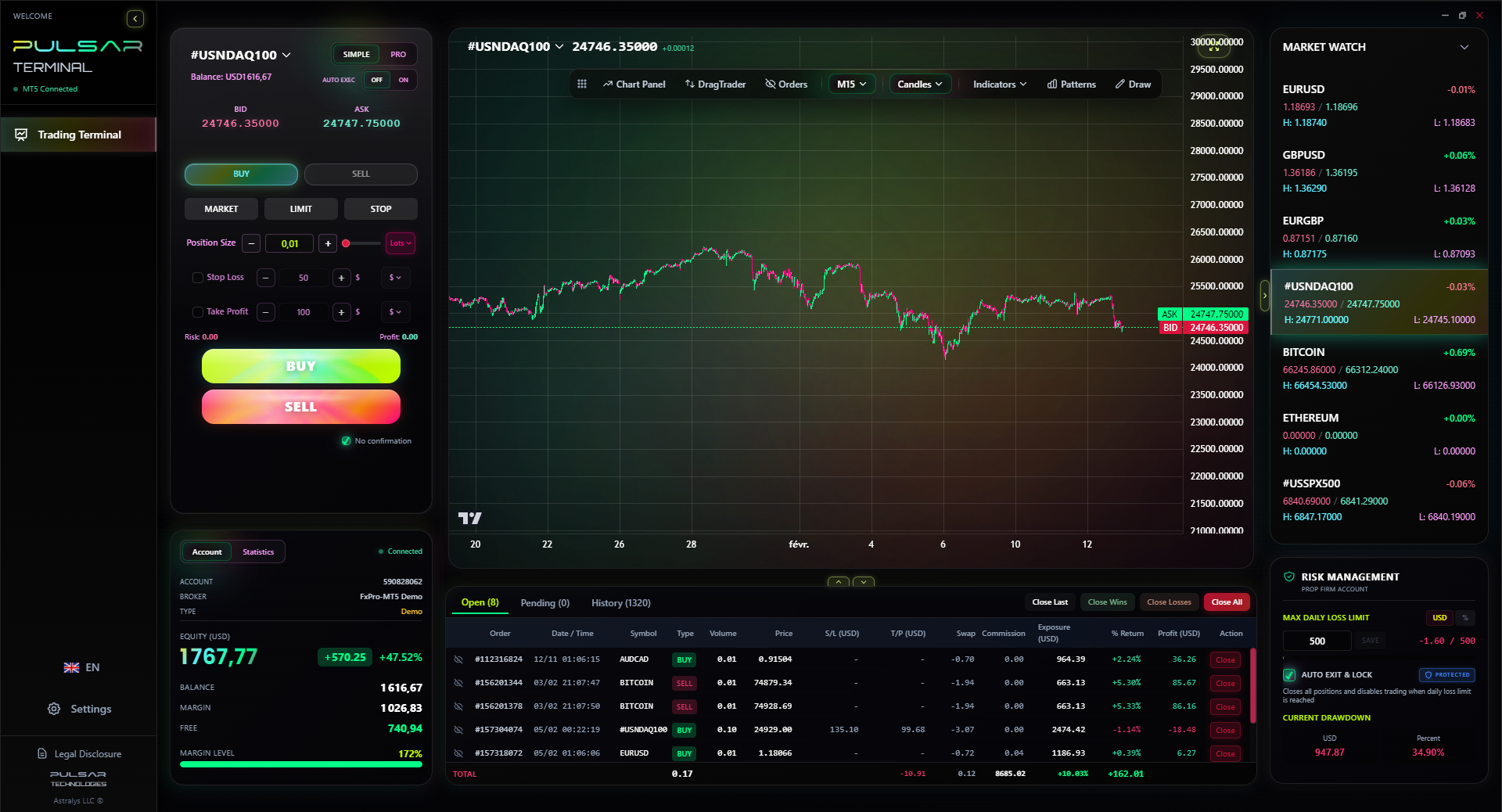
Managing multiple take-profit levels and a trailing stop on an evening star trade is complex, but Pulsar Terminal automates it all directly within your MT5 platform.
“Your stop-loss must be placed above the highest point of the entire pattern. This is non-negotiable.”
The evening star has cousins. Mixing them up leads to bad entries.
| Pattern | Number of Candles | Trend Context | What It Looks Like |
|---|---|---|---|
| Evening Star | Three | After an Uptrend | Bullish candle, gapped-up small candle (star), gapped-down strong bearish candle. |
| Bearish Engulfing | Two | After an Uptrend | A small bullish candle followed by a large bearish candle that completely 'engulfs' the body of the first. |
| Shooting Star | One | After an Uptrend | A single candle with a small lower body and a very long upper wick (like a star falling). It shows a rejection of higher prices. |
| Doji Star | Two | Can be anywhere | A strong candle followed by a Doji (where open ≈ close). It shows indecision, but not a confirmed reversal like the three-candle evening star. |
The key differentiator for the evening star is the three-candle structure with two gaps. The bearish engulfing is powerful but has no gap. The shooting star is just a single candle warning. The evening star gives you more information: momentum loss (star) followed by confirmed selling pressure (third candle). For a strategy that capitalizes on quick moves after these confirmations, see our scalping strategy guide.
💡 विंस्टन की सलाह
Your first loss is your smallest loss. If an evening star fails and your stop is hit, that's the system working. Revenge trading the next pattern is how you lose 10x more.
Your broker choice directly impacts your ability to trade this pattern effectively, especially on ZAR pairs.
Regulation is Non-Negotiable: Only use brokers regulated by the Financial Sector Conduct Authority (FSCA). This ensures your funds are in segregated accounts and you have a local recourse if things go wrong. Trading with an unregulated offshore broker to get 'better spreads' is how South Africans lose their entire deposit. It's not worth it.
Broker Considerations for Pattern Trading:
- Spreads on USD/ZAR: This is critical. If you trade local pairs, compare this spread. Khwezi Trade, as a local FSCA broker, often has competitive ZAR pricing. International brokers like IG or Pepperstone offer it too, but check the live spread during your trading hours.
- Platform: You need reliable candlestick charts. MT4/MT5 are the standards. Some brokers like XM offer these with very low minimum deposits ($5), which is great for practicing with tiny positions. For more advanced charting and pattern drawing, many traders link MT5 to tools like TradingView or dedicated terminal apps.
- Execution: You don't want slippage ruining your carefully planned entry on the close of the third candle. Look for brokers known for good execution. Reviews from other traders are key here; our Exness review and IC Markets review detail their execution models.
Funding in ZAR: Use a broker that offers a ZAR-denominated account or easy ZAR deposits. This saves you the hidden cost of currency conversion on every deposit and withdrawal. Local bank transfer (EFT) is usually the cheapest funding method.
“The pattern is the trigger, but volume and price location are the safety catches.”
To move from a 50/50 gambler to a systematic trader, you need confirmation. The pattern is the trigger, but these are the safety catches.
Volume Confirmation: This is a big one. The ideal volume profile for an evening star:
- Candle 1: High volume (enthusiastic buying).
- Candle 2 (Star): Noticeably lower volume (interest is fading).
- Candle 3: High volume again, especially on the decline (sellers are participating in force). If that third candle is bearish but on low volume, be skeptical. The selling pressure might not be genuine.
Indicator Confluence: Don't use ten indicators. Pick one or two that complement the price action.
- MACD: Look for the MACD line to be overbought and starting to hook down, or for a bearish crossover to occur during/after the pattern forms. Our MACD indicator guide breaks down the signals.
- RSI Divergence: As price makes a higher high on candle 1 or the star, the RSI makes a lower high. This 'hidden' weakness is a powerful confirmation.
- Support/Resistance: The pattern forming at a major resistance level (a previous price peak, a psychological number, a trend line) is the strongest confirmation of all. It means the pattern is occurring where sellers have historically stepped in.
A Real Failed Trade: I once took an evening star on GBP/USD that had perfect structure. But it formed in the middle of a wide range, not at resistance. I ignored that. The MACD was still strong. I ignored that too. I got stopped out for a full 1% loss. The lesson? A perfect pattern in the wrong location is a losing trade. Now, I only take the signal if at least two other factors (like location and volume) agree. This filters out probably 70% of potential trades, but the remaining 30% have a much higher success rate.
💡 विंस्टन की सलाह
The gap is the breath between moves. In liquid markets, it's meaningful. In thin ones like some exotics, it's often just a pricing artifact. Know your market's character.
The evening star isn't a strategy. It's a tool in your toolbox. You wouldn't use a hammer for every job.
For Swing Traders: This is where the pattern shines. Swing trading involves holding trades for days to weeks, aiming to capture the bulk of a new trend move. A well-confirmed evening star on a daily or 4-hour chart is a premier swing trade entry signal. It allows for sensible stop-loss placement and a good risk-reward ratio. If you're interested in this style, our core principles of swing trading align perfectly with this pattern's use.
For Day Traders: You can use it on lower timeframes (1-hour, 15-minute), but the filters need to be stricter. The pattern is more prone to failure due to noise. Confluence with a key intraday level (like the VWAP or the previous day's high) is essential. Your profit targets will be smaller, and you need to be quick to manage the trade.
The Golden Rule: It's Just One Signal. Build a checklist. Mine has 5 items: Uptrend? Valid Pattern Structure? At Key Resistance? Volume Confirming? Indicator (RSI/MACD) Agreeing? I only take the trade if I can tick at least 4 out of 5. This systematic approach removes emotion. Sometimes the most profitable thing you can do is see a beautiful evening star and... nothing. Just watch it. If it doesn't meet your rules, it's not your trade. There will always be another setup tomorrow.
Finally, practice on a demo account first. Find 50 historical evening stars on Gold (XAU/USD) or EUR/USD charts and backtest your rules. See what worked and what didn't. Our XAU/USD guide is useful as gold often forms clean patterns. Only when you have a documented, positive expectancy should you risk real money. This pattern can work, but only if you work harder than the pattern itself.
FAQ
Q1Is the evening star pattern reliable in forex?
It's reliable in specific conditions, not universally. The reported ~70% success rate is for textbook patterns in hindsight. In live trading, its reliability depends heavily on trend context, confirmation from other tools (like RSI or support/resistance), and the currency pair's liquidity. On a major pair like EUR/USD at a clear resistance level, it can be very effective. On a volatile exotic like USD/ZAR, it fails more often due to wider spreads and news-driven noise.
Q2What is the success rate of the evening star pattern?
Academic studies often cite a success rate around 70.2% for identifying a reversal. However, 'success' in those studies might just mean price moved down slightly. For a trader, success means a profitable trade after accounting for spreads, commissions, and hitting a defined profit target. In practical terms, with proper confirmation and risk management, a trader might aim for a win rate of 55-65% on well-selected evening star setups.
Q3Can I use the evening star for scalping?
Yes, but cautiously. On very short timeframes (like 1 or 5-minute charts), the pattern forms frequently but is often false. You need extremely tight filters: it must align with a major intraday resistance level and you should see confirming volume. The spreads become a much larger percentage of your target profit, so commission-free accounts or brokers with raw spreads are better. It's a high-skill approach.
Q4What's the difference between an evening star and a bearish engulfing pattern?
The main difference is structure. The evening star is a three-candle pattern with gaps, showing a gradual shift from buying to selling. The bearish engulfing is a two-candle pattern with no required gap; the second candle's body simply completely covers (engulfs) the body of the first. The evening star often shows more nuanced momentum loss, while the engulfing is a more immediate and violent rejection.
Q5Where should I place my stop-loss for an evening star trade?
Your stop-loss must be placed above the highest point of the entire three-candle pattern. This is typically the high of the first candle or the high of the star candle, whichever is higher. Placing it any lower (like above the star only) is dangerous because it doesn't account for the full invalidation point of the pattern and you risk being stopped out by normal market volatility.
Q6Which South African brokers are best for trading candlestick patterns?
Look for FSCA-regulated brokers that offer the MetaTrader platforms (MT4/MT5) for clear charting and low spreads on your chosen pairs. For major pairs, international brokers like IG, Pepperstone, and IC Markets (all FSCA-regulated) offer tight spreads. For trading USD/ZAR specifically, check local brokers like Khwezi Trade or the ZAR-pair spreads on the international brokers, as this can vary significantly.
Q7Do I need to use other indicators with the evening star?
Absolutely. Using the pattern alone is a low-probability game. Always seek confirmation. The most powerful confirmations are price-based: the pattern forming at a known resistance level. Indicator-based confirmations include bearish divergence on the RSI, a turn in the MACD, or a drop in volume on the star candle followed by an increase on the bearish candle.
प्रो. विंस्टन का पाठ
:
- ✓Wait for the third candle to close. Premature entry is gambling.
- ✓Always place your stop-loss above the pattern's high.
- ✓Seek confluence: pattern + resistance + indicator signal.
- ✓On USD/ZAR, the spread can be wider than your profit target.
- ✓The pattern is a tool, not a complete strategy.
यह लेख कितना उपयोगी था?
रेट करने के लिए स्टार पर क्लिक करें
साप्ताहिक ट्रेडिंग विश्लेषण
मुफ़्त साप्ताहिक विश्लेषण और रणनीतियाँ। कोई स्पैम नहीं।
लेखक के बारे में
David van der Merwe
उभरते बाजार के ट्रेडर
जोहानसबर्ग स्थित ट्रेडर, इमर्जिंग मार्केट करेंसीज में 11 साल का अनुभव। ZAR पेयर्स, FSCA-विनियमित ट्रेडिंग और दक्षिण अफ्रीकी मार्केट एनालिसिस में विशेषज्ञ।
टिप्पणियाँ
आपको यह भी पसंद आ सकता है

Cara Trading Forex Sukses: 7 Prinsip dari Trader Profesional
Cara trading forex sukses dengan 7 prinsip trader pro: manajemen modal, disiplin, journal trading, backtest. Data nyata, bukan janji profit palsu.
Jam Trading Forex Terbaik untuk Trader Indonesia: Panduan Lengkap dengan Tabel Waktu
Panduan jam trading forex untuk trader Indonesia. Tabel 4 sesi dunia, jam emas 20:00-00:00, sesi mana yang harus dihindari. Data akurat + tips dari trader berpengalaman.
Top 5 Sàn Forex Uy Tín Nhất 2026: Review Jujur dari Trader Indonesia
Top 5 sàn forex uy tín 2026 untuk trader Indonesia. Review jujur: spread, deposit, withdraw, dukungan lokal. Exness, XM, IC Markets & lebih.
All these calculators are built into Pulsar Terminal with real-time data from your MT5 account. One-click position sizing, automatic risk management, and instant calculations.
