


Here's a hard truth most South African traders learn the expensive way: checking the FNB forex rate before you trade is like checking the weather after you've been soaked.

David van der Merwe
उभरते बाजार के ट्रेडर ·  South Africa
☕ 9 मिनट पढ़ने
आप क्या सीखेंगे:
- 1What FNB Forex Rates Actually Are (And Aren't)
- 2The Real Cost: Why Trading on FNB Rates is a Loser's Game
- 3When It *Does* Make Sense to Use FNB Forex
- 4How to Get Real Trading Rates on the ZAR
- 5Practical Tips for Managing Your Trading Currency
- 6Common Pitfalls & How to Avoid Them
- 7The Final Verdict for South African Traders

Here's a hard truth most South African traders learn the expensive way: checking the FNB forex rate before you trade is like checking the weather after you've been soaked. It's a lagging indicator, not a leading one. The rate you see on their app or website is what they sold currency for in the past, not what you'll get for your next trade. If you're using FNB's spot rate as your trading signal, you're already behind the market by hours, sometimes a full business day. This guide isn't about bashing FNB. It's about understanding exactly what their rates represent, the staggering cost of using them for active trading, and the legitimate, cheaper alternatives that keep more of your rands in your pocket.
Let's clear this up first. When you look up 'FNB forex rates,' you're not looking at live, tradable prices from the interbank market. You're looking at a retail tourist rate, packaged for convenience.
They are Customer Rates: These are the rates FNB offers its retail and business banking customers for things like travel money, international payments, or converting ZAR dividends from overseas shares. The rate is set by the bank's treasury desk, usually once or twice a day, based on the interbank rate plus their markup.
They are NOT Trading Quotes: A tradable quote in the forex market has a bid price (what you can sell at) and an ask price (what you can buy at), with a tight spread between them. FNB's published rate is typically a single mid-rate. The actual rate you get will be worse once their spread is applied. I once needed to convert a $1000 withdrawal from a prop firm. FNB's advertised 'rate' for USD/ZAR was 18.50. The rate I was actually offered when doing the transaction? 18.32 on the buy, with a fee on top. That's an instant 0.97% loss before the money even hit my account.

Warning: Using FNB's published rate to calculate the profit on your broker trade is a classic rookie mistake. Your broker's exit price and the bank's conversion rate are completely different animals, separated by time, spreads, and fees.
The Spread is a Killer
Think the 1-pip spread on your EUR/USD broker account is good? Let's talk ZAR pairs. The spread on FNB's effective rate for a major like USD/ZAR can easily be 100 to 200 pips (that's 10 to 20 cents). Where a broker might charge a 5-pip spread on USD/ZAR, FNB's built-in spread is often 20 to 40 times wider. You start every single transaction in a deep hole.
It's Yesterday's News
Forex moves 24/5. A Bank of England rate decision at 2pm London time will move GBP/ZAR violently. FNB might not adjust their customer rate until the next South African business morning. By then, the market has moved 150 pips, and you're trading on stale information. I learned this painfully trying to time a GBP payment in 2022. The market rate was 21.10, FNB's site still showed 20.85 from the previous close. I thought I had a bargain. By the time my request was processed, their rate had updated to 21.25.
The Hidden Fee Structure
Even if you navigate their 'competitive' rate, watch for the fees. International transfer fees, receiving fees, and 'processing fees' can add a flat R100-R300 per transaction. On a R10,000 trade, that's another 1-3% gone. For active trading, this is financial suicide. It makes proper risk management with a position size calculator almost pointless, as your fixed costs devour any small, well-calculated profit.

Example: Converting R20,000 to USD.
- Interbank Rate: USD/ZAR = 18.5000
- FNB Effective Buy Rate (with spread): ~18.3000
- USD Received: R20,000 / 18.30 = $1,092.89
- USD at Interbank Rate: R20,000 / 18.50 = $1,081.08
- Instant Loss: $1,081.08 - $1,092.89 = -$11.81 (≈ -1.1%) + any transfer fees.
You've lost over 1% before you've even invested the dollars anywhere.

💡 विंस्टन की सलाह
A bank's forex rate is a product they sell you, not a market price. You buy it for convenience, not value. Never confuse the two.

“Using FNB's published rate to calculate trading profit is a classic rookie mistake.”
I'm not saying close your FNB Global Account. It has its place, just not in your active trading toolkit.
For Funding/Withdrawing from International Brokers: This is its primary use for traders. You need to get ZAR to your broker to trade EUR/USD or XAU/USD. FNB's online banking is a practical way to send an international wire (SWIFT) to brokers like IC Markets or Pepperstone. You're paying for the convenience and compliance, not a good rate. Tip: Always choose 'SHARE OUR FEES' (BEN) so the broker receives the full amount and you cover FNB's fees separately. Avoid 'SHA' or you'll get a deduction at the other end too.
For Large, Planned, Non-Trading Transactions: Buying property abroad, paying for university tuition, moving large emigrant funds. For these, you can use FNB's relationship managers to potentially negotiate a slightly better rate for a large, one-off deal. It's still not a trading instrument.
As a Rough Macro Indicator: Glancing at the weekly trend of FNB's ZAR rates can give you a vague, big-picture sense of which way the wind is blowing for the rand. But for actual entry and exit points? Useless. Use a real chart.
If you want to trade the Rand itself, or need cost-effective conversions, you have to step outside the retail banking system.
Use a Licensed South African Forex Broker: This is the big one. Brokers like Exness or XM offer live, tradable ZAR pairs (USD/ZAR, EUR/ZAR, GBP/ZAR) with spreads as low as 5-10 pips during major sessions. You're trading the actual market price, not a bank's delayed retail rate. This is where you execute your scalping strategy or swing trading ideas on the Rand.
Specialist Forex Providers: Companies like CurrencyFair, Wise (formerly TransferWise), or even newer fintechs often offer mid-market exchange rates with a small, transparent percentage fee. For moving money between your own accounts (e.g., ZAR to USD in your IC Markets account), they can be 50-80% cheaper than a bank. I use Wise to fund my offshore trading account. The last transfer saved me about 1.4% compared to FNB's total all-in cost.
Understand the 'Benchmark' Rate: The real benchmark for USD/ZAR is the USDZAR=X on Reuters or the futures price. Follow this, not your banking app. Your broker's quote should closely mirror this, minus their small spread. A wide spread is your enemy, so broker choice matters.
💡 विंस्टन की सलाह
Your first trade isn't on the charts. It's the moment you convert your ZAR to fund your account. Lose that trade to a bad spread, and you're fighting uphill for the rest.

“The spread on FNB's effective rate for USD/ZAR can be 20 to 40 times wider than a broker's.”
Keep Separate Buckets
Have a clear separation: your ZAR living expenses in your local bank (FNB, etc.), and your trading capital in a dedicated forex broker account. Only transfer what you allocate as risk capital. This mental accounting is crucial.
Hedge Your Withdrawals (If You're Advanced)
If you have a large profit in USD at your broker and plan to withdraw to ZAR, you can hedge the exchange rate risk. Open a short USD/ZAR position at your broker for an equivalent amount before you initiate the withdrawal. When the ZAR lands in your FNB account, close the hedge. This locks in a rate. It's advanced and carries its own risk, but it beats praying FNB's rate is good on withdrawal day.
Time Your Transfers
If you must use a bank, don't do it on a Friday afternoon or around major SA public holidays. Liquidity is lower, and the spreads on their internal rates will be worse. Mid-week, during London/NY overlap, tends to see better global liquidity, which can trickle down to slightly better bank pricing.

Pro Tip: Before any large currency conversion, get a quote from three sources: your bank (FNB), a specialist like Wise, and check the live rate on your forex broker's platform. The difference will shock you into action. That saved percentage goes straight into your trading capital, not the bank's profit line.

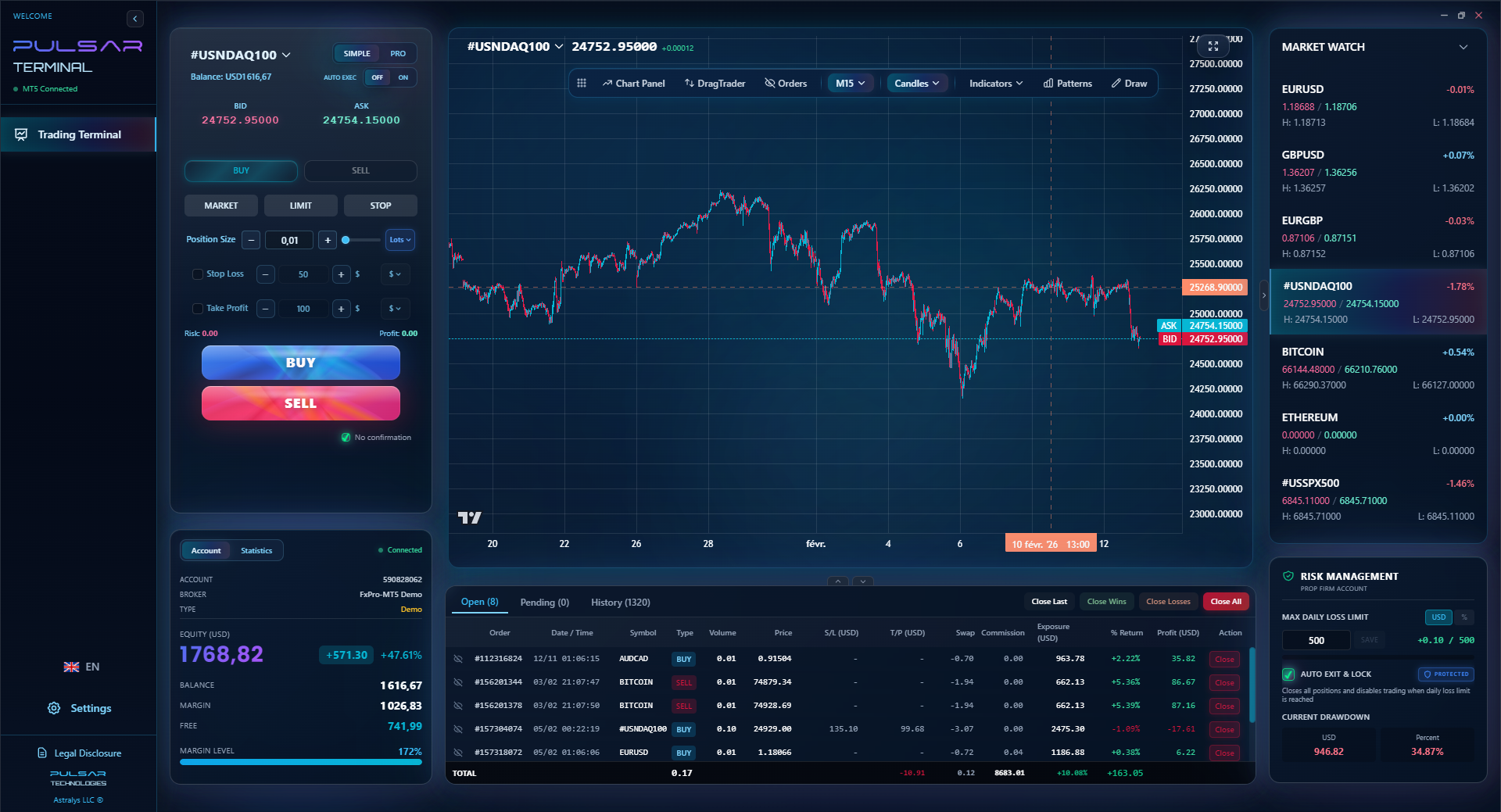
Managing complex trades and hedging currency risk requires precise tools, which is where a platform like Pulsar Terminal, with its advanced order types and risk management features, becomes indispensable for the serious trader.
Pitfall 1: Confusing the Rate for a Signal. You see ZAR strengthening on FNB's site and think, 'Time to buy USD.' Remember, that strength likely happened yesterday. The market may have already reversed.
Pitfall 2: Not Accounting for All Fees. The 'rate' is only part of the cost. You must add the international transfer fee, the possible correspondent bank fee, and the receiving fee. What looks like a 0.5% spread can become a 2.5% total cost.
Pitfall 3: Using It for Short-Term Trading. Just don't. The costs and latency make profitable short-term trading mathematically improbable. Use a real broker platform. I tried arbitraging between a broker's quote and FNB's rate early in my career. The execution delays and fees guaranteed I lost money on every 'winning' idea.
Pitfall 4: Ignoring Tax Implications. SARS wants its share on forex profits from trading. But converting ZAR to USD at a loss via your bank (due to their spread) is not a tax-deductible trading loss. It's just a bad personal financial transaction. Keep your trading P&L in your broker statements, clean and separate from your bank's currency conversion statements.
💡 विंस्टन की सलाह
If you can't explain the total all-in cost of your currency conversion in a single percentage, you haven't done your homework. Banks love complexity.

“FNB's forex rate is a utility, not a tool. It's the pipe, not the water.”
FNB's forex rate is a utility, not a tool. It's the pipe that brings water to your house, not the water itself. Your trading edge, your analysis, your execution - that's the water. Don't drink from the pipe.
For the active trader, FNB's role should be limited to: a conduit for moving ZAR to your international broker, and a place to receive ZAR profits back into. Even then, shop around for the conduit. Use their published rates only as a very rough, lagging indicator of overall ZAR sentiment, and never, ever as a basis for a trading decision.
Your focus should be on mastering the actual markets through your broker platform. Learn to read the MACD indicator or RSI on a live USD/ZAR chart. Understand what a margin call really means for your ZAR-denominated account. That's where the real game is played. FNB's rate is just the scoreboard from last week's match.

FAQ
Q1Does FNB have live forex rates for trading?
No. FNB publishes retail customer rates for conversions and transfers, typically updated once or twice a day. These are not live, executable trading prices with bid/ask spreads. For live trading rates, you need a forex brokerage account.
Q2What is the typical spread on FNB's USD/ZAR rate?
The effective spread (the difference between the rate they buy USD at and the rate they sell it to you) is often between 100 and 200 pips (1-2 cents). This is vastly wider than the 5-10 pip spread offered by competitive forex brokers on the same pair.
Q3Can I trade forex directly with FNB?
Not in the sense of speculative spot forex trading. FNB offers forex services for conversions, travel money, and international payments through its banking channels. They do not provide leveraged CFD or margin trading platforms like dedicated forex brokers do.
Q4Is it cheaper to use FNB or a forex broker to convert ZAR to USD?
Almost always, a reputable forex broker or a specialist currency transfer service (like Wise) will be significantly cheaper for pure currency conversion. FNB's rates include a large markup and additional fees. For example, a R100,000 conversion could cost you R1,500-R2,500 more via FNB compared to a cheaper alternative.
Q5How often are FNB forex rates updated?
They are typically updated at least once per business day, often in the morning. During periods of high volatility, they may update more frequently, but there is no guarantee of real-time pricing. There are no updates over weekends or South African public holidays.
Q6Should I check FNB's rate before withdrawing profits from my forex broker?
You can check it for a broad reference, but do not rely on it. The rate you actually get will be worse. To make an informed decision, compare the live USD/ZAR rate on your broker's platform and get quotes from currency specialists to understand the true cost of bringing your money home.
Q7What's the best way to fund an international forex broker from South Africa?
The most common method is an international SWIFT wire transfer from your FNB (or other local bank) account directly to your broker's bank details. Always select to pay all fees on your side (BEN). For smaller, regular amounts, some brokers accept credit/debit cards, and using a specialist like Wise can often reduce costs for larger transfers.
प्रो. विंस्टन का पाठ
:
- ✓FNB rates are retail, not trading, quotes.
- ✓Effective spreads can exceed 100 pips.
- ✓Use for transfers, not trade signals.
- ✓Specialist services are 50-80% cheaper.
- ✓Separate banking from trading capital.
यह लेख कितना उपयोगी था?
रेट करने के लिए स्टार पर क्लिक करें
साप्ताहिक ट्रेडिंग विश्लेषण
मुफ़्त साप्ताहिक विश्लेषण और रणनीतियाँ। कोई स्पैम नहीं।
लेखक के बारे में
David van der Merwe
उभरते बाजार के ट्रेडर
जोहानसबर्ग स्थित ट्रेडर, इमर्जिंग मार्केट करेंसीज में 11 साल का अनुभव। ZAR पेयर्स, FSCA-विनियमित ट्रेडिंग और दक्षिण अफ्रीकी मार्केट एनालिसिस में विशेषज्ञ।
टिप्पणियाँ
आपको यह भी पसंद आ सकता है

Cara Trading Forex Sukses: 7 Prinsip dari Trader Profesional
Cara trading forex sukses dengan 7 prinsip trader pro: manajemen modal, disiplin, journal trading, backtest. Data nyata, bukan janji profit palsu.
Jam Trading Forex Terbaik untuk Trader Indonesia: Panduan Lengkap dengan Tabel Waktu
Panduan jam trading forex untuk trader Indonesia. Tabel 4 sesi dunia, jam emas 20:00-00:00, sesi mana yang harus dihindari. Data akurat + tips dari trader berpengalaman.
Top 5 Sàn Forex Uy Tín Nhất 2026: Review Jujur dari Trader Indonesia
Top 5 sàn forex uy tín 2026 untuk trader Indonesia. Review jujur: spread, deposit, withdraw, dukungan lokal. Exness, XM, IC Markets & lebih.
All these calculators are built into Pulsar Terminal with real-time data from your MT5 account. One-click position sizing, automatic risk management, and instant calculations.
