


Here's a number that made me sit up straight: the average forex affiliate in South Africa makes about $5,000 a month from just 50 referrals.

David van der Merwe
उभरते बाजार के ट्रेडर ·  South Africa
☕ 10 मिनट पढ़ने
आप क्या सीखेंगे:
- 1What Exactly is Forex Afiliado? It's Not Just a Link
- 2The Legal Landscape: FSCA, POPIA, and Staying Out of Trouble
- 3The Real Numbers: What Can You Actually Earn?
- 4How to Start Your Forex Afiliado Business: A Practical Roadmap
- 5Taxes, Withdrawals, and Getting Paid
- 6Mistakes I Made (So You Don't Have To)
- 7Is Forex Afiliado Right for You in South Africa?
Here's a number that made me sit up straight: the average forex affiliate in South Africa makes about $5,000 a month from just 50 referrals. That's not some guru's fantasy. It's a benchmark from AffiliateFix. But here's the kicker - most people trying to break into forex afiliado here get tangled in regulations or pick the wrong broker, leaving that money on the table. I've been on both sides: as a trader and as someone who's built referral streams. Let me walk you through what actually works, what the FSCA really cares about, and the painful mistakes I made so you don't have to.
When you hear 'forex afiliado' in South Africa, you're talking about affiliate marketing or Introducing Broker (IB) programs for forex brokers. In simple terms, you refer traders to a broker, and you get paid for it. But it's far from passive. You're a sales and education channel.
There are two main models. The first is Cost Per Acquisition (CPA). You get a flat fee, sometimes a hefty one, when someone you refer makes a qualifying deposit and starts trading. I've seen offers from $200 all the way up to $1,850 for a single verified client. The second model is Revenue Share. Here, you earn a percentage of the trading fees (the spread or commission) generated by your referred clients for as long as they trade. This can range from 20% to an eye-watering 70% with some programs.

Warning: Many newcomers think this is 'free money.' It's not. Your reputation is on the line. If you send beginners to a dodgy broker with massive spreads or terrible execution, they'll lose money fast, blame you, and you'll kill your own business. Your success is directly tied to your clients' trading experience.
The real skill in forex afiliado isn't just driving traffic. It's matching the right trader with the right broker. A scalper needs razor-thin spreads from a broker like IC Markets. A beginner might need the educational resources of XM. Your job is to know the difference.

💡 विंस्टन की सलाह
Always calculate the lifetime value of a referred client, not just the upfront bonus. A $200 CPA is meaningless if the client quits in a week. A 30% revenue share from an active trader for two years is a small fortune.
This is where most aspiring affiliates in South Africa get it wrong, and I nearly did too. You can't just slap up a website and start promoting any offshore broker. The Financial Sector Conduct Authority (FSCA) is the main watchdog, and they take this seriously.
The FSCA and FAIS Act
If you're just providing a link and basic info, you might not need a license. But the moment you start giving what could be construed as financial advice - "This broker is best for EUR/USD," "Use this strategy" - you're stepping into regulated territory under the FAIS Act. I learned this the hard way early on. I had a simple blog with trading tips and broker reviews. A lawyer friend read it and pointed out several statements that could be seen as advisory. I had to rewrite almost everything.
More critically, if you handle client funds or act as a formal Introducing Broker (IB) managing accounts, you absolutely must have FSCA authorization. Don't play games with this.
POPIA is Your New Best Friend
Forget GDPR for a second. In South Africa, it's all about the Protection of Personal Information Act (POPIA). Every email address you collect, every name on your list, is protected. You must have a clear privacy policy, get proper consent, and secure that data. A data breach isn't just bad for business; it's illegal.
Consumer Protection Act (CPA)
This one's straightforward but vital. You cannot mislead people. No fake screenshots of profits, no promises of guaranteed returns. Your marketing must be honest. The CPA gives consumers powerful recourse if you over-promise.

Pro Tip: Before you promote a broker, check their FSP number on the FSCA's website. If they're not listed, walk away. Promoting an unregulated entity to South Africans is a recipe for legal and reputational disaster. I only work with brokers like Pepperstone or Exness that have clear, legitimate regulatory standing.
“I made a quick $3,600 upfront but destroyed all trust. The short-term gain wasn't worth the long-term pain.”
Let's cut through the hype with real data. The South African forex market is growing, projected to hit nearly $6.9 billion by 2033. There are over 200,000 active traders here. The opportunity is real.
Here’s a breakdown of what I’ve seen and earned myself:
| Commission Model | What It Is | Real-World Example from My Experience |
|---|---|---|
| Cost Per Acquisition (CPA) | Flat fee per qualified client. | In 2023, I ran a focused campaign for a broker offering $650 CPA. I referred 8 clients who met their deposit and trade volume criteria. Payout: $5,200 in one month. The catch? Their criteria were strict. 3 other referrals didn't qualify, so I got $0 for them. |
| Revenue Share | % of the broker's revenue from your client's trades. | My most consistent earner. I have a client from 2021 who is an active swing trader. He trades about 10 lots a month. At a 40% rev share on the spread, he nets me around $150-$300 monthly, like clockwork. This is the power of residual income. |
| Hybrid | CPA + smaller ongoing Revenue Share. | This is becoming more common. You get a smaller upfront fee (say $100) plus a 20% rev share. It’s a safer, long-term play. |
The reported average of $5,000/month from 50 referrals lines up. If those 50 are on a modest revenue share, it's easily achievable. But building that base of 50 active traders is the hard part. It requires consistent value, not just one-off clicks.
My biggest mistake was chasing the highest CPA offer I could find ($1,200!). The broker had terrible execution and high spreads. All my referrals blew their accounts within months. I made a quick $3,600 upfront but destroyed all trust. I made zero long-term income from them and had to rebuild my audience from scratch. The short-term gain wasn't worth the long-term pain.
Based on my scars and successes, here’s a step-by-step approach that actually works.
1. Niche Down Immediately. Don't try to attract 'all forex traders.' You'll attract no one. Pick a specific niche: "Forex for South African teachers," "ZAR pairs trading," "Beginners learning about pips." My first successful site was focused solely on scalping strategies for major pairs. This let me create hyper-relevant content and partner with brokers known for low latency.
2. Choose Your Broker Partners Carefully. Look beyond the commission percentage. Investigate:
- FSCA Regulation: Non-negotiable.
- Trading Conditions: Are spreads tight on the EUR/USD and XAU/USD (gold) that your audience will trade?
- Affiliate Support: Do they have a dedicated manager, timely payments, and reliable tracking software?
- Minimum Deposit: If your niche is beginners, a $500 minimum is a barrier. A $10-$100 minimum from brokers like Exness is more accessible.
3. Build a Platform, Not Just a Link. You need a home base. A simple website with a blog is enough. Create genuine, helpful content. Review brokers honestly. Explain concepts like margin calls. Use a position size calculator. Become a resource, not a billboard. This builds trust, and trust converts visitors into referrals.
4. Track Everything Religiously. Your affiliate portal is your bible. Track clicks, conversions, qualifying deposits, and trading volume. See which content drives the best clients. I once found that a single article explaining the MACD indicator was responsible for 30% of my highest-value referrals. I doubled down on that type of content.
💡 विंस्टन की सलाह
Your first ten referrals will come from people who know you. Be brutally honest with them about the risks of trading. That integrity will form the foundation of your entire affiliate business.
“The real skill in forex afiliado isn't just driving traffic. It's matching the right trader with the right broker.”
This is the boring but critical part that will save you a headache with SARS.
Taxes: Your affiliate income is taxable business income. It's not a lottery win. You must declare it on your annual tax return. Keep careful records of all your earnings and business expenses (website hosting, advertising costs, etc.). I work with an accountant who understands online income. It's worth the fee.
Payment Methods & Exchange Controls: Most international brokers will pay you in USD or EUR via international bank transfer, PayPal, or Skrill. Here's the crucial part: South Africa has exchange controls. When you bring that foreign income into the country, you must use an authorized dealer (your local bank) and declare the source of funds.
The recent SARB amendments (late 2025) have tightened things, especially for non-residents. The key takeaway is to keep everything above board. Your bank will likely ask for documentation from your broker affiliate portal showing the origin of the funds. Have your invoices and payment reports ready.
Payment Frequency: This varies by broker. Some pay monthly, some quarterly. Some have a minimum payout threshold (e.g., $100). Factor this into your cash flow planning. Don't expect to earn $500 and withdraw it the next day.
Let me be brutally honest about my failures. They were my best teachers.
1. Promoting the Highest Payout, Not the Best Fit. As I mentioned earlier, I chased that $1,200 CPA. The broker was awful. My referrals lost money, complained to me, and I lost sleep. The broker eventually had compliance issues. I earned short-term cash and long-term regret. Now, I'd rather promote a broker with a $300 CPA and excellent conditions. The clients stay, trade longer, and my revenue share from them over years dwarfs that upfront bonus.
2. Ignoring Content and SEO. For the first two years, I just bought Facebook ads pointing to my affiliate link. It was expensive and unsustainable. When I shifted to creating free, valuable blog content about trading psychology and strategy, I started getting organic traffic. People who read a 2,000-word guide trust you more than someone who just sees an ad. This free traffic became my most reliable source of high-quality referrals.
3. Not Using the Right Tools. I used to manually track everything in spreadsheets. It was a mess. Now, I use proper affiliate tracking software. More importantly, as a trader myself, I use advanced charting tools. For instance, managing multiple take-profit levels for my own trades was clunky in MT5 until I used a tool that automated it. This direct trading experience makes my content and advice more authentic.
4. Neglecting the Relationship. Once someone signed up through my link, I used to forget about them. Wrong move. Now, I have a simple email sequence: welcome, a few basic educational resources, and a check-in after a month. I don't give advice, but I point them to the broker's support or my general educational content. This reduces churn and keeps them trading actively, which boosts my revenue share. It's about being a helpful guide, not a ghost.
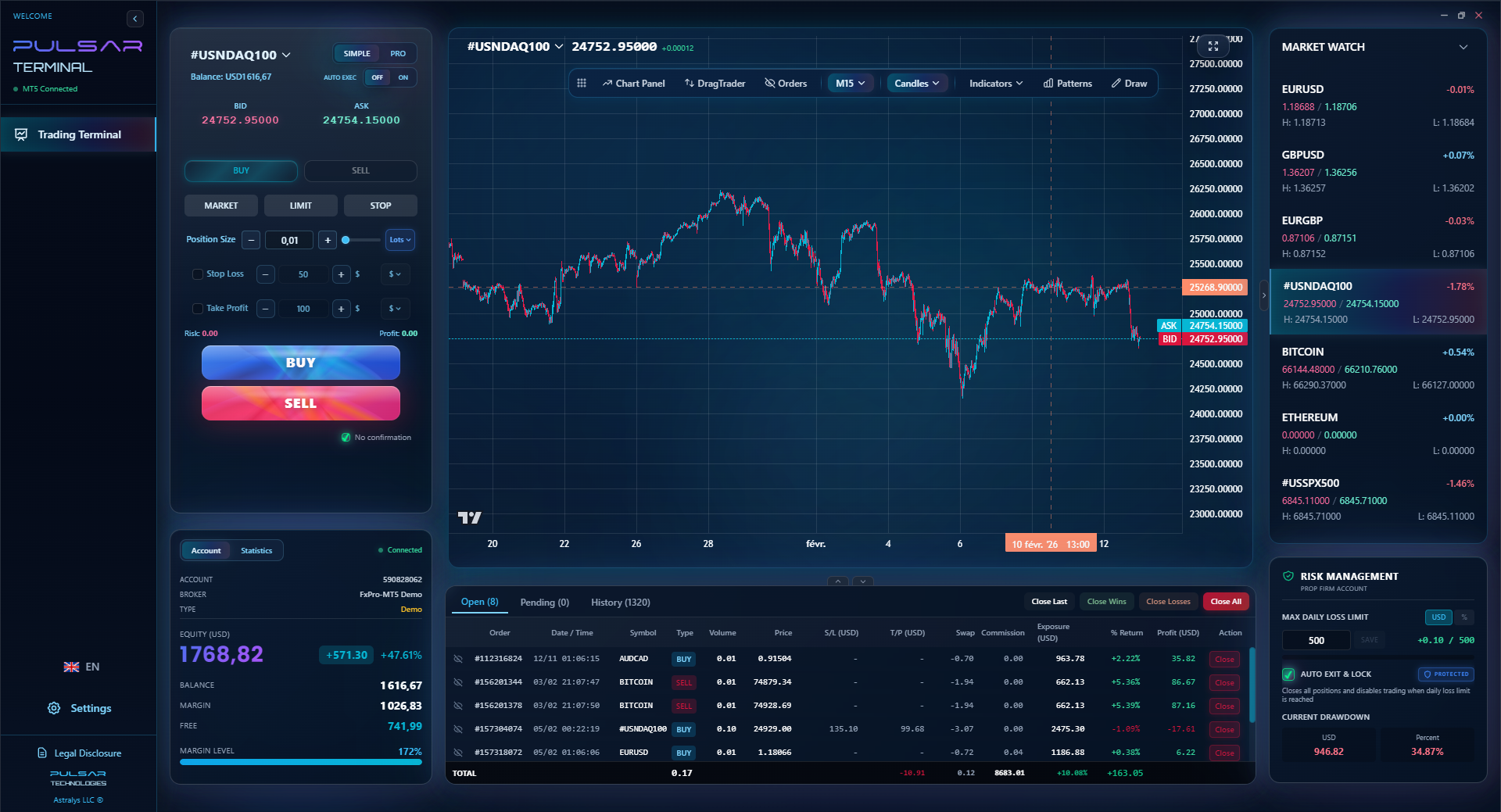
Just as you need the right tools to track your affiliate business, having the right trading tools is crucial for the clients you refer; platforms like Pulsar Terminal automate complex trade management on MT5, which can help them trade more effectively.
“It's about being a helpful guide, not a ghost.”
Forex afiliado isn't a get-rich-quick scheme. It's a legitimate online business that requires marketing skill, regulatory awareness, and patience.
It might be a good fit if:
- You have a genuine interest in forex and finance (faking this is obvious).
- You enjoy creating content, writing, or making videos.
- You're patient enough to build an audience over 6-12 months before seeing significant income.
- You're detail-oriented and can handle the compliance side (POPIA, honest marketing).
It's probably not for you if:
- You expect huge money in your first month.
- You want a completely passive income with zero work.
- The idea of learning about taxes and regulations makes you want to quit.
- You can't handle the ethical responsibility of referring people to a financial product where they can lose money.
The landscape here is growing, regulated, and full of opportunity. But like trading itself, it rewards discipline, risk management, and a long-term perspective. Do it right, build trust, and that $5,000-a-month benchmark isn't just a statistic, it's a very realistic target.
FAQ
Q1Do I need a license from the FSCA to be a forex affiliate?
Not necessarily, but the line is thin. If you only provide basic information and referral links, you might not need one. However, if you give specific trading advice, broker recommendations framed as advice, or handle client funds as an Introducing Broker (IB), you likely require FSCA authorization under the FAIS Act. When in doubt, consult with a financial services lawyer. It's the safest route.
Q2How and when do forex affiliates get paid?
Payment depends on your broker's program. For CPA (Cost Per Acquisition), you're paid a flat fee after your referred client makes a qualifying deposit and often places a certain number of trades. For Revenue Share, you're paid a percentage of the trading fees they generate, usually on a monthly or quarterly basis. Payments are typically made via international bank transfer, PayPal, or Skrill, and you'll need to declare this foreign income to SARS when bringing it into South Africa.
Q3What is the average income for a forex affiliate in South Africa?
According to 2023 industry benchmarks from AffiliateFix, the average monthly income for a forex affiliate in South Africa is around $5,000. This is typically generated from a base of about 50 active referred traders. However, this is an average. New affiliates may earn very little initially, while established affiliates with large, engaged audiences can earn significantly more through recurring revenue share models.
Q4Which forex affiliate programs are best for South Africans?
The 'best' program depends on your audience. Look for brokers with strong FSCA regulation, competitive trading conditions (like tight spreads), and reliable affiliate support. Brokers like Pepperstone, IC Markets, Exness, and XM have strong affiliate programs that are popular globally. Crucially, choose a broker whose product (trading platform, assets, fees) is a good fit for the specific type of trader you are targeting.
Q5How do South African exchange controls affect affiliate earnings?
South African exchange controls mean you must bring your foreign affiliate earnings into the country through an authorized dealer (your bank). You will need to declare the source of the income. Recent SARB amendments have tightened requirements, so having clear documentation from your broker affiliate portal (showing the earnings are from referral commissions) is essential. Always keep records for SARS.
Q6Is forex affiliate marketing sustainable long-term?
Yes, but only if you treat it as a real business. Sustainability comes from building trust and focusing on recurring revenue share, not just one-off CPA bonuses. If you send clients to a good broker and they become long-term traders, you can earn from their activity for years. My mistake was chasing quick CPA cash; my success came from building a resource hub that attracted traders who stayed in the markets.
प्रो. विंस्टन का पाठ
:
- ✓Regulation first: Always verify FSCA status.
- ✓Revenue share beats high CPA for long-term wealth.
- ✓Niche down to stand out in a crowded market.
- ✓Track everything - your data tells the real story.
- ✓Taxes are inevitable; plan for them from day one.
यह लेख कितना उपयोगी था?
रेट करने के लिए स्टार पर क्लिक करें
साप्ताहिक ट्रेडिंग विश्लेषण
मुफ़्त साप्ताहिक विश्लेषण और रणनीतियाँ। कोई स्पैम नहीं।
लेखक के बारे में
David van der Merwe
उभरते बाजार के ट्रेडर
जोहानसबर्ग स्थित ट्रेडर, इमर्जिंग मार्केट करेंसीज में 11 साल का अनुभव। ZAR पेयर्स, FSCA-विनियमित ट्रेडिंग और दक्षिण अफ्रीकी मार्केट एनालिसिस में विशेषज्ञ।
टिप्पणियाँ
आपको यह भी पसंद आ सकता है

Cara Trading Forex Sukses: 7 Prinsip dari Trader Profesional
Cara trading forex sukses dengan 7 prinsip trader pro: manajemen modal, disiplin, journal trading, backtest. Data nyata, bukan janji profit palsu.
Jam Trading Forex Terbaik untuk Trader Indonesia: Panduan Lengkap dengan Tabel Waktu
Panduan jam trading forex untuk trader Indonesia. Tabel 4 sesi dunia, jam emas 20:00-00:00, sesi mana yang harus dihindari. Data akurat + tips dari trader berpengalaman.
Top 5 Sàn Forex Uy Tín Nhất 2026: Review Jujur dari Trader Indonesia
Top 5 sàn forex uy tín 2026 untuk trader Indonesia. Review jujur: spread, deposit, withdraw, dukungan lokal. Exness, XM, IC Markets & lebih.
All these calculators are built into Pulsar Terminal with real-time data from your MT5 account. One-click position sizing, automatic risk management, and instant calculations.
