


Most traders think a forex breakout indicator is a magic button that prints money.

David van der Merwe
उभरते बाजार के ट्रेडर ·  South Africa
☕ 12 मिनट पढ़ने
आप क्या सीखेंगे:
- 1What a Breakout Indicator Actually Does (And Doesn't Do)
- 2The Breakout Indicators That Actually Work (With ZAR Pairs in Mind)
- 3A Step-by-Step Plan for Trading Breakouts from SA
- 4The Ugly Truth: Why Most Breakouts Fail (And How to Profit Anyway)
- 5Brokers, Platforms, and Making It Work in South Africa
- 6Putting It All Together: A USD/ZAR Breakout Trade
- 7Your Path Forward from Here
Most traders think a forex breakout indicator is a magic button that prints money. They slap a Bollinger Band on their chart, wait for the price to touch the edge, and then get stopped out as it reverses. I know because I lost a solid R8,000 thinking exactly that back in 2015. The truth is, a breakout indicator isn't a signal generator. It's a context tool. In South Africa's volatile market, especially with pairs like USD/ZAR, using them wrong is a fast track to a margin call. Let me show you how to use them properly, within our local rules, to actually catch moves instead of just hoping for them.
Let's clear this up first. A forex breakout indicator doesn't predict the future. Its job is to objectively define a state of compression or consolidation so you can see when that state breaks. It draws a line, a band, or a zone on your chart that says, "Price has been bouncing around here." When price closes decisively beyond that line, the indicator highlights a change in market structure.
The biggest mistake? Using a single indicator in isolation. A breakout from a Bollinger Band during the dead of the Asian session on a Tuesday means almost nothing. A breakout during the London/New York overlap, confirmed by a surge in volume? That's a different story. The indicator gives you the 'where,' but you need other factors - time of day, news, volume - to give you the 'why now.'
In South Africa, this is crucial. Our market hours (SAST) mean the real action for majors often happens when we're making dinner. A breakout on USD/ZAR might be driven by local mining output data at 11:00 SAST, but a breakout on EUR/USD at 15:00 SAST is likely foreign money moving. Your indicator shows the event; you need to interpret its cause.

Warning: No indicator can tell you if a breakout will be sustained or if it's a false move (a 'fakeout'). That's where your risk management, like a sensible position size calculator, comes in. Expect fakeouts, especially in ranging markets.
“A forex breakout indicator doesn't predict the future. Its job is to objectively define a state of compression so you can see when that state breaks.”
You'll find hundreds of fancy, paid indicators online. You don't need them. These are the workhorses that have stood the test of time and volatility, which is essential for trading a currency like the Rand.
Bollinger Bands
This is the classic. The bands plot two standard deviations above and below a moving average, creating a dynamic channel. The concept is simple: price tends to stay within the bands. A close outside the band suggests a potential breakout. The trick is in the settings and confirmation.
My Go-To Setup for USD/ZAR: I use a 20-period Simple Moving Average with bands set at 2 standard deviations on the 1-hour or 4-hour chart. I don't just look for the candle to touch the band. I wait for a full candle to close outside it. Even then, it's just an alert. I need to see if this coincides with a key support/resistance level breaking.
Average True Range (ATR)
This is your volatility meter, and it's more important than the breakout indicator itself. The ATR tells you how far price typically moves in a given period. When the ATR value is very low, it means the market is coiling - a tight consolidation often precedes a big move. When price breaks out of a tight range and the ATR starts rising sharply, you have volatility confirmation.
A Real Example: In early 2024, USD/ZAR was trading in a painfully tight 50-pip range for days. The ATR on the 4-hour chart sank to its lowest level in weeks. I set an alert above the range high. When the breakout came, fueled by a stronger Dollar index, the ATR spiked 150% within two candles. That was the confirmation to hold the trade, which ran for over 300 pips.
Donchian Channels
This is pure price action. The channel simply plots the highest high and lowest low over a set number of periods (e.g., 20). The channel's boundaries are your breakout levels. A break above the 20-period high is a bullish signal; a break below the 20-period low is bearish. It's brutally simple and effective for trend-following.

Pro Tip: Combine these. Use Bollinger Bands to see the squeeze, the Donchian Channel to define the exact breakout level, and the ATR to gauge if the resulting move has real energy. This trio is far more powerful than any single magic bullet.
Remember, these tools work on any pair. For something like EUR/USD, you're dealing with different volatility profiles than the Rand, so adjust your expectations and stop-loss distances accordingly.

💡 विंस्टन की सलाह
A quiet market is a coiled spring. When the Bollinger Bands on your 4-hour chart squeeze to their tightest point in two weeks, get your levels ready and your finger off the trigger. The move is coming, but your job is to wait for it to show its hand.
“The first breakout is often a lie for the amateurs. The smart money waits for the 'retest and hold.'”
Theory is nice, but let's get practical. Here’s a routine you can follow, keeping our time zone and market quirks in mind.
Step 1: Find the Compression. Scan the major pairs and USD/ZAR on the 4-hour chart. Look for periods where the Bollinger Bands have pinched in tightly, or where price has been moving sideways in a narrow range for at least 10-15 candles. This is your hunting ground.
Step 2: Define the Key Levels. Draw horizontal lines at the clear highs and lows of this range. These are your breakout and breakdown levels. Don't rely on the indicator line alone - use actual swing points on the chart.
Step 3: Wait for the Session. If you're trading EUR/USD or GBP/USD, the best breakouts happen during the London session (10:00-13:00 SAST) or the London/New York overlap (15:00-17:00 SAST). For USD/ZAR, be extra alert around 11:00 SAST when local economic data drops. A breakout on low liquidity is often a trap.
Step 4: Enter on Confirmation, Not Anticipation. This is where I used to fail. I'd place an order at the breakout level. Half the time, price would spike to my entry, take me in, and reverse. Now, I wait. I want to see a strong candle close beyond the level. For a long, I want to see a bullish candle close above resistance. Then, I might enter on a small pullback to that former resistance (now support).
Step 5: Manage the Trade. Your stop-loss goes on the opposite side of the range. If you're long on a break above a 50-pip range, your stop goes below the range low. Your initial profit target should be at least 1.5 to 2 times the range's height. Use the rising ATR as your guide to trail your stop.
A Trade I Got Wrong: I once saw a beautiful squeeze on GBP/JPY. It broke above the Donchian Channel high at the exact open of the Tokyo session. I jumped in. What I ignored was a major resistance zone just 15 pips above my entry on the daily chart. Price hit it, reversed, and stopped me out. The indicator showed a breakout, but the higher timeframe structure overruled it. Lesson learned.
“The first breakout is often a lie for the amateurs. The smart money waits for the 'retest and hold.'”
If breakouts always worked, everyone would be rich. They don't. In fact, a large percentage fail. The market loves to suck in traders at the breakout point, then reverse sharply. This is the 'fakeout' or 'stop hunt.'
Why Fakeouts Happen:
- Low Liquidity: Breaking out during off-hours (like the Asian session for EUR/USD) is often just a few algos pushing price around. No real volume follows.
- Major Institutional Levels: Big banks have orders clustered at certain prices. They may let price run to trigger all the retail stop-losses and pending orders above a level before moving in the opposite direction.
- Lack of Catalyst: A technical breakout needs a fundamental or sentiment driver to sustain it. No news? The breakout might fizzle.
Your Survival Toolkit:
- Volume is Key: If your platform has a volume indicator (not tick volume, but better yet, a Volume Profile), use it. A breakout on high volume is legitimate. A breakout on thin volume is suspect.
- The 1-2-3 Pullback Strategy: Instead of buying the initial spike, wait. After the breakout, price will often pull back to retest the broken level. If it holds as support (for a bullish break), that's your higher-probability entry. You miss the very first move, but your entry is better and your stop is tighter.
- Embrace Failure: Sometimes, you'll take a breakout trade and it will reverse. This is where your risk management is non-negotiable. You must have a predefined stop. If the trade fails and takes you out, you lose 1% of your account. No debate. This protects you from the one fakeout that turns into a 500-pip runaway move against you. I've seen too many guys on the XM review forums blow accounts because they moved their stop, hoping a failed breakout would come back.
💡 विंस्टन की सलाह
The first breakout is often a lie for the amateurs. The smart money waits for the 'retest and hold.' If price breaks a level, comes back to kiss it, and then pushes away, that's the confirmation you can trust. Patience here saves capital.
“In South Africa's volatile market, using breakout indicators wrong is a fast track to a margin call.”
Your breakout strategy is only as good as the tools you have to execute it. Here’s the local lay of the land.
FSCA Regulation is Non-Negotiable. Always use an FSCA-regulated broker. This ensures your funds are segregated and you have some recourse. The 1:30 use limit for retail traders is a good thing - it stops you from overleveraging on a volatile breakout. Brokers like IC Markets and Exness are popular here for their tight spreads, which is critical because a wide spread can turn a good breakout entry into a losing one before you even start.
Platform Choice: MT5 is Your Friend. MetaTrader 5 is the standard for a reason. All the indicators we've discussed (Bollinger Bands, ATR, Donchian) are built in. You can easily set price alerts for your breakout levels. The charting is solid. While some prefer Pepperstone's cTrader, MT5's ubiquity means every tutorial and idea you find is applicable.
Costs You Must Factor In. When trading breakouts, especially on a scalping strategy timeframe, costs matter. Look for:
- Low Spreads: On EUR/USD, look for averages under 0.5 pips. On USD/ZAR, spreads will be wider (3-5 pips is common), so factor that into your risk. A 5-pip spread means your trade is already 5 pips in the red when you enter.
- Commission Structure: Some brokers offer raw spreads but charge a commission per lot. Calculate the all-in cost. If you're trading multiple times a day, this adds up.
- Swap Fees: If you hold a breakout trade overnight on a ZAR pair, the swap (or finance charge) can be significant. Check your broker's swap rates, as they can eat into profits on a swing trading hold.
Local Payment Ease. Funding and withdrawing in ZAR via EFT without crazy fees is a huge quality-of-life benefit. It makes the practical side of trading so much smoother.
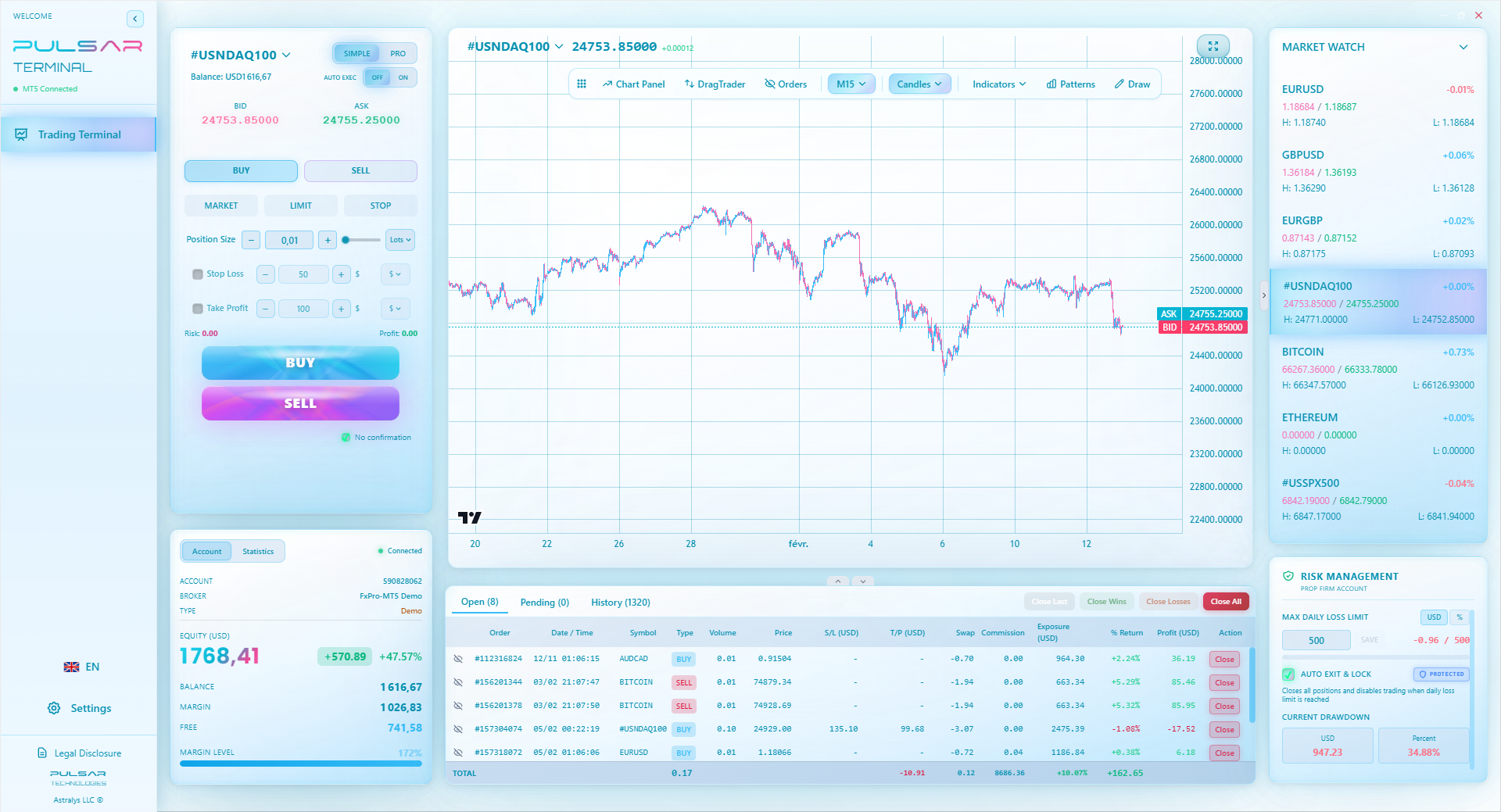
Managing multiple breakout trades and their stop-losses manually is stressful; Pulsar Terminal lets you set automated trailing stops and breakeven triggers directly on your MT5 charts.
“In South Africa's volatile market, using breakout indicators wrong is a fast track to a margin call.”
Let's walk through a hypothetical but realistic scenario using what we've learned.
The Setup: It's April 2026. USD/ZAR has been grinding sideways between R18.50 and R18.70 for a week. The 4-hour Bollinger Bands have tightened noticeably. The 14-period ATR has dropped to 0.45 (45 pips), its lowest in a month. Gold prices are stable, but the US Fed is due to speak at 17:00 SAST.
The Plan:
- Levels: Resistance is clear at R18.70. Support at R18.50.
- Trigger: I will only take a breakout trade if it occurs during or after the Fed speech (high liquidity/volatility event).
- Entry: I will NOT place a buy stop at R18.70. Instead, I set an alert. If price breaks above R18.70 and closes a 4-hour candle above it, I will look to buy on a pullback to R18.72-18.73 area.
- Stop Loss: I place my stop at R18.65, just below the breakout level and inside the old range. This is a 70-pip stop (R18.73 - R18.65).
- Position Size: Using my position size calculator, I risk 1% of my account, which is R1,000. With a 70-pip stop, that means I can trade a position size where 70 pips = R1,000. (At R18.73, a standard lot move of 1 pip is about R1, so I'd trade roughly 1.4 mini lots).
- Take Profit & Management: My first target is R18.90 (a 170-pip move from entry, a good risk-reward). If the ATR is expanding and price is moving strongly, I'll move my stop to breakeven once up 80 pips, and then trail it using a 2-period ATR.
This plan uses the indicator (Bollinger squeeze) to find the opportunity, respects time (Fed speech), avoids chasing, and has strict risk rules. It won't win every time, but over many trades, this discipline is what separates the consistent trader from the gambler.
💡 विंस्टन की सलाह
Your ATR reading is your stop-loss ruler. If the 4-hour ATR is 60 pips, placing a 15-pip stop on a USD/ZAR trade is fantasy. Your stop must respect the market's normal breathing room, or you'll be stopped out by noise every time.
“Your survival toolkit isn't a better indicator; it's better risk management and the patience to wait for confirmation.”
Breakout trading isn't about being right on every single trade. It's about having an edge - a repeatable process that, over many trades, puts the odds in your favor. Your forex breakout indicator is just one piece of that process.
Start by mastering one setup. Maybe it's the Bollinger Band squeeze on EUR/USD during London open. Paper trade it for a month. Log every trade: the setup, the entry, the outcome, and most importantly, why you think it worked or failed. Was volume there? Was there news?
Then, integrate one more element. Add the ATR confirmation. Then, practice the pullback entry. Build your process brick by brick.
Finally, always remember the South African context. Our Rand is a beast of its own, influenced by local politics, commodity prices, and global risk sentiment. A breakout on USD/ZAR can be explosive. Manage your risk accordingly, use an FSCA-regulated broker, and never let a single trade threaten your account. The market will always be there tomorrow. Your job is to make sure your capital is too.
Pro Tip: The best indicator you'll ever develop is your own patience. Waiting for the right setup - the true confluence of indicator signal, volume, time, and price level - is the hardest but most profitable skill. Most of your time should be spent watching and waiting, not clicking the buy button.
FAQ
Q1What is the best forex breakout indicator for beginners in South Africa?
Start with the Bollinger Bands. They're on every platform, easy to understand, and visually clear. Combine them with the Average True Range (ATR) to gauge volatility. This simple two-indicator combo on your MT5 platform will teach you more about market cycles than any fancy paid script. Just remember, they are for defining conditions, not giving buy/sell signals on their own.
Q2Is breakout trading profitable with South African Rand (ZAR) pairs?
It can be, but it's a different ball game. USD/ZAR is highly volatile and prone to sharp, news-driven moves. This means breakouts can be powerful, but fakeouts are also common. You need wider stop-losses to account for the normal noise, which means you must trade smaller position sizes to keep your risk in check. The wider spreads (often 3-5 pips) also mean your trade starts slightly in the red, so you need the breakout move to be substantial to be profitable.
Q3What time of day is best for breakout trading from South Africa?
It depends on the pair. For major pairs like EUR/USD, focus on the London session open (10:00 SAST) and the London/New York overlap (15:00-17:00 SAST). This is when liquidity and volume are highest, making breakouts more reliable. For USD/ZAR, be alert around 11:00 SAST when local economic data is released. Avoid trading breakouts during the Asian session (00:00-08:00 SAST) as they are often false moves.
Q4How do I avoid fakeout breakouts?
You can't avoid them entirely, but you can filter them. 1) Use Volume: A breakout on high volume is more trustworthy. 2) Wait for a Close: Don't trade the initial spike; wait for the price candle to close beyond the key level. 3) Trade with the Session: Only take breakouts during high-liquidity market hours. 4) Use the Pullback Entry: Instead of buying the initial break, wait for price to pull back and retest the broken level as support. This confirms the breakout wasn't just a spike.
Q5Do I need to use multiple breakout indicators?
Not necessarily multiple breakout indicators, but you need multiple types of confirmation. Using three different channel indicators (like Bollinger Bands, Keltner Channels, and Donchian) will just give you a messy chart. Better to use one channel indicator (e.g., Donchian to define the level), a volatility indicator (ATR), and a momentum oscillator like the MACD indicator or RSI indicator to see if momentum is supporting the breakout direction.
Q6What use should I use for breakout trading with an FSCA broker?
Stick to the FSCA's retail limit of 1:30, or use even less. Breakout trades often require wider stops to survive normal volatility, especially on ZAR pairs. Higher use on a wide stop means your position size is still too large, leading to huge losses if you're wrong. With 1:30 use, you are forced to be more sensible with your position sizing, which is a good thing for your long-term survival.
Q7Can I use breakout indicators for scalping?
Yes, but it's advanced. On very short timeframes like 1-minute or 5-minute charts, fakeouts are extremely frequent. You need incredibly tight execution, a broker with near-zero spreads (like a raw spread account from IC Markets or Pepperstone), and the discipline to take small, quick profits. A breakout on a 1-minute chart is noise; the same pattern on a 1-hour chart is structure. I'd master breakout trading on higher timeframes first before attempting a scalping strategy.
प्रो. विंस्टन का पाठ
:
- ✓Indicators define context, they are not signals.
- ✓Always confirm breakouts with volume and session timing.
- ✓Use the ATR to set realistic stop-loss distances.
- ✓Trade the pullback after the break, not the initial spike.
- ✓On USD/ZAR, factor in wider spreads (3-5 pips) immediately.
यह लेख कितना उपयोगी था?
रेट करने के लिए स्टार पर क्लिक करें
साप्ताहिक ट्रेडिंग विश्लेषण
मुफ़्त साप्ताहिक विश्लेषण और रणनीतियाँ। कोई स्पैम नहीं।
लेखक के बारे में
David van der Merwe
उभरते बाजार के ट्रेडर
जोहानसबर्ग स्थित ट्रेडर, इमर्जिंग मार्केट करेंसीज में 11 साल का अनुभव। ZAR पेयर्स, FSCA-विनियमित ट्रेडिंग और दक्षिण अफ्रीकी मार्केट एनालिसिस में विशेषज्ञ।
टिप्पणियाँ
आपको यह भी पसंद आ सकता है

Cara Trading Forex Sukses: 7 Prinsip dari Trader Profesional
Cara trading forex sukses dengan 7 prinsip trader pro: manajemen modal, disiplin, journal trading, backtest. Data nyata, bukan janji profit palsu.
Jam Trading Forex Terbaik untuk Trader Indonesia: Panduan Lengkap dengan Tabel Waktu
Panduan jam trading forex untuk trader Indonesia. Tabel 4 sesi dunia, jam emas 20:00-00:00, sesi mana yang harus dihindari. Data akurat + tips dari trader berpengalaman.
Top 5 Sàn Forex Uy Tín Nhất 2026: Review Jujur dari Trader Indonesia
Top 5 sàn forex uy tín 2026 untuk trader Indonesia. Review jujur: spread, deposit, withdraw, dukungan lokal. Exness, XM, IC Markets & lebih.
All these calculators are built into Pulsar Terminal with real-time data from your MT5 account. One-click position sizing, automatic risk management, and instant calculations.
