


Here's a fact that will save you hours of searching: as a South African trader, you almost certainly don't need a forex broker with KWD as a base currency.

David van der Merwe
उभरते बाजार के ट्रेडर ·  South Africa
☕ 10 मिनट पढ़ने
आप क्या सीखेंगे:
- 1The KWD Myth vs. Your Trading Reality
- 2Your First Filter: The South African Regulatory Landscape
- 3Real Broker Options: KWD as a Trading Pair
- 4The Real Cost Breakdown: It's Not Just the Spread
- 5Practical Payment Methods & Deposits for South Africans
- 6What You Should Be Looking For Instead
- 7Common Pitfalls & How to Avoid Them
Here's a fact that will save you hours of searching: as a South African trader, you almost certainly don't need a forex broker with KWD as a base currency. The Kuwaiti Dinar is one of the world's most stable currencies, but that stability makes it a terrible speculative instrument. I've watched traders chase exotic account currencies thinking it's a secret edge, only to get hammered by conversion fees and poor liquidity. Let's cut through the noise. This guide isn't about finding a unicorn broker; it's about understanding why the KWD question is usually the wrong one, and what you should be looking at instead.
I need to be straight with you. When a South African trader asks me about forex brokers with KWD currency, my first question is always: "Why?"
Nine times out of ten, the reasoning is flawed. They've heard the KWD is the world's highest-valued currency (it is, roughly 1 KWD = 45 ZAR). They think trading from a KWD-denominated account will somehow magically protect them from ZAR volatility or give them an advantage. It won't. In fact, it often creates more problems.
Your trade's profit or loss is determined by the price movement of the pair you're trading, not your account currency. If you buy EUR/USD and it goes up, you make money whether your account is in ZAR, USD, or KWD. The account currency just acts as the measuring stick for your final balance.
The real issue is conversion. Most international brokers that might offer KWD accounts will charge you to convert your ZAR deposit into KWD. Then, when you withdraw, they'll charge you again to convert your KWD profits back to ZAR. You're adding two unnecessary friction points before you've even placed a trade.

Warning: Chasing a specific account currency, especially a niche one like KWD, can lead you to compromise on far more important factors: regulation, spreads, execution speed, and customer support. I'd take a top-tier FSCA-regulated broker with a ZAR account over an obscure offshore broker with a KWD account any day of the week.
“The Kuwaiti Dinar is one of the world's most stable currencies, but that stability makes it a terrible speculative instrument.”
Before you think about currency pairs, you need to think about safety. In South Africa, the Financial Sector Conduct Authority (FSCA) is your primary guardian. A local FSCA license means the broker has a physical presence here, follows our laws, and must keep your money in segregated accounts. That's non-negotiable for serious capital.
Since 2021, the FSCA has capped use for retail traders at 30:1. This is a good thing, even if it feels restrictive. It's designed to stop you from blowing up your account in three seconds. I've seen the before-and-after. The 30:1 rule has forced more discipline on local traders.
Now, here's the twist. You are allowed to use offshore brokers. Many South Africans do. But ask yourself this: if something goes wrong - a platform glitch, a disputed withdrawal - do you want to fight it in a South African court under FSCA rules, or through international arbitration? The choice is obvious.
The FSCA's Real Value
The FSCA's capital requirements are flexible, based on a broker's business plan rather than a fixed sum. This encourages competition but means you must do extra homework. A broker like Khwezi Trade, which is deeply local, understands this market's nuances in a way a global giant might not. Their minimum deposit is R500, which is accessible, but remember my rule: your first deposit should be money you can afford to lose while you're learning. For most, that's a lot more than R500.
Stick with FSCA-regulated entities as your first port of call. It simplifies everything, from deposits in ZAR to legal recourse.

💡 विंस्टन की सलाह
A trader obsessed with the tool (the broker, the account currency) is often avoiding the hard work of mastering the craft (the strategy, the psychology).
“Your trade's profit or loss is determined by the price movement of the pair you're trading, not your account currency.”
Okay, let's say you have a genuine, well-researched reason to trade the Kuwaiti Dinar. Perhaps you're hedging a business exposure or have a specific macro view. You don't need a KWD account; you need a broker that offers KWD as a trading pair.
This is where the search gets practical, but still narrow. The KWD is pegged to a basket of currencies (heavily weighted to the USD), so its forex market is tiny and illiquid compared to majors. You'll typically only find it paired with major currencies.
- KWD/USD: This is your most likely find. It's the direct quote.
- KWD/EUR, KWD/GBP: Less common, but possible with larger international brokers.
- KWD/ZAR: Forget it. You will not find this pair offered anywhere with credible liquidity.
Brokers like Exness, known for a vast range of instruments, are your best bet for even finding these pairs. They've historically offered dozens of account currencies. While I can't guarantee KWD pairs for South African clients specifically, their global offering suggests it's possible. Other brokers like IC Markets or Pepperstone might offer KWD pairs on their raw ECN accounts, but you must check their specific instrument lists for your region.
Here’s the critical table:
| Broker Type | Likely KWD Offering | Pros | Cons |
|---|---|---|---|
| Major Int'l Broker (e.g., Exness) | Possible KWD/USD pair | Wide range, high use options | May not be FSCA-regulated, higher currency conversion fees for ZAR clients |
| Local FSCA Broker | Very Unlikely | Strong legal protection, ZAR accounts, local support | Limited exotic pair offerings |
| Specialist ECN Broker | Possible, but rare | Tight spreads on majors, good execution | May have high minimum deposits, not focused on exotics |
My own experience? I once took a small, curious position on KWD/USD through an international platform. The spread was over 15 pips. I was right on the direction, but the trade had to move 16 pips just for me to break even. The illiquidity makes scalping impossible and turns even swing trading into a waiting game. It was a lesson in why liquidity matters more than an idea.
“Your trade's profit or loss is determined by the price movement of the pair you're trading, not your account currency.”
Let's talk numbers. If you go down this path, here’s what will eat into your returns. We'll use a hypothetical 1 lot (100,000 units) trade on KWD/USD.
- The Spread: Expect wide spreads. Don't be surprised by 10-20 pips on an exotic pair like this. At 20 pips, your trade is down R900 (20 pips * ~R4.50 per pip on a mini lot) the moment you enter. Compare that to EUR/USD, where you can get spreads under 1 pip on a Raw account.
- Commission: If using an ECN broker, add a commission. Say $7 per lot round turn. That's about R130.
- ZAR to KWD Conversion Fee: Your broker or payment gateway will charge for this. Using Capitec's 2025 fee as a guide, an outgoing foreign payment is R250. If you deposit $500, that's a 5% haircut before you start.
- Swap Rates (Overnight Fees): These can be significant on exotics. You must check the broker's swap table. Holding a KWD pair overnight could cost or earn you more than a major pair.

Example: You deposit R10,000. You pay R250 to convert and send it. Your usable capital is now R9,750. You open a KWD/USD trade with a 15-pip spread. You're instantly down R675. You need the market to move 16 pips in your favor just to cover the spread and the bank fee impact. You've set up a hurdle race for your trade.
This is why a ZAR-denominated account with a local broker is so efficient. You avoid conversion fees entirely. You fund via EFT (often free), trade USD/ZAR or EUR/ZAR with decent liquidity, and your profit/loss is in Rand. Simple. Clean. This is how you keep costs predictable, which is half the battle in consistent trading. Always use a position size calculator to understand the exact Rand risk before entering any trade, especially on wide-spread pairs.
“With R150, even at 30:1 use, your position size is so small that a meaningful move barely registers. More importantly, you won't take it seriously.”
Forget KWD for a second. What's the best way for you, sitting in Johannesburg or Cape Town, to fund a trading account? This is where local knowledge pays.
EFT (Electronic Funds Transfer) is king. It's direct from your bank, usually free from the broker's side, and reflects quickly. Every reputable local broker supports it.
Debit/Credit cards are fine for speed, but check if your bank charges a cash advance fee. International brokers might also support e-wallets like Skrill or Neteller. These can be useful but add another layer of currency conversion.
Let me be blunt about minimum deposits. I see brokers advertising "Start with R150!" That's a trap. With R150, even at 30:1 use, your position size is so small that a meaningful move barely registers. More importantly, you won't take it seriously. It's play money. You'll overtrade, misuse use, and learn bad habits.
My firm advice? Don't touch live trading until you can comfortably deposit at least R5,000. This is capital that allows for proper position sizing and can absorb the inevitable learning-curve losses without causing you emotional or financial distress. That R5,000 is your tuition fee. Expect to pay it. If you can't, stay on demo.
I learned this the hard way. My first live account was $200 (about R3,000 at the time). I was so focused on not losing that $200 that I closed winning trades too early and let losers run, blowing the account in two weeks. The amount was psychologically significant to me, but far too small to trade properly. It was the worst of both worlds.
💡 विंस्टन की सलाह
Your first major trading epiphany will be realizing that minimizing friction - bad spreads, slow execution, emotional decisions - is more important than finding a magical setup.
“With R150, even at 30:1 use, your position size is so small that a meaningful move barely registers. More importantly, you won't take it seriously.”
Shift your focus. Instead of "forex brokers with KWD currency," your search should be:
- FSCA Regulation: This is your safety net. Full stop.
- Low & Transparent Costs: Look for tight spreads on the pairs you'll actually trade (USD/ZAR, EUR/USD, Gold). Understand all commissions and fees. A broker like Tickmill is famous for raw spreads.
- Quality of Execution: Slippage, requotes, and platform stability matter more on volatile pairs. Read reviews from actual traders.
- MT4/MT5 Platform: This is the standard for a reason. The environment of tools, indicators like the RSI or MACD, and expert advisors is unmatched.
- Local ZAR Support: Can you call a South African number and get help? It matters when you have a withdrawal question at 4 PM on a Friday.
If your strategy involves multiple take-profit levels or managing trades under pressure, your platform tools are crucial. Manually moving stop-losses to breakeven is a hassle and prone to error.

Pro Tip: Your energy is better spent mastering a major currency pair or a commodity like XAU/USD (Gold) than hunting for an exotic like KWD. The liquidity, tighter spreads, and available analysis will give you a far better chance of success.
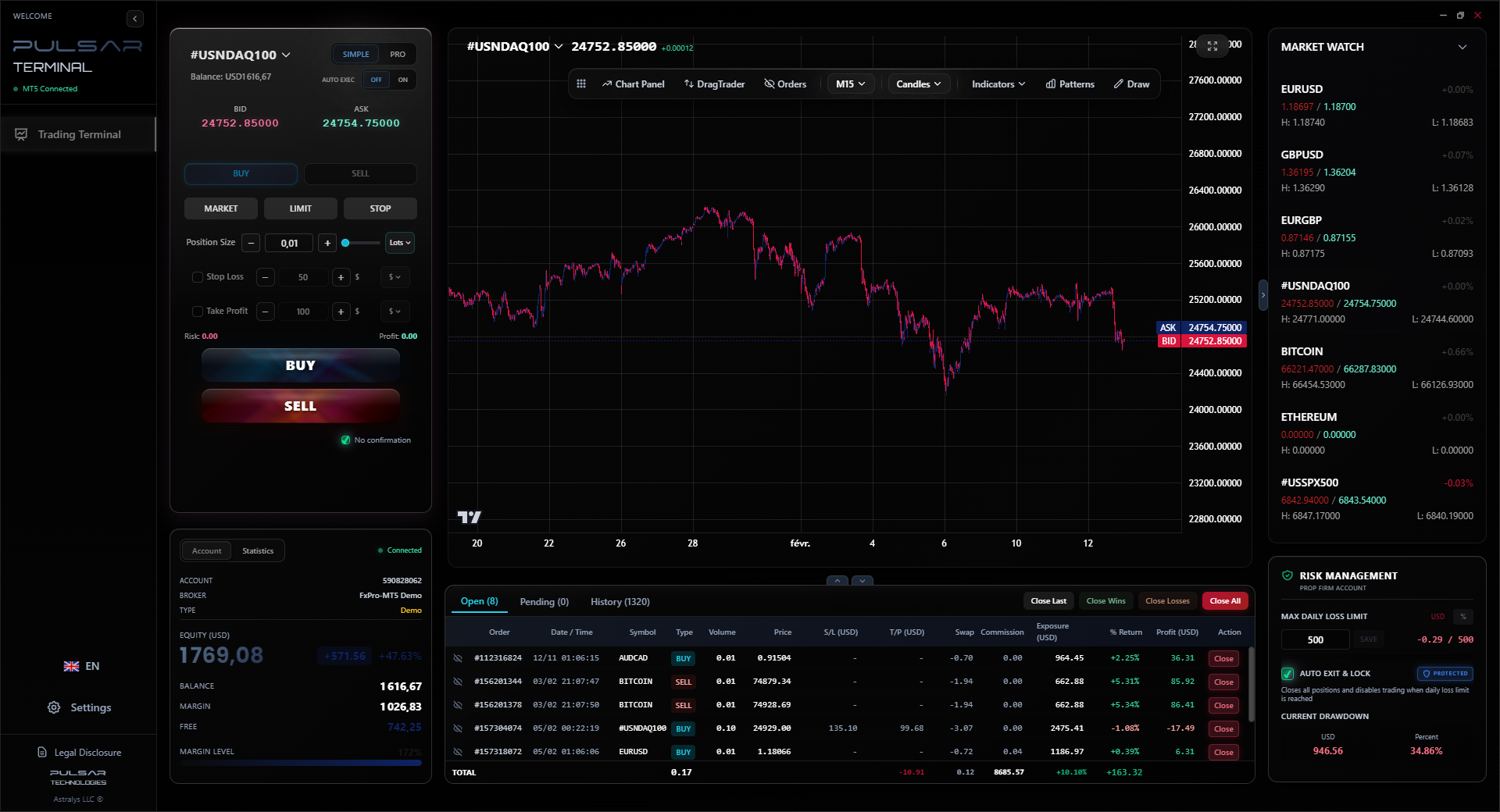
Managing complex trades on illiquid pairs requires precision; Pulsar Terminal's drag-and-drop order and multi-TP/SL tools on MT5 eliminate manual errors and help you execute your plan flawlessly.
“The core of trading is probability and edge. You stack the odds in your favor by reducing friction.”
Let's wrap this up by listing the mistakes I've made and seen, so you can skip them.
- Pitfall 1: Choosing a Broker for One Exotic Pair. You find a broker offering KWD/USD but ignore their terrible reviews on execution. You'll get filled on losers but not on winners.
- Pitfall 2: Ignoring the Total Cost of Conversion. That R250 bank fee might seem small on a R10,000 deposit, but it's 2.5%. Your trading edge needs to be huge just to cover that.
- Pitfall 3: Using Excessive use on Illiquid Pairs. A wide spread plus high use is a margin call waiting to happen. A small move against you can trigger a stop-out because the illiquid spread has eaten your buffer.
- Pitfall 4: Not Testing Withdrawals First. Before depositing large amounts, do a small test deposit and then a test withdrawal. See how long it takes, what the process is, and if any hidden fees appear. This tells you more about a broker than any sales page.
The core of trading is probability and edge. You stack the odds in your favor by reducing friction (costs, poor execution) and increasing clarity (good data, reliable platforms). Chasing a KWD account does the opposite on all fronts for 99% of South African traders.
FAQ
Q1Is it legal for South Africans to trade with brokers offering KWD accounts?
Yes, it's legal. South Africans can trade with both FSCA-regulated brokers and international (offshore) brokers. However, using an offshore broker means you forfeit the protections of South African law and the FSCA. If the broker fails or disputes arise, your recourse is much more difficult and expensive.
Q2What is the best base currency for a South African forex trading account?
The South African Rand (ZAR) is almost always the best choice. It eliminates currency conversion fees on deposits and withdrawals, and your profit/loss is immediately clear in your home currency. Only consider a USD or EUR account if you are trading very large sizes where the slightly wider USD/ZAR spread on your local broker becomes a meaningful cost, which is rare for most retail traders.
Q3Why are KWD trading pairs so rare and have wide spreads?
The Kuwaiti Dinar is not a freely floating speculative currency. It's pegged to a currency basket, and the Kuwaiti economy is not heavily integrated into global speculative capital flows. This results in a very small, illiquid forex market for the KWD. Low liquidity means fewer buyers and sellers, which leads to much wider spreads to compensate market makers for the risk of holding the position.
Q4Can I trade KWD/ZAR?
No, you will not find a credible forex broker offering a direct KWD/ZAR pair. The market for this simply doesn't exist. If you wanted exposure between the two, you'd have to trade KWD/USD and USD/ZAR separately, incurring double the spreads and commissions.
Q5What's a realistic minimum deposit to start trading seriously in South Africa?
While some brokers allow deposits as low as R500, a realistic minimum to trade properly - with sensible position sizing and emotional detachment - is between R5,000 and R10,000. This allows you to risk 1-2% per trade (R50-R200) which is manageable and sustainable for learning and developing a strategy.
Q6Do FSCA-regulated brokers offer high use like some international brokers?
No. The FSCA caps use for retail clients at 30:1 on major forex pairs. International brokers may offer 100:1, 500:1, or even 1000:1 to South African clients. While high use seems attractive, the 30:1 cap is a protective measure that forces better risk management and prevents the rapid account blow-ups that are common with excessive use.
प्रो. विंस्टन का पाठ
:
- ✓FSCA regulation is your non-negotiable safety net.
- ✓A ZAR account saves you 2-5% in hidden conversion fees.
- ✓Realistic starting capital is R5,000+, not R500.
- ✓Wide spreads on exotics like KWD can be 15+ pips.
- ✓Focus on liquid majors (USD/ZAR, EUR/USD) first.
यह लेख कितना उपयोगी था?
रेट करने के लिए स्टार पर क्लिक करें
साप्ताहिक ट्रेडिंग विश्लेषण
मुफ़्त साप्ताहिक विश्लेषण और रणनीतियाँ। कोई स्पैम नहीं।
लेखक के बारे में
David van der Merwe
उभरते बाजार के ट्रेडर
जोहानसबर्ग स्थित ट्रेडर, इमर्जिंग मार्केट करेंसीज में 11 साल का अनुभव। ZAR पेयर्स, FSCA-विनियमित ट्रेडिंग और दक्षिण अफ्रीकी मार्केट एनालिसिस में विशेषज्ञ।
टिप्पणियाँ
आपको यह भी पसंद आ सकता है

Cara Trading Forex Sukses: 7 Prinsip dari Trader Profesional
Cara trading forex sukses dengan 7 prinsip trader pro: manajemen modal, disiplin, journal trading, backtest. Data nyata, bukan janji profit palsu.
Jam Trading Forex Terbaik untuk Trader Indonesia: Panduan Lengkap dengan Tabel Waktu
Panduan jam trading forex untuk trader Indonesia. Tabel 4 sesi dunia, jam emas 20:00-00:00, sesi mana yang harus dihindari. Data akurat + tips dari trader berpengalaman.
Top 5 Sàn Forex Uy Tín Nhất 2026: Review Jujur dari Trader Indonesia
Top 5 sàn forex uy tín 2026 untuk trader Indonesia. Review jujur: spread, deposit, withdraw, dukungan lokal. Exness, XM, IC Markets & lebih.
All these calculators are built into Pulsar Terminal with real-time data from your MT5 account. One-click position sizing, automatic risk management, and instant calculations.
