


Here's a fact that'll make you pause: for every legitimate forex bureau in Lagos, there are at least two 'agents' or unlicensed shops ready to take a chunk of your capital.

Olumide Adeyemi
पश्चिम अफ्रीकी ट्रेडिंग अग्रणी ·  Nigeria
☕ 12 मिनट पढ़ने
आप क्या सीखेंगे:
- 1What Exactly Is a Forex Bureau (And What It Isn't)
- 2How Nigerian Traders Actually Use Forex Bureaus
- 3The Elephant in the Room: Crypto vs. The Forex Bureau
- 4Red Flags: How to Spot a Rogue Bureau or Agent
- 5A Step-by-Step Walkthrough: Funding Your Broker
- 6Navigating CBN Regulations and Your Paper Trail
- 7When You Shouldn't Bother Searching 'Forex Bureau Near Me'
- 8Putting It All Together: Your Personal Funding System

Here's a fact that'll make you pause: for every legitimate forex bureau in Lagos, there are at least two 'agents' or unlicensed shops ready to take a chunk of your capital. Searching 'forex bureau near me' in Nigeria isn't just about finding the best Naira-to-dollar rate. It's a critical part of your trading infrastructure, connecting your local cash to the global markets. I've seen traders make perfect entries on EUR/USD only to get wrecked by a terrible bureau exchange or a frozen transaction. This isn't ancillary stuff. It's as important as your stop-loss. We're going to break down exactly what you need from these places, how to use them without getting burned, and when you should avoid them entirely.
Let's get this straight from the start. A forex bureau in Nigeria is a licensed retail outlet authorized by the Central Bank of Nigeria (CBN) to buy and sell foreign currency. Think of it as a physical bridge between your Naira and the outside world. They're for cash exchange, international wire transfers (like Western Union), and sometimes, loading prepaid travel cards.
What they are NOT is a broker. You cannot open a trading account with them or execute trades through their platform. Their job ends once you have the foreign currency in hand or sent abroad. The moment you start thinking of them as part of your trading platform, you're confused, and confusion costs money.

Warning: The term 'forex bureau' is often misused. Many unlicensed money changers (the guys with calculators on the street or in small shops) call themselves bureaus. They might offer better rates, but you're trading security for a few Naira. If it looks shady and isn't displaying a clear CBN license, walk away.
The legitimate ones are your safest bet for converting larger amounts. Names like Travelex, First Rate Bureau de Change, and a network of licensed independents. Your goal isn't just to find a 'forex bureau near me,' but to find a reputable, licensed one. The difference can be the difference between funding your IC Markets review account and funding a scammer's vacation.

💡 विंस्टन की सलाह
The spread at a bureau is just like the broker's spread: a direct cost. If their buy/sell spread is more than ₦10 for major currencies, you're being taken for a ride. Shop around.
You're not a tourist changing money for a holiday. Your needs are specific, repetitive, and often larger in volume. Here’s what you’re really using them for.
Funding Your International Broker
This is the big one. Most top-tier brokers like Pepperstone review or Exness review don't accept direct Naira deposits. You need USD, EUR, or GBP. You go to the bureau with Naira, buy USD, and then initiate an international wire transfer (SWIFT) or use a card they provide to deposit. The fees here are multilayered: bureau exchange spread, wire transfer fee ($15-$50), and possible receiving fee from your broker. I once made a $2,000 deposit that cost me nearly $90 in total fees because I didn't shop around. That's 4.5% gone before I even placed a trade.
Cashing Out Profits
The reverse journey. Your broker wires USD to your Nigerian bank account. Your bank will convert it to Naira at their own (often poor) official rate. Many traders instead have the broker send to a USD domiciliary account, then take the USD cash to a bureau to sell for Naira. You can sometimes get a better rate than the bank. Crucially, you must be able to explain the source of funds to your bank and the bureau to avoid your account being flagged.
The Crypto On-Ramp
This is increasingly common. You can't buy USDT directly with Naira on Binance P2P? No problem. Go to the bureau, buy USD cash, then find a P2P vendor who accepts physical cash deposit. It's a workaround. I've done this when P2P rates were insane. I bought $500 cash at ₦1,480/$, met a vendor at a GTBank, deposited the cash into his account, and got my USDT. It felt sketchy, but it worked. It's higher risk, but it's a reality.

Pro Tip: Build a relationship with one good bureau. After a few transactions, you can often call for their best rate, bypass the queue, and they'll be more helpful with documentation for larger sums. Don't bounce around for every 50k Naira transaction.
“For funding a trading account, crypto is eating the forex bureau's lunch for many traders.”
Let's be blunt. For funding a trading account, crypto is eating the forex bureau's lunch for many traders. Here’s the breakdown.
| Method | Speed | Typical Cost | Risk |
|---|---|---|---|
| Bureau (Wire Transfer) | 1-5 business days | 3-6% total fees | Bank rejection, frozen funds, poor rate |
| Crypto (USDT Transfer) | 5-60 minutes | 0.5-2% network/swap fees | Crypto volatility during transfer, P2P scam risk |
I switched to almost exclusively using crypto for funding about two years ago. The speed is the killer feature. I can see a setup on the XAU/USD guide, deposit via USDT to a broker that accepts it, and be in the trade within the hour. With a bureau wire, the market could be gone by the time the money lands.
However, searching 'forex bureau near me' is still essential because crypto isn't perfect. If you need to cash out a large profit - say $10,000 - converting that all through P2P is a hassle and raises flags. A bureau transfer into your domiciliary account is often cleaner for large, documented sums. Also, if you're not tech-savvy, the P2P process is a minefield of scams. The bureau, for all its slowness, is a physical place you can complain to.
The smart move? Use crypto for fast, routine deposits. Use the bureau for large withdrawals where you need a paper trail and stability. And always, always calculate the total cost of both routes using a position size calculator to see what percentage you're losing before you start.
This is where I get serious. Losing money in a trade is one thing. Losing it to a thief before it even hits your broker is a special kind of stupid. Here are the signs.
Too-Good-To-Be-True Rates: If the rate is significantly better (like ₦20-₦50 more per dollar) than the official market or other bureaus, it's a trap. They'll either give you counterfeit notes, delay the transfer until you're frustrated and leave, or just vanish with your money.
No Physical Office or License: A proper bureau has a visible, permanent office with a displayed CBN license. The 'agent' who meets you at a mall parking lot or a hotel lobby is operating in a grey area. You have zero recourse if things go wrong.
Pressure to Pay Upfront for Transfers: For wire transfers, a legitimate bureau will initiate the transfer and give you the SWIFT receipt before you pay the full Naira equivalent. If they demand full cash payment upfront with a promise to transfer 'later,' run. I learned this the hard way early on, losing ₦150,000 to a smooth talker in Abuja.
Vague or Changing Fees: All fees should be stated clearly and upfront: exchange rate, transfer fee, receiving fee. If they keep adding small charges or can't give you a final total, they're improvising, and you're the one who'll pay for it.
Your due diligence is non-negotiable. Ask for their license number. Check it. Look them up online. Ask other traders. The few minutes you spend verifying can save you a year's worth of profits. This is a foundational part of your risk management, as critical as setting a margin call level.
💡 विंस्टन की सलाह
Never, ever let the bureau's agent leave your sight with your money to 'go and process it in the back.' Your eyes stay on your cash until the transaction is complete and you have the foreign currency or receipt in hand.

“Losing money to a thief before it even hits your broker is a special kind of stupid.”
Let's make this concrete. Here’s exactly how I'd do a $1,000 deposit today using a bureau.
- Preparation: I already know my broker's (XM review) receiving bank details. I have my account number and the required reference. I call my trusted bureau and ask for their USD buying rate for a $1,000 wire transfer, and their total transfer fee.
- The Math: They quote ₦1,450/$ and a $30 transfer fee. So, I need $1,030 total. $1,030 * ₦1,450 = ₦1,493,500. I confirm this is the total all-in cost.
- At the Bureau: I go in with my ID (International Passport or National ID). I give them the broker's bank details and my trading account number as reference. I pay the ₦1,493,500. They initiate the transfer and hand me the SWIFT receipt (MT103). This receipt is my proof. I check every detail on it.
- The Wait: I note the expected correspondent bank fees (maybe $15). So, my broker will likely receive $1,000 - $15 = $985. I adjust my mental position size calculator accordingly. The deposit shows in 2-3 days.
- The Alternative - Crypto: For comparison, to deposit $1,000 via crypto, I'd check the USDT/NGN rate on Binance P2P (say ₦1,465). I'd need ~$1,000 * ₦1,465 = ₦1,465,000. I buy USDT from a verified merchant, send it to my broker's crypto address, and it's there in 15 minutes. The cost is just the P2P spread and network fee, often cheaper and infinitely faster.
The bureau process is slower and more expensive, but for some, it feels more secure and official. The choice is yours, but now you know the real numbers involved.
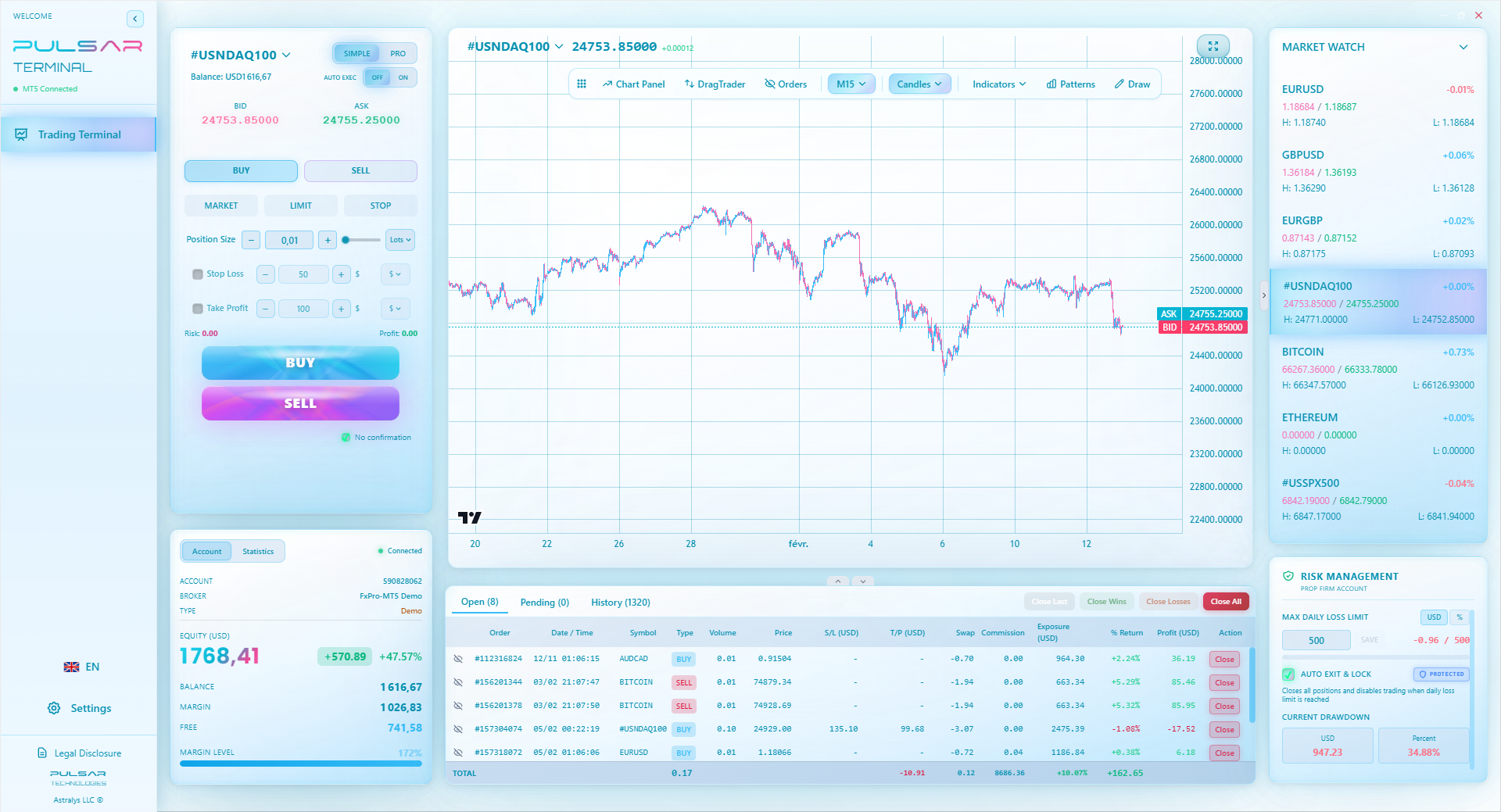
Managing the complex entries and exits you plan after finally funding your account is where a tool like Pulsar Terminal shines, letting you set multi-level take-profits and stop-losses directly on your MT5 chart.
You can't talk about 'forex bureau near me' in Nigeria without talking about the CBN. Their policies directly control the flow of your money.
The central issue is source of funds. For any significant transaction, the bureau and your bank have a legal obligation to ask. For deposits, be prepared to show where your Naira came from (business income, salary, etc.). For withdrawals (incoming wires), you must be able to explain the source to your bank. 'Trading profits' is a valid answer, but you better have some supporting docs: statements from your broker, a simple profit/loss summary.
I keep a dedicated folder. Screenshot of my trading platform showing the withdrawal request, the broker statement, and the SWIFT confirmation. When my bank called about a $5,000 incoming wire last year, I emailed them the PDFs within minutes. No frozen account.
Regulations change. Limits on cash transactions, allowable purposes for forex purchase (travel, education, medical). As a trader, your purpose is 'International Remittance' for trading capital. It's not always a category they love, but it's legitimate. Staying informed prevents nasty surprises. A good bureau will tell you the current rules; a bad one will tell you 'no problem' and get you into trouble.
This regulatory friction is a major reason crypto is attractive. It bypasses these questions (for now). But that doesn't mean the questions won't come later. However you move money, keep that paper trail. It's boring, but it's the armor that protects your capital from institutional friction.
“The bureau is a heavy, reliable truck. It's good for moving large loads. It's terrible for quick dashes.”
There are times when the bureau is the wrong tool for the job. Recognizing these will save you time and stress.
For Small, Frequent Deposits: If you're practicing with a $100 account or making weekly scalping strategy deposits, the fixed wire fees will murder you. At that scale, crypto is the only sensible choice, or using a broker with a local Naira payment option (though these often have worse execution).
During Extreme Market Volatility: When the Naira is in freefall or there's a major forex policy announcement, bureaus freeze. They don't know what rate to give. You'll get 'no dollars' or a rate that's completely unfair. I tried to buy dollars during a major devaluation rumor once and was quoted a rate 15% worse than the day before. I walked out.
If You Need Speed for a Trade Setup: This is crucial for swing trading entries on a specific candle close or breakout. If you see your setup on the EUR/USD guide forming, and your money is in Naira, a bureau wire will make you miss it. Your edge disappears. This is the strongest argument for always keeping some capital in your trading account or in stablecoins ready to go.
When You Can't Verify Their Legitimacy: If you're in a new city and can't do basic checks, just wait. It's better to miss a potential trade than to definitely lose your capital to a scam. Use your mobile banking app or crypto until you can properly vet a local bureau.
Think of the bureau as a heavy, reliable truck. It's good for moving large loads on a planned route. It's terrible for quick dashes to the store. Use the right vehicle for the trip.
💡 विंस्टन की सलाह
Treat the total cost of funding (bureau spread + wire fees) as your first trade loss. If it's 4%, your very first trade needs to make 4% just to break even. This changes your entire risk calculus from the start.
So, stop just searching 'forex bureau near me' reactively. Build a system. Here’s mine.
Step 1: The Relationship. I have one licensed bureau in VI, Lagos, that I use for all large (>$2k) wire-based deposits/withdrawals. I have the manager's direct line. I know their process.
Step 2: The Primary Channel. For 90% of my activity, I use crypto (USDT). I have a trusted list of P2P merchants, and I fund my broker directly from my cold wallet. The speed is unbeatable for acting on signals from my MACD indicator or RSI indicator divergences.
Step 3: The Documentation. Every single transaction, bureau or crypto, gets logged in a spreadsheet: date, amount, rate, fees, purpose. Every wire receipt is scanned. Every broker statement is downloaded monthly.
Step 4: The Buffer. I maintain a small float in my trading account at all times. This means I'm never forced to make a rushed funding decision during a market opportunity or a bureau crisis.
Your system will look different. Maybe you hate crypto and prefer the bureau's paper trail. Fine. But have a planned, repeatable process. The cost of not having one is measured in lost opportunities, wasted fees, and the very real risk of theft. The bureau is a tool. Learn its specs, its limits, and its cost. Then integrate it into your trading business like you would any other piece of software or analysis. Because in the end, the money has to move. Your job is to make sure it moves safely, cheaply, and gets you into the trade on time.

FAQ
Q1Is it legal to buy forex from a bureau for trading?
Yes, it is legal. The purpose falls under 'International Remittances.' You are allowed to send money abroad for legitimate purposes, which includes investing/trading on international platforms. The key is using a CBN-licensed bureau and being able to explain the source of your Naira and the purpose of the transfer if asked.
Q2What's the difference between a bureau rate and the black-market rate?
The bureau rate is set by licensed operators within a band influenced by the official market. The black-market (or parallel market) rate is determined by street demand and supply, is illegal, and is usually higher (you get more Naira for your dollar). However, using the black market carries the risk of counterfeit notes, robbery, and no legal recourse. The bureau rate is safer and provides a receipt for your records.
Q3Why would my bank reject an incoming wire from my broker?
Banks are required to combat money laundering. An unexpected large foreign wire can trigger a review. They may reject it if you cannot immediately provide proof of the source (broker statement, proof of earlier outward transfer). Always inform your bank manager of expected large incoming wires and have your documents ready to email.
Q4Can I fund a prop firm challenge through a forex bureau?
Technically, yes. You would wire the challenge fee from the bureau to the prop firm. However, the strict daily loss limits of prop firms make managing risk paramount. Using a tool that automates stop-losses can be a lifesaver here, letting you focus on strategy rather than micro-managing every pip definition.
Q5What ID do I need to use a forex bureau?
You will need a valid government-issued photo ID. Your International Passport is the most universally accepted. Your National ID card or Driver's License may also be accepted, but always carry your passport to be safe. They are required by law to record your details for any significant transaction.
Q6Are bureau rates negotiable?
For large transactions (typically above $5,000 equivalent), you can often call and ask for their 'corporate' or 'best rate.' For smaller amounts, the rate is usually fixed and displayed. Building a relationship is the key to getting better rates over time.
Q7What's safer for a large withdrawal: bureau or crypto?
For a single, large withdrawal (e.g., $10,000+), a bureau wire into your domiciliary account is generally safer from a regulatory and documentation standpoint. Moving that volume through P2P crypto involves multiple transactions with different strangers, increasing counterparty risk and potential for account freezes on the P2P platform.
प्रो. विंस्टन का पाठ
:
- ✓A licensed bureau's rate spread should be under ₦10 for USD.
- ✓Total funding cost via wire often hits 4-6%.
- ✓Crypto deposits can be 10x faster than bureau wires.
- ✓Always get the SWIFT receipt BEFORE paying full Naira.
- ✓Keep a folder of broker statements for every wire.
यह लेख कितना उपयोगी था?
रेट करने के लिए स्टार पर क्लिक करें
साप्ताहिक ट्रेडिंग विश्लेषण
मुफ़्त साप्ताहिक विश्लेषण और रणनीतियाँ। कोई स्पैम नहीं।
लेखक के बारे में
Olumide Adeyemi
पश्चिम अफ्रीकी ट्रेडिंग अग्रणी
नाइजीरिया के सबसे सक्रिय फॉरेक्स ट्रेडिंग एजुकेटर्स में से एक। लागोस से 8 साल का ट्रेडिंग अनुभव। अफ्रीकी ट्रेडर्स के लिए लो-कैपिटल स्ट्रैटेजीज और प्रॉप फर्म चैलेंजेज में विशेषज्ञ।
टिप्पणियाँ
आपको यह भी पसंद आ सकता है

Cara Trading Forex Sukses: 7 Prinsip dari Trader Profesional
Cara trading forex sukses dengan 7 prinsip trader pro: manajemen modal, disiplin, journal trading, backtest. Data nyata, bukan janji profit palsu.
Jam Trading Forex Terbaik untuk Trader Indonesia: Panduan Lengkap dengan Tabel Waktu
Panduan jam trading forex untuk trader Indonesia. Tabel 4 sesi dunia, jam emas 20:00-00:00, sesi mana yang harus dihindari. Data akurat + tips dari trader berpengalaman.
Top 5 Sàn Forex Uy Tín Nhất 2026: Review Jujur dari Trader Indonesia
Top 5 sàn forex uy tín 2026 untuk trader Indonesia. Review jujur: spread, deposit, withdraw, dukungan lokal. Exness, XM, IC Markets & lebih.
All these calculators are built into Pulsar Terminal with real-time data from your MT5 account. One-click position sizing, automatic risk management, and instant calculations.
