


Tired of staring at charts all day? Wondering if a Forex EA builder can finally give you that 'set and forget' trading edge you've heard about? You're not alone.

David van der Merwe
उभरते बाजार के ट्रेडर ·  South Africa
☕ 11 मिनट पढ़ने
आप क्या सीखेंगे:
Tired of staring at charts all day? Wondering if a Forex EA builder can finally give you that 'set and forget' trading edge you've heard about? You're not alone. Over 190,000 traders in South Africa are in the market, and the idea of a robot doing the work is incredibly tempting. I've built my share of bots, some that made money and some that spectacularly blew up accounts. Let's talk honestly about what these tools can and can't do for you, how to navigate our local regulations, and whether building your own EA is a smart move or a fast track to frustration.
Let's cut through the jargon. A Forex Expert Advisor (EA) is just a robot - a piece of software that runs on your MetaTrader 4 or 5 platform. It follows a set of rules you give it to open, manage, and close trades automatically, 24/7. No emotions, no bathroom breaks.
A Forex EA builder is the tool you use to create that robot without needing to be a coder. Think of it like a visual recipe book for trading strategies. Instead of writing complex MQL4/5 code, you use drag-and-drop blocks or fill in forms: "IF the RSI indicator goes below 30, THEN buy." "IF price hits my take-profit, THEN close the trade."
The promise is huge: automate your winning strategy, trade multiple pairs at once, and catch moves while you sleep. The reality? It's a powerful tool, but it's only as good as the strategy and the person building it. Garbage in, garbage out, as they say. I once spent weeks building a beautiful, complex EA based on three confirming indicators. It looked brilliant in testing. In live markets, it managed to lose R2,300 in two days because I'd completely overlooked how it would handle sudden news volatility. The builder worked perfectly; my logic was flawed.

Warning: An EA builder makes the creation easy. It does not make the strategy profitable. You still need a solid, tested trading edge to automate. Don't expect the tool to give you one.

💡 विंस्टन की सलाह
A builder constructs the house, but you must own the land. Your profitable strategy is the land. Secure that first before you even open the builder software.
Is it right for you? Let's look at the local scene. Our market is growing fast, with daily volumes over $2.1 billion. The USD/ZAR pair is a local favourite, but it's an exotic pair, which means wider spreads and more erratic moves - something any EA must handle carefully.
The Good: Why It Can Work
If you already have a clear, rule-based strategy that you trade manually with success, automation is the logical next step. It removes emotional hiccups - like that time you hesitated on a GBP/USD entry and missed 40 pips. It also lets you test your ideas ruthlessly with historical data before risking a cent. For our busy lives here, the ability to not be chained to the screen during load-shedding or work hours is a massive plus.
The Bad: Where It Goes Wrong
Most newcomers get this backwards. They look for a 'magic bot' to solve their trading problems. I've been there. I bought a fancy EA builder years ago thinking it was the missing link. I had no consistent strategy, so I just automated a bunch of random ideas. The result was a quick way to lose money systematically. Automation amplifies everything: a good strategy gets better, a bad strategy gets worse, faster.
Also, our market isn't isolated. Your EA trading the Rand will be affected by global liquidity drops (like during Asian lunch hours), which can widen spreads and trigger unintended orders. You need a broker with stable execution. I've had good experiences with the tight spreads and reliable MT4/5 platforms from brokers like IC Markets and Pepperstone for this kind of automated trading.
“Automation amplifies everything: a good strategy gets better, a bad strategy gets worse, faster.”
This is the most important part. Automated trading is completely legal in South Africa, but you must play by the rules to keep your money safe.
The Financial Sector Conduct Authority (FSCA) is our main financial watchdog. They don't regulate you, the individual trader, but they do regulate the brokers you use. This is your first line of defence.
Always, always use an FSCA-regulated broker. Why? Because they are required by law to keep your client funds in segregated accounts. This means your money is separate from the broker's operating money. If the broker goes under (it happens), your capital should be protected. Regulated brokers also have to follow strict conduct rules. I only ever keep significant funds with brokers like XM or Exness that clearly display their FSCA authorization number.

Pro Tip: Before you deposit, check the broker's website for their FSP number. Then, verify it on the official FSCA website. It takes two minutes and is the best habit you can develop.
What about those flashy offshore brokers offering crazy bonuses? The FSCA strongly advises against them. If you have a dispute with an unregulated offshore entity, good luck getting help. Your recourse is much clearer with a locally regulated firm. Remember, your fancy EA can't protect you from a shady broker.
Also, understand your broker's specific rules on EAs. Some might restrict certain types of high-frequency trading or have rules about minimum distances for stop-loss orders. Check their FAQ or ask support before you run your bot live.
Let's get practical. Here’s a roadmap I wish I had when I started.
Step 1: Start with a STRATEGY, not software. You need a mechanical, unambiguous trading plan. For example: "Buy EUR/USD on a 1-hour chart when the 50 EMA crosses above the 200 EMA, and the MACD indicator is above zero. Stop-loss is 20 pips below the recent swing low. Take profit is at a 1.5:1 risk-to-reward ratio." See? No "I think" or "maybe." This is the recipe your EA builder will follow.
Step 2: Choose Your EA Builder Tool. Costs vary. A popular web-based option like EA Builder has a free version for indicators and a full one-time license around $97 for building EAs. More professional-grade software like Forex Strategy Builder can cost over €1,000. My advice? Start with a cheaper or free option. You're learning, not launching a hedge fund.
Step 3: Paper Trade (Backtest & Forward Test). This is non-negotiable. Use the builder's backtesting feature to run your EA against years of historical data. Does it make money? How does it handle the 2020 COVID crash or a major SARB announcement? Look at the equity curve - is it a smooth rise, or a rollercoaster?
Then, run it on a demo account in real-time market conditions for at least a month. This checks for any bugs with live spreads and execution. I once had an EA that passed backtesting but failed in demo because my stop-loss was set too close to the spread in volatile USD/ZAR trading, causing instant slippage.
Step 4: Go Live with a Tiny Account. Start with the absolute minimum you can. If your broker's minimum is $5 or $100, use that. This is your final test. Monitor it like a hawk for the first week. Use a position size calculator to ensure your risk per trade is microscopic - like 0.5% of your account. The goal here is to validate the process, not get rich.
💡 विंस्टन की सलाह
Backtest to learn, not to win. The goal isn't a perfect historical profit chart; it's to find your strategy's breaking points before real money is on the line.
“The dream of passive income from forex is real, but it's built on a foundation of hard work, patience, and relentless discipline.”
Let's talk numbers and common traps.
The Real Costs:
- EA Builder Software: $97 to €1,500+ (one-time or subscription).
- Broker Spreads & Commissions: This is your ongoing cost. For EAs that trade frequently, this is critical.
| Broker Type | Typical EUR/USD Spread | Best For... |
|---|---|---|
| Standard/Commission-Free | 0.8 - 1.5 pips | Beginners, low-frequency EAs. You pay via the spread. |
| Raw Spread/ECN | 0.0 - 0.3 pips + commission | Serious EA trading. Lower total cost for high volume. |
For a scalping strategy EA, those tiny fractions of a pip add up fast. An ECN account from a broker offering 0.0-pip spreads is often cheaper in the long run, even with a commission per trade.
Common Pitfalls to Avoid:
- Over-optimization: This is the killer. You tweak your EA so perfectly to fit past data that it fails in the future. It's called "curve-fitting." If your strategy has 10 complicated conditions, it's probably overfitted.
- Ignoring Slippage & Spreads: In your backtest, always set the model to "Every tick" or "Control points" and use realistic spread settings. Assuming a fixed 1-pip spread when USD/ZAR can gap 5 pips on news is a recipe for a margin call.
- No Safety Protocols: Your EA must have a daily loss limit. I learned this the hard way. One of my early bots entered a losing trade, then doubled down 5 times in a row trying to average down. It wiped out a day's profits in an hour. Now, any EA I build has a hard rule: "Stop all trading if daily drawdown exceeds 3%."
Broker Selection Checklist:
- FSCA Regulation (Non-negotiable).
- Supports MT4/5 (Almost all do).
- Offers stable VPS hosting (or allows you to connect one). This keeps your EA running 24/7 without needing your PC on.
- Clear, low-cost fee structure. Understand if they have inactivity fees.
- Good local support (South African phone number or responsive live chat).
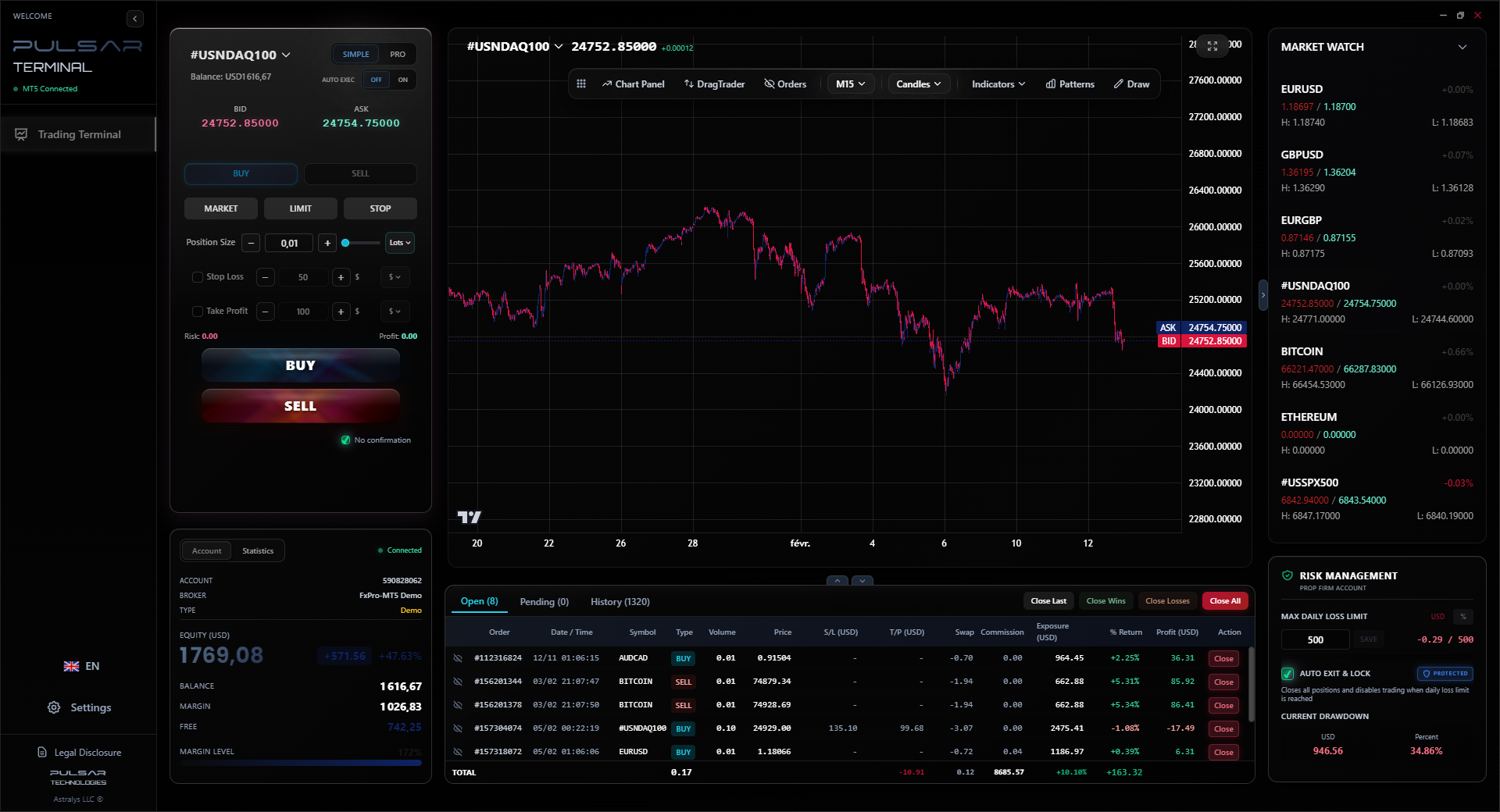
Managing complex EA orders and setting strict daily loss limits—key for prop firm challenges—is far easier with a tool like Pulsar Terminal that integrates directly with your MT5 platform.
You've got the basics. Here's the stuff they don't tell you in the tutorial videos.
Money Management is King: The EA handles the entry. You must handle the risk. Never let the EA control your position size dynamically unless you are an expert programmer. Instead, fix your risk per trade. If your account is R10,000 and you risk 1%, that's R100 per trade. Your EA's stop-loss distance then determines your lot size. This is the single most important factor in long-term survival.
The Market Changes. Your EA Must Too. A strategy that works in a strong trending market will get slaughtered in a tight range, and vice-versa. Consider building two separate EAs: one for trending conditions (using indicators like moving averages) and one for ranging conditions (using something like RSI indicator overbought/oversold levels). You manually switch them on or off based on your market assessment. Full adaptability is incredibly hard to code.
Keep It Simple, Seriously. My most profitable EA to date is embarrassingly simple. It's a basic swing trading idea on XAU/USD (gold). It identifies a support level, waits for a bullish pin bar to close, and enters with a 2:1 risk-reward. That's it. No fancy algorithms. It works because the logic is sound and strong, not clever. I've made over R15,000 with it across several months, not because it wins every time, but because its wins are bigger than its losses.

Example: That gold EA has a 45% win rate. It loses R500 per losing trade and makes R1,000 per winner. For every 100 trades: 45 wins = R45,000. 55 losses = R27,500. Net profit = R17,500. It's not about being right most of the time; it's about the maths.
“Your EA must have a daily loss limit. I learned this the hard way when a bot doubled down 5 times in a row and wiped out a day's profits.”
So, is a Forex EA builder worth it for you in South Africa?
Yes, if: You have a proven, written-down manual strategy. You understand risk management cold. You're disciplined enough to test thoroughly. You want to free up your time and remove emotion. You're committed to using an FSCA-regulated broker.
No, if: You're still searching for a profitable strategy. You think automation is a shortcut to profits. You can't be bothered to learn about backtesting or money management. You're tempted by unregulated brokers promising the moon.
What about just buying a pre-made EA? I'm skeptical. The truly profitable ones are rarely sold. The market is flooded with "Martingale" or "Grid" EAs that hide risk until they blow up your account. If you buy one, dissect its logic in a demo account for months first.
Your best path forward? Pick one major pair like EUR/USD, develop a simple strategy, and learn a basic EA builder. Treat it as a fascinating educational project, not a money-printing machine. The skills you learn - in strategy design, testing, and risk management - will make you a better trader, whether you use a bot or not.
The dream of passive income from forex is real, but it's built on a foundation of hard work, patience, and relentless discipline. The EA builder is just a tool. You are the craftsman. Now, go build something solid.
FAQ
Q1Is it legal to use a Forex EA in South Africa?
Yes, it's completely legal for individual traders to use Expert Advisors. The key legal requirement is that you must use a broker that is authorised and regulated by the Financial Sector Conduct Authority (FSCA) to ensure your funds are protected under South African law.
Q2How much money do I need to start trading with an EA?
You can start with very little. Some FSCA-regulated brokers like XM allow minimum deposits as low as $5 (around R90), and Fusion Markets has a $0 minimum. However, for serious testing and to properly manage risk, I'd recommend starting with at least R1,500 - R2,000 in a demo account, then moving to a live account with a similar amount once you're confident.
Q3Can I build an EA with no programming experience?
Absolutely. That's the whole point of an EA builder platform. They use visual interfaces, dropdown menus, and rule builders that let you create trading logic without writing a single line of code. You just need to be able to define your trading strategy in clear "if this, then that" rules.
Q4What's the biggest mistake new EA traders make?
Over-optimization, also called curve-fitting. They tweak their EA's rules so much to perfectly fit past price history that the strategy becomes fragile and fails miserably in live, unseen market conditions. The second biggest mistake is not understanding or controlling position size, letting the EA risk too much per trade.
Q5Do I need to leave my computer on 24/7 for the EA to work?
Not necessarily. Many brokers offer or support Virtual Private Server (VPS) hosting for a small monthly fee (sometimes free if you trade a certain volume). This is a remote computer that runs your trading platform and EA continuously. It's more reliable than using your own PC, especially with load-shedding.
Q6Are pre-made EAs from online markets worth buying?
I'm very cautious about this. The vast majority are not worth it. Many use dangerous strategies like Martingale (doubling down on losses) that can show steady profits until they completely wipe out an account. Always, always test any bought EA on a demo account for several months, and fully understand its logic and risks before going live.
Q7Which is better for EAs, MT4 or MT5?
Both work. MT4 is older but incredibly stable and has more freely available EAs and indicators. MT5 is newer, can handle more asset types, and has a slightly more advanced backtester. Most EA builders support both. For pure forex, MT4 is still the industry standard and is perfectly sufficient.
प्रो. विंस्टन का पाठ
:
- ✓Start with a 100% mechanical strategy, not the software.
- ✓FSCA regulation for your broker is non-negotiable capital protection.
- ✓Test for at least one month in demo under real market conditions.
- ✓Never let an EA risk more than 1-2% of your account per trade.
यह लेख कितना उपयोगी था?
रेट करने के लिए स्टार पर क्लिक करें
साप्ताहिक ट्रेडिंग विश्लेषण
मुफ़्त साप्ताहिक विश्लेषण और रणनीतियाँ। कोई स्पैम नहीं।
लेखक के बारे में
David van der Merwe
उभरते बाजार के ट्रेडर
जोहानसबर्ग स्थित ट्रेडर, इमर्जिंग मार्केट करेंसीज में 11 साल का अनुभव। ZAR पेयर्स, FSCA-विनियमित ट्रेडिंग और दक्षिण अफ्रीकी मार्केट एनालिसिस में विशेषज्ञ।
टिप्पणियाँ
आपको यह भी पसंद आ सकता है

Cara Trading Forex Sukses: 7 Prinsip dari Trader Profesional
Cara trading forex sukses dengan 7 prinsip trader pro: manajemen modal, disiplin, journal trading, backtest. Data nyata, bukan janji profit palsu.
Jam Trading Forex Terbaik untuk Trader Indonesia: Panduan Lengkap dengan Tabel Waktu
Panduan jam trading forex untuk trader Indonesia. Tabel 4 sesi dunia, jam emas 20:00-00:00, sesi mana yang harus dihindari. Data akurat + tips dari trader berpengalaman.
Top 5 Sàn Forex Uy Tín Nhất 2026: Review Jujur dari Trader Indonesia
Top 5 sàn forex uy tín 2026 untuk trader Indonesia. Review jujur: spread, deposit, withdraw, dukungan lokal. Exness, XM, IC Markets & lebih.
All these calculators are built into Pulsar Terminal with real-time data from your MT5 account. One-click position sizing, automatic risk management, and instant calculations.
