


You're sitting in Johannesburg or Cape Town, charts open, wondering when you should actually be trading.

David van der Merwe
उभरते बाजार के ट्रेडर ·  South Africa
☕ 11 मिनट पढ़ने
आप क्या सीखेंगे:
- 1The 24/5 Illusion: What 'Open' Really Means for You
- 2The Global Sessions, Translated to SAST
- 3The Golden Hours: Session Overlaps for South Africans
- 4Trading the ZAR: Your Home Court Advantage
- 5Brokers, Costs & The 30:1 use Rule
- 6Matching Your Strategy to the SAST Clock
- 7The Daylight Saving Trap (Don't Get Caught)
- 8Your South African Trading Routine
You're sitting in Johannesburg or Cape Town, charts open, wondering when you should actually be trading. Is the London session the only one that matters? What about the Asian open? And when does the USD/ZAR really wake up? I've been there, staring at a flat screen for hours, wasting my time. Let's cut through the noise. This isn't about when the market is 'open' - it's open 24/5. This is about when the market is alive, and more importantly, when it's alive for you, trading from South Africa.
Right off the bat, forget the idea of a single opening bell. The forex market is a global relay race, and the baton is constantly being passed. For us in South Africa, the official week kicks off at midnight SAST on a Sunday. That's when Sydney starts humming. It closes at midnight SAST on Friday when New York packs up.
But here's the raw truth I learned the hard way: just because it's open doesn't mean it's tradable. Trading during the Sydney session from SAST midnight to about 7 AM is like watching paint dry on most major pairs, unless you're specifically trading the AUD. The spreads are wider, the moves are sluggish, and unless you're a night owl with a specific scalping strategy for thin markets, you're better off sleeping.
The real game is about liquidity - the volume of trades hitting the market. No liquidity means your orders get filled at worse prices and the charts move in frustrating, choppy ticks. The magic, and the danger, happens when the big financial centers' working hours overlap. That's when banks, hedge funds, and corporations all jump in at once. For South African traders, this timing is everything. Our time zone, SAST (UTC+2), actually gives us a fantastic window into the most volatile periods without having to stay up all night. You just need to know when to look.

💡 विंस्टन की सलाह
The market pays you for patience, not presence. Sitting through the Sydney session from SA just proves you're dedicated to losing money slowly.
Let's break down the four main sessions into South African Standard Time. Remember, these are the core hours when the named financial center is most active, but trading happens before and after.
| Session | Core Hours (SAST) | Key Currency Pairs | Typical Character |
|---|---|---|---|
| Sydney | 00:00 - 09:00 | AUD, NZD, JPY crosses | Quiet, range-bound. Start of the week. |
| Tokyo | 03:00 - 12:00 | JPY pairs (USD/JPY) | Can see steady trends. Asian liquidity peak. |
| London | 10:00 - 19:00 | EUR, GBP, CHF (All Majors) | High volatility, big moves. The main event. |
| New York | 15:00 - 24:00 | USD pairs (EUR/USD, USD/CAD) | Extreme volatility at open, then often a directional push. |
The Asian Window (00:00 - 09:00 SAST)
If you're an early riser, you can catch the tail end of Tokyo. I used to try trading USD/JPY at 5 AM. It can work for a methodical swing trading approach, but the moves are often slow and deliberate. It's a good time for analysis and planning your day, not for adrenaline-filled action.
The London Powerhouse (10:00 SAST Onwards)
This is where your screen should be on. London is the undisputed king of forex volume. When London traders hit their desks, the market wakes up. EUR/USD, GBP/USD, they all start moving. This is when you'll see real momentum build. I've taken some of my best trades simply by being ready at 10:30 AM SAST, watching for the initial London-driven breakout.

Warning: The first hour of London (10:00-11:00 SAST) can be chaotic. False breakouts are common as the market absorbs the new liquidity. I've been whipsawed more times than I care to admit jumping in too early. Let the market settle for 30-60 minutes.
The New York Storm (15:00 SAST Onwards)
New York opens at 3 PM our time. This creates the most important overlap of the day with London. From 3 PM to about 7 PM SAST, you have both European and American traders in full force. Liquidity is massive, news is often released, and trends can accelerate violently. This is the most profitable - and riskiest - window for a South African trader. It's also perfectly timed after the workday for many.
“The London/New York overlap from 3 PM to 7 PM SAST is the most profitable - and riskiest - window for a South African trader.”
This is the core of the guide. If you only remember one thing, remember these overlap periods. This is when the majority of my pips have been made (and lost).
1. London/New York Overlap (15:00 - 19:00 SAST) This is the superstar. It's the most liquid and volatile period of the entire 24-hour cycle. Economic data from both the US and Europe often drops in this window. Trends that started in London get confirmed (or reversed) by New York money. The EUR/USD guide is essential reading for this session. The average true range of a pair like GBP/USD can double during this time. My single biggest win was a short on GBP/USD during this overlap in 2019. I entered at 1.3280 on a break of the Asian range low, set a trailing stop, and rode it down 180 pips to 1.3100 as New York selling piled in. The move was clean and powerful, purely driven by overlap liquidity.
2. Asian/European Overlap (08:00 - 10:00 SAST) A quieter but often underrated period. Tokyo is still open, and London is coming online. You can sometimes catch nice, early directional moves on EUR/JPY or GBP/JPY. It's less about earth-shattering news and more about technical breaks. The spread definition is important here - spreads on cross pairs can tighten nicely during this window, making entries cleaner.
3. The "Afternoon Lull" & Friday Close After New York lunchtime (around 21:00 SAST), volume starts to die. Avoid trading major decisions late at night SAST. Also, be hyper-aware of the Friday close (23:00-24:00 SAST). Squaring of positions can cause weird spikes. I once got stopped out on a perfectly good USD/CAD long 5 minutes before the weekly close by a random 8-pip spike. It came back Monday, but my trade was already dead.
Trading USD/ZAR, EUR/ZAR, or GBP/ZAR is a different beast. These pairs have their own rhythm, heavily influenced by local factors.
Liquidity for ZAR Pairs: The deepest liquidity for USD/ZAR aligns perfectly with the London and London/New York overlaps. That's when international banks and corporates are most active in the Rand. Don't expect much before 10:00 SAST. The most violent moves often happen between 3 PM and 5 PM SAST when US data hits and local banks are also active.
Local Data is Key: South African CPI, SARB interest rate decisions, budget speeches, and mining/production data are massive catalysts. These are almost always released between 10:00 AM and 12:00 PM SAST. Mark these on your calendar. A SARB rate decision can see USD/ZAR move 300-500 pips in an hour. I learned this painfully in 2022 when I was caught on the wrong side of a 50-bps hike. I was short USD/ZAR expecting a dovish hold. The pair ripped 450 pips against me in minutes, triggering a brutal margin call because my position size calculator didn't account for such an extreme local event.

Pro Tip: When trading ZAR pairs, use a broker with local regulation (FSCA) and tight spreads on these pairs. Check our Exness review and IC Markets review for brokers known for good ZAR pricing. The spread on USD/ZAR can be 50-100 pips during quiet times but tighten to 10-20 pips during London hours.
💡 विंस्टन की सलाह
Your biggest edge trading from SA is understanding the ZAR. Local data moves it more predictably than any fancy indicator. Ignore local news at your peril.
“30:1 use forces smarter position sizing. I used 100:1 early in my career and it magnified my losses, not my wins.”
You can't talk trading in SA without discussing the rules of the game. The FSCA is the sheriff in town, and they've made some big changes.
The 30:1 use Cap: Since 2021, retail traders are capped at 30:1 on major forex pairs. This is a good thing for most. It prevents you from blowing up your account in two bad trades. I used 100:1 early in my career and it magnified my losses, not my wins. 30:1 forces smarter position size calculator use. Some international brokers might offer higher use if you sign up with their global entity, but you lose FSCA protection. It's a risky trade-off.
Broker Landscape: You have solid FSCA-regulated options. XM review shows they're popular with a low $5 minimum. Pepperstone review highlights their razor-sharp spreads. For local flavor, Khwezi Trade is fully FSCA licensed and offers MT5 with ZAR accounts. The key is to pick one that offers stable execution during the volatile overlaps we discussed.
Real Cost Breakdown:
- Spreads: Your main cost. On EUR/USD, expect 0.8 - 1.5 pips on a standard account during London hours. It can double during off-hours.
- Commissions: On Raw/ECN accounts, you pay a commission (e.g., $3.50 per 100k lot) but get spreads near 0.0 pips. This is cheaper for high-volume traders.
- Funding: Depositing in ZAR to a ZAR account avoids currency conversion fees. This is a small but meaningful saving over time.
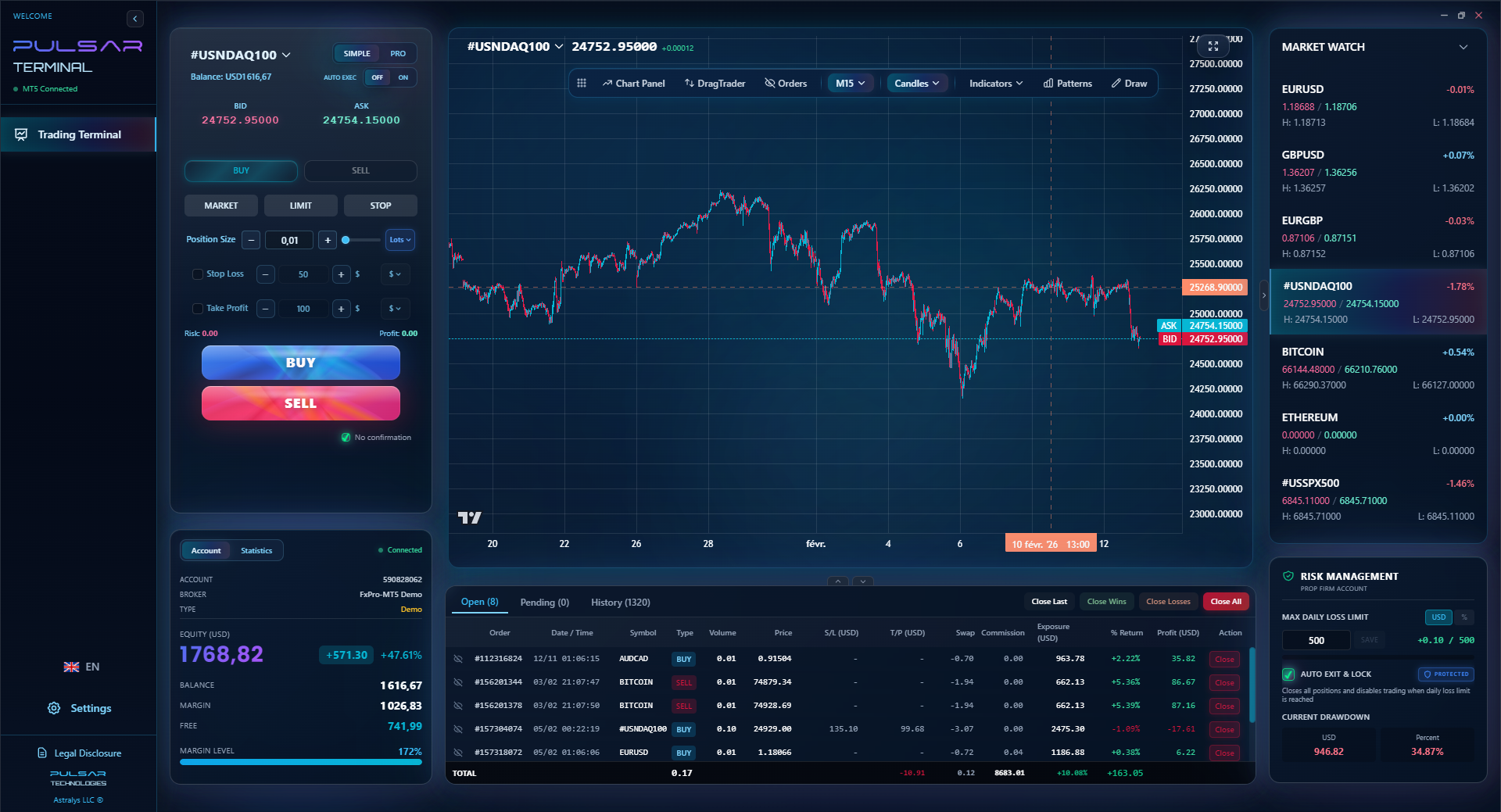
Managing multiple trades across volatile session overlaps is complex, but tools like Pulsar Terminal let you set multi-TP/SL and trailing stops on MT5 with one click, so you can focus on the market, not your order tickets.
Your trading style must adapt to the market's personality throughout the day.
Early Morning (05:00 - 09:00 SAST): This is analysis and preparation time. Review overnight price action, mark key levels on your charts. If you trade, consider longer-term setups on daily charts. It's terrible for scalping.
London Session (10:00 - 15:00 SAST): This is where trend-following and breakout strategies shine. The market picks a direction with conviction. Use the MACD indicator on a 1-hour or 4-hour chart to gauge momentum. This is your primary trading window if you have a day job - you can trade the open during a break.
London/New York Overlap (15:00 - 19:00 SAST): This is high-octane trading. Momentum strategies, news trading, and even shorter-term scalping can work due to the high liquidity and clean moves. The RSI indicator can help spot overbought/oversold conditions in a strong trend. This is the most important window for active South African traders.
Evening (Post-20:00 SAST): Wind down. Manage existing positions, but avoid new entries. The market gets thin and unpredictable. Use this time to review your trades, journal, and plan for tomorrow.
“Sometimes the best trade is no trade. If the overlap is a messy chop-fest, walk away. The market will be there tomorrow at 10 AM SAST.”
This is a classic rookie mistake that will mess up your market times for half the year. South Africa does NOT observe daylight saving time. But the UK, US, and Europe do.
When the Northern Hemisphere springs forward (usually late March), their clocks go ahead by one hour. Relative to SAST:
- The London Session now starts at 11:00 SAST (instead of 10:00).
- The New York Session now starts at 16:00 SAST (instead of 15:00).
The London/New York overlap shifts to 16:00 - 20:00 SAST.
When they fall back (late October), everything shifts an hour earlier again.
I got burned by this years ago. I was ready for a big move at my usual 3 PM, but the market was dead. An hour later, it exploded without me because New York had shifted. Now, I have a recurring calendar reminder for these clock changes. Most trading platforms will adjust the session indicators on their charts automatically, but you need to be mentally prepared for the shift in your daily routine.
💡 विंस्टन की सलाह
If you can only watch the market for one hour a day, make it 3:30 PM to 4:30 PM SAST. That's the heart of the storm. Everything else is just the build-up or the cleanup.
Here's a sample schedule based on everything we've covered. Adjust it for your life.
The Part-Time Trader (With a 9-5):
- 06:30 AM: Quick check of overnight closes on daily charts. Set potential alerts for key levels.
- 10:00 AM - 10:30 AM: Monitor the London open during a coffee break. Look for setup, but don't force a trade.
- 15:30 PM - 19:00 PM: Your main trading session. Focus on the London/New York overlap. This is 90 minutes after you get home - enough time to settle and focus.
The Full-Time Trader:
- 08:00 - 10:00 SAST: Deep analysis, plan trades for the day. Watch the Asian/European overlap for early setups.
- 10:00 - 12:00 SAST: Actively trade the London-driven momentum. Watch for SA data releases.
- 12:00 - 15:00: Manage London session trades, prepare for New York open.
- 15:00 - 19:00 SAST: Peak trading activity. Execute your best setups during the overlap.
- After 20:00 SAST: Review, journal, shut down.
The final piece of wisdom? Respect the clock, but don't be a slave to it. Sometimes the best trade is no trade. If you miss the London open or the overlap is a messy chop-fest, walk away. The market will be there tomorrow at 10 AM SAST, ready for another round. Your capital is your ammunition. Only fire when you have a clear shot.
FAQ
Q1What is the best time to trade forex in South Africa?
The single best time is the London/New York session overlap from 3:00 PM to 7:00 PM SAST. This period has the highest liquidity and volatility, offering the clearest trends and best trading conditions for most strategies.
Q2When does the forex market open and close in SAST?
It opens at 00:00 (midnight) SAST on Monday morning and closes at 24:00 (midnight) SAST on Friday night/Saturday morning. However, active trading for major pairs doesn't really begin until the Asian sessions get going and peaks during European and US hours.
Q3Can I trade USD/ZAR at night?
Technically yes, but you shouldn't. Liquidity for USD/ZAR dries up significantly outside of South African and European business hours. Spreads widen dramatically (sometimes over 100 pips), and price action can be erratic and illiquid. Stick to trading it between 10:00 AM and 7:00 PM SAST.
Q4How does daylight saving time affect my trading times?
South Africa doesn't have DST, but the UK, US, and EU do. When their clocks change, all their session times shift by one hour relative to SAST. For example, when the UK is on BST (Summer), the London session starts at 11:00 SAST, not 10:00. Always double-check session times in late March and late October.
Q5What is the maximum use I can use in South Africa?
For retail traders with an FSCA-regulated broker, the maximum use is capped at 30:1 for major currency pairs. This rule has been in effect since 2021 to protect traders from excessive risk.
Q6Is the Asian trading session important for South African traders?
It's important for setting up the day. The price levels established during the Asian session (00:00-09:00 SAST) often act as support or resistance for the London open. While it's not the most volatile time to trade majors, it's a crucial period for analysis and identifying the day's initial range.
प्रो. विंस्टन का पाठ
:
- ✓Trade the London/New York overlap (3-7 PM SAST) for maximum opportunity.
- ✓Avoid trading USD/ZAR outside 10 AM - 7 PM SAST due to wide spreads.
- ✓Always adjust for Northern Hemisphere Daylight Saving time shifts.
- ✓Use the 30:1 use cap to enforce disciplined position sizing.
- ✓Schedule your trading around liquidity, not just market 'open' times.
यह लेख कितना उपयोगी था?
रेट करने के लिए स्टार पर क्लिक करें
साप्ताहिक ट्रेडिंग विश्लेषण
मुफ़्त साप्ताहिक विश्लेषण और रणनीतियाँ। कोई स्पैम नहीं।
लेखक के बारे में
David van der Merwe
उभरते बाजार के ट्रेडर
जोहानसबर्ग स्थित ट्रेडर, इमर्जिंग मार्केट करेंसीज में 11 साल का अनुभव। ZAR पेयर्स, FSCA-विनियमित ट्रेडिंग और दक्षिण अफ्रीकी मार्केट एनालिसिस में विशेषज्ञ।
टिप्पणियाँ
आपको यह भी पसंद आ सकता है

Cara Trading Forex Sukses: 7 Prinsip dari Trader Profesional
Cara trading forex sukses dengan 7 prinsip trader pro: manajemen modal, disiplin, journal trading, backtest. Data nyata, bukan janji profit palsu.
Jam Trading Forex Terbaik untuk Trader Indonesia: Panduan Lengkap dengan Tabel Waktu
Panduan jam trading forex untuk trader Indonesia. Tabel 4 sesi dunia, jam emas 20:00-00:00, sesi mana yang harus dihindari. Data akurat + tips dari trader berpengalaman.
Top 5 Sàn Forex Uy Tín Nhất 2026: Review Jujur dari Trader Indonesia
Top 5 sàn forex uy tín 2026 untuk trader Indonesia. Review jujur: spread, deposit, withdraw, dukungan lokal. Exness, XM, IC Markets & lebih.
All these calculators are built into Pulsar Terminal with real-time data from your MT5 account. One-click position sizing, automatic risk management, and instant calculations.
