


You're sitting there, chart open, trying to figure out why your EUR/USD trade just reversed for no apparent reason.

Olumide Adeyemi
पश्चिम अफ्रीकी ट्रेडिंग अग्रणी ·  Nigeria
☕ 10 मिनट पढ़ने
आप क्या सीखेंगे:
- 1What Exactly Is This 'Forex New Calendar'?
- 2Why the Calendar is Your Secret Weapon in Nigeria
- 3The Events You Can't Afford to Miss
- 4How I Actually Use the Calendar: A Step-by-Step Walkthrough
- 5Our Unique Hurdles (And How to Jump Them)
- 6Tools, Brokers, and Making It All Work Together
- 7Crafting Your Personal News Trading Plan
You're sitting there, chart open, trying to figure out why your EUR/USD trade just reversed for no apparent reason. Sound familiar? It happens to all of us. More often than not, the reason isn't on your chart at all. It's buried in an economic calendar you didn't check. For us trading from Nigeria, with the Naira doing its own chaotic dance, understanding the 'forex new calendar' isn't just strategy. It's survival.
Let's clear this up first. When traders, especially here in Nigeria, talk about a 'forex new calendar', they're not referring to some shiny new app (though those exist). They mean the constantly updated schedule of economic events that move the markets. It's 'new' every single day, week, and month. Think of it as the market's heartbeat monitor.
For us, it's the difference between trading blind and trading with purpose. A major U.S. Federal Reserve announcement can wipe out a week's profits in minutes if you're on the wrong side. I learned this the hard way back in 2022. I was long on GBP/USD, feeling clever, when Fed Chair Powell gave a unexpectedly hawkish speech. The pair dropped 180 pips in an hour. I lost $450 on that one trade because I was focused on my charts and ignored the calendar. That loss stung, but it taught me more than a dozen wins.
The calendar lists everything: interest rate decisions, inflation data (like Nigeria's own CPI figures), employment numbers, GDP releases, and speeches by central bank officials. Each event has a potential volatility rating - low, medium, or high impact. Your job is to know when these events are scheduled and, more importantly, what they mean for your open positions.

Warning: Trading during high-impact news events without a specific strategy is like gambling during a hurricane. The volatility is insane, spreads can widen massively, and slippage can destroy your stop-loss orders. Most brokers serving Nigeria, like Exness or IC Markets, are transparent about this risk in their terms.

💡 विंस्टन की सलाह
The calendar isn't a crystal ball telling you which way price will go. It's a traffic report telling you when the roads will be dangerously icy. Your job is to slow down or pull over, not guess if you'll skid left or right.
Trading from Nigeria adds unique layers to this. It's not just about global events. It's about how they interact with our local reality.
The Naira Volatility Factor
Our currency has been on a wild ride. When the Central Bank of Nigeria (CBN) makes a policy announcement or adjusts the official exchange rate, it doesn't just affect NGN/USD. It affects your entire trading life. Why? Because your deposit and withdrawal conversions happen in Naira. A sharp devaluation between the time you deposit and withdraw can eat into your profits, even if all your forex trades were winners. You need to calendar the CBN's Monetary Policy Committee (MPC) meeting dates. They are your local high-impact events.
The Liquidity Crunch
During major global news, liquidity dries up. For Nigerian traders using international brokers, this can mean even wider spreads than advertised. I've seen the spread on EUR/USD blow out to 5 pips on an Exness Standard account during a Non-Farm Payroll (NFP) release, when it's normally around 1 pip. If your position size calculator isn't accounting for potential spread widening, you're undercapitalized for the real risk.
Regulatory Grey Area & Your Money
Since the SEC doesn't regulate retail forex here, we're on our own. Brokers operate under offshore licenses. This makes understanding global economic health crucial. If a major economy goes into recession, it affects your broker's liquidity providers. Your calendar helps you anticipate these macro shifts, not just trade them. It's a risk management tool for your entire operation.
“The 'forex new calendar' is the difference between trading blind and trading with purpose.”
Don't try to watch everything. You'll get overwhelmed. Focus on these pillars. I keep a simple text file with these dates pinned to my monitor.
| Event | Why It Matters | Typical Volatility |
|---|---|---|
| U.S. Non-Farm Payrolls (NFP) | Drives USD strength/weakness. Impacts all major pairs. | Very High |
| U.S. Federal Reserve (FOMC) Rate Decision | Sets the tone for global interest rates. | Extreme |
| European Central Bank (ECB) Rate Decision | Critical for EUR pairs, especially EUR/USD. | Very High |
| Consumer Price Index (CPI) - US, EU, UK | The main inflation gauge. Directly influences central bank policy. | High |
| CBN Monetary Policy Committee (MPC) Meeting | Affects Naira value, local inflation, and your conversion rates. | High (for your finances) |
| Bank of England (BoE) Rate Decision | Moves GBP pairs significantly. | High |
A Personal Rule: I do not open new positions within 30 minutes of a High or Extreme impact event. I either close existing trades before the news or I widen my stops significantly and accept the risk. This rule saved me just last month. I had a nice profit on a Gold (XAU/USD) swing trade, but the U.S. CPI was due. I closed it 1 hour before, banking a $620 profit. The data came in hot, Gold dropped $35, and it would have taken out my stop-loss. The calendar gave me the cue to take money off the table.

Pro Tip: Use the calendar to plan your trading week, not just your trading day. Mark the high-impact events. That's when you be extra cautious or employ specific news scalping strategies. The quiet days between major events are often better for swing trading setups.
Theory is fine, but how does this work on a Monday morning in Lagos? Here's my process.
Step 1: The Weekly Scan (Sunday Evening) I open my preferred free calendar (Investing.com or ForexFactory work fine). I scan the whole week. I highlight every High and Medium impact event in red and yellow on my physical planner. This tells me which days will be noisy (Tuesday, Wednesday, Thursday are often busy) and which might be calm (Monday, Friday sometimes).
Step 2: The Daily Drill-Down (Before Market Open) Each morning, I look at the day's events. I note the exact time (converted to WAT), the currency, and the forecast vs. previous values. My most important question: Is the actual data likely to be better or worse than expected?
For example, if U.S. Retail Sales are forecast at 0.3% but the prior month was -0.8%, the market might be poised for a positive USD move if the number meets or beats. I'm not trading the news directly (that's a specialist game), but I'm aware of the potential direction.
Step 3: Adjusting My Trading
- If it's a quiet day: I look for technical setups on the 1-hour and 4-hour charts. I might use indicators like the MACD indicator or RSI indicator for confluence.
- If it's a high-impact day: I reduce my position size by at least 50%. I move my stop-loss to breakeven on any profitable trade well before the event. I avoid entering new trades near the event time.
A Real Mistake I Made: I once got greedy. It was a Wednesday with a medium-impact US event. I thought, 'It's only medium, I'll be fine.' I entered a long USD/JPY trade 15 minutes before the data. The spread widened, I got filled at a worse price, and the move was instantly against me. I was stopped out for a 25-pip loss that should have been a 10-pip loss. The lesson? Respect all scheduled events. The 'forex new calendar' is there for a reason.
💡 विंस्टन की सलाह
If you wouldn't drive from Lagos to Abuja without checking for roadblocks and fuel stations, don't place a trade without checking the economic calendar for the next 48 hours. It's basic trip planning for your money.
“In Nigeria's unregulated trading space, the only real regulator is your own discipline. The calendar builds that discipline.”
Let's be real. Trading from Nigeria isn't the same as trading from London. We face specific issues that the calendar helps us manage.
Internet Reliability: News spikes cause massive volatility. What if your power or internet goes out during a CBN announcement? Solution: Use a calendar to know when these events are. If you have a trade open, set a wide stop-loss or close the trade before the event if you're unsure of your connectivity. Don't rely on being able to react in the moment.
Broker Execution During News: Not all brokers are equal. Some with offshore regulation for Nigerian clients may have slower execution during news. Check reviews on sites like The Trading Mentor for brokers known for good execution, like Pepperstone or XM. The calendar tells you when to test your broker's limits.
Tax Implications: Remember, profits are subject to capital gains tax. A volatile news week might generate a large winning trade. That's great, but are you setting aside the 10%? The calendar-driven volatility can create tax events quickly. Plan for it.
Mental Fatigue: Staring at the screen waiting for news is exhausting. The calendar allows you to walk away. You know nothing big is due for 3 hours? Take a break. Your mental capital is as important as your financial capital.

Example: Let's say the CBN MPC is meeting. You expect Naira volatility. You have a $1,000 account. Instead of your normal 1% risk ($10), you drop to 0.5% risk ($5) on any trades you place that day. This isn't cowardice. It's intelligent adaptation to a known, scheduled risk.
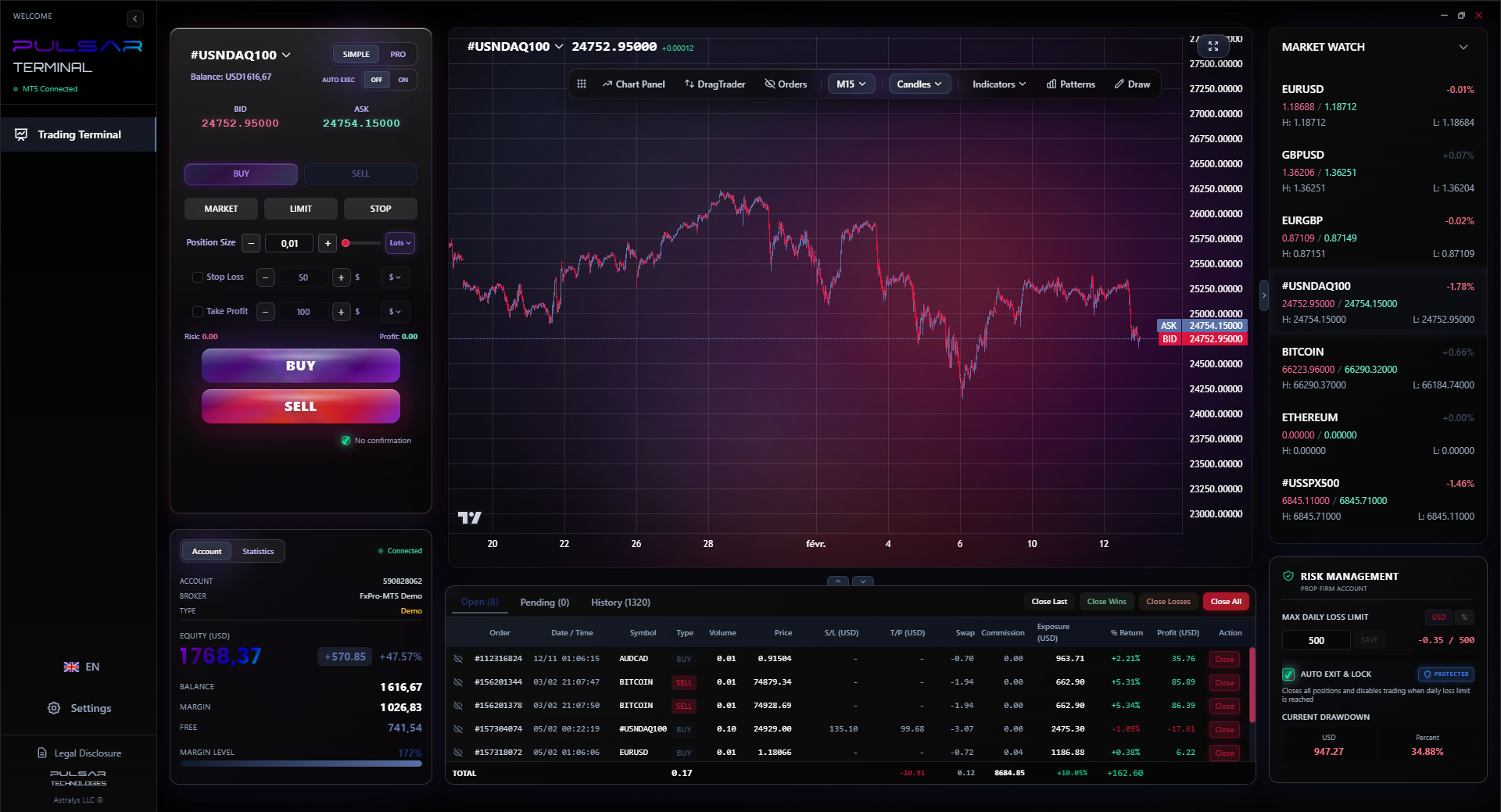
Managing trades around volatile news events requires precision; Pulsar Terminal's drag-and-drop order modification and multi-TP/SL features let you adjust your risk on MT5 in seconds, not minutes.
You don't need expensive software. Start with the free tools.
Free Calendars: ForexFactory.com is the community standard. It's simple, filterable, and shows forecasts clearly. Investing.com's calendar is also excellent and integrates with their app.
Broker Integration: Most broker platforms have a built-in calendar. On MT4 or MT5, it's usually under the 'View' menu > 'Economic Calendar'. The data is fed from a provider. It's convenient, but I always cross-reference with ForexFactory as a double-check.
The Real Upgrade: It's not about a fancier calendar. It's about integrating it into your trading journal. After every trade, note the nearest economic events. Did you trade into news? Did you ignore it? This journaling will reveal your blind spots. My biggest improvement came when I realized 80% of my losses were on trades held over medium-impact news. Now I just don't do that.
Regarding brokers, your choice should consider how they handle news. Look for:
- Stable platforms (MT4/MT5 are strong).
- Transparent policies on spreads and slippage during news.
- Reliable deposit/withdrawal for Naira. A broker like HFM or FXTM often has good local payment options.
The calendar is your planner. Your broker is your vehicle. Your strategy is the map. They all have to work in sync.
“A volatile news week might generate a large winning trade. That's great, but are you setting aside the 10% for tax? The calendar-driven volatility can create tax events quickly.”
This is where you take control. A plan turns reaction into action.
- Define Your News Personality: Are you a 'news avoider' or a 'news trader'? I'm mostly an avoider. I find the volatility too unpredictable. But some traders thrive on it. Decide which you are and stick to rules for that style.
- Set Concrete Rules: Write them down.
- "I will close all positions 1 hour before any High impact event."
- "I will only trade news if I have studied the historical market reaction for the past 3 releases."
- "I will double my normal stop-loss distance if I choose to hold through a Medium impact event."
- Practice with a Demo: Before you risk real Naira, practice your news plan on a demo account for a full month of economic events. See how your emotions and your strategy hold up.
- Review and Adapt: At month's end, check your trades. Did your rules work? Did you break them? Why? The 'forex new calendar' provides a perfect structure for this review because your trades are tagged by the economic environment.
Final thought from my own experience: The calendar made me a patient trader. Knowing that a huge event is coming tomorrow stops me from forcing a low-quality trade today. It creates discipline. And in this unregulated Nigerian space, where the only real regulator is your own discipline, that's the most powerful tool you have.
FAQ
Q1Is forex trading legal in Nigeria?
Yes, individuals can trade forex with their own funds through international brokers. However, the Securities and Exchange Commission (SEC) Nigeria states that the online retail forex market is currently unregulated. This means you are operating at your own risk, and brokers serving Nigerian clients are typically regulated offshore (e.g., Seychelles, Mauritius).
Q2What is the best economic calendar for Nigerian traders?
ForexFactory.com is widely considered the best free option. It's complete, easy to use, and allows you to filter events by currency and impact. Most trading platforms like MT4/MT5 also have built-in calendars, but using an independent source like ForexFactory for cross-reference is a good practice.
Q3How does the Naira's volatility affect my forex trading?
It affects you in two main ways. First, it impacts the conversion rate when you deposit or withdraw Naira to/from your USD-denominated trading account. A falling Naira between deposit and withdrawal can reduce your profit in Naira terms. Second, Central Bank of Nigeria (CBN) policy announcements are major local market events that can cause wider spreads and volatility across all your trades during that time.
Q4Should I trade during high-impact news like NFP?
For most retail traders, especially beginners, it's advisable to avoid trading during the immediate release of high-impact news. Volatility is extreme, spreads widen, and slippage can cause significant, unexpected losses. It's safer to close positions before the event or wait for the market to settle (usually 15-30 minutes after) before assessing new opportunities.
Q5What broker features are important for news trading?
Look for fast and reliable execution, a stable trading platform (MT4/MT5), and transparent policies on how they handle orders during news (spread widening, slippage). Brokers with strong international regulation often have better infrastructure. Check reviews for brokers like Pepperstone or IC Markets that are known for good execution during volatile periods.
Q6How do I manage risk around economic events?
The core rules are: 1) Reduce your position size significantly (by 50% or more) if trading near news. 2) Use wider stop-loss orders to account for spike volatility. 3) Consider moving stops to breakeven on profitable trades before the event. 4) Always use a position size calculator that factors in the potential for larger than normal spreads.
Q7Are there taxes on forex trading profits in Nigeria?
Yes. According to Nigerian tax law, profits from forex trading are generally treated as capital gains and are subject to a 10% Capital Gains Tax (CGT). It is your responsibility to declare and pay this tax on your gross profits.
प्रो. विंस्टन का पाठ
:
- ✓Check the calendar every Sunday. Plan your week, don't just react.
- ✓Reduce position size by 50% before High Impact news.
- ✓Mark CBN MPC meetings. They affect your Naira's value.
- ✓Never trade the 30 minutes before major news without a specific, practiced strategy.
- ✓Journal which news events cause your biggest losses. Then stop trading during them.
यह लेख कितना उपयोगी था?
रेट करने के लिए स्टार पर क्लिक करें
साप्ताहिक ट्रेडिंग विश्लेषण
मुफ़्त साप्ताहिक विश्लेषण और रणनीतियाँ। कोई स्पैम नहीं।
लेखक के बारे में
Olumide Adeyemi
पश्चिम अफ्रीकी ट्रेडिंग अग्रणी
नाइजीरिया के सबसे सक्रिय फॉरेक्स ट्रेडिंग एजुकेटर्स में से एक। लागोस से 8 साल का ट्रेडिंग अनुभव। अफ्रीकी ट्रेडर्स के लिए लो-कैपिटल स्ट्रैटेजीज और प्रॉप फर्म चैलेंजेज में विशेषज्ञ।
टिप्पणियाँ
आपको यह भी पसंद आ सकता है

Cara Trading Forex Sukses: 7 Prinsip dari Trader Profesional
Cara trading forex sukses dengan 7 prinsip trader pro: manajemen modal, disiplin, journal trading, backtest. Data nyata, bukan janji profit palsu.
Jam Trading Forex Terbaik untuk Trader Indonesia: Panduan Lengkap dengan Tabel Waktu
Panduan jam trading forex untuk trader Indonesia. Tabel 4 sesi dunia, jam emas 20:00-00:00, sesi mana yang harus dihindari. Data akurat + tips dari trader berpengalaman.
Top 5 Sàn Forex Uy Tín Nhất 2026: Review Jujur dari Trader Indonesia
Top 5 sàn forex uy tín 2026 untuk trader Indonesia. Review jujur: spread, deposit, withdraw, dukungan lokal. Exness, XM, IC Markets & lebih.
All these calculators are built into Pulsar Terminal with real-time data from your MT5 account. One-click position sizing, automatic risk management, and instant calculations.
