


I watched my screen in disbelief as the ZAR/USD chart ripped against me.

David van der Merwe
उभरते बाजार के ट्रेडर ·  South Africa
☕ 11 मिनट पढ़ने
आप क्या सीखेंगे:
- 1The Legal Landscape: FSCA Rules You Can't Ignore
- 2The Real Costs of Trading: It's More Than the Spread
- 3Choosing a Broker in South Africa: Beyond the Flashy Ads
- 4Trading the ZAR Pairs: Our Home Turf Advantage (and Danger)
- 5Why Most Traders in Pretoria Blow Up: The 4 Major Pitfalls
- 6Building a Survivable Strategy for the SA Market
I watched my screen in disbelief as the ZAR/USD chart ripped against me. I was short from R18.45, convinced the rand would weaken. A sudden political headline out of Pretoria sent it soaring to R18.15. My 2-lot position, leveraged at 1:100, wiped out R6,000 in under an hour. That trade taught me more about trading in South Africa than any course ever did. It's not just about charts; it's about understanding the local rules, the real costs, and the psychological traps unique to our market. Let's talk about what forex trading in Pretoria actually looks like, from someone who's made every mistake so you don't have to.
First thing's first: trading forex is legal here, but only if you play by the house rules. The house, in this case, is the Financial Sector Conduct Authority (FSCA). They're based right in Pretoria, and they're not messing around. If your broker isn't FSCA-licensed, you're basically handing your money to a stranger. I learned this the hard way early on with a slick offshore broker that offered 1:500 use. When I tried to withdraw profits, it was a nightmare of delays and excuses. Stick with FSCA-regulated entities.
The FSCA has some specific rules designed to (theoretically) protect you. The big one is the use cap of 1:30 for retail traders. This was introduced in 2021, and honestly, it's a good thing. My R6,000 loss on ZAR/USD would have been a total account wipe-out at 1:500. At 1:30, it was a painful but survivable lesson. You'll see international brokers advertising crazy use like 1:1000 to South Africans - this is a major red flag about their compliance.
Other key rules involve client fund segregation (your money is kept separate from the broker's money) and strict disclosure on costs. But here's the practical reality many in Pretoria don't talk about: the FSCA regulates the broker's conduct, but it doesn't guarantee your trading success. They won't bail you out if you make bad trades. Their license is a safety net for fraud, not for stupidity.

Warning: Many "international" brokers serving South Africans operate under dubious licenses from offshore jurisdictions. Always verify the FSCA license number on the broker's website and cross-check it on the FSCA's official register. If it's not there, walk away.
The Twin Peaks and Your Money
South Africa uses a "Twin Peaks" model. The FSCA is one peak (conduct). The other is the South African Reserve Bank (SARB), which controls monetary policy and exchange controls. This affects you directly. Ever tried moving a large sum overseas? You'll bump into SARB's rules. As an individual, you have a R1 million Single Discretionary Allowance (no tax clearance needed) and a R10 million Foreign Investment Allowance (requires tax clearance from SARS). If you're dreaming of funding a massive offshore trading account, you need to plan around this. Profits from trading are also considered taxable income by SARS. I keep a simple spreadsheet of all trades; it makes tax season less of a horror show.
“use doesn't make you a better trader; it just makes your mistakes more expensive.”
Brokers love to advertise "tight spreads!" and "zero commissions!" Let's break down what it really costs to trade from Pretoria. The spread is just the entry fee.
On a decent FSCA-regulated broker, you might see EUR/USD spreads around 0.8 to 1.5 pips on a standard account. On a raw ECN account, it could be 0.0 pips plus a commission. Let's do the math so you feel it. Say you trade 1 standard lot (100,000 units) on EUR/USD with a 1-pip spread. That 1 pip costs you $10 the moment you enter the trade. Your trade needs to move 1 pip in your favor just to break even on the spread.
Now add the overnight financing charge, or swap. If you're holding a trade for more than a day, this can add up or subtract from your profit. I once held a short AUD/JPY position for two weeks during a slow trend, only to find the swap fees had eaten nearly 30% of my eventual gain. You must check the swap rates on your platform before holding a trade long-term.
Then there's the hidden cost of the rand itself. You deposit in ZAR, but most trading accounts are denominated in USD. Your broker converts your deposit at their rate, which usually includes a markup. A 1% difference on a R20,000 deposit is R200 gone before you place a single trade.

Example: Trading 2 lots of EUR/USD.
- Spread: 0.9 pips. Cost = 0.9 * $10 per pip * 2 lots = $18
- Commission (if on raw account): $7 per lot round turn. Cost = $7 * 2 = $14
- Total entry/exit cost: $18 to $32. Your trade needs to make at least 2-3 pips just to cover costs.
This is why scalping with a large position size is so difficult for beginners in Pretoria. The costs eat you alive. A better approach for most is swing trading where the trade's potential profit is 50-100 pips, making the 2-3 pip cost a much smaller percentage.

💡 विंस्टन की सलाह
Your first R10,000 in the market is tuition, not investment. Expect to lose it while learning. If you can't afford to lose it, you can't afford to trade.
“The FSCA's 1:30 use cap isn't a limitation, it's a seatbelt for your trading account.”
You'll see ads on Facebook and YouTube promising the world. I'm going to give you a boring, practical checklist instead. Your broker is your lifeline; treat the choice like hiring a brain surgeon, not choosing a takeaway spot.
1. Regulation is Non-Negotiable: FSCA license. Full stop. Check our deep dive on Exness and IC Markets to see how we analyze their regulatory standing.
2. Deposit and Withdrawal in ZAR: Can you deposit via Instant EFT, SID, or PayFast? How long do withdrawals take back to your South African bank account? I use a broker that processes withdrawals in 24 hours on business days. Anything longer than 3 days is suspect. Also, check if they charge fees for these transactions. Many don't, but your bank might.
3. Platform and Tools: Most use MT4 or MT5. That's fine. But does the broker offer decent charting tools and execution? Slippage during our volatile market openings (8 AM SAST) can be a killer. Test with a small account first.
4. Customer Support in SA Time: Do they have a local number or support that operates during JSE hours? Calling a call centre in Cyprus when you have a margin call at 10 PM is useless.
Here’s a quick comparison of some major players seen in the Pretoria market:
| Broker | FSCA Regulated? | Min. Deposit (ZAR approx) | Key Feature for SA Traders |
|---|---|---|---|
| IG | Yes | ~R5,800 | Strong reputation, local presence, but higher min deposit. |
| XM | Yes | ~R90 | Very low minimum, good for absolute beginners to practice. |
| Pepperstone | Yes (via SA entity) | ~R1,800 | Excellent execution, popular with serious retail traders. |
| IC Markets | Yes | ~R3,600 | Some of the tightest raw spreads available locally. |
My personal rule? I keep two accounts. A main account with a top-tier broker for most of my capital, and a small account with a second broker as a backup. It’s saved me during platform outages more than once.
“Your local knowledge of the ZAR is an advantage, but your emotional attachment to it is a liability.”
Trading USD/ZAR, EUR/ZAR, or GBP/ZAR feels familiar. You hear the news, you feel the economy. This is where many traders in Pretoria start, thinking it's an advantage. It can be, but it's also a psychological trap.
The advantage is context. You understand when load-shedding announcements might impact investor sentiment. You can gauge political rhetoric from Union Buildings in Pretoria. This local knowledge can help you avoid trades that look good on a chart but are doomed by local events.
The danger is emotional attachment. You live in the economy the rand reflects. When the rand crashes, you feel it at the petrol station. This makes it incredibly hard to take a cold, analytical short position on the ZAR when everything in your gut is screaming that it's "unpatriotic" or just feels wrong. I've missed huge trends in USD/ZAR because I let my lived experience override my trading plan.
ZAR pairs also tend to have much wider spreads than majors like EUR/USD. A 15-pip spread on USD/ZAR is common. That means your trade needs to move 15 pips just to break even. The volatility can provide that quickly, but it increases your initial risk significantly. You must use a proper position size calculator and account for that wider spread in your stop-loss placement. Placing a stop 10 pips away on a pair with a 15-pip spread is a guaranteed way to lose.

Pro Tip: If you trade ZAR pairs, pay for a real-time news feed like Reuters or Bloomberg. The initial spike on major SA news (budget speeches, SARB rate decisions) is where the money is made and lost. Your broker's free news is too slow. I once caught a 400-pip move on USD/ZAR within 3 minutes of a surprise cabinet reshuffle announcement because I saw the headline the second it hit.
💡 विंस्टन की सलाह
The spread isn't a fee, it's a toll bridge. You pay it to get into the market. Never place a trade where the toll is more than 20% of your expected profit.
“Your local knowledge of the ZAR is an advantage, but your emotional attachment to it is a liability.”
After mentoring traders here for years, I see the same four killers again and again.
1. Overleveraging with "Cheap" Capital: Because minimum deposits can be as low as R100, people think it's "affordable" to trade. They then use maximum use to control a huge position with that R100. This is a guaranteed account destroyer. use amplifies losses faster than it amplifies gains. With the FSCA's 1:30 cap, this is somewhat curbed, but you can still wipe out a small account in minutes.
2. Chasing "Prop Firm" Dreams: The promise of trading a $100,000 account if you pass a challenge is everywhere. What they don't show you is the insane risk management rules. A 5% daily loss limit means on a $100k account, losing $5,000 closes the challenge. With excessive use, that's one bad trade. The pressure leads to reckless decisions. I blew two prop firm challenges in a row trying to hit profit targets quickly, violating every rule of my own strategy.
3. Ignoring Total Cost: As we discussed, they see a 50-pip win but forget the 10-pip spread, swap fees, and commission. They're net negative but think they're profitable.
4. No Tax Planning: They have a great six months, withdraw money, and spend it. Then SARS comes knocking. Trading profits are income. You need to set aside a portion (consult a tax professional for the rate) for tax. I put 25% of any net profit into a separate savings account immediately. It's not my money until tax is paid.
The core of all these pitfalls is a lack of a written, mechanical trading plan. A plan that dictates your position size, your entry/exit rules, and your maximum daily loss before you even log in for the day. Without it, you're just gambling with a fancy graph.
Managing prop firm daily loss limits and setting multiple take-profit levels manually is stressful and error-prone, which is why tools like Pulsar Terminal automate these rules directly on your MT5 platform.
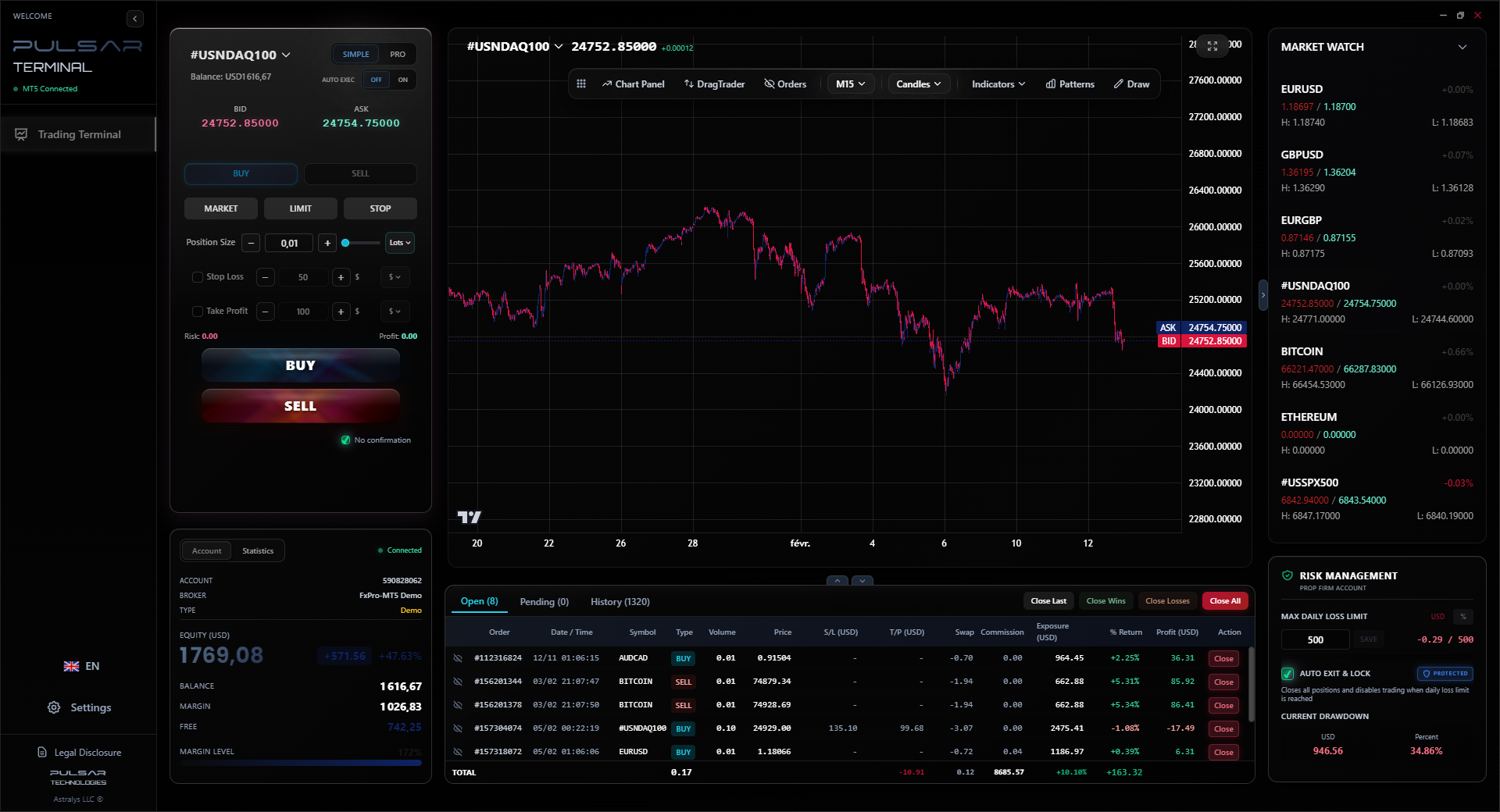
“A profitable trade that violates your risk management rules is more dangerous than a losing one that follows them.”
Forget finding a "secret indicator." A survivable strategy is about risk management first, everything else second. Here's a blunt, step-by-step approach I wish I'd followed from day one.
Step 1: Define Your Risk Per Trade. This is the most important number in your career. Never risk more than 1% of your account capital on a single trade. On a R10,000 account, that's R100. Use a position size calculator to work out how many lots or units you can trade based on your stop-loss distance.
Step 2: Choose Your Battles. Don't trade every pair. Start with one major pair like EUR/USD or XAU/USD (gold). They have lower spreads and more predictable liquidity. Master one market before adding another.
Step 3: Use Simple Tools Well. A trend line and one or two indicators like the RSI or MACD are enough. I know a trader in Centurion who only uses the 50 and 200-day moving averages and has been consistently profitable for years. Complexity is the enemy of execution.
Step 4: Have a Clear Exit Plan. Before you enter, know where your stop-loss is (to protect your capital) and where your take-profit is (to secure your gain). A common rookie mistake is moving their stop-loss further away when a trade goes against them, hoping it will come back. This is how a R100 loss becomes a R1,000 loss. Be robotic about it.
Step 5: Journal Religiously. Write down every trade. The pair, the entry/exit price, the reason for entry, the outcome, and most importantly, your emotional state. You'll start to see patterns: "I lose money every time I trade after a bad day at work." This self-awareness is more valuable than any trading signal.
This process isn't sexy. It won't make you rich overnight. But it will keep you in the game long enough to learn, adapt, and potentially become one of the minority who actually makes money consistently from forex trading in Pretoria.
💡 विंस्टन की सलाह
If you feel a strong emotional urge to "revenge trade" after a loss, close the platform. Go for a walk in the Pretoria National Botanical Garden. The charts will still be there tomorrow.
FAQ
Q1Is forex trading legal in Pretoria?
Yes, it is completely legal, but you must use a broker that is licensed by the Financial Sector Conduct Authority (FSCA). Trading with unregulated offshore brokers is extremely risky and offers you no legal protection as a South African resident.
Q2What is the best broker for beginners in South Africa?
There's no single "best" broker. For an absolute beginner, a broker with a very low minimum deposit (like R100-R500) and a user-friendly platform like MT4 is a good start for practicing with minimal capital. However, as you become more serious, you should prioritize FSCA regulation, reliable ZAR deposits/withdrawals, and competitive costs. Our reviews of brokers like XM and Pepperstone detail their pros and cons for the SA market.
Q3How much money do I need to start trading forex in Pretoria?
Technically, you can start with as little as R70-R150 with some brokers. Realistically, to trade properly using sane risk management (risking 1% per trade), you need at least R1,500-R5,000. A more comfortable starting point for a serious beginner is R10,000-R20,000. This allows you to withstand a series of losses without blowing your account while you learn.
Q4Do I pay tax on my forex trading profits in South Africa?
Yes. The South African Revenue Service (SARS) views profits from forex trading as taxable income. You are required to declare these profits on your annual tax return. It's crucial to keep detailed records of all your trades, deposits, and withdrawals. Consult with a tax professional who understands trading to ensure you comply correctly.
Q5Why is the use for South African traders limited to 1:30?
The FSCA imposed this use cap in 2021 to protect retail investors. The goal is to prevent traders from losing more money than they have deposited by using extremely high use. While it may feel restrictive, it forces better risk management. Most traders who blow up accounts do so because of excessive use, so this rule, while frustrating for some, saves many from financial ruin.
Q6What is a pip and how is it calculated for ZAR pairs?
A pip is a "percentage in point," the smallest price move a currency pair can make. For most pairs like EUR/USD, a pip is 0.0001. For USD/ZAR, because the quote is often around R18.00, a pip is typically 0.0010 (one-tenth of a cent). The value of a pip depends on your trade size. You can use our detailed pip definition guide to learn how to calculate it for any pair.
Q7What is a margin call?
A margin call happens when the losses on your open positions eat up most of the money (margin) you have deposited to keep those trades open. If your account equity falls below the required margin level, your broker will automatically close some or all of your positions to prevent further losses. It's a safety mechanism for them and a catastrophic event for you. Understanding margin call mechanics is essential to avoid it.
प्रो. विंस्टन का पाठ
:
- ✓Always verify FSCA license before depositing.
- ✓Risk a maximum of 1% of capital per trade.
- ✓Account for total costs: spread, commission, swap.
- ✓Set aside 25% of profits for SARS immediately.
- ✓Trade majors (EUR/USD) before volatile ZAR pairs.
यह लेख कितना उपयोगी था?
रेट करने के लिए स्टार पर क्लिक करें
साप्ताहिक ट्रेडिंग विश्लेषण
मुफ़्त साप्ताहिक विश्लेषण और रणनीतियाँ। कोई स्पैम नहीं।
लेखक के बारे में
David van der Merwe
उभरते बाजार के ट्रेडर
जोहानसबर्ग स्थित ट्रेडर, इमर्जिंग मार्केट करेंसीज में 11 साल का अनुभव। ZAR पेयर्स, FSCA-विनियमित ट्रेडिंग और दक्षिण अफ्रीकी मार्केट एनालिसिस में विशेषज्ञ।
टिप्पणियाँ
आपको यह भी पसंद आ सकता है

Cara Trading Forex Sukses: 7 Prinsip dari Trader Profesional
Cara trading forex sukses dengan 7 prinsip trader pro: manajemen modal, disiplin, journal trading, backtest. Data nyata, bukan janji profit palsu.
Jam Trading Forex Terbaik untuk Trader Indonesia: Panduan Lengkap dengan Tabel Waktu
Panduan jam trading forex untuk trader Indonesia. Tabel 4 sesi dunia, jam emas 20:00-00:00, sesi mana yang harus dihindari. Data akurat + tips dari trader berpengalaman.
Top 5 Sàn Forex Uy Tín Nhất 2026: Review Jujur dari Trader Indonesia
Top 5 sàn forex uy tín 2026 untuk trader Indonesia. Review jujur: spread, deposit, withdraw, dukungan lokal. Exness, XM, IC Markets & lebih.
All these calculators are built into Pulsar Terminal with real-time data from your MT5 account. One-click position sizing, automatic risk management, and instant calculations.
